All Activity
- Past hour
-
January 2026 regional war/obs/disco thread
40/70 Benchmark replied to Baroclinic Zone's topic in New England
Now the +TNH that results from the reflection event should act as a precursor to the February SSW, just as the Pacific Trough Regime that is just wrapping up was the precursor to the upcoming +TNH interval born of stratospheric reflection. -
2025-2026 ENSO
40/70 Benchmark replied to 40/70 Benchmark's topic in Weather Forecasting and Discussion
Now the +TNH that results from the reflection event should act as a precursor to the February SSW, just as the Pacific Trough Regime that is just wrapping up was the precursor to the upcoming +TNH interval born of stratospheric reflection. -
Another Coating of Snow Saturday - "It's all we Got"
Damage In Tolland replied to Sey-Mour Snow's topic in New England
Most models printing out .25-.35. At 31-32.. that’s gonna do some damage -
And EPS... unfortunately it's locked in with both OPs. However, I will say there was a storm in 2017 in December where the globals kept the wave flatter and to the east right up until go time, and actually the hrrr and NAM were one of the first to show the moisture way more expansive. All and All though, Euro is concerning.
-
6z Euro was warmer and east. Temps are becoming a concerning trend outside the mountains (what’s new)
-
2025-2026 ENSO
40/70 Benchmark replied to 40/70 Benchmark's topic in Weather Forecasting and Discussion
-
That was at 3:00 AM
-
Snow showers in my area.
-
Its difficult to believe any solutions right now. Over all the models are having an unusually difficult time with this pattern. The area of precip on Saturday is so limited along with temps borderline in some areas - I doubt most areas south of I-80 will see more than Trace amounts and only in some locations. Sunday ? Will determine after 12Z model runs.
-
First Legit Storm Potential of the Season Upon Us
Snowcrazed71 replied to 40/70 Benchmark's topic in New England
And there you go, you have to come back with some kind of attack. Only one that has an issue is you man. You can't get over yourself. What you need to do is act like a man and stop having tantrums. How's that for jumping on a unicorn. Go take a cold shower ( And for the record, I never once jumped on you. I just told you it may be to take a break ). -
Storm potential January 18th-19th
EastonSN+ replied to WeatherGeek2025's topic in New York City Metro
Yeah, I look at this as an opportunity for a light event. -
January 2026 regional war/obs/disco thread
40/70 Benchmark replied to Baroclinic Zone's topic in New England
-
Winter 2025-2026 Offers Return to Normalcy
40/70 Benchmark replied to 40/70 Benchmark's topic in New England
Looks like my prediction of the mid January Pacific Trough regime acting as a precursor to the ongoing reflection event is a hit. Judah's blog: "And as I have been routinely doing, looking at the wave diagnostics in Figure iv continues to display wave reflection over the weekend and into late January. For both periods shown, wave energy goes up and east over Asia, reflects off the stratospheric PV and then heads down and east over North America where the energy is re-absorbed and could potentially amplify the standing wave over North America and deliver cold air from the Arctic south, east of the Rockies. There is westward wave tilt with height over Asia and an eastward wave tilt with height over North America that is a classic signature of wave reflection. Though the eastward tilt is more pronounced in the first period compared to the second period". Here is the relevant excerpt from my blog: Stratospheric Reflection Event Likely During January 2026 Society's understanding of the stratosphere and the role that it plays in modulating our weather is very rudimentary to say the least. The basic conceptualization is that a weak polar polar vortex makes the mid latitudes more prone to cold outbreaks, and while that is true, the method of delivery for cold to North America is multifarious in that it is not relegated to a weak polar vortex/-NAO pattern. In fact, the coldest outbreaks in the CONUS are actually triggered by a strong polar vortex and +NAO regime in what is referred to as a "stratospheric reflection event". During these stratospheric reflection events, heat is transferred upward by a Rosby wave (kink in the jet stream) over Siberia and reflects back downward of off the PV into Canada via the reflective surface posed by negative vertical wind shear in the stratosphere. ( Lee et al 2019). The study notes that these reflection events are most common during the month of January. There is one reflection event on average each season, so they are by no means rar events. Reflective events are declared when the reflection index (RI), which denotes the difference in anomalous poleward eddy heat fluxes in the lower stratosphere between Siberia and Canada, exceeds 1 for 10 or more consecutive days (Lee et al 2019). Reflective events are unique occurrences in that the PV is undisturbed and initially remains strong, before being stretched by the development of Alaskan and Aleutian ridging and returning to normal strength. It is the stretching that delivers the cold south and eastward into the CONUS, as depicted in the "end of event" graphic above. This type of stratospheric phenomenon differs from the SSW events, in which heat propagates upward in waves that converge in the stratosphere, thus weakening the PV by decelerating and even reversing the zonal westerly winds that are ordinarily prevalent in the polar stratosphere. Reflection events also differ from SSW in that they are more favored during the westerly phase of the QBO, with 30/44 events since 1980 having occurred during a +QBO. While this ostensibly renders a such occurrence unlikely this winter given the very strong easterly QBO that is nearing peak, the analog events of January 16, 2001 through February 18, 2001, and January 13, 2018 through February 2, 2018 are being weighted heavily in the seasonal forecast given their strength as general analog seasons due to considerations previously discussed, such as polar, ENSO and solar considerations. This is also why these two seasons are considered superior SSW analogs. The January 2001-February 2001 reflection event is one of just 9 out of the 44 cases examined in which the reflection window overlapped with a SSW event, which is why there is a heightened risk of this co-occurrence relative to climatology this season. This actually reduces the risk of severe cold, per the study. Here is a list provided by Lee at al (2019) of the most prominent reflection events of the past 45 years, including the primary analogs of 2001 and 2018. Courtesy Lee et al 2019 The mean length of the process is 20 days, with 10 days being the minimum, and 60 days the maximum, per Lee et al (2019). Considering the length of the 2001 (33 days) and 2018 (20) events, it is expected that a reflection event will begin between approximately January 13th and 16th 2026, and end between about February 2 and 18th. This is consistent with the climatologically favored time frame per the research that was referenced previously. In order to better understand how the PV interacts with North American weather, Lee at al identified four distinct weather regimes and listed their respective frequency of occurrence between the months of November and March, from 1979 through 2017, since they last longer than synoptic scale patterns and thus provide an opportunity for longer range prediction. Pacific Trough Pattern Precursor for Reflection Events Pattern recognition is paramount in the analysis and diagnosis of reflection events because the behavior of the polar vortex has predictive value on each of these regimes at both seasonal, and sub-seasonal leads, which is roughly 15-60 day in advance. "The PV strength significantly affects the occurrence and persistence of each regime and transition between regimes" (Lee at al 2019). Research by Kretschmer et al (2018) illustrated the importance of planetary wave reflection for anomalous cold across North America. This expounded on earlier work by Kordera et al (2016) that found that wave reflection born of Pacific blocking tele-connected to a down stream trough over North America. Thus the implication here is that the Alaskan ridge pattern, which is not at all connected to the PV and is actually accompanied by a +NAO, as alluded to earlier, is most conducive to reflection events and is this correlated to the most severe arctic outbreaks in the US. Lee et al (2019) refers to this type of pattern as the "Alaskan Ridge Regime" , which is similar to the Tropical Hemisphere Pattern (+TNH). This has been the most common vehicle for cold delivery over the past decade given the increased tendency for +NAO during the winter season, so it is important to remain mindful of the fact that climate change is certainly not prohibitive to severe cold outbreaks. It does, however, decrease residence time due to the enhanced Pacific jet keeping the flow more progressive. Here is a composite of seasons that fit this +TNH description over the past decade or so. Note the similarity to the -EPO predominate extra tropical Pacific pattern that is favored this winter season. -
Storm potential January 18th-19th
BoulderWX replied to WeatherGeek2025's topic in New York City Metro
This board is hilarious. To see the way people reactive from 0Z to 6Z is hilarious and could be a case study in psychology. OT - but light snow ATM -
First Legit Storm Potential of the Season Upon Us
ORH_wxman replied to 40/70 Benchmark's topic in New England
Why is everyone just punting? Even the shittiesr solutions are scraping the coast. Doesn’t take much to get accumulating snow at least to eastern areas. -
Anyone got the JMA?
-
Another Coating of Snow Saturday - "It's all we Got"
ORH_wxman replied to Sey-Mour Snow's topic in New England
ORH to Kevin should be plenty cold enough for snow. It’s the QPF that is the question. If you get less than a tenth of QPF at 31-33F then it might be just coatings. But you rip a quarter inch and I can easily see 1-3” -
First Legit Storm Potential of the Season Upon Us
NorEastermass128 replied to 40/70 Benchmark's topic in New England
The beatings shall continue. I’m just ready for the Hadley Cell or whatever to unleash a CONUS furnace that carries us to an early Spring, 2012 style. -
Another Coating of Snow Saturday - "It's all we Got"
Spanks45 replied to Sey-Mour Snow's topic in New England
yeah, I am lower elevation (160ish), so these borderline setups with weak rates never do well regardless of the time of year, unless it is during the evening or at night -
I give myself (in Hillsborough) about a 10% chance at measurable snow at this point. I'm far from an expert, but I listen well to the experts, and I'm hearing the same tune. Daytime event if there's much precip at all, warmer temps during the day and waiting till night for cold air to spill over the Apps. By then the precip is all but gone. Still hopeful for another system soon!
-
Has anyone heard why there was no balloon sampling in the west recently and whether that could be playing into the model madness?
-
Storm potential January 18th-19th
RU848789 replied to WeatherGeek2025's topic in New York City Metro
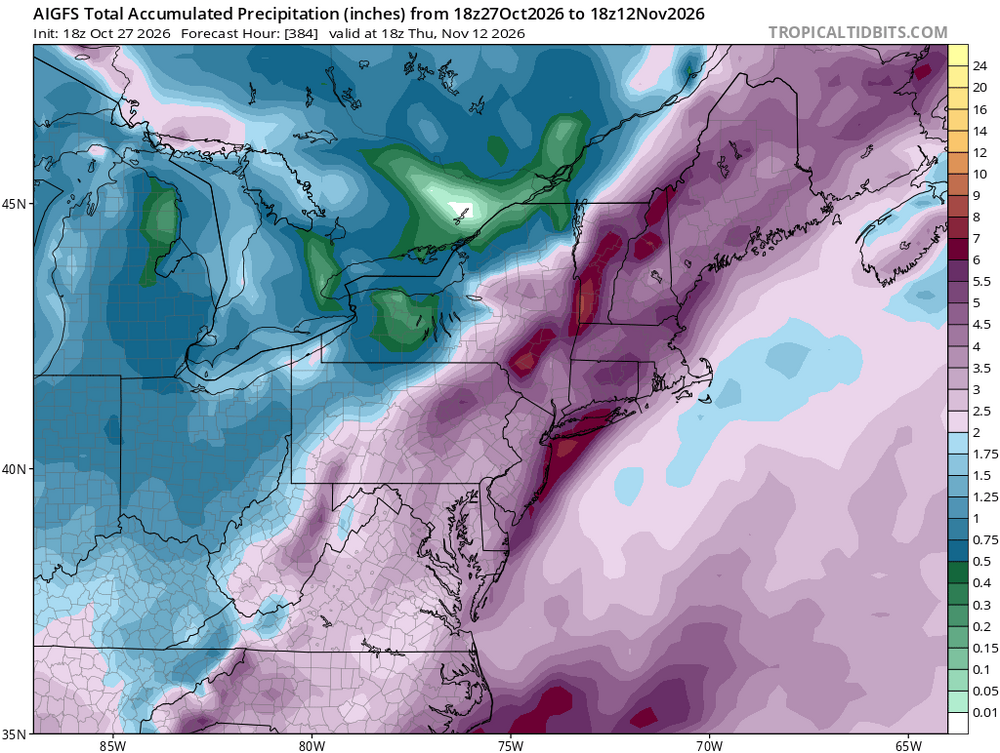
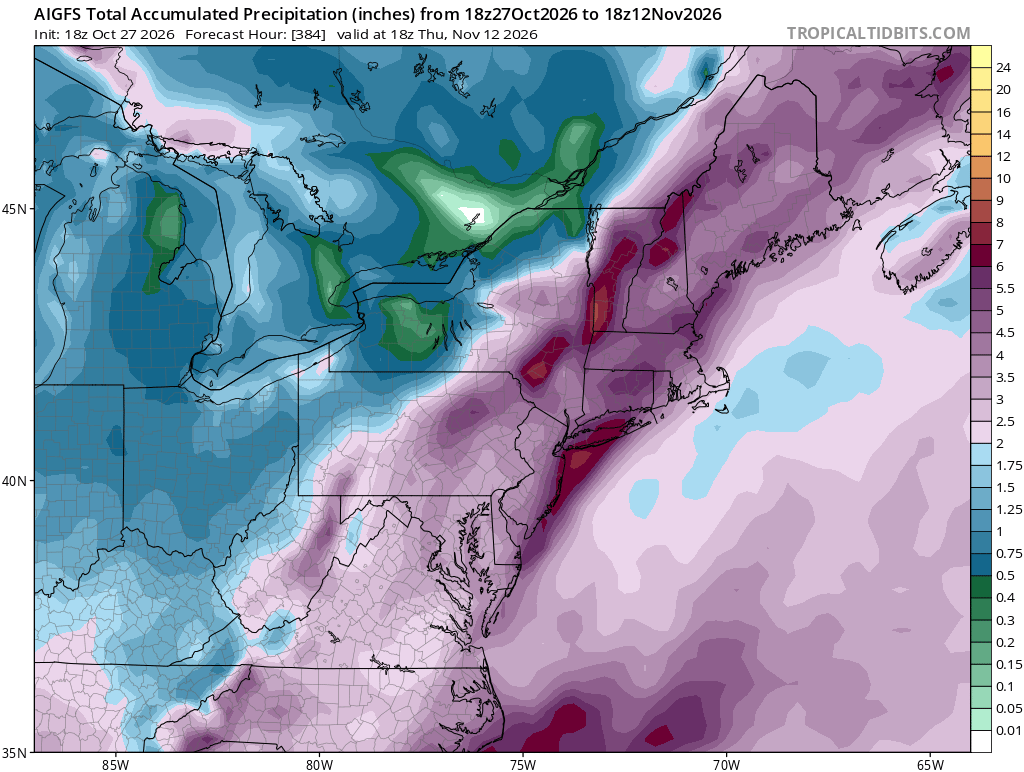
So, just woke up and saw that there were only a handful of posts for 6Z relative to the dozens at 0Z, which told me that the threat must have been reduced and the GFS must have caved as the very snowy outlier and we'd have a 1-2" threat at best (and similarly, that there had not been a thread created for this thread on 33). Not far off, lol - and I'll still take 1-2", hoping the Euro/GFS/ICON are wrong in showing very little except maybe <1" for the coast and the AI models have it right with a 1-3" event (AIFS) or even a 3-5" event (AIGFS, if the surface temps are too high on that model as many have said). Not ready to believe the nice RGEM/RRFS at the end of their ranges yet (or the snowless NAM - same reason). -
Mid-Long Range Discussion 2026
WinstonSalemArlington replied to BooneWX's topic in Southeastern States
-
Records: Highs: EWR: 67 (1932) NYC: 67 (1932) LGA: 62 (1995) JFK: 58 (1995) Lows: EWR: 0 (1957) NYC: 0 (1957) LGA: 0 (1957) JFK: 2 (2004) Historical: 1780: One of the coldest times in Washington, DC history that froze all the waterways of the Middle Atlantic region including the Potomac River and most of the Chesapeake Bay. The cold started in Dec. 1779 and lasted through the first week in Feb. The coldest periods were Jan. 6-8, Jan. 13-16 and Jan. 19-29. On the northern part of the Bay, sleighs crossed from Annapolis to the Eastern Shore. To the south Norfolk, Hampton, Newport News and Portsmouth were connected by thick ice that supported foot traffic between ports.(p. 30 Washington Weather Book 2002 by Ambrose, Henry, Weiss) The New York Harbor froze over completely during the famous Hard Winter of 1779-80. It would stay frozen for five weeks. Heavy cannons were transported across the ice. (Ref. AccWeather Weather History) 1831: The Great Snowstorm, Jan. 14-16, Deep snow measuring 13 inches in Washington, DC and the Shenandoah Valley prompted an Alexandria, VA observer to state that nothing since 1809 even approached the fury of this storm. Petersburg suffered a 50-hour blizzard and eight inches of snow. The Winchester Republican reported, "Never was such a storm known here, nor does any person whom we have seen, remember to have witnessed one more severe elsewhere. The storm stretched from Georgia to Maine and west into Ohio.(Ref. The Great Snowstorm of 1831) 1852 - Between January 15th and February 24th a total of 1378 railroad cars were drawn by horses across the frozen Susquehanna River to engines waiting at Havre De Grace, MD. (The Weather Channel) 1852: In 1852, the long, cold winter froze the Susquehanna River in Maryland to a depth of 2 to 3 feet, preventing all ferry service. Railroad officials overcame this perplexing situation by laying tracks across the ice, with trestles for either bank’s inclines. During the several weeks from January 15 to February 29, approximately 1,300 cars with a total weight of 10,000 tons were hauled across the river from Havre de Grace, Maryland, to Perryville, Maryland. 1932 - Up to two inches of snow whitened the Los Angeles basin of California. The Los Angeles Civic Center reported an inch of snow, and even the beaches of Santa Monica were whitened with snow, in what proved to be a record snowstorm for Los Angeles. (David Ludlum) (The Weather Channel) 1952 - A six day snowstorm was in progress in the western U.S. The storm produced 44 inches of snow at Marlette Lake NV, 52 inches at Sun Valley ID, and 149 inches at Tahoe CA, establishing single storm records for each of those three states. In addition, 24 hour snowfall totals of 22 inches at the University of Nevada, and 26 inches at Arco ID, established records for those two states. The streamliner, 'City of San Francisco' was snowbound in the Sierra Nevada Range, near Donner Summit. (David Ludlum) 1957: A deep upper level trough brought brutally cold temperatures from the Mid-Atlantic to the Northeast. Burlington, VT and Binghamton, NY set their all-time record lows with -30° and -20° respectively. Montreal, Quebec Canada recorded their lowest temperature on record as they dropped to -36°. Worcester, MA set their all-time January record low with -19°. Locations reporting daily record lows included: Caribou, ME: -28°, Syracuse, NY: -24°, Albany, NY: -20°, Casper, WY: -20°, Portland, ME: -18°, Rochester, NY: -16°, Hartford, CT: -15°, Boston, MA: -12°, Buffalo, NY: -12°, Avoca, PA: -10°, Providence, RI: -9°, Bridgeport, CT: -5°, Newark, NJ: 0°, New York (Central Park), NY: 0°, New York (LaGuardia), NY: 0° and Philadelphia, PA: 5°. (Ref. Wilson Wx. History) 1961: A nor'easter battered the Mid Atlantic region. 78 miles E of Barnegat, NJ, waves exceeding 35 feet and winds of 85 mph destroyed the Air Force radar Texas Tower 4, killing all of the 14 airmen and 14 civilian workers. The 3-legged tower was nicknamed Texas tower because it resembled the oil rigs in the Gulf of Mexico. Tower 4 had previously been damaged by hurricanes Donna in 1960 and Daisy in 1958. (Ref. Wilson Wx. History) 1967: The Green Bay Packers beat the Kansas City Chiefs, 35-10, in Super Bowl I at the Memorial Coliseum in Los Angeles. From the weather station at the USC campus in downtown LA, the high temperature was 79 degrees, and the low was 51. There was a light west wind. 1972: In Flint, Michigan, the daytime temperature rose to only -3 degrees. This is the second coldest maximum temperature recorded in the city of Flint since 1921. Detroit's high temperature was zero. 1987 - A powerful storm over the Southern Plateau and the Southern Rockies produced 24 inches of snow at Colorado Springs CO, including 22 inches in 24 hours, a January record. High winds in the southwestern U.S. gusted to 65 mph in the Yosemite Valley of California. (National Weather Summary) (Storm Data) 1988 - A small storm over the Atlantic Ocean produced heavy snow along the coast of North Carolina. The five inch total at Wilmington NC was their third highest for any storm in January in 117 years of records. (National Weather Summary) 1989 - A storm in the northwestern U.S. produced up to 14 inches of snow in the Cascade Mountain Range. Light snow in the north central U.S. was just enough to push the snowfall total for January at Fargo ND past their previous all-time monthly record of 30.7 inches. 1990 - While one Pacific storm crossed the Central Rockies, another approached the west coast. The northern mountains of Utah were buried under 17 to 35 inches of snow while the mountains of southern Utah received another 12 to 16 inches. Eighteen cities in the central U.S. reported record high temperatures for the date as readings warmed into the 50s and 60s. Wichita KS reported a record high of 68 degrees. (National Weather Summary) (Storm Data) 1992: January 15, 1992 A miserable day in central Illinois. An Alberta Clipper left up to 4 inches of snow in parts of Illinois; 40 -- 50 mph winds caused whiteout conditions in central Illinois in the storm's wake. Hundreds of vehicles ended up in ditches; parts of I-39, I-55, I-57, I-74 were closed. Wind chills as low as 50 °F below zero were recorded. (Weather Guide Calendar with Phenomenal Weather Events 2007 Accord Publishing, USA) 1993: Fairbanks, AK measured 47 inches of snow on the ground, their deepest snow cover ever recorded. (Ref. AccWeather Weather History) 1994: Temperatures in the teens and 20s across N/C GA. Water pipes burst in 2 labs at the University of Georgia in Athens. A $150,000 spectrometer was damaged in one lab. Water sprinklers in a Dalton elementary school burst, causing $40,000 damage to ceilings/walls/books. (Ref. Weather Guide Calendar with Phenomenal Weather Events 2011 Accord Pub. 2010, USA) 1995: A strong southerly flow ahead of a storm across the Southeast brought record highs from the Mid-Atlantic while a few locations across the Rockies set record highs ahead of a cold front. Caribou, ME established their all-time January high temperature of 53°. Just 4 days earlier they set a record low with -33°. Locations that reported record highs for the date included: Roswell, NM: 78°, Cape Hatteras, NC: 71°, Rochester, NY: 68°, Syracuse, NY: 68°, Allentown, PA: 68°, Buffalo, NY: 67°, Providence, RI: 67°, Burlington, VT: 66° (broke previous record by 10 degrees), Boston, MA: 66°, Islip, NY: 66° (broke previous record by 10 degrees), Atlantic City, NJ: 66°, Albany, NY: 65°, Sterling (Dulles Airport), VA: 65°, Milton, MA: 64°, Hartford, CT: 63°, New York (LaGuardia), NY: 62°, Wallops Island, VA: 62°, Bridgeport, CT: 61°, Binghamton, NY: 59°, New York (Kennedy Airport), NY: 58° and Casper, WY: 52°. (Ref. Wilson Wx. History) Williston, ND recorded its greatest twenty-four hour snowfall when 12.6 inches of snow fell.(Ref. AccWeather Weather History) 2006: The high wind gust of 45 mph from the WNW on the 15th at 0401 was the strongest wind gust recorded in January since 2000 and the strongest for the year 2006. (Annandale Weather Records) 2007: An upper level high pressure off the Southeast Coast brought record highs to parts of the East. Locations across the South and East that reported record high temperatures for the date included: Charleston, SC: 79°, Atlanta, GA: 73°, Wallops Island, VA: 70°, Sterling (Dulles Airport), VA: 68°, Atlantic City, NJ: 66°-Tied and Jackson, KY: 64°. (Ref. Wilson Wx. History) 2009: Northern Maine: Depot Mountain records a low temperature of -38 °F, and Fort Kent shivers at -32 °F. (Ref. Wx.Doctor)
-
I think the best bet is to find the model that shows the absolute least amount of snow for the Central Mountains and the foothills. There is your forecast.