All Activity
- Past hour
-
That April 1982 snowstorm showed just what could have been. If not for a long lull in February and March, 1981-82 could have been a historic snow season. But the April storm was a nice reminder of that cold and snowy pattern in January 1982.
-
Super Duper El Nino?
-
Thanks, can't wait.
-
Freeze watch in effect for most of the region
-
Just got my Alexa freeze watch. Yay?
-
It’s been off and on flurries all day in Greenfield.
-
Oh Jay Peak, 397" lol, sure.
-
Some warm weather without back doors every 2 days would be nice, but we need some action from frontal systems or coastal lows-wouldn’t be good if we’re entering a big east coast ridge into the summer pattern.
- 195 replies
-
- 1
-

-
- april showers bring may..
- rain
- (and 2 more)
-
Is it warm up again yet? Clouds already en route…because that’s what northern stream systems bring.
- Today
-
Looking pretty dry for a while going forward.
-
Getting some flakes here now
-
Looks pretty warm from next weekend on....ridge builds over the east finally
-
Not bad!
-
hmm
-
Day of my Christening
- 195 replies
-
- 1
-

-
- april showers bring may..
- rain
- (and 2 more)
-
Luckily it’s early so soil moisture is still high from the winter. Though we definitely do not want that to continue .
-
TORCH!!!
-
That might be a tough ask. Ski areas up north though I could wee getting 2-4...maybe 5".
-
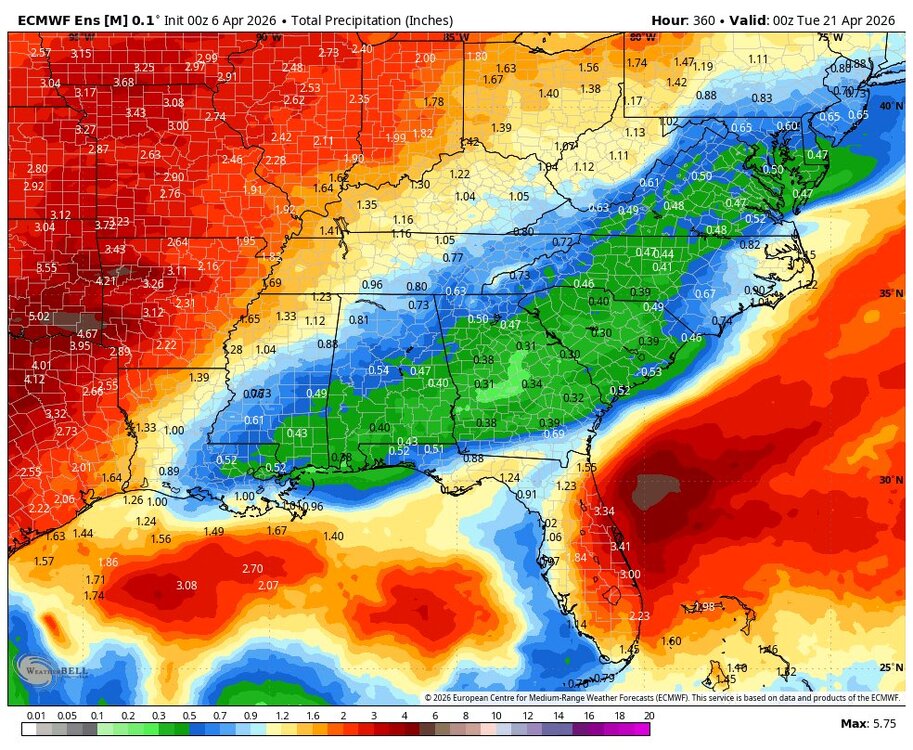
Yeah not looking good. Ensembles not much better
-
I could see a inch or two here if things break right.. NAM and HRRR look good
-

Central PA Spring 2026 Discussion/Obs Thread
Jns2183 replied to Voyager's topic in Upstate New York/Pennsylvania
Here's the addition to drop into the message board post, after the site link and before the feedback section: --- **Lowest Radar Beam by County — South-Central PA Reference** For those who want to know what's actually looking at their county, here are the lowest 0.5° beam heights for the counties covered by this study, sorted alphabetically. Listed as best radar and beam height, with the runner-up in parentheses: **Adams** — KLWX: 4,680 ft MSL (KCCX: 9,241 ft) **Berks** — KDIX: 7,642 ft MSL (KCCX: 10,418 ft) **Cumberland** — KCCX: 7,235 ft MSL (KLWX: 7,377 ft) **Dauphin** — KCCX: 8,029 ft MSL (KLWX: 10,267 ft) **Franklin** — KLWX: 4,902 ft MSL (KCCX: 7,605 ft) **Lancaster** — KDIX: 9,420 ft MSL (KDOX: 8,523 ft) **Lebanon** — KCCX: 10,155 ft MSL (KDIX: 10,763 ft) **Perry** — KCCX: 5,498 ft MSL (KLWX: 8,789 ft) **Schuylkill** — KDIX: 10,008 ft MSL (KCCX: 10,418 ft) **York** — KLWX: 5,874 ft MSL (KDOX: 9,530 ft) A few things worth noting on these numbers. First, these are county-wide averages computed from five representative coordinate points distributed across each county they represent the typical beam height across the bulk of the county's land area, not any specific location within it. This matters especially in south-central PA where the terrain is anything but uniform and several counties are genuinely split between radar coverage zones. Adams, Cumberland, and Lancaster in particular have portions of their land area where a different radar may actually be lower than the county average suggests in some cases up to three different radar sites each hold the lowest beam advantage over some piece of a single county depending on which direction you're standing in it. Second, and this trips people up: these heights are above mean sea level, not above your head. To get the actual distance between you and the beam you need to subtract your own elevation. If you're at 500 feet in the Cumberland Valley and the KCCX 0.5° beam shows 7,235 ft MSL over Cumberland County, the beam is roughly 6,735 feet above you — not 7,235. In the ridge-and-valley terrain to the north and west where elevations run 1,200 to 1,600 feet, that same beam is considerably closer to the surface than the MSL number implies. It's the AGL figure that tells you whether the beam is actually seeing your weather. Sent from my SM-S731U using Tapatalk -
Central PA Spring 2026 Discussion/Obs Thread
Jns2183 replied to Voyager's topic in Upstate New York/Pennsylvania
Central PA In-Depth Series — NEXRAD Beam Coverage & Precipitation Analysis** For those who haven't been following along, I've been working on a series of data-driven deep dives into the weather observation landscape of central Pennsylvania, the kind of local, granular analysis that doesn't get done because it doesn't scale nationally. Each project starts with a question that's been nagging at me as a 35-year observer of this stretch of the Susquehanna Valley and Ridge-and-Valley terrain. The two earlier projects in the series are still up and active. The first is the **MDT vs. CXY Bias Deep Dive** a two-era instrumentation study confirming the ~11% precipitation bias between Harrisburg International and Capital City Airport is real and physical, not an instrumentation artifact, spanning cooperative observer records back to 1948 through 2025 ASOS data: https://jns182wx.github.io/kmdt-cxy-analysis/ The second is the **South-Central PA 25 Years of Winter Weather Deep Dive** a comprehensive climatological look at winter precipitation across our region covering storm catalogs, snow ratio verification, RSI maps, and terrain-aware elevation bias decomposition across the ridge-and-valley province: https://jns182wx.github.io/winter-weather/ --- **The New Project — NEXRAD Beam Geometry & Precipitation Coverage** The question that drove this one: when it rains in south-central Pennsylvania, how much of that rainfall does NEXRAD radar actually see? The geometry alone is striking, the 0.5° beam from KCCX clears 8,000 to 9,000 feet above ground level by the time it reaches the Harrisburg corridor, sitting well above the cloud base during the shallow stratiform rain, drizzle, and cold air damming events that define our winter and early spring precipitation climatology. To answer this properly I pulled three months of hourly ASOS data from ten south-central PA stations, paired each precipitation hour with rawinsonde thermodynamics from IEM, and computed precise beam heights using the standard 4/3 Earth-radius WSR-88D formula for all four radars covering us, KCCX, KLWX, KDIX, and KBGM, selecting the best radar per station by actual geometry rather than assumed proximity. Along the way I found a critical data quality issue that affects anyone using IEM's ASOS archive: the p01i field is a running cumulative total since the last routine observation, not a per-period amount. Naive summation of sub-hourly SPECI observations inflates event totals by 1.5 to 2.5 times. Every precipitation number in this project uses the corrected method. The findings are instructive but also honest about the limits of what surface observations alone can tell us. For the Harrisburg corridor stations the beam is provably below the cloud base, sampling clear air, during a meaningful fraction of rainy hours. For the majority of precipitation hours the beam is at or above the cloud base, but without cloud-top data we can't say whether it's sampling the precipitating layer or overshooting it entirely. What the rawinsonde thermodynamics add is character, the February 20th CAD event shows the freezing level within 300 feet of the beam height, textbook conditions for bright band contamination. January 25th shows the opposite: deep warm frontal overrunning with 105-knot bulk shear and the beam solidly inside a saturated column, exactly when radar performs well. The five storm deep dives each pull hourly RAP BUFKIT soundings for all ten stations, compute hodographs, storm tilt, raindrop trajectory, dry air intrusion, and wet-bulb zero, and render a west-to-east atmospheric cross-section showing where the beam intersects the thermodynamic structure of the storm. Full site with all interactive tools and downloadable data here: https://jns182wx.github.io/radar_site/ --- **Feedback, Corrections, and What's Next** If you spot an error in the beam geometry, a station assignment that looks wrong, a precipitation total that doesn't match your records, or a methodology choice you'd push back on, please say so. Same goes for the earlier projects. Local knowledge improves local science and if you've been observing in this part of PA for any length of time your instincts about what the data should look like are worth hearing. If you have ideas for sections to add to any of these , additional storm events, verification against CoCoRaHS or COOP records, cross-sections to other radar sites, those conversations are welcome too. The next project is going to need community input to be worthwhile so I want to put it out there now. I just got my **Ecowitt GW90 "Fatboy"** up and running and in that spirit of personal weather stations, the next deep dive is going to look at the PWS landscape across south-central PA: station distribution, hardware and software variety, network density, and most importantly bias estimation and quality weighting against official observations. The core idea is to take any location, wherever you live or work, drop a 5, 10, 15, and 20km radius around your coordinates, and map every PWS, ASOS, CoCoRaHS, COOP, and DCP station in each ring with historical bias estimates where the record supports them. Think miniaturized personal MADIS for your specific spot. Long term the goal is to integrate that localized ground truth with NBM (which is taking over NWS short-range forecasting) and MRMS (radar-derived QPE) to arrive at a reliable blended daily ground truth that's actually calibrated to where you are rather than the nearest official station. This requires a significant amount of manual data collection to do right, so I want to direct the effort toward people for whom it will be genuinely useful. **If you want to be part of this, respond here or DM me with your town name or coordinates.** At minimum you'll get a full report on your local station landscape with whatever bias estimates the historical record supports, within the next month. And if you have ideas for other locally-rooted projects , anything about the weather in your corner of central PA that nobody seems to have a good quantitative answer for, I'd genuinely love to hear them. Sent from my SM-S731U using Tapatalk -
I never realized CC was so XXX.
-
https://x.com/therealdtox/status/2041138070888567159?s=61
-

2026-2027 El Nino
snowman19 replied to Stormchaserchuck1's topic in Weather Forecasting and Discussion



.thumb.png.4150b06c63a21f61052e47a612bf1818.png)