All Activity
- Past hour
-
I think we got one two years ago during the evening in February and it was the most impressive thunderstorm (severe warned too) than in many years here. And of course that summer was very quiet
-

2026-2027 Super El Nino
GaWx replied to Stormchaserchuck1's topic in Weather Forecasting and Discussion
Agree 100% about the volatility of Nino 1+2, but I’m talking about Nino 3.4, for which the latest CFS has a record obliterating high in Nov followed by a record rate of cooling afterward. The CFS’ volatility is not unlike how 1+2 can often be! But it is out on its own with that rapid a cooling of 3.4. And I agree about the atmospheric lag, regardless. -

Central PA Summer 2026 Discussion/Obs Thread
Itstrainingtime replied to Voyager's topic in Upstate New York/Pennsylvania
He's convinced now - forecasting 100 on Thursday and 103 on Friday... -
Miniature landphoon? Pretty wild whatever it is.
-
It's more of the fact that everything is being blamed on something which has not yet become established and its not like these episodes of heat and large ridges are solely a response to EL Nino.
-
Dang it man just why? Lololol
-
That's late. We ended around 6/10
-
We get them in February now
-
Mm folks in here are getting annoyed by rhetoric. I say tough cookies. One cannot be a verbal fascist. People are going to be artful with their speech when they are attempting ( if not necessarily, just because they are human beings ) to emphasize the significance of whatever it is they're trying to convey. I also get the hunch that some of these same individuals would incline toward less hurt feelings on Jan 20 whenever the models are sending 30" snow total clown maps rollin' up the eastern seaboard. Noted for future analysis. Beside, by geometric comparison, damnable descriptions like heat dome is what that is. It's a ridge that is made larger by non-Markovian feedback of thermal aggregation. SO it is in fact an exceptionally good and on-point metaphor. That said, though I do not read this person's mind, if by "super-charged" he means synergistic resonance?, he's spot on. Unfortunately for the word Karens, it fits the grammatically definition of what supercharged fucking means. It means taking a result, and adding to it. Which is what a synergistic heat waves inherently do.
-
2026-2027 Super El Nino
40/70 Benchmark replied to Stormchaserchuck1's topic in Weather Forecasting and Discussion
Region 1.2 is pretty volatile given it's so small, so it may be helpful to consider region 3. -
2026-2027 Super El Nino
40/70 Benchmark replied to Stormchaserchuck1's topic in Weather Forecasting and Discussion
I agree 100% on this...but it's also important to remember that we DID get a crippling KU in January 2016 and we DID get a record breaking arctic outbreak in February. I am suggesting that same volatility here due to the basin-wide nature, not because El NINO is "dying", which is of course silly given the atmospheric lag. -

Occasional Thoughts on Climate Change
donsutherland1 replied to donsutherland1's topic in Climate Change
The updated June monthly record for the UK during the most recent climate change-enhanced heatwave is 37.7C (99.9F). Key contextual point from World Weather Attribution: This June 2026 heatwave occurred under a circulation pattern broadly similar to historical analogues – Southerly Flow. However, a similar circulation pattern now produces significantly hotter temperatures than it did in the mid-20th century because the climate baseline has warmed...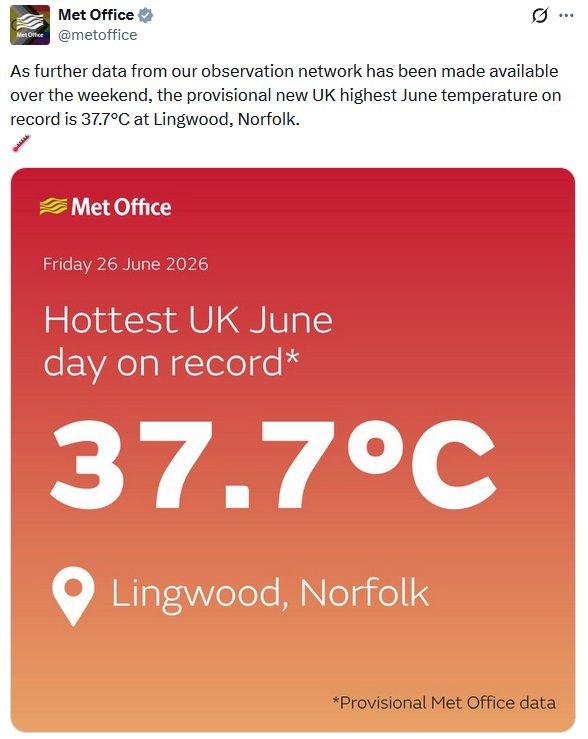
-
2026-2027 Super El Nino
GaWx replied to Stormchaserchuck1's topic in Weather Forecasting and Discussion
I agree with you on a lot of this, especially the late winter hype and the fact that the CFS is out on its own with this record rate of cooling. However, at the same time, I’ll say these things: -It’s fair to post this aspect of the CFS as you did the first CFS post of the morning. Not only a record peak, but also a record cool off afterward (V shape). -This cooling of 1.3 from Nov to Jan would be a new record cooling as the current record per ERSST monthlies is the 1.0 cooling from Nov to Jan of 2002-3 -Sometimes they’ve actually strengthened from Nov to Jan -
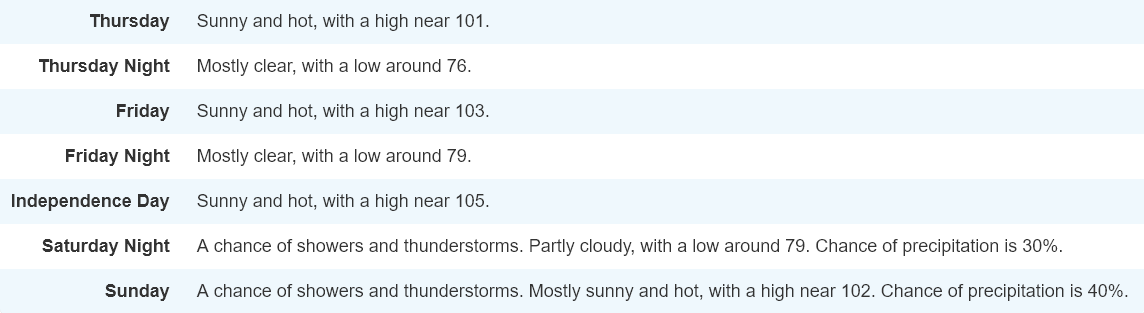
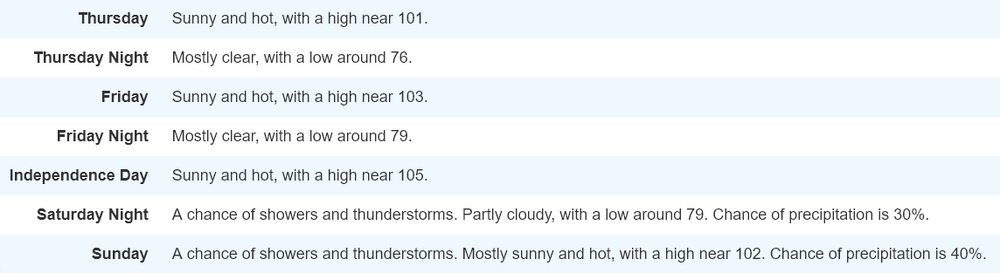
Our latest point and click in Raleigh:
-
And you have to watch it outside in the sun
-
My point/click was 105 for Thursday and Friday, which I have never seen before! Now it's 102 which is probably more realistic If folks in OC MD for the week can get a S wind off the ocean, they are getting their money's worth! Maybe 89 or 90 for highs?
-
2026-2027 Super El Nino
40/70 Benchmark replied to Stormchaserchuck1's topic in Weather Forecasting and Discussion
Yea.....on the table as in the main course. I think a few are continuing to obfuscate the sheer magnitude of the event with the concept of "basin-wide". Yes, largest anomalies are east and the seasonal mean will likely resemble the east-based composite, but there are very strong anomalies throughout the ENSO region, so some volatility is likely. Basin-wide doesn't necessarily mean it can not, or will not act more like an east-based event in the end....some do, some don't.....there is more variability. I do agree that this one will look east based in the DJFM mean pattern, but I also think that there is a decent shot of month of MC and Modoki forcing...but yes, eat-based likely strongest. -
Dude I don’t even like to say that word out loud because if it isn’t clearly overheard then all hell breaks loose. But saying little tiny biting bugs that cause incessant itching is too long.
-
Around here 10 per minute is a lot. My only experience with anything close to the above came July 15 years ago at DEC. The storm was 6-8 miles to our south and the flashes were essentially uncountable - at least 100 per minute. Thanks to frequency and distance, the thunder was a constant drum roll. Had a brief (10 minutes with most of the 0.16" in the first 2) but noisy TS arrive at 5 last afternoon. That makes 6 days with thunder this month, one more than all of last year. (Annual average is 15.)
-
Wow day 1: Wednesday ... NAM's new grid numbers from 12z for BOS, 18z 54000574750 -0493 10 26 09 80 32 24 18 60000655534 -0493 112612 80302518 32 C is 980 mb at Logan's sigma, which given a sfc pressure is closer to 1015 or so, the actual sfc 2-m is probably closer to 37 C ( (72 - 7.2) + 32 = 96.x not bad considering this conceptually/validly results higher than the machine MET for couple of cycles now. Haven't seen the 12z MET but we'll see. In the past the MOS has been too cool when that's observed. 850 mb T ~ 21 or 22C here ( 24+18) = 41/2 assuming equal mixing but I suspect the slope isn't linear. The above 24 C bulging skyward... probably expanding through the mid point so it's likely closer to 22 or so at 850. This appears to match the objective guidance illustration ... If so, +22C adiabat supports ~ 36 C 1000 mb T, so as another means to infer the surface ...that doesn't include the 2 C slope to the right during high proficiency heat - which this NAM run's definitely going to be on that day, given those RH field are all 50% or less. Anyway, the NAM's 32 at 980 mb could actually be a tick cool (wrong) in this quasi synergistic potential/holistic synopsis. Bottom line is top heavy with temp on this new run. The 26 conceptually means '260 degrees' ..which pertains to the wind direction - in this case at 2pm. It's blowing straight out of Boston urban anus right at Logan, and right around fart velocity of that 9 kts. So if actually getting that particular completely idiot to civility location to be a temperature that represents what it's like walking down Cambridge Ave to the Fens, that's about as good an opportunity as you'll find.
-

Fireworks Heat Contest W 7/1 - S 7/4 for Five MA Airports
MillvilleWx replied to nw baltimore wx's topic in Mid Atlantic
DCA: 97, 100, 99, 98 BWI: 99, 102, 100, 99 IAD: 97, 101, 99, 98 SBY: 98, 102, 99, 98 RIC: 99, 102, 101, 98 Total Rain: 0.31 -

2026-2027 Super El Nino
snowman19 replied to Stormchaserchuck1's topic in Weather Forecasting and Discussion
So far the CFS (relative) is the only model showing the extremely rapid drop. That said, once DT and JB see that, they will be all over it like white on rice. EVERY El Nino weakens dramatically as we go through Winter. And this one is forecast to remain strong through Feb or March, no different than the last 2 super El Nino's (1997-1998, 2015-2016). Plus it’s the atmospheric response to the Nino 3.4 anomaly that matters. Just using 1997-98 and 2015-16 as the most recent super El Niño examples…both peaked the last week of November, both rapidly weakened throughout the winter (with the most rapid weakening occurring from Jan-Mar). 2015-16 was a start to finish +QBO winter, like this one is expected to be, 1997-98 started as a +QBO in 1997, then transitioned to a -QBO. DT and JB both argued that the rapid weakening in 2016 was going to result in some miracle winter comeback in the east. I remember January of 2016 vividly. They were screaming to the heavens that the El Niño was rapidly falling apart, the easterlies and trade winds were coming back with a vengeance and that the east was going to turn into an arctic cold tundra with KU’s crippling the I-95 corridor in February and March. We all know how that worked out….they utterly embarrassed themselves. I had to do some research for the 1997-98 winter (DT wasn’t around back then), but I was able to find it. JB was still at Accuweather at the time and he argued the same thing he did in 2016. He was warning people in the east in January ‘98 not to “write off winter yet” and was hyping that there was going to be some miracle winter comeback in February and March because of the rapid weakening of the El Niño and the transition to a -QBO, which he said was going to result in high latitude blocking and a turn to arctic cold and big snowstorms up the east coast. Another epic fail -
Spot on. I worked as a laborer for a construction company in the summer while going to college. Trucks did not have air con. Once you get drenched in sweat there's not much more stink you can pile on. Baled hay too. Helped my brother in Ohio last week move, stack and restack nearly 200 bales. It's one thing when you are young and skinny and can dissipate heat well. It's another when you're in your mid-60's, fat, and out of shape (haha). I feel for the people who HAVE to be out in the heat because it's their work/profession. Those who choose to be in the heat out of their own preference have the luxury to quit when they want. This week is going to put a load on the electrical grid to keep up.
-
81/75 at 10 am is soupy af.
-
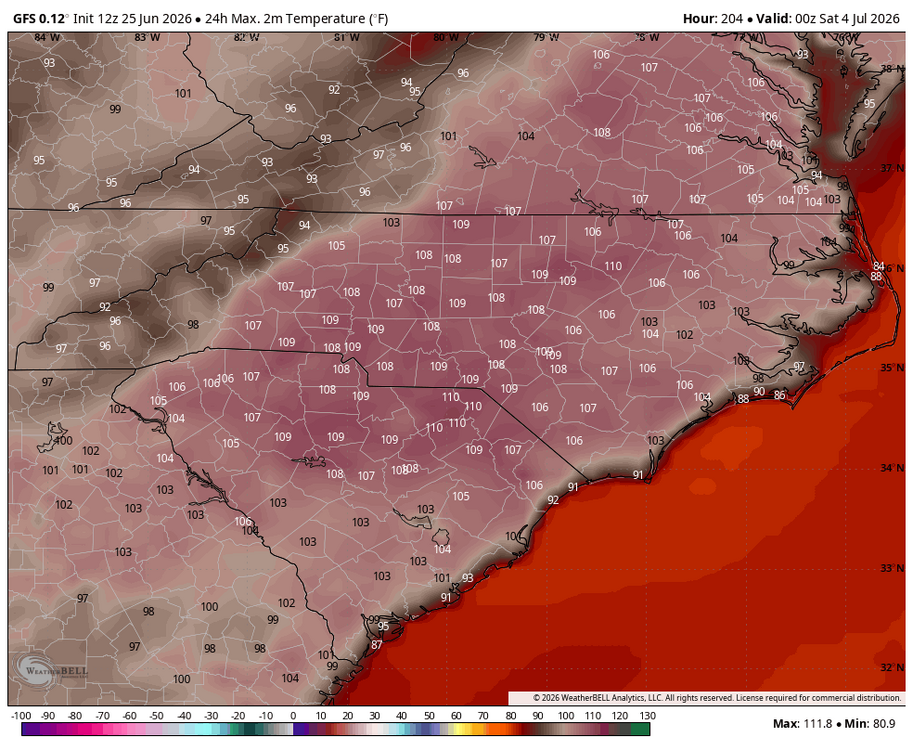
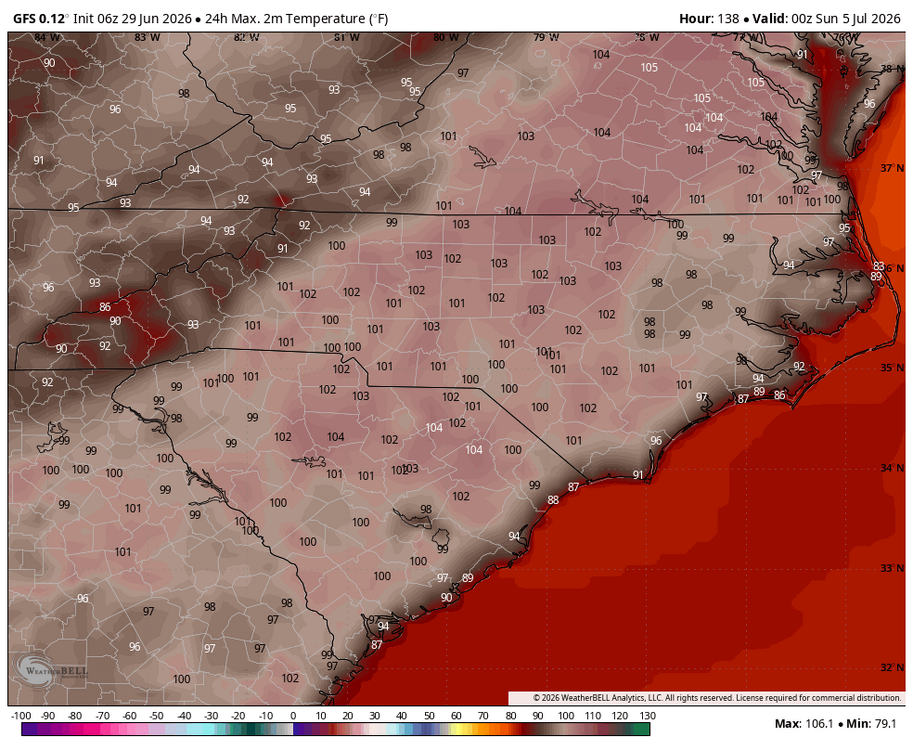
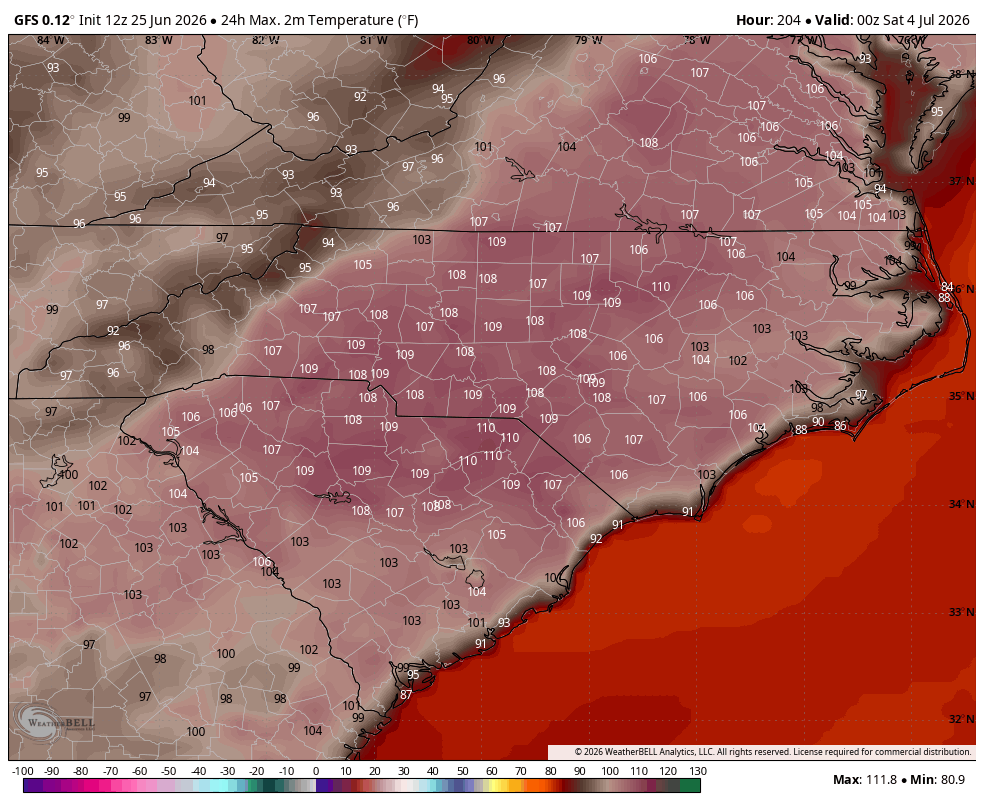
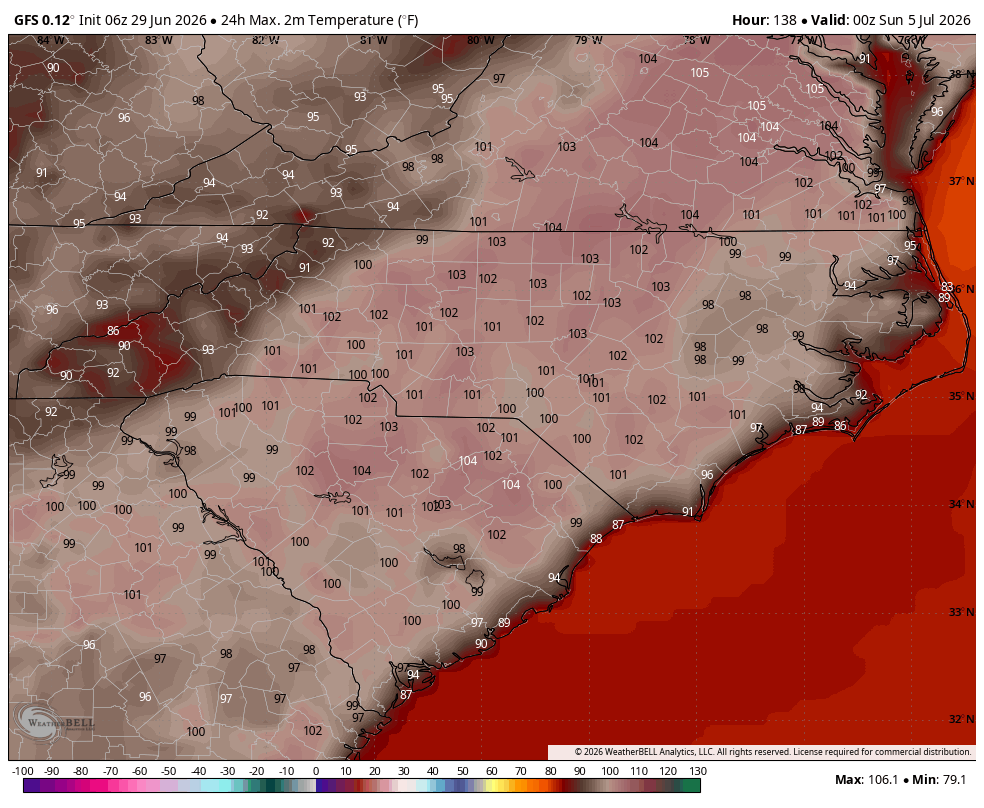
Bump to show that once again the GFS looks like it is going to end up quite a bit too hot: Here is an apples to apples comparison with 24 hour highs on the GFS runs of 12Z 6/25 vs 6Z 6/29: still miserable and dangerous for sure but most of Carolinas are 5-9F less hot! This is a common bias of the GFS in summer in the SE US on mainly sunny days. 12Z 6/25 GFS 24 hour max ending 0Z 7/5: 6Z 6/29 GFS 24 hour max ending 0Z 7/5: