All Activity
- Past hour
-
 "If the wx is not *exactly* normal, then something is wrong!" The notion of normal is so messed up these days in public perception and in the field. Well, how about this to make ppl go ????? - "it's normal NOT to be normal! Normal all the time would be a problem in reality!" And ever notice that "not normal" is always associated w/ the negative? So how does one resolve atypical low tornado years or a quiet hurricane season? Or a winter than is rather mild in the CONUS, like strong EL Nino typically is? Heating costs and energy demand reduced alone makes it more beneficial than not.
 -
I saw one sitting here on the porch, and that made me think of it, but I haven’t heard any. I blame the lantern flies.
-
Accords are tanks. Had one several years ago and it’s by far the most reliable car I’ve driven.
-
40 at HIE on the latest GFS MOS. *Almost* a touch of frost!
-

Central PA Summer 2026 Discussion/Obs Thread
canderson replied to Voyager's topic in Upstate New York/Pennsylvania
DOGE is one big reason -
Positive. Here is the PNA progression from DJFM 2023-2024, a weaker El Niño within the heart of the Pacific cold phase. 1.21, 0.45, 0.09, 0.45 It's going to be more negative than that season? Good luck....take a look at all of the super El Niño events....waaaaay positive. Even 1991....only one that was neutralish was 1972, but it was still barely positive. Now, maybe the orientation of the PNA ridge will suck....but the reading won't come out negative for the DJFM mean.
-
There’s some around my neighborhood but I would say fewer than usual. Huh…wonder why.
-
By the way, where are all the annual cicadas??? I haven’t heard any this year.
-
Whiskey on the porch here!
-
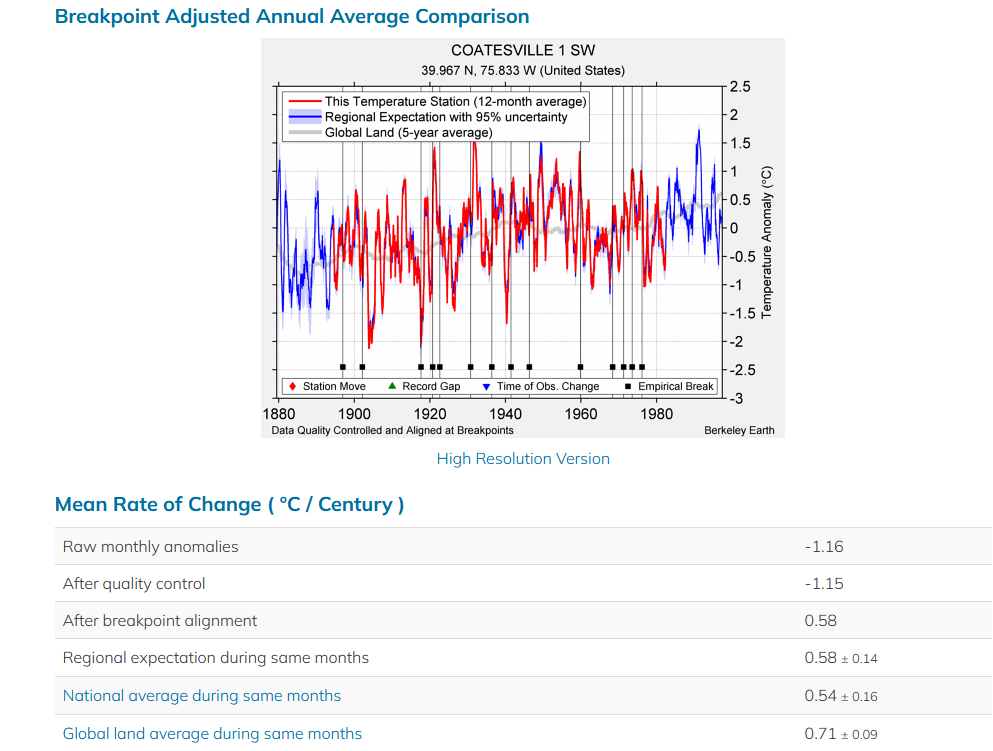
(002).thumb.png.6e3d9d46bca5fe41aab7a74871dd8af8.png) Don you may want to look at my last post and help answer these gaps or as you call them "breakpoints" on why on a single station basis with rigorous long term station data such as Coatesville 1SW the annual supporting data from raw to adjusted for 99.7% of years from 1895 through 1971 was chilled by NCEI. We can see it is certainly not TOB and not site moves so what is it and why can't we quantify it if the science is so transparent by year with attribution to all of the potential reasons for chilling the data basically every single year for this station. Where is the NCEI detailed file explaining this particular stations unique adjustments by year?
Don you may want to look at my last post and help answer these gaps or as you call them "breakpoints" on why on a single station basis with rigorous long term station data such as Coatesville 1SW the annual supporting data from raw to adjusted for 99.7% of years from 1895 through 1971 was chilled by NCEI. We can see it is certainly not TOB and not site moves so what is it and why can't we quantify it if the science is so transparent by year with attribution to all of the potential reasons for chilling the data basically every single year for this station. Where is the NCEI detailed file explaining this particular stations unique adjustments by year? -
El Niño summer from here on out.
-
You can see the mid-level center spin on radar near CRP currently. Talk about a tilted vortex sfc to mid-levels! This one of the most "disconnected" TCs I think I have ever seen. Great case study. The ECWMF handled this evolution very well. Compare its 925 mb RH/streamlines to its 500 mb RH streamlines, and the disconnect was fcst very well. This is about as far as you can get from a classic TC structure, but they exist on a *spectrum*. You can't use textbook examples all the time for what actually occurs in the real world. So both Arthur and Bertha were odd ducks, and even for sheared TC, more atypical for this variant of a TC. It also shows how the models still struggle w/ initial TC genesis for systems like this. Pre-Bertha was a non-tropical low that appeared it would remain broad and cold core, and strong shear was factor. Not that the models can't handle non-tropical to tropical transition, but the overall environment was not favorable, so that likely influenced the models. Yet the system still managed to form a large, solid LLCC in the mid 990s.
-
Peak rosé weather on the patio kind of day
-
When the addition was done on the house in Taunton an interlock was put in on our panel. If you’re planning on a portable setup, this is something that may need to be installed. It basically is a fail safe that prevents power back flowing into the grid and prevents power being supplied from both.
-
2026 Spring/Summer Mountain Thread
Maggie Valley Steve replied to Buckethead's topic in Southeastern States
I need to get my old eyes checked. Picked up 1.66 for 24 hours. -

Mid-Long Range Discussion 2026
WinstonSalemArlington replied to BooneWX's topic in Southeastern States
-
TMLP was so reliable. I think in the 20 years I lived in East Taunton I lost power for maybe a handful of days. Their prices were also great compared to the larger suppliers.
-
2.15” event total here. Not sure we see any more given radar. Stayed in 70s all day, incredible. Also incredible, my MTD is now 11.17”
- Today
-
 Coatesville 1SW has a strong cooling trend in the raw data, as you observed. However, there are multiple breakpoints. Adjusting for those breakpoints brings Coatesville's trend in line with regional trends. From Berkeley Earth: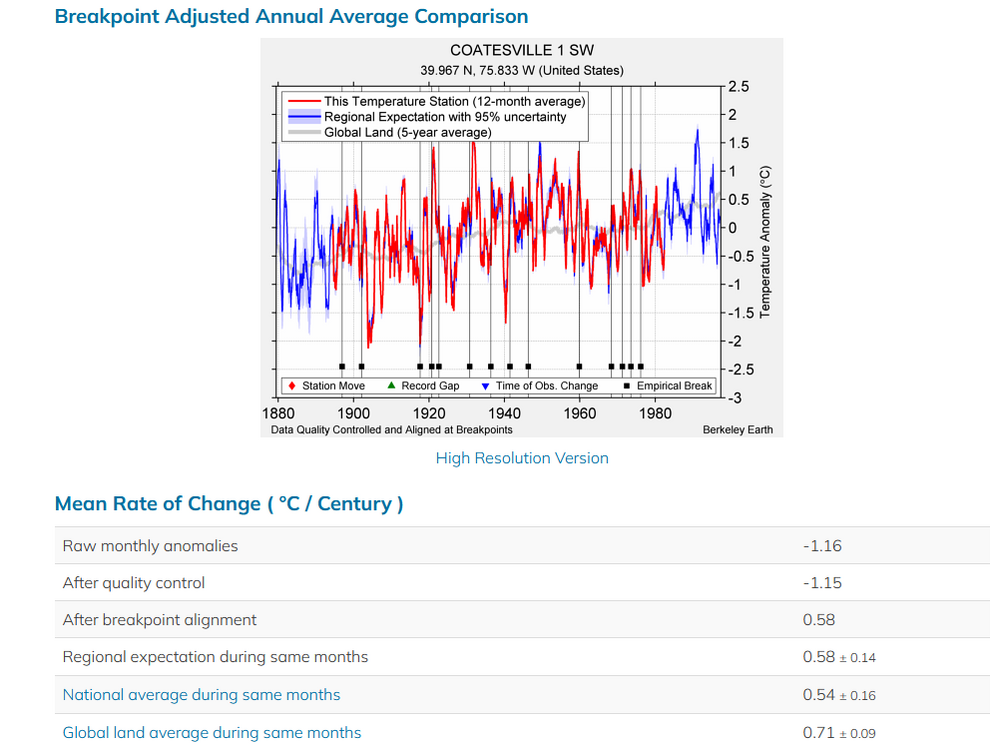
-

E PA/NJ/DE Summer 2026 Obs/Discussion
Hurricane Agnes replied to PhiEaglesfan712's topic in Philadelphia Region
It's official. Chief meteorologist Cecily Tynan to retire after more than 30 years with Action News Her last broadcast will be on Monday, Aug. 31. https://6abc.com/post/cecily-tynan-retirement-announcement-6abc-action-news-wpvi/19562769/ Birds will be in mourning ! -
So let's look at a single station with long term data 1894-1982 Coatesville 1SW. I performed an analysis of that station to see if TOB bias was part of the adjustment for 77 of 78 years of cooling data that we have documented many times before from the raw actual data. I evaluated all of the changes in observation times for the entire period of record. Of note from 1946-1982 the station observed a consistent 8am reading whhich sits close to the −0.15°C (cool bias) end of the curve, meaning the TOBS-correct move would be to add temperature back (a small positive adjustment) — yet the actual 1946-82 adjustment stayed negative on average (−0.83°F). That's a clear red flag in the NCEI adjustments as TOBS alone would predict the sign should have flipped positive after 1946, and it didn't. So without TOBS alone there remains a clear and significant leftover unexplained cooling of roughly -1.1 to -1.8°F in every single period — evening, dual, and morning alike. That's the thing that needs a separate explanation, since TOBS alone doesn't account for it. So we have seen @chubbs likes to often say that station movements tied to Coatesville's industrial history and station moves impacted the data and made it critical to chill the old data. The problem that NCEI and Charlie has is that in reality Coatesville was home to Lukens Steel — a continuously operating steel mill since 1810, one of the largest specialty steel producers in the country, still headquartered there through 1982 and beyond this is a station within a mile of significant industrial activity! This of course is a textbook candidate for a persistent local warm bias — waste heat, paved/industrial surfaces, altered local airflow. But here's the problem for NCEI and Charlie to address - this doesn't match the data adjustments made by NCEI. The facts are that Lukens was arguably at its industrial peak in the postwar decades (1946–82) — yet that's exactly the period where the adjustment (and the residual) is smallest, not largest. If growing industrial heat were the main driver, the bias should have gotten worse over the 20th century, not better. So it is not TOB adjustments and clearly not site moves behind these adjustments so what say you Charlie?
-
 That is likely because normal people don't speak with you..???
 -
 What a day! Got about 1” in last nights rains, couple that with the day before’s 1.5”. Probably won’t do much for drought as it came too fast to soak in and most ended up in storm drains.
 -
I bought a 2018 Accord from Lake Norman Genesis. (I would highly recommend them - great service, no pressure, let me drive it to Hickory so my mechanic could give it a look over.) I had a 2014 Accord. Wanted to upgrade a few years, and the older model became my youngest son’s first car. So, we both got new (to us) cars today!
-
what is so bad about seeing the euro after a restful night's sleep