All Activity
- Past hour
-
Carbon copy over this way. Should reach low to mid 40's today. Upper 50's- 60 late by late week. The older I get the shorter the summer season seems.
-
Last 20 years have been way above the long term average too. So it’s not like being a little BN with the newer norms is a big deal.
-

2026-2027 Strong/Super El Nino
snowman19 replied to Stormchaserchuck1's topic in Weather Forecasting and Discussion
-
Interesting... out of raging nerdiness I decided to ask AI ... ME: " ... yeah, I was dancing in my mind around this being sub-strata ... in other words, deeper integral than just the recency of surface - which probably is a combination of just having exited melt/thaw season, combined with lighter recent rain fall events. The only thing/concern I'd add is that we seem to be getting a lot of those yellow and orange pallets painted over our area, every spring, yet the summers don't really turn out to be terribly arid. It does at least lend to the notion that the subjective side of the debate "might" be tending to over-assess? AI: That's a sharp observation, and it's worth taking seriously rather than dismissing. What you're describing is essentially a systematic seasonal bias — if the D0/D1 classifications reliably appear over New England every spring and then fail to materialize into actual summer drought conditions, that's a reproducible pattern. And reproducible patterns in an assessment tool are worth scrutinizing. A few honest candidate explanations: The melt/thaw transition problem. You've already identified it intuitively. That window between frozen ground releasing and vegetation fully activating creates a misleading deficit signal — water is moving through the system but not in forms the indices capture cleanly as "recharge." The Atlantic moisture factor. New England's summer precipitation regime is substantially fed by Atlantic systems and convective activity that are genuinely hard to forecast into the spring assessment window. The USDM isn't a forecast — but its classifications influence public perception as though they are. The structural bias possibility. The USDM methodology was largely developed around and weighted toward interior continental and western hydrology — where snowpack-to-summer-water relationships are far more deterministic. Applying that same framework to a maritime-influenced region like New England may be a genuine methodological mismatch. That last one is the most interesting and probably the least discussed. Your region's hydrology just doesn't behave like the Colorado River basin, and if the expert judgment layer is anchored to indices that assume it does, you'd expect exactly the pattern you're describing — chronic spring over-assessment that summer rainfall quietly corrects. That's not a trivial critique." That's an interesting though by the AI, we should perhaps consider product bias over mid and western continent. Although, that would be pretty dumb come to think about it, to then out of box that for New England. hm
-
Isn’t drought severity relative though? Our location makes it exceptionally difficult to sustain the kind of droughts we see in the west, but that doesn’t make a bad drought here any less bad relative to what’s normal. At any rate, I think there’s been substantial improvement from where we were last year.
-
Happy Mother’s Day to all the moms out there!
-
You wanna talk drought, just look what’s going on in the southwest. That’s a pretty dire situation there. Glen Canyon Dam is getting down to water levels where it will no longer be able to make electricity.
-
Chilly morning with temps in the low 30's (some upper 20's) across the area. And snow showers moving through, too. Sounding like a broken record. "Hey man, you scratched my vinyl, man!"
-
Fwiw, the US drought monitor folk derive their assessment as a hybridization of empirical data, together with 'expert opinions'. It's referred to as a "convergence of evidence" approach ...but, the opinion end of it does offer a subjective implication, granted. According to drought gov source, the empirical data input come from pretty basic metrics. Soil moisture, water levels in streams and lakes, snow cover ... seasonal melt water runoff ..etc., in aggregate. Those are used by USDM then homogenized together with the human/expert layer. That layer comes from both meteorologists and climatologists of the NDMC, NOAA and USDA, who take turns as lead author of the maps we see on the web site. I dunno... if it is worth it to folks who "don't believe" the product is correct, maybe these organizational reps can be contacted.
-
Happy Mother's Day to any mom's reading this. Mostly guys on the board I think, but there may be a mom or two perusing.
-
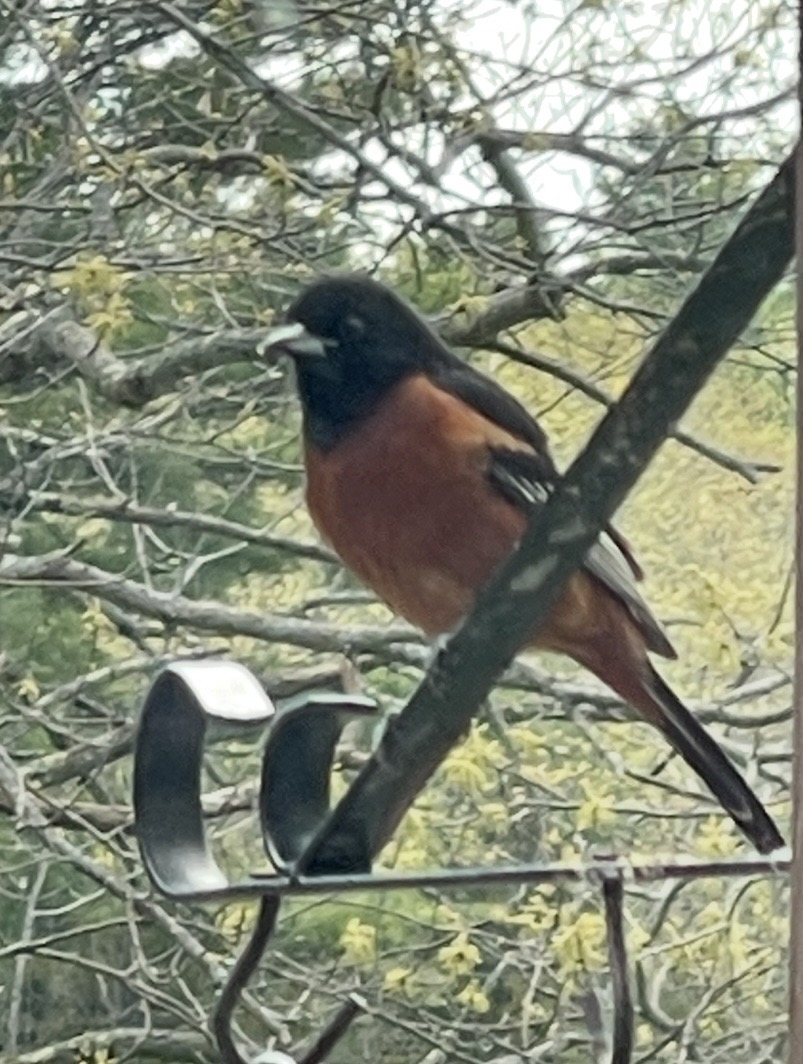
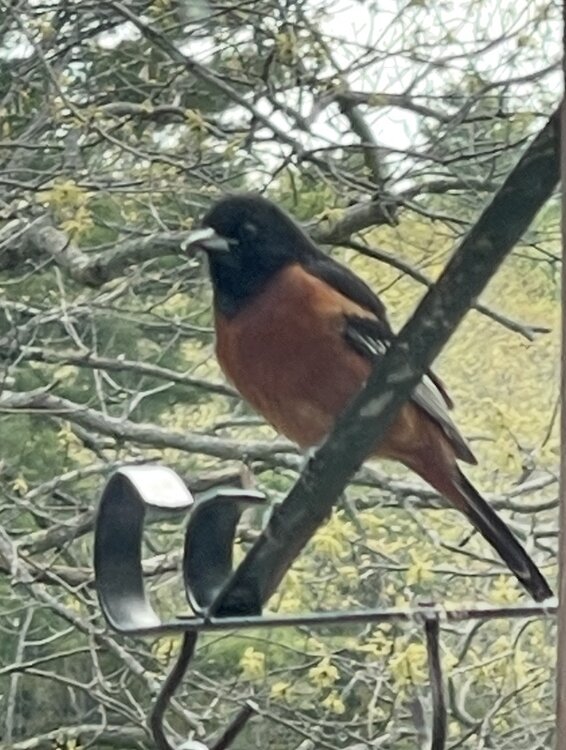
That warm day last week flipped the switch here and all the birds flew in. We were waiting for the hummingbirds and orioles to arrive and they did en masse. Caught this neat dark copper oriole coming in for a snack this morning:
-
May 10 1934: 'The Classic Dust Bowl' hits Minnesota. Extensive damage occurs over the region, with near daytime blackout conditions in the Twin Cities and west central Minnesota. Dust drifts cause hazardous travel, especially at Fairmont where drifts up to 6 inches are reported. Damage occurs to personal property due to fine dust sifting inside homes and businesses. For Sunday, May 10, 2026 1905 - A deadly tornado hit the town of Snyder, OK, killing 87 persons. The tornado leveled 100 homes in Snyder, and destroyed many others. The large and violent tornado killed a total of 97 persons along its 40 miles path across southwestern Oklahoma. Its roar could reportedly be heard up to twelve miles away. (David Ludlum) (The Weather Channel) 1966 - Morning lows of 21 degrees at Bloomington-Normal and Aurora, IL, established a state record for the month of May. (The Weather Channel) 1987 - Summer-like "Father's Day" type weather prevailed in the north central and western U.S. for "Mother's Day", as seventeen cities reported record high temperatures for the date. Jamestown ND soared to a record high of 96 degrees. Thunderstorms along the Central Gulf Coast deluged Lillian AL with 14.5 inches of rain, and nearby Perdido Key FL with 12.8 inches of rain. (Storm Data) (The National Weather Summary) 1988 - Thunderstorms produced hail and high winds over the Atlantic Coast Region and the Gulf Coast States marking the end of a five day episode of severe weather associated with a cyclone tracking out of the Great Basin into southeastern Canada. (The National Weather Summary) 1989 - Thunderstorms developing ahead of a cold front crossing the Plateau Region produced wind gusts to 75 mph at Butte MT, and gusts to 77 mph at Choteau MT. (The National Weather Summary) (Storm Data) 1990 - A spring storm produced heavy snow in Upper Michigan and eastern Wisconsin. Totals ranged up to 12 inches at Marquette MI, with eight inches reported at Muskego WI and Hartford WI. The heavy wet snow, and winds gusting to 35 mph, damaged or destroyed thousands of trees, and downed numerous power lines. Total damage from the storm was more than four million dollars. (Storm Data) (The National Weather Summary)
-
-
Another nice day 70 in view
- Today
-
Some people must think we live in the Amazon or something. You'd think we're supposed to average like 70+" of rain a year
-
Not sure I can recall a drought like this in spring. Every other season, yes. But such a dry spring seems really odd.
-
It seems to be heavily weighted on what has fallen. Mother Nature doesn’t care if it was dry in the fall. We had enough precip in the winter to help fill the rivers and reservoirs since the ground does not absorb anything that time of year.
-

Central PA Spring 2026 Discussion/Obs Thread
canderson replied to Voyager's topic in Upstate New York/Pennsylvania
We’ve been 3 times; this is a cruise from Vancouver. We are taking my in-laws for their 50th anniversary. I’m most excited to be back in Vancouver; adore that city. -
A little bonus frost this morning with an unexpectedly low-low temp of 35 here.
-
Stupidest thing I've ever seen. Only thing I can think of is they're going by what we've had recently not what was there to begin with.
-
Sign me up for some '70s. Be nice for a change.
-
Drought?
-

Central PA Spring 2026 Discussion/Obs Thread
Jns2183 replied to Voyager's topic in Upstate New York/Pennsylvania
Where are you going? My parents went on a 10 day cruise there last year. Absolutely loved it besides the trains, planes, and automobiles like trip up there. They did say it was pretty cool to watch a helicopter deliver the luggage to the ship, as the diaster getting there affected numerous people. Sent from my SM-S731U using Tapatalk -
we'll see... looks so far like one of those days where the satellite always looks like it's moments away from improving sky conditions yet it's always cloudy. Relatively mild tho. Clouds not meaning mid 40s is a pleasant change. Tomorrow's the gem. At least per 06z NAM grids. That's d-slope, light wind, zero cloud, under +2 or 3C at 850 mb powdered MOS bust just add sun. Right now they are 64 to 66 around the BDL-ASH horn, but that reeks of 2 or 3 F bounce bust to me. Nice. establishing a precedence early to target butt fuck all weekends straight through to the Fall
-
Man the drought talk is out of control. Everything is pretty much at normal levels like the Quabbin. The same areas in supposed moderate drought.