
Windspeed
-
Posts
4,850 -
Joined
-
Last visited
Content Type
Profiles
Blogs
Forums
American Weather
Media Demo
Store
Gallery
Everything posted by Windspeed
-
Major Hurricane Melissa - 892mb - 185mph Jamaica landfall
Windspeed replied to GaWx's topic in Tropical Headquarters
Melissa's eye is clearing out fast now. -
Major Hurricane Melissa - 892mb - 185mph Jamaica landfall
Windspeed replied to GaWx's topic in Tropical Headquarters
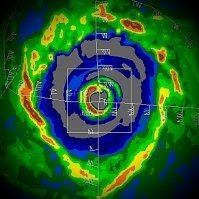
Mesovorticies rotating around the eyewall. it shouldn't be long until we start seeing pressure dropping like a rock. -
Major Hurricane Melissa - 892mb - 185mph Jamaica landfall
Windspeed replied to GaWx's topic in Tropical Headquarters
Here's some heat content and isotherm depth maps as well. Melissa's core, despite being a slow-mover, has plenty of energy to tap prior to land interaction. Credit to RSMAS at Miami for maintaining these to the public. -
Major Hurricane Melissa - 892mb - 185mph Jamaica landfall
Windspeed replied to GaWx's topic in Tropical Headquarters
Fourteen hours between those two images is absolutely absurd. We kept harping that all forecast indicators were showing substantial decrease in wind shear to a near to pristine favorable upper environment. The system is now positioned right under an amplifying ULAC. Powder keg stuff. I think we'll see a Category 5 today. -
Major Hurricane Melissa - 892mb - 185mph Jamaica landfall
Windspeed replied to GaWx's topic in Tropical Headquarters
Intense VHT is now going up in the NE eyewall. Obviously, we're in an ongoing rapid intensification phase. Expect some beefy pressure drops between now and Sunday afternoon with such an eyewall presentation on radar, which is getting more and more symmetrical each passing hour. -
Major Hurricane Melissa - 892mb - 185mph Jamaica landfall
Windspeed replied to GaWx's topic in Tropical Headquarters
OHC is very deep in that part of the Caribbean. The 26°C isotherm is over 100 meters of depth. It would take a multi-day stall before upwelling became a significant factor, and we're talking in terms of a Category 5 sustaining itself. For all practical purposes, the main reason even slow-moving hurricanes in the western Caribbean can maintain Cat 5 intensity well into November. Some of our most powerful historical Cat 5s were slow movers in that part of the world (Wilma, Mitch, etc.). It's where the Western Hemisphere's version of WPAC typhoons can occur, though still considerably rare. -
Major Hurricane Melissa - 892mb - 185mph Jamaica landfall
Windspeed replied to GaWx's topic in Tropical Headquarters
Unfortunately, with atmospheric conditions progressively becoming more favorable with each passing hour, I do not see a scenario where Melissa does not efficiently achieve its MPI. Land interaction or internal structural changes are the only limiting factors until it's picked up by the trough in a few days. -
Major Hurricane Melissa - 892mb - 185mph Jamaica landfall
Windspeed replied to GaWx's topic in Tropical Headquarters
Shear is modeled to relax significantly. There may still be some light mid-level shear, but not enough to prevent a major hurricane given other environmental features. The real key here is the eventual position of the center when the steering currents change. Land interaction will be the only significant deterrent to high-end intensity, such as where Melissa is positioned when it begins the slow turn north. Upwelling isn't going to be much of a factor until it has already reached MPI, if Melissa goes through a stall or slow crawl during its northward turn, as OHC is deep in that part of the Caribbean. -
Major Hurricane Melissa - 892mb - 185mph Jamaica landfall
Windspeed replied to GaWx's topic in Tropical Headquarters
The HAFS suite shows just how dire the slow recurve scenario would be with regards to a catastrophic flooding / mudslide scenario. The general wind and pressure intensities may be overdone, but the amount of rainfall will be extreme regardless. -
Major Hurricane Melissa - 892mb - 185mph Jamaica landfall
Windspeed replied to GaWx's topic in Tropical Headquarters
Given the slow recurve motion, Jamaica is facing a catastrophic flooding and mudslide situation. -
Yeah, Gabrielle is cranking. Should help a little with the low seasonal ACE numbers if it can hold onto major hurricane status for a few days.
-
High risk now...
-
I saw this interesting thread pertaining to the Chattanooga area this evening and boundary in place. https://bsky.app/profile/chattwjonathan.bsky.social/post/3lkgjvldr5s2g
-
2025 Atlantic Hurricane Season
Windspeed replied to BarryStantonGBP's topic in Tropical Headquarters
Yeah, I wasn't aware of a Main Forum thread to cover all the firings and potential dismantling of NOAA, etc., when I posted the news. I had just seen Andy got fired, was shocked, and understanding how we share his critical information so frequently (almost daily during the season), thought it of utmost importance to post here. Numerous critical personnel we rely on in these tropical threads have been terminated, some of which were not probationary due to being new hires, having had promotions or clearance level changes. I don't know how else we could avoid sharing these firings specifically in this particular thread since we post their work verbatim so often. This "situation" will clearly have impacts our pre-seasonal and active seasonal discussion as their analysis may not even be available. Though I did make my brief opinion known in the initial post, I will not delete it, and these additional comments are merely stating obvious impacts for our future discussions from an empirical standpoint. I will say no further. -
2025 Atlantic Hurricane Season
Windspeed replied to BarryStantonGBP's topic in Tropical Headquarters
https://www.nbcmiami.com/news/local/noaa-employees-laid-off-in-doge-cuts/3555471/ Pathetic. -
It's straight ripping fatties in Bristol. Column must be cooling off fast. Ground is already white. Surfaces are sticking. I agree with the above about the ground temps still being below freezing from the past week of bitter cold temps. Air temperature is currently 34°F here.
-
2024 Atlantic Hurricane Season
Windspeed replied to Stormchaserchuck1's topic in Tropical Headquarters
I am also surprised by the decrease of winds upon Carriacou landfall. Images from the ground there appeared to verify operational intensity. -
Filling in nicely in the northern and upper NE Valley as well. Flow is backing and becoming more northwesterly. I think KTRI may do quite well over the next 4-6 hours.
-
https://forecast.weather.gov/showsigwx.php?warnzone=TNZ040&warncounty=TNC029&firewxzone=TNZ040&local_place1=3%20Miles%20SE%20Lowland%20TN&product1=Winter+Storm+Warning&lat=36.1242&lon=-83.1732
-
There is a modeled snow hole over upper NE Holston Valley for a reason, which is likely due to some downslopping with the 850 flow *IF* the SLP cuts across the Southern Apps. Notable with the adjacent to high ridges of Unaka in Greene and Washington Counties, and Sullivan with Holston Mountain. I'm thinking it may very well stump totals versus the western NE TN counties, but I don't forsee graupel or sleet taking over due to warm nose. It should remain cold enough for snow, just weaker overall totals. That being said, if the SLP remains further south, upper NE Tennessee and KTRI may exceed 3-5". But if we land in the middle ground and end up with 4 inches, I am proclaiming this a big win, all things considered. Someone is likely to still get hammered, and I feel like portions of SW VA, such as Gate City to Abingdon, are being under modeled. It would not surprise me to see those places end up with 6-8 inches of powder. Also, I know we post the Icon but take it far less seriously than the GFS, ECMWF and Euro suites, but it is interesting it keeps wanting to pump higher totals over the upper NE Holston watershed this late in the game.
-
ETN needs the cold surface and 850 hPa airmass to hold in place and cooperate. We're in the 120 hr range now. We may still get a warm nose, but I am hopeful the upper Holston Valley will remain cold enough. If rates are weak with low QPF, we probably lose. If rates can pump up the column, we win. Therefore, the 10-11 system may come down to the wire before we know the cutoff of the graupel vs heavy snow line. Going to require a little patience until it plays out. Curbing my expectations and perhaps the Eastern Valley gets a surprise.
-
Chido's first landfall from the Island of Mayotte a few days ago. It appears to have been an intense landfall there as well. Community of Kaweni: Unsure of the exact location in the island here:
-
Yeah, someone got hit hard. A rapidly intensifying landfall per ADT analysis. Hopefully, it avoided a major population center. That looks to be the case as the small core came ashore a good distance south of the port city of Pemba.
-
Chido's organization has improved in the hours leading up to landfall. Looks like at least a Category 3 strike.