-
Posts
4,731 -
Joined
-
Last visited
Content Type
Profiles
Blogs
Forums
American Weather
Media Demo
Store
Gallery
Everything posted by Windspeed
-
I can assure you that the overwhelming majority of the National Oceanic and Atmospheric Administration does NOT support that ridiculous statement by that anonymous puppet, whomever, who was clearly dancing at the strings of their boss. I'm not even going to begin to show my disgust about the situation as I have refrained up until this point. Keep in mind there still is not a formal director of NOAA at this point, as Trump's really bad nomination has yet to be confirmed. Hard to imagine even the interim taking such action. I'm sure the Dept. of Commerce head was happy to oblige. Embarrassing.
-
Oh look it's a banter thread... Well here's my contribution: Just be sure to apply an applicable super heat retardant/resistant suit onto your person before being subjected to this low-silica basalt river of heat, otherwise this song will turn your flammable corpse quickly into the heaping insignificant pile of carbon of which it will become...
-
Holy shit!!!
-
Josh is about to get Haiyaned again. In the Atlantic even!!! Holy shit!
-
When the NAM isn't even being used in ill-advised posts about intensity and track guidance, you clearly got no game as a powerful hurricane. Much disrespect, brah.
-
Lekima is approaching 130 kts or upper Cat 4 per ADT#s the past few hours. This cyclone may even become a Cat 5 on Saffir Simpson scale. Of course a reminder that the agency responsible for that region measures in 10-minute sustained averages, but nonetheless the TC is a beast tha lt may be a Super Typhoon near initial brush / land interaction with Ryukyu Islands, Japan, near to Ishagaki.
-
Central/Western Medium-Long Range Discussion
Windspeed replied to andyhb's topic in Central/Western States
Did not see a recent banter thread so thought I would just post here. This new video by Pecos Hank discussing super computer mesocyclone and tornado genesis with Dr. Leigh Orf is an absolute must watch: -
Strong storms moved through TYS and MRX but most things have calmed down and seem rather tame at the moment.
-
Tornado warning north of Knoxville. Rotation/strong winds moving towards Maynardville.
-
The SPC did upgrade to a slight risk for much of the eastern TN Valley including an enhanced risk for the northeastern portion.
-
Vanu began a westward drift and should avoid landfall as a strong cyclone. Globals show a westward motion for a few days before eventually getting sheared off. A weaker system may still get pulled via the low level flow into Pakistan/NW India so flooding rainfall may still be a concern in the coming week.
-
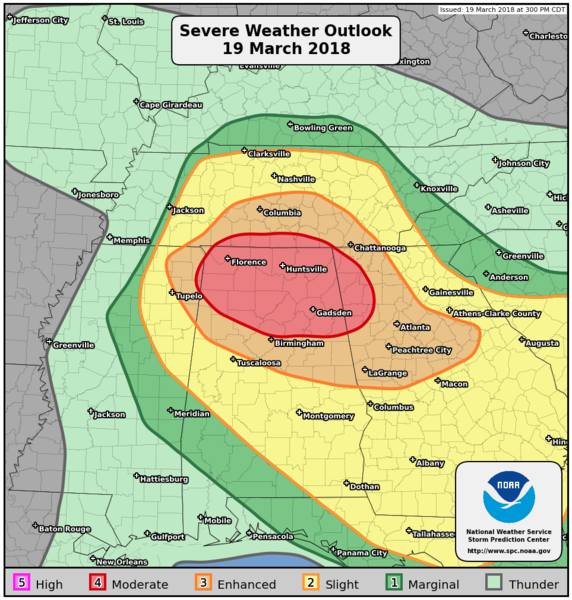
Day 1 Outlook Graphic...
-
SPC sticking with marginal for Tennessee and Ohio Valleys. Day 1 Convective Outlook NWS Storm Prediction Center Norman OK 0752 AM CDT Wed Jun 12 2019 Valid 121300Z - 131200Z ...THERE IS A MARGINAL RISK OF SEVERE THUNDERSTORMS ACROSS PARTS OF THE OHIO/TENNESSEE VALLEYS INTO THE SOUTHEAST AND COASTAL CAROLINAS...MISSOURI/ARKANSAS VICINITY...AND WEST TEXAS... ...SUMMARY... Isolated strong to severe thunderstorms will be possible today across parts of the Ohio/Tennessee Valleys into the Southeast and coastal Carolinas, Missouri/Arkansas vicinity, and west Texas. Marginally severe hail and strong/gusty winds should be the main threats. ...Synopsis... For convective purposes, the mid/upper-level pattern will be dominated by a high-amplitude, synoptic-scale trough now located from northwestern ON across the upper Mississippi Valley, to the KS/MO border area and deep south TX. By 12Z, this trough should shift eastward to Lakes Superior and Michigan, IN, middle TN, AL, and the north-central Gulf. Several embedded/minor shortwaves will traverse the associated cyclonic-flow field through the period, contributing to relatively maximized potential convective coverage on the mesoscale. Farther west, a weak shortwave trough will move inland over parts of the Pacific Northwest and northern CA, contributing to locally gusty dry thunderstorms, as noted in the SPC fire-weather outlook. At the surface, 11Z analysis showed a wavy, quasistationary frontal zone from southern SC across central/southern GA, to near the LA coastline, and across deep south TX. This boundary should move little through the day, while becoming more diffuse west of central/eastern GA. Another cold front was drawn from Hudson Bay across northern ON, Lake Superior, to a low near CID, to another weak low near TUL, and finally, to yet another weak low near INK. This front will move eastward/southeastward through the period, reaching lower MI, southern MO, the Arklatex region, and portions of central/southwest TX by 00Z. By 12Z, the approach of the mid/upper trough will induce frontal-low formation over southeastern Lower MI. The cold front will extend from the MI low across eastern TN, southeastern MS, and south-central TX. ...Southeastern CONUS to Ohio Valley... Scattered thunderstorms should develop through this afternoon in an arc of favorable buoyancy and weak CINH, wrapping around the southern/western Appalachians, along and outside of the low-theta-e damming air mass. Isolated severe hail and damaging to marginally severe gusts are possible. The most favorable conditions at various levels for severe will be horizontally displaced from each other across this broad, arching area, but individual elements may contribute to at least marginal severe potential locally. Moisture quality and theta-e will be greatest over the FL/GA/Carolinas swath, while mid/upper flow, cooling aloft, and deep shear will increase northward/northwestward through the western Appalachians/Ohio Valley lobe. Warm and moist advection north of the frontal zone, across western GA and eastern portions of AL/KY, will contribute to destabilization through the afternoon, in tandem with diabatic heating, enabling a narrow corridor of 500-1500 J/kg MLCAPE to develop there. Despite modest midlevel lapse rates, pockets of 1500-2500 J/kg MLCAPE should develop this afternoon in the Southeast. Weak low-level flow is forecast area-wide, except for some hodograph enhancement possible above the surface late afternoon and evening near the Atlantic coastal areas of GA/Carolinas. An assortment of boundaries will focus convection, including the frontal zone, outflow, differential- heating areas, confluence lines in the warm sector, and sea breezes. ...Ozarks and vicinity... Airmass recovery following the morning clouds/convection should become favorable for the next round of thunderstorms -- this time including surface-based cells -- by mid/late afternoon. Seasonably cold, -16 to -18 deg C 500-mb temperatures will spread over this region this afternoon, near the mid/upper-level trough. When juxtaposed with residual boundary-layer moisture, afternoon surface diabatic heating and related strengthening of low/middle-level lapse rates, forecast soundings reasonably suggest around 500-1000 J/kg MLCAPE with little or no MLCINH and a well-mixed subcloud layer. Organization will be tempered by lack of more robust moisture and shear, with little directional shear and effective-shear magnitudes generally less than 30 kt. However, strong anvil-level flow will aid in ventilation aloft, and the most robust cells may offer marginally severe hail/gusts. With convective potential extending northward into much of IA, the northern bound of the marginal risk area is, in reality, much fuzzier than the graphical line indicates, but already low-end severe potential still appears to diminish with northward extent into lesser magnitudes of cloud-layer shear and low-level theta-e. ...TX Big Bend/Trans Pecos... Isolated thunderstorms may develop this afternoon over this region south of the cold front, especially near higher terrain where diabatic heating will erode MLCINH preferentially. Severe hail and strong to marginally severe gusts are possible from any sustained convection that can form, though convective coverage is in question. Low-level convergence will be maximized near the generally southward-moving surface low, and any associated convergence zone extending southward. The main uncertainty involves whether associated lift will be sufficient to form/maintain thunderstorms long enough to produce severe, in an environment characterized by steep low/middle-level lapse rates and adequate boundary-layer moisture. Surface dew points in the mid 50s to low 60s F contribute to potential MLCAPE 1500-2500 J/kg in modified model soundings. In areas south to southeast of the low where an easterly surface wind component will enhance directional shear, 35-45 kt effective-shear magnitudes may be found. Any severe threat in this region should be conditional and short-lived, decreasing markedly after dark. ..Edwards.. 06/12/2019
-
TC Vayu in the NW Indian Ocean / Arabian Sea is forecast to become a Category 2 cyclone in the coming days and make landfall over the NW Indian and Pakistani coastline / borderlands. HWRF is most agressive in intensification making Vayu a Category 4 cyclone. The late track may be quite problematic for significant flash flooding as the cyclone will slow down and drift somewhere between Sindhu (Indus) of Pakistan and Mahi River Valleys.
-
Though they kept the graphic marginal, the wording is such that they definitively left the door open for a slight risk to be added tomorrow over the eastern Valley. Perhaps even a small area of enhanced if buoyancy and lapse rates are in line with the sharpening trough. We shall see...
-
Though not our area, I feel it's still worth a brief mention here in case anyone focuses mostly just on our region. There is a high risk for a significant tornado outbreak in the southern Great Plains today. First SPC High Risk since 2017. A lot of troubling parameters in play for this to verify. If anyone has relatives out there, never hurts to give attention. There will be a main thread in the Central/Western Subforum to follow as the event unfolds.
-
Most of the communities along the track have densely populated townships even if they are small in size, such as Puri, India, which has around 200k residents in its last census. Puri may also find itself in the right-front quadrant of the eyewall. Trying to estimate track, Chatrapur, a smaller township of about 20k may get the direct hit. Regardless, as the cyclone moves inland, there are even higher population densities across the state of Odisha, and of course, per usual, the greatest threat is still going to be flash flooding of low lying communities.
-
Fani's Adj T numbers had already hit 140 kts. The earlier pinhole eye had also cleared and warmed. Though unofficial, Fani could very well have already attained Cat 5 intensity on the Saffir-Simpson scale. I don't know if the cyclone will maintain upper Cat 4 to Cat 5 intensity all the way through landfall however, as Fani's forecast track moves its core slightly adjacent and in close proximity to the shape of the Indian coastline for a while prior to actual landfall. Disruption of the core and eyewall interaction with land should weaken it before official landfall occurs. Regardless, this is a very powerful tropical cyclone, and with intense winds impacting a lot of shoreline, this cyclone has the potental to be a devestating event to multiple communities with a high population density. Edit: Fani, not "Lani".
-
Right. But from a climatological and historical perspective, the SSTs of the northern gulf shelf by Sept-Oct have generally cooled below what is required to support a rapidly deepening Cat 5. Sure, the central, southern GOM and Bay of Campeche would continue supporting Cat 5 intensity through October, but those storms tend to weaken drastically if steered into the N. GOM. Major hurricane Opal being a prime example. October of 2018 hopefully remains anomalous in its mutliple contributing factors that lead to Michael, as generally multiple cold fronts have swept through the northern gulf by mid-to-late September and subsequent dry continental air plus radiational cooling has brought down mean heat content by 3-4°C. Again, it's one thing to consider a rare Category 5 threat in July, August, perhaps still even September, but October? Michael is hopefully the rarest of generational occurrences.
- 46 replies
-
- 4
-
-
- historical tropical cyclones
- hurricanes
-
(and 3 more)
Tagged with:
-
Reading back through this thread, I was dead wrong in one point while trying to discredit preconceptons or misconceptions about landfalling Cat 5s along the N. GOM coast, including rapid intensification over its shallow shelf. I never once imagined that scenario being possible in the month of October. Then having that play out approximately one year later? Crazy!
- 46 replies
-
- 3
-
-
- historical tropical cyclones
- hurricanes
-
(and 3 more)
Tagged with:
-
Cyclone Idai: Death toll rises to 750 as Mozambique city of Beira begins long road to recovery.
-
Veronica's core is slowing down and will eventually begin a SW to WSW motion in close proximity to the Australian coast before or just after landfall. Though cloudtops have cooled and ADT increased to 115 kts over night, the eye has become rather ragged in the last several hours. With a slow motion and bend in track in close proximity to coast, should a landfall occur, it may take a while. This region of Australian coast is sparsely populated. Roebourne is the only major township beyond several coastal getaways and they're roughly a few thousand people combined. This area no stranger to cyclones however. They should be prepared.
-
Trevor's landfall is imminent. JTWC has the intensity around 105 kts. ADT still supports that. Looks like a solid Cat 3 landfall.
-
Despite low shear, Veronica can't seem to intensify. JTWC actually downgraded. Unsure of dry air intrusion or core alignment. Microwave shows multiple concentric bands. Probably all downhill from here as far as intensity. Likewise, Trevor seems to be struggling with 700-600mb southwesterly shear, tilting the MLC northeast of the LLC. Despite -85°C intense convective cloudstops, it's running out of time. Doesn't look like either cyclone will come anywhere close to the 920s millibars in pressure despite days of unanimous modeling support to the contrary. Looks like JTWC's earlier intensity forecasts are also going to bust hard on both systems. But again, Cat 5s are extremely difficult to forecast even with days of good modeling consensus.
-
Severe cyclone Veronica looks to have completed an ERC and is beginning to clear out the cloud canopy over its eye. A run at Cat 5, if it's going to happen, should be commencing in short order. Atmospheric conditions including strong divergence aloft and 30°C SSTs are supportive for such run before increasing shear becomes an issue near landfall. Hopefully that shear will weaken Veronica prior to landfall, though we're more hopeful it will come ashore away from any populated communities.