All Activity
- Past hour
-
Late February/Early March 2026 Mid-Long Range
stormtracker replied to WxUSAF's topic in Mid Atlantic
PD is tomorrow. -
False Spring is an endorphin rush.
-
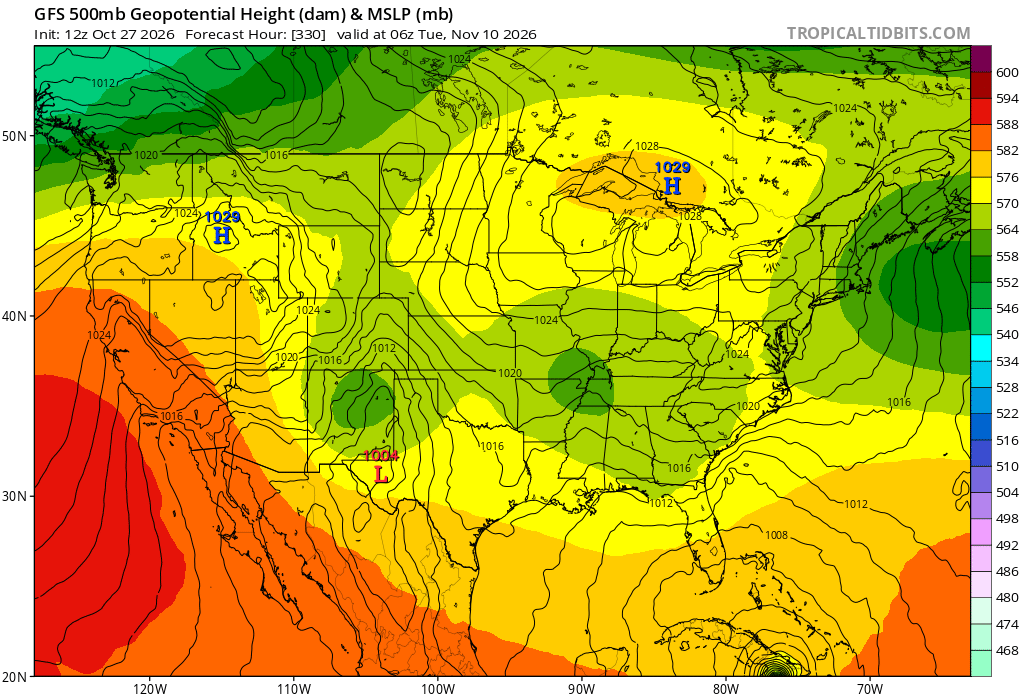
Yeah it’s basically a temporary spike producing a good Rockies ridge…not a classic full scale PNA ridge but eastern Rockies ridges have often produced excellent systems. That allows the shortwave to dig more and produce a coastal. We just don’t know quite yet where it
-
Is we back? February discussion thread
Boston Bulldog replied to mahk_webstah's topic in New England
Seen lots of “tenor” talk this year being used to project colder outcomes. Yes I think there is some credence to this year having a distinct trend of modeled ridging regimes getting muted, we’ve seen some gnarly looking torches (early January for example) get cut down into brief thaws and or mixed events. However, there is an additional “tenor” to this season that will likely lead to some SNE disappointment mid-to-late next week: overmodeled blocking and confluence in the medium range. We saw this on the 12/26-27 event, in which confluence remained strong but trended rapidly away from complete suppression in the final 36 hours until flakes started. We also saw blocking relax substantially from medium range projections for the mega-SWFE in January. In both of these cases, the majority of this forum’s SNE contingent benefitted. Even the colder storm during the muted warmup on 1/10-1/11 saw a bit of southerly pushing against confluence. The double barreled low pressure, which was destined to cut without high latitude help, pushed farther north in short range modeling. Despite salvaging the potential cutter 4-5 days out from verification, there was a slight boomeranging that occurred in the final 24-36 hours where confluence relaxed a bit. Thus substantial mixing was introduced into CNE and NNE regions that were previously supposed to remain frozen. It’s possible the midrange blocking relaxing slightly into the short range occurs again, the “tenor” of high amplitude blocks seem to be overmodeled this year. Of course, the implications are that warmth lifts farther north. NNE and CNE seem like a much better spot to be in right now for next week, despite some operational models (GFS) keeping them dry on the initial wave. -
Thanks, that helps a lot, i will certainly look into doing those 80s storms if they meet the benchmark/criteria i set which is at least 12"+ over a portion of the region (at least a county or so wide) May 18th, 2002 is there, just not in the main archive since it wasn't a 3"+ storm for CT/SNE/Tri-State (just a part of the berkshires) but it's in the SNE snowfall maps for that season (kinda wild how the worst season ever had the latest snowfall ever haha. Kinda like 19-20 here with that May 9th storm.) https://www.jdjweatherconsulting.com/sne-01-02 Oct 30th, 2020 is definitely there and in the main archive https://www.jdjweatherconsulting.com/oct-30-2020 There are many snowfall maps for each season in the SNE section that didn't make the main archive https://www.jdjweatherconsulting.com/snowfall-maps/sne-snowfall-maps
-
HRRR has a bit more. I agree with 1-3" for most
-
2026-2027 El Nino
donsutherland1 replied to Stormchaserchuck1's topic in Weather Forecasting and Discussion
CANSIPS's limitations notwithstanding, ENSO forecasting skill at this lead time is low, especially when it comes to ENSO region details. If some of the ENSO guidance is correct, an El Niño could develop during the summer. That might inhibit tropical cyclone activity during the peak of hurricane season. Given ENSO forecasting challenges at the current lead time, a shortened/below normal Atlantic tropical cyclone season is a possible scenario but not yet assured. It does seem that this scenario is probably somewhat more likely than a highly active season. MJO forecasting skill is limited beyond 7-10 days due to its chaotic and convective nature. Speculation about predominant MJO phases next winter is nothing more than a wild guess. There is no skill whatsoever. Further, geothermal activity has no impact on ocean-atmosphere coupling and the synoptic patterns that result from such coupling. In sum, his idea of a cold Winter 2026-2027, which can't be made skillfully at the present lead time, is based on speculative propositions (the predominant MJO state more than three seasons in advance and geothermal, which has no linkage to weather/climate). This does not mean that there can't be a cold winter, but the nature of next winter cannot be forecast with any skill right now. -
That timeframe has a signal from all the models. Brief spike in pna ridge ?
-
Euro and AI slightly bumped north 1-3 inches for the city
-
Euro skynet is a huge hit for Monday. Let’s hope it has a clue. It’s actually ok for the Friday system too. CT peeps get a bit on Wednesday.
-
3 months of 45° and rain incoming soon
-
Thanks, Charlie. Here’s Mike’s response to your reply: These people remind me of MAGA, seriously. It's complete fake climate crisis RELIGION. CO2 below 1,000 parts per million is a massively beneficial gas. To compare it to when CO2 was numerous times higher that this [sic] is a strawman attack (assigning a position that doesn't exist and attacking that position instead of the REAL one). And to keep projected CO2's increase for another 100 years and to keep insisting that the residence time for today's CO2 in the atmosphere is hundreds of years lacks critical thinking based just on how we watch it DROP during the Northern Hemisphere's growing season every year. Ignoring the fact that fossils fuels are finite and will be running out well before then and the chances of us ever getting over 900 ppm, the optimal level for life/plants/crops is minuscule. So what if CO2 was X thousands of parts per million in the past???? That is NOT what will be happening from CO2 increasing this time. The highest reasonable projection is still BELOW the optimal level of 900 ppm. Regarding all the articles from so called authorities that climate change is already cutting back on food production: 100% nonsense. It's the exact opposite. With crops, we can't tell how much impact is from CO2, climate/weather, genetics, fertilizers, use of pesticides/herbicides(technology). When you change numerous variables at the same time, like we do with crops, it's impossible to separate the impact from each one on the outcome. However, we have 2 ways to address that with OBJECTIVE data which clearly speaks for the impact of photosynthesis by itself and for photosynthesis +climate change. 1. The impact of JUST adding CO2 and not changing anything else: Here is irrefutable evidence using empirical data to show that the increase in CO2 is causing a huge increase in crop yields/world food production. We can separate the CO2 effect out from other factors effecting [sic] crops and plants with many thousands of studies that hold everything else constant, except CO2. Observing and documenting the results of experiments with elevated CO2 levels tell us what increasing CO2 does to many hundreds of plants. Here's how to access the empirical evidence/data from the site that has more of it than any other. Please go to this link: http://www.co2science.org/data/data.php 2. But other human factors impact soybeans, including climate change that we can't separate out. That's ok because we have something that looks almost exclusively at the increase in CO2 and climate change as the main factors. Planet earth has been a huge open air experiment the past XX years. The objective results are striking. The impacts have been mostly from changes in photosynthesis and changes in the climate. Carbon Dioxide Fertilization Greening Earth, Study Finds https://www.nasa.gov/technology/carbon-dioxide-fertilization-greening-earth-study-finds/ In addition: Earth greening mitigates hot temperature extremes despite the effect being dampened by rising CO2 https://www.sciencedirect.com/science/article/pii/S2590332223005584 ++++++++++++++ Importantly, the indisputable science tells us that increasing CO2 allows plants/crops to be more drought tolerant(not the other way around). The reason is that plants open their stomata to get CO2 and while doing so, they transpire(lose water from their roots that get it from the soil) As CO2 increases, the stomata don't need to open as wide and this REDUCES water loss from their roots. It's rock solid agronomy/plant science. CO2 Enrichment Improves Plant Water-Use Efficiency https://www.masterresource.org/carbon-dioxide/co2-increased-water-use-efficiency/ +++++++++++++++= Despite me just PROVING the points with indisputable science above, this is what the very predictable response will be from people that posted to you previously with the same response they gave the first time: "Those are denier sources" NASA's satellite study showing the greening of the planet obviously can't be put in that category but CO2 Science and Dr. Craig Idso, an elite authority on plants and the impact of CO2/climate change, has been labelled a denier. Never mind everything he shows is backed up with empirical data and rock solid scientific principles, which is why I use that source(as an atmospheric scientist for 44 years). If he or anybody else, including me, contradicts the mainstream view on the climate crisis.........they are discredited as deniers no matter us [sic] using 2+2=4 science to prove that 2+2 is not 5.
-
Sounds about right for SNE.
-
Well I’m coming back 2 weeks from tomorrow. Sounds like there’s time to evolve into a snowy and coldish pattern by then.
-
-
Ok, looked it over. I realize getting data for events long ago is not as easy, but here's a list of the "biggies" in the 80s (not that there were many!) that you could add when you have time. Dec 5-6. 1981 - big bust as the storm was fcst OTS April 6-7, 1982 - powder blizzard in April! Mar 29, 1984 - nasty wet paste bliz, among the worst power outages for SNE on record for a snowstorm, G108 mph MQE and tons of TS+ Jan 2, 1987 - the "syzygy storm" w/ big storm tides that breached the barrier island in Chatham Jan 22, 1987 - worst traffic gridlock in SNE since 1978 Jan 26, 1987 - Cape Cod bliz only #1 Feb 9-10, 1987 - Cape Cod bliz only #2 Apr 28-29, 1987 - poorly fcst late season crushing Nov 23, 1989 - big surprise Thanksgiving snowstorm Others: Feb 24-28, 1969 - "100 hr snowstorm" Jan 20, 1978 - bliz #1 w/ 24 hr snowfall record for BOS to date Dec 11-12, 1992 - the blockbuster that started the epic snow period 1992-93 to 2015-16 May 18, 2002 - latest accumulating snow on record for many locations in SNE Oct 30, 2020 - BOS biggest Oct snowstorm and also many other areas far E/SE MA
-
Yea, but I still want no part of that right now lol
-
Probably should be in banter bit can I put out pre emergent if I overseeded with winter rye. Warm season grass is Bermuda. Thought I read it would stunt the rye. Huge issue last year with grabgrass
-
Pd3. It's happening
-
39/rain at DCL.
-
How do you know?
-
Will parking be available?
-
Correct. It's around where the American Legion Bridge crosses the Potomac. The rafting and tubing companies will be fine, but I wouldn't want to be kayaking or paddleboarding in Georgetown...
-
CO2 is not “pollution” from my perspective. I never agreed with using that term for CO2 despite fully believing in AGW.
-