All Activity
- Past hour
-
Ladies and gentlemen: it’s pouring
-

-
Nice!!!!
-
Not too shabby. I think there's a lot of that going on along this line.
-
Trying wash the lawn away?
-
Poor bikers!( Motorcycle week)
-
From my phone…Sped it up 9x IMG_0609-ezgif.com-video-speed.mov
-
Good to see yall score. It’s warm but based on the short range guidance, I think rates will overcome and you should get some solid dynamic cooling from the top down.
-
Bring it to mama Sent from my SM-S921U using Tapatalk
-
Got to smell the rain again, and now the sun is out. Beginning to wonder if it will ever rain again
-
And no sensible weather
-
mi casa is where storms go to die, but it is eerily quiet out there right now after being pretty windy earlier. hatches are battened down just in case, and yes, I am trying my best to stay safe
-
Based on the radar signature earlier, that tracks.
-
-
Most of the time the outflow is the death kiss. lol..hope you get lucky though.
-
My temp is 13C/55F with a windchill of 11 at 3pm on June 18. Lake effect rains.
-
E PA/NJ/DE Summer 2026 Obs/Discussion
Albedoman replied to PhiEaglesfan712's topic in Philadelphia Region
Today's conditions are exactly why common sense needs to prevail when it comes to open burning. Frankly, a Wind Advisory should have been issued. We have strong southwest winds crossing the Blue Mountain ridge, critically dry vegetation, and a growing rainfall deficit. These are the types of conditions that can turn a routine burn pile into a fast-moving brush fire in minutes. What concerns me even more is not the immediate fire danger, but what these continued dry conditions mean for the long-term health of our water resources. The drought situation is becoming increasingly serious, and too many people are focused on brown lawns instead of the bigger picture. The Little Lehigh Creek is one of the most important cold-water fisheries in Pennsylvania. Its exceptional wild trout habitat is sustained almost entirely by groundwater discharge. Unlike streams that respond quickly to rainfall, the Little Lehigh depends on a healthy aquifer system maintaining adequate base flows year-round. When groundwater levels decline, streamflows decline. When streamflows decline, water temperatures rise. When water temperatures rise, trout populations and the entire aquatic ecosystem suffer. The importance of the Little Lehigh extends far beyond the Lehigh Valley. Anglers, conservationists, and outdoor enthusiasts travel from across Pennsylvania and neighboring states to fish its waters. It is recognized as one of the premier limestone trout streams in the Commonwealth and serves as an indicator of the health of the region's groundwater resources. If base flows continue to decline, the repercussions extend well beyond trout. Reduced groundwater discharge affects wetlands, springs, private wells, agricultural operations, public water supplies, and the overall ecological health of the watershed. Once groundwater levels drop significantly, recovery is often measured in months—not days or weeks. What is often overlooked is the direct connection between the Little Lehigh, the regional aquifer system, and the Lehigh Valley economy. Numerous industries depend on abundant, reliable groundwater supplies. Companies and facilities associated with Nestlé Waters, Coca-Cola bottling operations, Pepsi distribution and beverage facilities, Ocean Spray suppliers, regional breweries, food processors, pharmaceutical manufacturers, and countless other businesses throughout the Lehigh Valley all depend upon the same groundwater resources that ultimately sustain streamflows in the Little Lehigh and surrounding watersheds. A prolonged drought does not simply affect trout streams. It can result in mandatory conservation measures, restrictions on water withdrawals, increased pumping costs, reduced groundwater recharge, higher treatment expenses, and operational challenges for water-dependent industries. When water supplies become stressed, the economic impacts ripple throughout the region through higher costs, reduced production capacity, and increased pressure on both public and private water systems. This is not simply a local issue. The Little Lehigh watershed plays a critical role in supporting downstream water resources throughout eastern Pennsylvania. Healthy base flows help maintain water quality, aquatic habitat, groundwater recharge, and ecological stability across the broader Lehigh River system. At the same time, dry conditions dramatically increase wildfire risk. The combination of low fuel moisture, gusty southwest winds, and abundant dry vegetation creates conditions where a single escaped burn pile can threaten woodlands, homes, farms, and emergency responders. The larger concern is that the Little Lehigh is essentially a window into the health of the region's aquifer system. When sustained reductions in base flow occur, it is often an indication that groundwater reserves are under increasing stress. That should concern every resident, every farmer, every business owner, and every municipality that relies on those same groundwater resources. The Little Lehigh is not important simply because it is a trout stream. It is important because it is one of the best indicators of groundwater conditions in eastern Pennsylvania. The trout are merely the first to tell us there is a problem. Long before municipal wells begin showing stress, long before industries face water restrictions, and long before consumers see increased costs, the Little Lehigh starts sending warning signals through declining base flows and rising water temperatures. If the Little Lehigh were ever to experience a significant and sustained reduction in groundwater-fed flows, it would be a warning sign for everyone—from homeowners with private wells, to farmers irrigating crops, to municipalities supplying drinking water, to major employers and manufacturers throughout the Lehigh Valley. Drought is not just an inconvenience. It is a public safety issue, an environmental issue, and an economic issue. Every day without meaningful rainfall places additional stress on our groundwater reserves, our streams, our industries, and the ecosystems that depend on them. Until significant precipitation returns and streamflows recover, extreme caution is warranted. The consequences of continued drought and unnecessary burning extend far beyond any one property—they affect the water resources, economy, and environmental health of the entire region. -
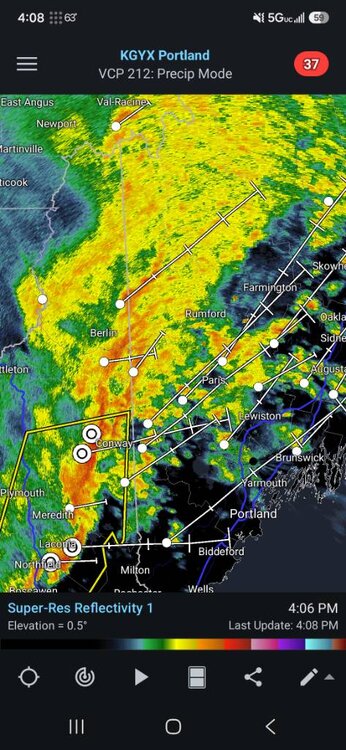
Looks like it had a brief blow up there on velocity before it weakened again. We tried to take out the Tilton Market Basket. Maybe next time
-
It was rotating.
-
Any more info?
-
Well that was interesting Keep an eye on that cell north of me downstream for a tor
-
Yeah, a near to record Great Lakes cutter for this time of year.
-
We just got hit with the outflow here hopefully our number is about to be called
-
Looks like it’s aiming for center Sanbornton. Probably won’t see too much on my cam. Feeling very safe.
-
This cam aims due N www.newenglandwx.com/northfield-nh/sky.jpg