
Typhoon Tip
-
Posts
44,869 -
Joined
-
Last visited
Content Type
Profiles
Blogs
Forums
American Weather
Media Demo
Store
Gallery
Everything posted by Typhoon Tip
-
-
Occasional Thoughts on Climate Change
Typhoon Tip replied to donsutherland1's topic in Climate Change
Mm... not going to defend that meme, no... however, it smacked me as more of the humorist voice - an attempt at sarcasm, perhaps sardonic giggles. I do that sometimes. I write something outlandish, with vivid descriptions of the physicality in dire consequences, over-the-top, as though people are in the room with me and can actually hear my tone of voice. Oops... It may be possible this was where he was coming from - if he had just said something like 'nyuk nyuk' on the end of it, you could hear that as Jay Leno-ism sarcastic barb -
Occasional Thoughts on Climate Change
Typhoon Tip replied to donsutherland1's topic in Climate Change
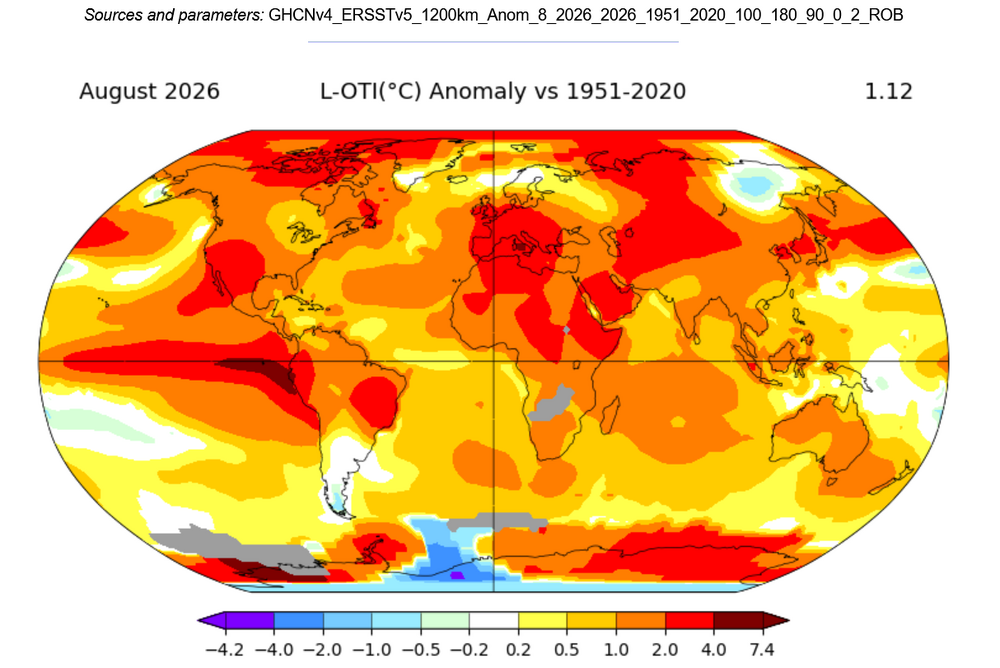
Thanks Don ( and forward TheClimateChanger ) What's disturbing about these kind of graphical results - which an observant sort may have noted over the years, they are not linearly rising, rather exponential - is that even if humanity's contribution to climate change were unrealistically ( impossible hypothetic state) suspended all at once, there seems to be a forgotten realization: The damage caused won't actually fully register for a number of decades. People don't realize just how dire this situation has become. The 2023 spring's ~ 1/2 a whole deg C leap in global wholesale systemic temperature, spanning mere months, evinces that there is a lag in the realization. People just stared at it. Moreover, the portions that are realized, ... are not always "catching up" in a kind, gentle administration. That proves they are unpredictable - otherwise, machine and man would have had a fucking clue that phenomenon was going to occur at all. That singular event should be vastly more alarming than humanity seems to have registered - evidenced be reactions et al. You just succeeded in moving an entire planetary system, a whole planet, ~ 4 orders of magnitude more thermal energy than if the entire world's nuclear armament were immediately expended. And really, the collective reaction so torpid argues that the en masse either doesn't respect, or cannot doesn't dimensionalize that significance for what it was. Either way, "life can't morally just go on as usual", yet it did and does, without the necessary imperative, much less very much if any reproach. So what happens over the next decade(s)? Humanity only sees the weather of the present era ... There's an overwhelming tendency to recency bias there. There's a stark failure to extrapolate/visualize what this sort of future will bring because ... as an aside, despite our innovation capacity, that capacity doesn't extend nearly as far into the realm of consequence. In fact, the reaction appears to be entirely guided by what can be actually seen - so is entirely recency bias. Humans won't act with any sense of imperative until that threat is appealing. Meanwhile, continuing to add to a system that has a built in time delay, because the oceans are 90% absorbing of the thermal imbalance created by the shock C02 and other green house gases the last 300 years of human activity has fluxed into the planetary system. Thereof is a calculation where that storage takes another 50+ years to recursively then find the longer term thermal equilibrium, in a truer ocean-atmospheric coupled state. One has to think of this as a built-in 'getting worse' factor - a scalar extent of which is completely unknown. But the specters of the last decade as any indicator? ...mm We can think of extrapolation thermal curves based upon varying exponentials... but, try extrapolating "phenomenological and/or consequence curves" themselves. None of which takes into consideration the "synergistic products" along the way.. Ironically, I happened across this article on Phys.org just this morning, "Future catastrophic weather could be 'far worse' than history suggests" ( https://phys.org/news/2026-09-future-catastrophic-weather-worse-history.html ) ..perhaps apropos -
Occasional Thoughts on Climate Change
Typhoon Tip replied to donsutherland1's topic in Climate Change
the partial right amount is precisely = to the amount that is doubted -
Septorcher 2026 Discussion - Endless Summer
Typhoon Tip replied to Damage In Tolland's topic in New England
The Euro's dystopian for the MA in that time range. Worthy of a "wow" if it were not for the fact that neither solution will be there on the next run cycle from this range.. -
Septorcher 2026 Discussion - Endless Summer
Typhoon Tip replied to Damage In Tolland's topic in New England
i think that's in AMS' official glossary, yeah... 5 = torch -
Septorcher 2026 Discussion - Endless Summer
Typhoon Tip replied to Damage In Tolland's topic in New England
We know this ... but just in case. The idea that acorns can predict a wet warm or snowy cold winter has very low or no skill as a forecasting metric. Years with perceived surpluses of acorns have nothing to do with ensuing seasonality. According to all science/peer reviewal, those were influenced/triggered by past environmental factors - so yeah... , it was cold and snowy last year. or warm and wet... which ever. tell us what we already know. but obviously... we are so fantastically bored - -
One aspect that lurks that I'd be careful to mention is that single event results tend to exceed QPF at an observably increasing frequency over recent decades ... I feel this needs to be a bullet point in seasonal forecasting summaries. Don't linger on it per se. Just a mention is needed. this is already papered/correlated to increased ambient WV in the overall machinery of the planet. There appears to be a synergistic phenomenology - handsome words to say that when we are raining or snowing or sleeting or hailing or whatever, when doing so through higher WV mass, favors "positive busts" The models seem to be physically challenged in this area, too - although I don't mean to claim that is true. Just that I keep seeing real events where 30" of rain in 24 hours falls and models might have had an "eye-popping" foot of rain as it is. Heh, it is almost as though eye-popping is a warming that there a GOATie uh oh'er a-comin' I was just thinking that in a year that may be a shitty wet warm one, a single snower could be something truly short duration historic. Like shock and awe given that scale/degree of ENSO plausibly feeding two sources of WV+: the ENSO itself, together with the ambient argument. That's like synergy, then synergizing yet further, in a single event that happened to roll a 7 cold enough airmass at the right time. A couple of storms like this and we have an average snow year ...when the real story ends up being the flooding next March. LOL 63" of blue snow at ORH and National Guard only reserved for Science Fiction, right? I mean that's rhetoric for fun there... but think back to December 23 1997. The day before that happened, the then 'ETA' ( grandfather to the soon-to-be made extinct blood lined NAM) model had something like .6" of total QPF at Logan, in a sounding that was -3 at 800, 0 and 900, and +2 mid way up the Pru' tower altitude. Very little or no QPF at ALB, which was colder... Now, the forecast was probably in error anyway. It was 1-3" of transparent glop for the Worcester Hills, to raining a cat paw or two down town Boston... I Emailed Harvey and thought that was too wet. I was not right enough! Because 20" of snow later, an amount that fell in 5 hours, pretty much herald in the era of choke snow deposition rates... I had seen and heard of 3 and even an unimaginable 4" in a single hour though rarely. Not a 7, book-ended by a couple of 5s! These types of events have been occurring world over, too. Rain or snow, with increasing frequency since the late 1990s. That ENSO that year ... mm seems like a climo revolving door sometimes to me.
-
Occasional Thoughts on Climate Change
Typhoon Tip replied to donsutherland1's topic in Climate Change
I know ... and it smacks like a bit of a synergistic feedback/resonance connect(able) to the ID CGT correlating to ridging there. That area "wants to ridge"as the basal westerlies goes up and over the western continental terrain expanse. As the westerlies incur and then have to rise up and over the western continental topography; then, the Coriolis necessarily applies... bends to the N... The flow then flattens down as it exits the continent/E. The result casts an allusion to low amplitude ridge axis roughly collocated with the Continental Divide, but it's physical emerge isn't the same as barotropic/thermodynamic feature. Rather is land/air in origin. And is thus a circumstance that is perpetual - so long as the land forces the westerlies up and over. Such that before applying any other factor/consideration... there's a tendency. But then superimposing... there is constructive feedback suggested by the negative mode of ID CGT - a correlation that is sending a complementary ridge signal to that same longitude. This isn't the first year I've noticed heat/hot patternization being stolen back west at a continental scale - even premature of forecast timing/expectation. The harmonic feedback causes a bit of an exaggerated bias over the climatology base described by the terrain argument. It began some 15 (or so) years ago, and well... it turns out that's about when the IA CGT began to observably preference an ~ 1/4 retrograde position with respect to canonical spatial-climate orientation ( Rossby waves). This longer term bias is exposed through the inter-decadal version of that teleconnector ( ID CGT). Kind of like the 22 years vs the 11 year solar cycles ( analogy...) The ID CGT is a newer version of the global spatial scaled circum-global teleconnector ... particularly notable in summers. I frankly see/sense something like this as being useful in winter, though. I suggest it is related to why SE Canada/NE and the Maritime of Canada have been biasing negative temp results, relative to the whole (in other words, these regions may be warm but lag in averages comparatively ), regardless of season. Not all months.. ~ 2/3 since 2000. I strongly believe whatever global forcing is responsible for moving the ID CGT is also causing height biases W on top of the 'terrain bulge'. Then the wave mechanics/mass balancing causes a downstream eastern continental behavior to calve backwards (NW) which shears heat from getting to Boston/limits duration. Thing is, we're still going to be 82.9 on day when climo is 82.1 ... so we're technically above normal. But the counter to this, in the W and SW ... seems to be an exponential gain. -
Occasional Thoughts on Climate Change
Typhoon Tip replied to donsutherland1's topic in Climate Change
This is an 'Andy Rooney': Not sure what the preoccupation for defining the culpability pie slices is all about in baking the end of the world. It's also perfunctory that nature provides cataclysms - yeah. okay. 'why are you telling us this' like it's novel? It seems attempting to dole out blame as being less because of anthropomorphic forcing is like seeking permission to keep doing it. The role of humanity is actively problematic to the world. That still exists, either way. - as an aside... there is an apparent lack of applied physical science backgrounds that echoes in the way voices are sounding off. It's coming across as regurgitated skepticism from other sources, those that push backs against human caused environmental urgency in a way that is fairly obviously rooted in agenda, at best sketchy motivated - Increasing melt water destabilizes land... that's just perfunctory. All this stuff about needing research isn't actually necessary because of that factored reality; that is already known. The amount of x-y-z should be less meaningful if you helped the killer aim the gun. Your contribution is not 0. At some point, that which is known needs to be applied as a common sense approach - otherwise you're waiting around to reinvent the wheel every time you have to jump in the care to go for a ride. You're not doing that - right? No need to prove melt water, plied to a bedrock - when it was visibly doing so - is going to cause a reaction. It's also a bad term, bed'rock' - when the generic ear hears bedrock ... they hear rock. Like a solid impenetrable igneous or granite-like substance. It's more like compact sedimentary deposits covered over by other regolith-ice composites that were the destabilizing aspects. Also, cracking deeper is perfunctory in repeating thaw and freezes, an oscillation of phase change forces that have been incurring with greater frequency over recent decades. All of this is not debatable. And as that has occurred post antecedent and ongoing concurrent warmer than normal setting that is heavily correlated already to CC breaching the high country up there... I don't believe your going to get a really 'in depth' report any more than than you would over whether wheels are round. stop this. Again, what is the purpose... this latter aspect is still happening, and since the variable cites fit it 100%, there's no use - humanity does not escape culpability. -
Occasional Thoughts on Climate Change
Typhoon Tip replied to donsutherland1's topic in Climate Change
Of course it did there was never any debate by anyone not either deluded or immoral - pick -
Septorcher 2026 Discussion - Endless Summer
Typhoon Tip replied to Damage In Tolland's topic in New England
Yet KFIT was 57 on the low ( +6 ), and 73 on the high (-1 ), for a net diurnal +2.5 (any rounding trickery notwithstanding) The Thornburgh effect - ...we'll see what happens before midnight for the low T but ... heh, see how CC works class ? you're only programmed to think this is below normal -
Septorcher 2026 Discussion - Endless Summer
Typhoon Tip replied to Damage In Tolland's topic in New England
Folks would be wise to architect winter expectations around higher than normal precipitation, only. Leave snow out of it. Too many reasons to go liquid rather than frozen. -
2026-2027 Record-breaking El Nino
Typhoon Tip replied to Stormchaserchuck1's topic in Weather Forecasting and Discussion
It's interesting that while this is observably weighted E ... the 3.4 is historically high. -
Occasional Thoughts on Climate Change
Typhoon Tip replied to donsutherland1's topic in Climate Change
"Global warming doesn’t cause bedrock to buckle...." whaaaat, um, no. I mean I realize you're asking Don but I could help my self. Just in brief and off the top of the head, there are three easy aspects in how CC may both directly and indirectly factor. 1, glacial rebound. 2, liquid water fluxing 3, bedrock? With rebound, that happens because if land spends multiple multiple Millennia in a stable/colder climate regime, the ice accumulation weighs down. This gravitational anomaly supplies a constant pressure downward into the undergirding and surrounding bedrock. Over time ...succumbs by sinking. Remove the ice, the land may rebound... upward. And it doesn't do so according to any necessary ease. It tends to do so in jolts felt as tremors. With increasing melt ( liquid flux) the basal water may enter ground; in CC, the warming summer means this quantity is rising. Over decades, repetitious freezing and thawing literally cracks the Earth due to phase change expansion(contraction). How much so notwithstanding. But this is a weakening implication in the integrity of the supporting geology beneath the overriding ice - failure ( land slide) results. These two also work together. In fact, #2 actually happens first, then... #1 tremor triggers the landslide. Whether these factors were in play in the higher terrain/alpine region of Nepal, I am not claiming so.. But Mr Martz makes a blanket all preclusive statement that is epistemically false. Beyond these two, the third relates to, what officiating/reviewed source said or analyzed and proved that "bedrock" indeed failed? It is possible that the undergirding was actually a strata of compressed glacial deposits mixed with icy compressed rubble. An avalanche was inevitable - probably so, anyway, but if this was the type of supporting foundation beneath the overcasting of ice weight ( which itself was calving the leading segments), then the whole structure probably would not need to wait for the geological time for #1 and #2 to work together. -
Occasional Thoughts on Climate Change
Typhoon Tip replied to donsutherland1's topic in Climate Change
Slowly turnin' the fire up under the toads -
Septorcher 2026 Discussion - Endless Summer
Typhoon Tip replied to Damage In Tolland's topic in New England
looks like an April -NAO retrograde jet coming from the NE too -
2026-2027 Record-breaking El Nino
Typhoon Tip replied to Stormchaserchuck1's topic in Weather Forecasting and Discussion
Definitely the rub ... whether ENSO is related or not, that 'bleeding into AK' is often a torpedo, and it's useful to note too because the model handling of the GOA is idiosyncratic; it's positive or negative interference in the actual state sends mid and extended range error. Smaller GOA errors in position seems toward a higher sensitive and a larger total response in whether cold conveyors orient more S or ... more importantly for cold/winter enthusiasts, deflects more E across the Canadian northern tier - regardless of CPF of or not. The latter aspect of La Nina hangover episodes is interesting, though. The whole RONI aspect is also relevant here. -
2026-2027 Record-breaking El Nino
Typhoon Tip replied to Stormchaserchuck1's topic in Weather Forecasting and Discussion
To imagine that careening into the STJ over Texas, huh ho man -
2026-2027 Record-breaking El Nino
Typhoon Tip replied to Stormchaserchuck1's topic in Weather Forecasting and Discussion
Not part of the conversation's immediate history here but... the EPO and PNA can sometimes be in the -EPO/+PNA tandem. When extreme enough, and fully physically realized on the actual hemispheric synoptic layout out, this results in the "cross polar flow" type. This is synonymous with a deep layer cold conveyor that patterns from Siberia, across the (pre-CC explosion era) frozen expanse Arctic Ocean, down over and usually E of the Canadian Rockies ... into the NP and ultimately frosting oranges in Florida. It's important to context that the longer term moment correlation between these indices is actually modestly positive. So having a tandem -EPO/+PNA should be rarer than the means, and well ... we don't actually observe a bona fide Cross Polar Flow set up so often and there we go... As an aside, when time lags are applied to the indices, I'm not sure ( though suspect it is so - ) if there is a better negative correlation that is exposed. Because I have observed countless times over 30 years of this crap, a -EPO --> +PNA over an ~ 3-5 day lapse. A time in which the EPO relaxes back to neutral aft of a +d(PNA). It gives the allusion if not physical exposure of a planetary wave roll out of the N. Pacific. This is not the same as cross polar flow. More like a "relay". It's the more common type and regulates the periodicity of cold loading events into Canada. For regions between the NP/GL-NE drape, the difference between a CPF hemisphere, vs this latter delivery, is probably less than meaningfully different - both showcase someone heaving a boiling cup of water to demo saturation vapor pressure causing half of it to explode into vapor, while the other half rings to the ground like shattered stemware. Maybe the CPF is 7 deg colder in the core of the cold extreme or something but below -10 F either way, wtf cares... Just sayn' ... -
Septorcher 2026 Discussion - Endless Summer
Typhoon Tip replied to Damage In Tolland's topic in New England
(psst startin to think 'people of earth, get a new planet') -
Septorcher 2026 Discussion - Endless Summer
Typhoon Tip replied to Damage In Tolland's topic in New England
Actually yeah... can almost see a pathway to improvement - yup, right when I f'n clicked Submit Reply. Told ya The visible loop now better exposes that there are two main ceiling layers. The higher one is moving exceptionally fast for this time of year... That's another thing. wow. Perceived 'back edge' moved from near Syracuse NY at dawn, to almost Albany in 1.5 hours. Some 150 miles ? that's 100mph. That seems a bit fast for September 1? more like a flat flow in winter thing. interesting. Anyway, depending on the underwear in this scenario...as the upper peals away here over the next couple of hours we'll see how much grunge lingers frumunda - -
Septorcher 2026 Discussion - Endless Summer
Typhoon Tip replied to Damage In Tolland's topic in New England
I only glanced at the NAM so probably low scoring anyway, but the front appears behind schedule relative to what I saw. Supposed to be thru the region far enough to improve skies and elevate temperatures all the way to Logan by 2pm. Looking at morning satellite, doesn't lend much confidence of those two metrics laying into the area, huh. I'm routinely wrong in this morning arm chair analysis shit, though. I always see them pessimistically and then usually ... the moment I click 'Submit Reply' it was as though the button really said should, 'Clear skies and warm up anyway' hidden from me. So we'll see. -
Septorcher 2026 Discussion - Endless Summer
Typhoon Tip replied to Damage In Tolland's topic in New England
It seems NE of New York City this summer ... we rain just fine synoptically, as we've had three definitive events each raining pan-regionally 1.5 to 3" ( yes with some exceptions in either direction). Anything remotely related to convection has resulted in either less, or not at all...depending on one's specific location. This is just going from memory and being a weather dweeb and always paying attention to what's going on.. so, taken fwiw I have only had one direct thunderstorm at my location. It occurred when I was away on vacation. Otherwise, ...nadda. I realize this region of the continent does appear challenged for convection - certainly there is a grousing/commiserating support group mentality going on in this social media over the matter ( jesus -). But relative to our climatology, nadda is an exceptionally low result even for SNE summer - both by numbers and anecdotally. I can honestly say, I've never seen that in the 45 years I've been a New Englander. I actually have a high confidence understanding as to why this took place, but if the orbit of the moon is the extent of the average reader's attention span or even will to use the energy to read in here, the former explanation unfortunately requires the orbit of Pluto ... so - -
Septorcher 2026 Discussion - Endless Summer
Typhoon Tip replied to Damage In Tolland's topic in New England
In October today would be +10