Typhoon Tip
-
Posts
44,871 -
Joined
-
Last visited
Content Type
Profiles
Blogs
Forums
American Weather
Media Demo
Store
Gallery
Everything posted by Typhoon Tip
-
Occasional Thoughts on Climate Change
Typhoon Tip replied to donsutherland1's topic in Climate Change
I didn't shift anything. Nor have I been in your debate, guy - merely made the observation that people have different ideas on the nature of what a existential threat is - time and imminence being a part of that. By the way, you are factually wrong much of the time. "- it has very much *not* been due to global warming; " garbage semantics. Climate-related die-offs are happening now. If you want to dodge acknowledgement by saying they’re not all caused by climate change alone that's elementary anyway, but doesn't work to abase the former. I also said the toxicity ( meaning pollution) plays a roll. Either way, this can and should all be under anthropomorphic activity. That's not 'goal posts', that's intelligence. It is divisive to attempt to do otherwise, that or ignorance, anyway, because the use of fossil fuels for combustion creates toxicity, in conjunction green-housing... But as far as temperature specifically, a clear current example is coral reefs: NOAA reports that the fourth global coral bleaching event affected about 84.4% of the world’s coral reef area with bleaching-level heat stress between January 2023 and September 2025. Plus, I spoke of diasporas in that, too - which is species migrations... which is evidentiary supporting the same notion. There's plenty of others, and I'm not going to do the petty low-brow game of citing them for you - go do the research. More broadly, warming and extreme weather are already affecting wildlife and this is just flat empirical fact. Habitat loss, disease, and other pressures are scienced and heavily papered. -
Occasional Thoughts on Climate Change
Typhoon Tip replied to donsutherland1's topic in Climate Change
...there's also a moral consideration... It's one thing to be a hunter, with a gun or arrow ... traipsing through the bush stalking stock for the winter. Not to sound too 'out there' but to for brevity, "Gaia" set that table of predator-prey relationship since the beginnings of life some billions of years ago. Obliviously swiping ecologies clean from a smoke stack 10,000 miles away ... I'll tell ya, at a minimum that's an interesting philosophy for the process of global Darwinism. you know? strong survive and so forth. It just seems, however, that's an overstep on "evolution's intent" - poetically... who deserves reprisal? How's that for a creepy prelude. haha Anyway, an "existential crisis" should include all species of the planetary system, not just human kind. Particularly considering ... the holistic system ..."Gaia" or whatever you wanna call it, has to be healthy if and when our technology can't keep up if/when our own adaptation rate is being tested. The world is experiencing a mass die off, and it is inextricably connected to CC. Anthropomorphic culpability in that die-off is, in a clinical sense, an incredible achievement by the machinery of Darwinian heh... It smacks of that stuff about how technological feedback creates a paradox, 'Evolution evolves the means to de-evolve the progenitor to the previous state'. Basically, tech makes survival easy; "easy" stops Darwinism; traits dissolve away because nature never holds onto attributes - entropy ensures decay. That's at least one plausible explanation for Fermi's Paradox right there. I'm sure there's more direct means ...like, species A can't survive their technological infancy before blowing themselves to kingdom come ... If we survive the dad's gun scenario, we have this slow cook Law of Lessening Returns. CC and the perils in store ... it reminds me of that "Star Trek: Next Generation" episode, "The Ensigns of Command". In that episode, a kind of xenophobic alien antagonist species known as "Sheliak" claim rights to a planetary system where several generations of colonist had adapted and were surviving - naturally ... not wanting to yield to the Sheliak's demand. Meanwhile, the Sheliak make it clear they would be willing to exterminate the "infestation", apparently having no compunctions in doing so... The colonist have technology, but they are vastly inferior, as well, had been completely closed off from the Federation for over a hundred years, and therefore, had sort of devolved to this incredulous state ... Implicit in the plot is that they can't see the Sheliak threat so they don't believe it to be what it is purported to be in lieu of the majesty they can see, which is their proud achievement as a surviving colony. The episode is a Sci Fi story exploring sociological aspects - really quite fascinating. "Data" ( Brent Spiner), essentially a cyborg life form, was the only crew member that could withstand the "hyperonic" ( whatever that is/means) radiation the colonists themselves learned to adapt to, so he, being the less human of lot is naturally charged with the responsibility of exposing and convincing these people, first hand, of the existential threat the Sheliak impose... Things aren't going so well. He is even violently opposed to for his typical ingratiating uber polite methodical approach and efforts... But the true hero is a sympathizer and realist member of the colony that restores him from a 'shut off' state, just in time! He rises to demo the Sheliak's ability, first hand, by destroying the aqueduct that feeds the colony by use of his modified phaser. Heh, everything in Start Trek is always solved by phasers or triquarters. Stunned by the power of what the phaser did, Data seizes the moment and tells them that the Sheliak will obliterate them from space, 'Without you ever having seen the faces of your annihilators'. In other words, tell a human they are in danger, they'll look around and float trial balloons. If they see it happening, they get out of the way. At last, the colonists acquiesce. I find all that strikingly metaphoric where, just because humanity cannot real see, feel or sense the danger of CC directly, they are more than willing to deny the peril of it as being real. -
Occasional Thoughts on Climate Change
Typhoon Tip replied to donsutherland1's topic in Climate Change
If someone is distorting, or attempting to alter an understanding of reality, that is “demagoguery” or gaslighting. The data that is real and empirical does not support a grand CC conspiracy to fabricate a climate crisis to jump in bed with macro-economics required to rewire the world around a green infrastructure, though... The following does not support the first sentence above. Glaciers melted... Seas already rising ... Global temperatures exceed previous record along a contiguously accelerating curve ... Species dying off or in states of diaspora due to lacking the ability to adapt at a pace their habitats are forcibly changing ... Math and physics demonstrating that these should exactly happen - and here we are... This compendium of objective realities does not suggest a grand CC conspiracy. They suggest CC. Period. -
Occasional Thoughts on Climate Change
Typhoon Tip replied to donsutherland1's topic in Climate Change
The reality vs mere notion of an 'existential crisis' is more debatable than a bullet point. No question.... With the ambrosia of empirical data that points to a crisis, a crisis that is geophysically determined by taking said data and implementing in physical/mathematical laws of nature ... no one can say there is no existential crisis with any assurance - in fact, quite the contrary. However, one may personally define crisis differently than the next person. Define crisis: is there a false dawn at the 3am as a fiery wall is imminently cresting the horizon in 20 minutes? No are we in a proven multi-species die off that is presently being considered a mass extinction event ? Yes The problem with acknowledging the latter is in part misrepresentation. That's the problem with "any" misrepresentation - however... I would argue that there are those choosing the wrong information to be true relative to that uncertainty. Because in the whole of it, there is both truth and falsity. People could and should choose information based upon some ability to objectively filtrate either content - As an aside ... there's also a gleaming logical flaw in denialism. If the price of denying is death... why take the risk? You cannot circumstantially be more certain in your denial than is the science in the other direction. So the cost of doing nothing, for what? so we don't have to change... It baffles the mind that this is a position at all. -
Occasional Thoughts on Climate Change
Typhoon Tip replied to donsutherland1's topic in Climate Change
https://phys.org/news/2026-10-countries-vulnerable-fossil-fuel-phaseout.html seein' as y'all arguin' about it. Apropos timing from Potsdam Institute for Climate Impact Research (PIK) ... -
Get used to cold solutions, correcting warmer passing through the mid ranges
-
You may have already observed that correlation
-
Mentioned yesterday or the day before .. I was suss about that magnitude. Seriously not being a dick but the reason that's important is because the models have a bias in amplitude with that type of wave space/propagation. It's doing it already ...what's happening in winter - Not sure if it is a specific model bias because they all seem to do this. Probably it's just chaos load balancing, in that they don't see the permutations of the future, so all they physically end up with out in time is a purified field of just a shorter logistic of events in handling. But in reality ...all those future distractions will be there eroding - i mean it's the only logic i can come up with that starts to explain that all but completely dependable bullshit amplitude bias at that mid/ext range
-
Occasional Thoughts on Climate Change
Typhoon Tip replied to donsutherland1's topic in Climate Change
Plus... if fossil fuel really is that impossible to get away from then we are assured of two world destinies: an ontological death an actual die-off I suspect though that folks just enjoy the sport of the argument...? fine. But while that ball-game is being played, those overarching ultimatums are objectively looming. In other words, do it! tough shit. But of course, the problem with that is that people do not believe that the proverbial pistol is actually pointed at the head. For the rest, look ... no one is insinuating any of this is going to be easy. It is going to be hard, very hard. In fact, so much so that it is of higher likelihood that humanity won't be able to get off the oil-heroin without transferring violent withdraw frustrations, unilaterally. That's rhetorical euphemism for destructive conflicts. I just wanna point out couple aspects for muse/thought: The first is ... the problem with Global Warming is not warming of the globe. That was a mistake of the early science ambit when this issue of humanity's industrial flatulence become abundantly clear to the very small population that is really even capable of understanding the future peril. When that become obvious to those that know, the 99.9999999% of the world that finds all this "math" as mentally untenable, simply were ill-equipped so... denial was going to be inevitable after sociological forces worked it over. The way GW should have been exposed was to say - it's species adaptation rate, more importantly .... being slower than the changes to the environments within which they were evolved prior to the arrival anthropomorphic forcing. Resources become challenged ? But that's a separate issue... We are inexorably dependent upon the interconnected species of the global "Gaia" - for lack of better word. When those relationships sever - because keystone bacteria ...say etc...- undermines the foundation of food and resource pyramids... tick tick tick The 2nd is that innovation in our species as tool makers has outpaced the normal checks-n-balances that intertwine use with the surrounding ecology. There are probably better ways to formulate that sentence/phrase out that sentiment, relative to the reader's comprehension, in hopes that they really understand what is trying to be conveyed. Look at it this way... in the Darwinian machinery, all other species mutate enough to survive, and those mutations thus live on so that the next generation has that ability built in. Human have a unique power, to innovate beyond that species requirement. If you sum-up the quotient that is over the top of the species basal requirement, that surplus is probably 1::1 equal with problems that are being defined. I've been saying for years that the moment in antiquity that the early hominid picked up the burning stick, we were doomed. It was just a matter thousands of years... a time span - by the way - that is an instant cataclysm relative to the geological ages. At a minimum, that same mutation, innovation, will have to become our savior. -
it's probably underdone. these types of science -based studies result in estimates. Sophisticated as they may be compared to oh say ..., Kevin-types and their brilliant objective-based illustrations of what is going to happen to trees and building and stuff... , they are still based upon more linearly algebraic resolutions using available/reanalaytic metrical inputs. what they don't include are the synergistic products of complex higher order energetic systems. one question that immediately leaps to mind for me is the 'domino effect' thereof. You get to a certain pervasive failure quotient and the weight just topples everything. We actually observed something similar to this during the 2008 ice storm up there in N Worcester and Middlesex Co. The margin towns that didn't record any icing, or if so... limited amounts, lost power by load balancing when substations reeled - often times safety measures built in cut regional grids... This is particularly true in tangled messes of major events where regions are a labyrinth of partially mixed with total and non disrupted messes. Everyone goes down in that region... I'm sure their science takes that into consideration, but when events get in that GOAT range ... which comparing to 1938, heh ... there's almost always unexpected emergent properties.
-
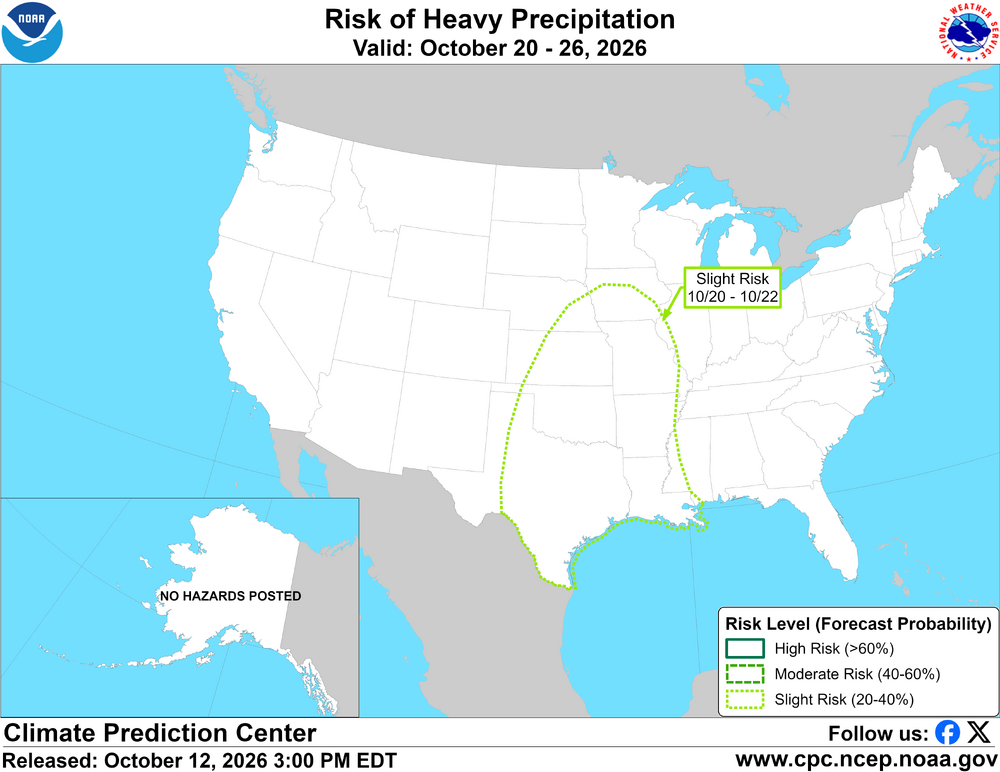
First El NINO -related risk event of the season ?
-
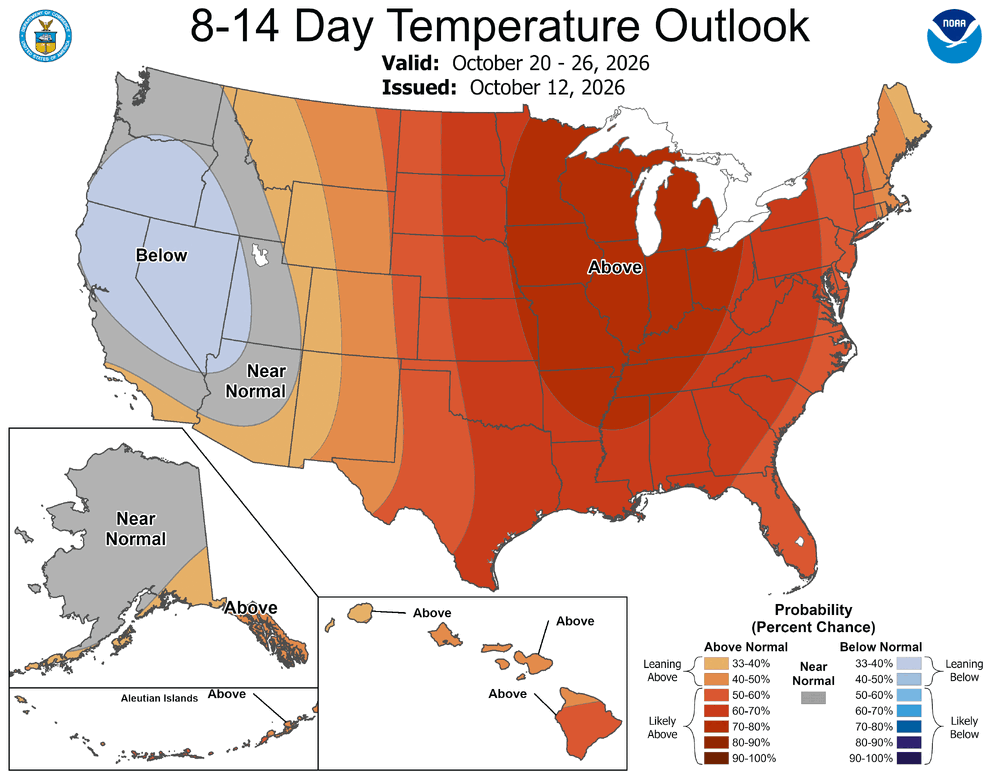
Oh great ... instead of early season snow chance(s), the last half of the month is way better with higher chances for 59 F mist instead
-
come to think about it ... sudden potent short duration events have also been increasing in frequency every time Gretta sneezes so heh
-
i'm always a little suss about those fast moving cold slicing waves like that. often enough they prove to have been over amplified. but like Scott just noted ... the ambient polar boundary appears to be gradient saturated so maybe this time we'll yo-yo 36 deg spanning 30 hours.
-
Hell ... gon' be Georgian climate in a couple o coffee breaks so may as well get ahead of the investment curve.
-
what a day. 73 no wind tolerable RH and at least some feeble warmth value still to the sun. top 10er actually -
-
Occasional Thoughts on Climate Change
Typhoon Tip replied to donsutherland1's topic in Climate Change
https://phys.org/news/2026-10-climate-fingerprints-reveal-stronger-evidence.html -
Occasional Thoughts on Climate Change
Typhoon Tip replied to donsutherland1's topic in Climate Change
We should bear in mind that as of 2023, if we consider all transport vs the total of all of the industrialized world, fossil fuels is a lot less than that used to power industrialized civilization. Yeah, EV will shorten the car/light truck load, but seeing as some 70 or so % of fossil fuel energy consumption is outside of the transportation sector, and 70 % is still above what is the geophysical harm threshold... bigger eggs to fry. It's not hurting, no - I read that a long while ago. I ran this inquiry past Luna/AI and it's still the case per Stanford studies. Industry, et all, is the bigger problem in the carbon footprint of humanity. The same Luna Q/A resulted in this as far EV offsetting ... "Using 2024, the best-supported estimate is roughly 60%: about 17 million electric cars, plus roughly 1 million electric light commercial vehicles, out of a total near 29 million electric road vehicles when electric two- and three-wheelers, buses, and trucks are included. " That's A B, the surge in EV is notable, but has a long way to go. For the sake of morality and virtuosity, a surge may be an indicator of shitting attitudes and acknowledgements ... may be. It would need more sociological/geo-political type review of course. But even so, considering current on the road usage were a small minority as recent as 2024. We'll see if a surge closes the gap very much but it had a long way to go. By early 2025 only about 4% of the world’s passenger vehicles. So good (possible) indicator of an awakening state; vastly insufficient. Based on all this, I would be surprised if oil spike shifts lower based upon EV surging. Obviously it would effect the curve some small amount... What is needed to turn the curve down is forcing humanity to objectively acknowledge that CC is tantamount to the stench of shitting on their own dinner table - metaphor. -
whatever that was or wasn't, okay. but that above is probably a record challenging warm blast clear to moose dung
-
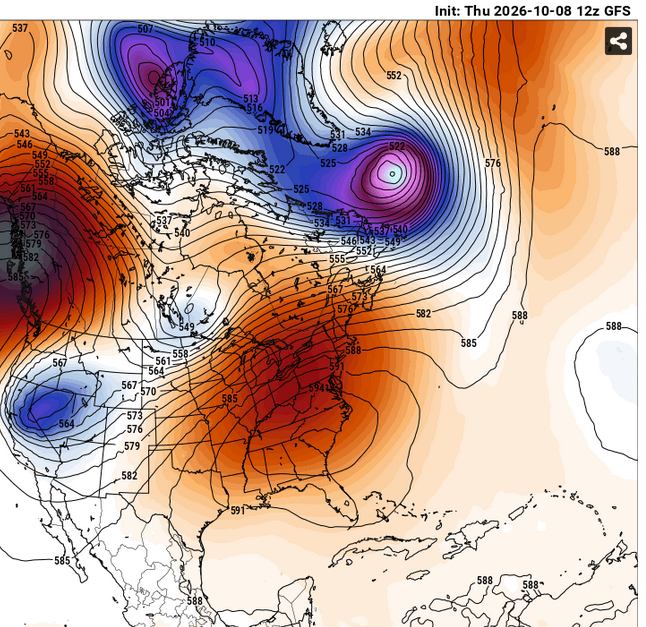
heh... in and of itself this is rather impressive for a week from tomorrow
-
Heh...going below average is a low probability choice - per both epistemic to climatology, but then physically substantiated by empirical/objective data results over recent decade(s). There is questions about the nocturnal temperature behaviors. Yes. They tend to own our departure weight - why so is a matter of ongoing science. Probably just water vapor logistics and the fact that our region is basically the asshole of the continent. Daytime recoveries are where we are being enabled from having to admit certain things. We just don't get as hot as we could have in most circumstances. ... Countless times since 2000, all signals modeled argued for warmer results from synoptic air masses, but then what really happened was a poorly predicted cloud/ceiling, and/or precipitation timing that forced an offset. The end result was more like 'colder relative to the recent mode' while not really being colder than 30-year norms. But, also lagging our common experience behind the rest of the world... Then we do get a below normal pop here and there... but if we get it, there is an under the radar sort of behavior note on all of them that they don't last. In the 1980s... a massive arctic intrusion would happen, then it would take 7 to 10 days to recover to normal. Now, we get Feb 2021ers where it is -9 F at 1pm with 22 mph wind gust, and just two days later ... it's 40 and above normal. Then it is 40 for 5 days significantly offsetting if not erasing the deep incursion event entirely. Climatology as moving goal post is a facet that apparently most acknowledge but I sense not enough use or allow to modulate impressions of the future. So the crowd and consensuses tend more so than not, to sag below the result curve. I see that from just about every source... I read qualifiers like, ' aware of this and that regarding climate'. Then my internal monologue interrupts that reading voice with, 'but if that's true it would be unwise to think the proceeding' so it's not clear the +delta aspect of the climate system et al is sufficiently modulating - this is evidence spanning all of society - not just in here. No one's getting singled out...
-
Tomorrow's sounding is interesting meteorologically ... which means nothing to a snow-obsessed, dystopian d-drip seeking audience but it is what it is... This is the first time I've seen the 900 to 800 mb layer be that cool modeled so far this autumn, but the wind being W and paralleling the hydrostatic thickness contours, that means zip actual CAA. So, the west wind is sourcing from a mild region and albeit feebler sun work to offset about evenly. We just end up with -2 at 800 mb over a milder llv ... steepened the lapse rate.. Probably will cause gustier chop to the wind. 2 meter's possibly approaching 20 C though, and above normal.
-
It skewers into their ...phew, winter's here now take on reality
-

-
It's a silly semantic thing. Probably. altho, some may think it actually means something. If the charts look like a low or 41, yet it bottoms 31 at climo holes and the like, those results are disassociated local feedbacks that don't represent the qualitative state of the whole. ... interpreted as "it's not 'posed to be that cold" -almost imagine a tone there that something's unfair. ha Radiational cooling is modified by local feedback phenomenon. But the nature of what that does/is, it is disassociated from the larger expectation - the latter being some combination/weighted seasonality vs synoptics. A product that is evinced by the fact that here we are at 11am and it's 57 unilaterally even where it was 31 - an example. Objective reality: it is both 31 and cold, while being in a 41 suggested holistic synoptic state. Both are true. Nothing else. There is no "fake cold" Nothing novel about this ...it's just the shenanigans of public noise - shimmering with intelligence as it does