

Windspeed
-
Posts
4,850 -
Joined
-
Last visited
Content Type
Profiles
Blogs
Forums
American Weather
Media Demo
Store
Gallery
Everything posted by Windspeed
-
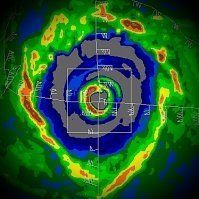 Recon just punched the weaker western and southern eyewall.
-
Tropical Storm Chris—40mph/1005mb
Windspeed replied to WxWatcher007's topic in Tropical Headquarters
This is a way more positive development for the central altoplano volcanic region of Mexico as they are in dire need of the beneficial rains this TC will provide. Whether it attains weak TS status or remains a depression only matters for numbers and record-keeping. Folks along the Campeche coastline will hardly blink at 40-50mph winds. They need the rain, however, and this could be a drought buster. Hopefully, not too much at once to avoid flooding issues. -
960 mb is a pretty high observed central pressure for a Category 4 hurricane. However, 1) Beryl has a very tight core of gradient-driven winds and 2) is embedded within higher overall background pressure regime influenced by the strong SPHS cell positioned directly to the north of the hurricane. Essentially, this means that if the central pressure continues to fall, Beryl could attain high-end Category 4 with only another 10 millibars of pressure drop and would hypothetically attain Category 5 windspeeds in the 940s hPa. I am not saying that it will, but background pressures and the core riding such a strong easterly low-level jet means that the northern eyewall could be very destructive if it encounters any of Windward islands.
-
There are some outter bands, but like you said, dry air to the north is keeping them from consolidating into an outter ring. Irma went days with partial ERC failures due to the same scenario. However, moist southerly flow could abate drier stable airmass and allow an outter ring to form by the time Beryl reaches the islands. So we can't rule out an EWRC starting prior to land interaction. We still have a full 24 hour window.
-
I've not anything to say that hasn't already been added. Pretty unbelievable events unfolding. Got to hope Beryl's eye threads the needle between islands to mitigate eyewall impacts as much as possible. Also, as is typical with intense TCs, hopefully, Beryl has maxed out early enough that an ERC would limit any further intensification. However, structural changes are difficult to predict. Never thought we'd see a Cat 4 in this part of the Atlantic in June, even if we are on July's doorstep. Usually, climatology wins out, and it still may win out by the time Beryl reaches the central Caribbean to allow windshear to counter MPI there, but we have several days to figure that out still.
-
Of note...
-
24 hours from classification to hurricane aint too shabby...
-
I would rather just pour through the landfall record each year to be sure, but perhaps my guess of 20-25 is probably too high. Cat 1 & 2s, sure, but major landfalls are obviously rarer and, more often than not, get retired. I'll look into it when I've more time.
-
You referenced the islands, and assuming NA plus central/Latin, that number has names that didn't strike the contiguous US.
-
The strong E to ENE 700-600hpa flow is allowing some SAL-influenced airmass into Beyrl's core, hence the microwave structure. Still a steady strengthening rate but perhaps deters any rapid intensification until that flow can ease up or Beryl's core structure can expand some and better shield against it.
-
That's a question that would take several hours of research to answer. We started naming storms in the 1950s. Every few years, there is such a scenario. I'd guess there are two to four per decade. Perhaps 20-25 major unretired landfalls since naming began.
-
Shrimp mode...
-
A low-level reconnaissance flight will be investigating on Saturday.
-
I think we will have Beryl by 5AM AST, if not the 11PM. Even with easterly mid-level flow displacing/tilting the core convection slightly west of the LLC, TD2 has strong convection wrapping the vortex. It's not an excellent upper level environment through the core of the depression's column yet, but it appears to be improving with time. Certainly, there is not enough hindrance to prevent steady intensification, which clearly appears to be ongoing. It would not be a stretch to imagine TS force winds within the northern and ridge interacting side of the circulation.
-
TAFB AL, 02, 2024062818, , BEST, 0, 90N, 410W, 30, 1007, TD The first forecast package is coming out at 5PM AST.
-
But the ensembles don't have a pretty simulated IR map of a Category 4 to hype out!
-
Latest ASCAT pass, which is now a bit behind the last few hours of most recent satellite images in this animation.
-
95L's axis is only at 38°W longitude right now. The system has the bulk of the MDR remaining to continue organizing prior to land interaction in the Antilles. However, persistent pulsing CBs this evening do appear to be evolving a new MLC. This is evident in the overall cloud pattern and perhaps is allowing better alignment in closer proximity to the surface low within the wave axis, just to the canopy's NE, versus the old MLC that is down around 7-8N° latitude -- mostly devoid of convection. A new low-level vort max could form on Friday and I do think 95L has a great shot at TCG in the next 24 hours.
-
Nice convective burst going up where an MCV should be located. There may not be a closed LLC yet, but if this persists, it may not take long for one to develop. A depression and eventual tropical storm looks more likely than not at this point. We may have Beryl before the weekend.
-
Even weak TCs can and do intensify in the ECARIB, just generally not this early in the season. By August, persistent mid-to-upper level westerlies give away to longer durations of intermittent ULACs between TUTTs, therefore, naturally, there is a higher probability of MDR TCs tracking under a more favorable environment in the ECARIB as we reach ASO. But even well-organized systems generally get shredded in June and July. 2005 remains the craziest anomaly with conditions we usually do not see until late August fast-forwarded to late June, hence Dennis and Emily. But even more typical hyperactive seasons do not see an advanced favorable Caribbean until August. 2017, case in point, Harvey got shredded in the ECARIB before redeveloping in the WCARIB. Later that season, Maria was under a dominate ULAC in the ECARIB on Septermber 16th.
-
Both initial runs of HAFS have a hurricane in the ECARIB. THE HAFS-B is the stronger of the two, reaching hurricane intensity prior to the Lesser Antilles. HAFS-A has a more asymmetrical sheared structure through the Windwards.
-
I don't presently have access to compare, but yesterday's 12Z EURO had the ULL over the central GOM, which aided ventilation and built an ULAC right over the TC in the WCARIB. The GFS runs have all had the TUTT/ULL placed much further south and in closer proximity to the TC in WCARIB, which kept the TC under 20+ KTs of shear. Perhaps the new 00Z Euro came to a similar solution, hence a weaker system. Other than monitoring to see if we get a TC out of 95L, the evolution in modeling between the upper level features in the Caribbean is going to be the focus on any potential ceiling for intensity in the forecast. I do think 95L has an excellent shot of TCG and may become a strong TS, even a low-end hurricane, but I am very apprehensive of the major hurricane solutions that we may again see come and go over the next several days that would have any basis in reality. As has been repeated, the Caribbean in July is generally a graveyard for early MDR TCs for good reason. Climatology more often wins out this early in the season despite the above normal SSTs in place along potential track.
-
The last few GFS OP runs have strong westerly shear embedded across the western and central Caribbean during the range in which a hypothetical TC/95L would be running through the region. Which is why, though the GFS brings 95L to hurricane intensity through the Lesser Antilles, ramps down the TC significantly late in the forecast. The most recent ECMWF that has caught everyone's attention does something much different with the upper Caribbean environment. Shear is initially there, however, a TUTT closes into a potent ULL that retrogrades west at enough distance in front of hypothetical TC track to allow significant intensification from the central into the WCARIB prior to the Yucatan. These sims are very late in the forecast so it will change, but it is worth explaining the difference between the two mid-range solutions. Confidence must remain low on anything until we have a center to track and upper pattern within closer proximity to forecast.
-
2024 Atlantic Hurricane Season
Windspeed replied to Stormchaserchuck1's topic in Tropical Headquarters
Don't forget Dennis that same year, which formed on July 4th in the Lesser Antilles out of a well-organized MDR disturbance and reached Category 4 intensity on July 8th. It remains the earliest Major on record in the Caribbean, preceding Emily's formation on July 10th, though Emily holds the record for earliest Category 5. I still do not understand why Emily wasn't retired by the WMO. It devastated the central Rivera Maya. -
Summer-Fall 2024 Weather Disco Med/Long Range
Windspeed replied to John1122's topic in Tennessee Valley
From Ben Noll's site. Long range ECMWF-UKMET superblend indicative of La Niña and AMO+ pattern taking hold by ASO. If this unfolds, expect a dry late summer pattern into autumn. Caveat being any landfalling tropical systems moving inland over the Southeast and Tennessee Valley regions to break potential dry conditions. We're still in a period of transitional ENSO until that time, however. We should still experience periods of frontal boundary precip through June into mid-July, with hot and humid days intermingled by August. How hot and humid remains the question, though. Muggy August and September humidity can still lead to isolated evening thunderstorms, so here's to hoping we avoid any outright drought conditions.- 688 replies
-
- 1
-

-
- heat
- thunderstorms
- (and 7 more)