
Windspeed
-
Posts
4,850 -
Joined
-
Last visited
Content Type
Profiles
Blogs
Forums
American Weather
Media Demo
Store
Gallery
Everything posted by Windspeed
-
 This is the recorded update/live stream from the NHC director, Mike Brennan.
 -
Yes, the tip of the peninsula. But that is mostly a coastal reserve down to Portland Point. The closest communities of Shearer's Heights near Portland, Rocky Point, etc., may have just missed the inner periphery of the northern eyewall on that closest pass, just based on radar observation. It was definitely too close for comfort, however.
-
The worst of Beryl still remains just offshore. Again, hopefully, no sudden jogs to the north that would get the inside of the eyewall over the southern Jamaican shoreline, as Beryl's northern eyewall looks quite nasty. I should stress, I am referring to the 10m wind at sea level. Edit: As before, I stress that wind gusts in the higher elevations along the ridges of the Blue Mountains may still be experiencing extreme hurricane force gusts due to their altitude within the northern circulation.
-
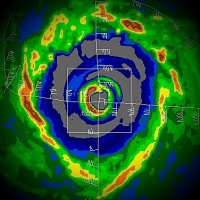
That is a pretty stunning recovery by Beryl in satellite presentation. Not surprising, given the appearance of the core on radar currently.
-
Sheesh, talk about a close shave. The outside of the eyewall is going to shave the small peninsula, but unless there is a jog north, the shoreline is going to miss the worst 10m winds of Beryl. Granted, there may still be higher wind gusts up on the ridges and higher elevations within the circulation.
-
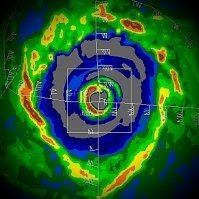
Beryl's eye is just starting to come into range from the radar site in Pilon, Cuba. The returns from the northern eyewall reveal it looks as it should given this morning's most recent recon data. Beryl is still an intense hurricane for now, despite moderate shear. There is still time for weakening prior to impacts on Jamaica, but the window is closing. Hopefully, the northern eyewall can miss to the south.
-
It's 6AM-3AM depending on where you are, stateside. That's why it's quiet. It even got slow in here yesterday morning...
-
Interesting exchange between Hazelton and Webb. RE: Beryl's intensity in the NW Caribbean will have big influences on track evolution in the GOM. A stronger hurricane may help cut-off the TUTT faster, leading to an ULL that may retrograde faster over the GOM. This would have two impacts: 1) ventilate Beryl versus shear it and 2) allow Beryl to slip towards the weakness. Again, obviously, that scenario requires a stronger hurricane prior to Yucatan interaction, and Beryl could be significantly degraded there instead; however, it bears close watch of modeling trends with a focus on the upper levels.
-
The larger eye is completely covered by high cirrus right now. But the cloudtops are not warming. Perhaps the flow above 200 hPa is blowing over top of the eye from the SW, but so far, it looks like the core is overcoming the upper level environment with a vengeance.. OHC is very high here. Diurnal influences and strong convection are winning the night for Beryl at present. If anything, the CDO has expanded from the SW quadrant.
-
Like clockwork, watch the intense CBs and overall CDO structure rapidly improving on satellite. That was perfect timing for recon. It looks like Beryl is back on the upswing. Perhaps the EWRC had already completed, and the core is taking off again...
-
The northern quadrant is definitely still packing. Wouldn't want to downgrade despite the ragged satellite appearance with such in situ data support of a high-end Category 4. Though one would expect the satellite appearance to improve if the new northern eyewall band is that strong. Satellite can be deceiving sometimes versus actual core structure. Some of the cloudfill in the eye may simply be high cirrus and not indicative of weaker convection.
-
Lol... These SFMR readings are ridiculous.
-
Lots of comparisons to Ivan and Gilbert with respect to Jamaica impacts on social media. I don't want to downplay Beryl, as folks there should prepare for a major hurricane landfall, or worst case, but potential is there for significant weakening of Beryl before it reaches the island. Those two storms were either rapidly intensifying (Gilbert) or close to MPI (Ivan) on their approach. Unless the TUTT closes off post haste and retrogrades quickly (this appears unlikely) prior to Beryl reaching Jamaica, Beryl should still be in a weakening trend on approach. It may even drop below Category 3 status prior to interaction. There are obvious differences between a weakening vortex and one that is intensifying or close to MPI. Again, trying not to downplay potential wind impacts there, I just do not think Beryl will be as severe as those previous TCs. Perhaps shear will do its job here. I should note that most of the TC (HWF and HAFS suites) models do maintain a major huricane on impact for now. We shall see... I am concerned for flash flooding and mudslides. Not just for Jamaica, but Haiti as well. It's an old hat with these strong Caribbean TCs, but there is a strong boundary of ascent between Beryl and the ridge to the north. Training bands combined with orographic lift over the mountains of Hispaniola are going to squeeze 10-20 inches out of that airmass, despite Beryl's swift forward motion.
-
The frequency of events has had an effect, however, in combination with economic status. Strict building codes are a recent development versus decades of lower income infrastructure. Prior to the 2000s, you could count the number of major landfalling GOM hurricanes on one hand since the population boom of the 1950s. Strict codes weren't in practice. Now we do have codes being implemented. But you consider the average household income and the cost of building? Take a supply list to Lowe's. Good luck. Poor people in general, not just contractors, do what they can to cut corners. I do not think mobile home parks should even exist near hurricane prone regions. Not to confuse with RV parks, because those are temporary, and you can evacuate them. But specifically, trailer homes. Additionally, for as great and world hyped as the US is as a military and economic superpower, there is a huge separation between the lower working classes and the few percent that can afford stricter building codes. The vast majority of its citizens struggle paycheck to paycheck. Most cannot afford to spend 300k on a home that can withstand a major hurricane. These islands, and Latin nations, may be poorer countries, yet they somehow have better access to lower cost building infrastructure than Americans do. I am not arguing your point. I am simply stating empirical observation that the odds of an eyewall crossing your home are very low even along the GOM coastal region. People do what they can to survive the cost of living. The Southeastern US struggles with more than just building practices. Hence why we are where we are. You brought up California. Try to shop for a home there. If you can afford it, you aren't worried about building materials.
-
This ERC isn't going as smoothly as the first. Atmospheric conditons likely aren't what they were before with the TUTT in place. Still, the new eyewall should take over eventually, and the core is still outside of the strong axis of shear. Beryl should still be a major hurricane as it approaches Jamaica. Still, some questions remain on if the TUTT can get pinched off and where exactly the ULL develops with regards to shear in the NW Caribbean. RE: Building codes. Most structures in the Windwards are made to withstand high winds. Generations of folks that aren't strangers to high wind events, most of which aren't due to hurricanes, but strong trade winds by the occasional stout low level easterly jet, beyond just an easterly storm or tropical disturbance. They don't have to necessarily be under threat of a hurricane to have gusty 30-60 mph days. That kind of weather is much less common along the GOM coastline unless there actually is a tropical cyclone. Unfortunately, it's a situation of economic factors and poor demographics versus the low frequency of high wind events, even if you live near the GOM coastline, that has led to years of bad building practices. Not everyone can afford a hurricane house, much less afford to live in a well-built house at all, hence all the mobile home parks and cheap flats that plague our residential infrastructure.
-
The CDO in the western semicircle has periodically warmed. A sign that Beryl has peaked whether by influences of southwesterly shear or perhaps some structural changes are in progress. Either way, Beryl remains intense. The eye appears to be decreasing in diameter as well. Perhaps an outer band is finally taking over. Note the cloud pattern in the southern periphery of the eye. That is very typical of an inner eye fluctuating versus a strengthening outer band. Suspicious-looking that perhaps an EWRC has finally commenced.
-
If this is an accurate video, Union Island in the Grenadines looks trashed.
-
Last MW pass scored a hit. And, well... though banding is evident, the eyewall remains solid and healthy. Edit: Corrected image to SSMIS pass.
-
Beryl has gone over 24 hours since the completion of its last EWRC. Perhaps a concentric band has intensified since last recon. I have no idea, as the most recent MW pass missed the TC. Regardless, the eyewall remains very stable. We may even have a sub 930s central pressure now due to the duration of persistent deep convection overnight. It doesn't look like Beryl has leveled off yet. Unfortunately, we've to wait a few more hours until the next reconnaissance mission.
-
Meanwhile, Beryl continues to rip and may still be intensifying...
-
In short, there is shear just to Beryl's NW. You can see strong 300-200 hPa level southwesterly flow blowing off the tops of storms in Beryl's bands to the north of the circulation. But the core remains separated from this stronger upper flow for now. How long Beryl's core remains undisturbed from that flow? Perhaps it can shrug it off until late Tuesday (today). Inevitably, it will have some impact. We'll have to watch how that upper tropospheric trough (TUTT) evolves, and if that fearure can close off and reteograde west (and at what distance it does so from Beryl) in the coming days. This will have a direct impact on Beryl and if it can maintain Major Hurricane intensity in close proximity to Jamaica. I do expect we will see a weakening hurricane, but how much and how quickly is the big question.
-
Pressures falling down into the 920s would be extremely impressive considering the higher background pressure regime across the eastern Caribbean and SW Atlantic Basin right now. 22 mph (19 kts) on a WNW heading is indicative of how strong the flow around the SPHS remains. Honestly, if Beryl wasn't already such a powerful vortex, or rather, a weak or developing TC, it would likely be having coupling issues with surface convergence and efficiency of latent heat content despite high SSTs. It's moving about as fast as Andrew was during its status as a Cat 5. I believe Janet was even a bit faster at 24 mph (21 kts). So fast Cat 5s do happen, obviously, but only after they're already strong TCs. Edit: Actually, Andrew's top speed of 18 mph (16 kts) didn't occur until it reached the Bahamas. I am trying to find some other Category 5s that compare to Beryl with regards to forward motion if anyone wants to contribute. Edit 2: Hurricane Ivan was moving at 17 mph when it attained Category 5 status in the same general area of ECARIB. Interestingly, it had a swift motion of 21 mph as a Category 4 storm in the MDR, but gradually slowed down to around 16 mph upon its tear through the ECARIB, then to nearly a stall and NW turn after Jamaica. *still looking*
-
Good thread with an excellent cross section on Beryl's structure.
-
We were most likely too close to the 11PM AST advisory package for the need of a special update. But I do anticipate an upgrade to at least 160 now in the advisory, perhaps even 165, as that would be supported by recon data conservatively.