All Activity
- Past hour
-

Potential Tropical Cyclone One
LongBeachSurfFreak replied to WxWatcher007's topic in Tropical Headquarters
Track and structure scream throw in the towel for this ever being named. . -

Occasional Thoughts on Climate Change
WolfStock1 replied to donsutherland1's topic in Climate Change
Google is your friend. https://www.agweb.com/opinion/doomsday-addiction-celebrating-50-years-failed-climate-predictions https://bradleyhook.com/why-extreme-climate-change-predictions-failed-what-we-can-do-now/ https://reason.com/2025/04/16/3-apocalyptic-climate-change-predictions-that-failed-to-come-true/ https://www.forbes.com/sites/michaelshellenberger/2019/11/25/why-everything-they-say-about-climate-change-is-wrong/ (does include some Al Gore stuff) etc. etc. Just search on "climate change failed predictions" -
Let’s coastal next week.
-
No hope for drought ravaged areas of northern piedmont. Discussion from RAH: QPF still remains quite variable and in flux, but remains rather light (mostly under a 0.25 to 0.50). The GFS shows absolutely nothing over the drought plagued northern Piedmont of NC. The hi-res models are now coming into range, but do not offer much hope. We need a pattern change. The pattern has been so persistent with either a dominate ridge aloft or a zonal flow. The areas east of the Appalachians have had an atypical mountain shadow hole in the rainfall due variations of a dominate westerly flow in the mid levels for quite some time. We need a break in the mid/upper levels over our region or a dominate Bermuda high with SW flow aloft to consistently bring Gulf moisture and lift to the region. This is not seen in the foreseeable future. The zeros keep stacking up.
-
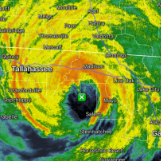
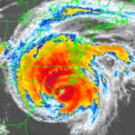
Potential Tropical Cyclone One Discussion Number 4 NWS National Hurricane Center Miami FL AL012026 400 AM CDT Wed Jun 17 2026 The center of the low pressure area is very near the Middle Texas coast, and offshore buoy observations indicate that maximum winds remain 25 kt. A line of deep convection has formed over the northwestern Gulf waters since the last advisory, but due to strong westerly shear, this activity is located more than 120 n mi to the east/southeast of the low-level center. As a result, the latest Dvorak classification from TAFB is Too Weak To Classify, meaning the system does not have the convective organization necessary to be designated as a tropical cyclone. The current motion is northeastward, or 045/5 kt. The system is embedded in strengthening low- to mid-level southwesterly flow, and with another trough approaching from the northwest, it is expected to accelerate northeastward today. The track guidance has shifted slightly westward on this cycle, and the center of the low is therefore likely to straddle the Texas coast for much of the day, before moving farther inland over eastern Texas or Louisiana tonight. The NHC official track has been nudged westward, close to the TVCN and HCCA consensus aids. The prospects for this system to become a tropical cyclone may be decreasing. With the low-level center unlikely to fully emerge over the Gulf waters for an appreciable amount of time, and 25-30 kt of westerly shear expected to continue for the next 12 hours, it will be difficult for the system to gain the convective organization necessary to become a tropical cyclone before it moves inland tonight. Even if the system doesn't become a tropical cyclone, there could still be some strengthening of the wind field well east of the center during the day, and the NHC official forecast will continue to show a peak of 35 kt in 12 hours. After that, all of the global models now show the system opening up into a trough over Louisiana by tonight. The official forecast shows the system as a remnant low at 24 hours, but it's entirely possible it will have dissipated by then. The global models show the remnant low-level vorticity continuing eastward across the Southeast U.S. on Thursday and Friday, and the ECMWF, Canadian, and UKMET models indicate that a low pressure system could redevelop, especially once the system moves offshore over the western Atlantic. The exact nature of this low is unclear at this time, but we will monitor model trends for the possibility of tropical cyclone formation over the western Atlantic late this week or this weekend. Regardless of whether the system becomes a tropical cyclone, heavy rainfall and life-threatening flash flooding will be the primary hazards with this system. KEY MESSAGES: 1. Potentially life-threatening flash flooding and urban flooding are likely through Thursday across southern Louisiana, southern Mississippi, southern Alabama, southwestern Georgia and the Florida Panhandle, with possible flooding near the Upper Texas coast. Ongoing heavy rainfall could prolong the flood threat into the weekend. 2. Tropical-storm-force winds are expected along the Louisiana coast today from Sabine Pass to Morgan City where a Tropical Storm Warning is in effect. 3. Minor to moderate coastal flooding is expected along portions of the Upper Texas and Louisiana coastlines today. FORECAST POSITIONS AND MAX WINDS INIT 17/0900Z 28.0N 96.7W 25 KT 30 MPH...POTENTIAL TROP CYCLONE 12H 17/1800Z 29.1N 95.2W 35 KT 40 MPH...TROPICAL STORM 24H 18/0600Z 31.1N 92.8W 25 KT 30 MPH...POST-TROP/REMNT LOW 36H 18/1800Z...DISSIPATED $$ Forecaster Berg
-
.thumb.jpg.6a4895b2a43f87359e4e7d04a6fa0d14.jpg)
Central PA Summer 2026 Discussion/Obs Thread
Yardstickgozinya replied to Voyager's topic in Upstate New York/Pennsylvania
I bet he's feeling good about himself today. -
If it was bit stronger and a bit larger, yeah it could shunt the surface moisture flow into the OH Valley. But I think its too little too late. It's already embedded into the established SW flow of the incoming trough over the conus and will like be absorbed into it. Not a non 0 effect but not as much as if it were stronger IMO. Crazy jet dynamics with the incoming trough, gonna be hard to overcome those.
- Today
-
Yep. They're really bullish on keeping the main event long tracked lines of sups with little consolidation. That surface low looks to do a good job of clearing out the brewing line in Iowa after it moves through later. 60+KT LLJ on some of the models is nothing to scoff at. Good long track sup setup its looking like between I70 an I80.
-
Actually asking. What is the effect of the tropical storm going to have on this? It has to have some impact I feel like it’ll steal some energy, no? Nobody seems to be talking about it and I’m legit asking
-
To my dusty cobwebbed eyes, it looks like the threat may have modulated downward for much of LOT CWA. Window for recovery is fairly brief after morning to early afternoon convection.
-
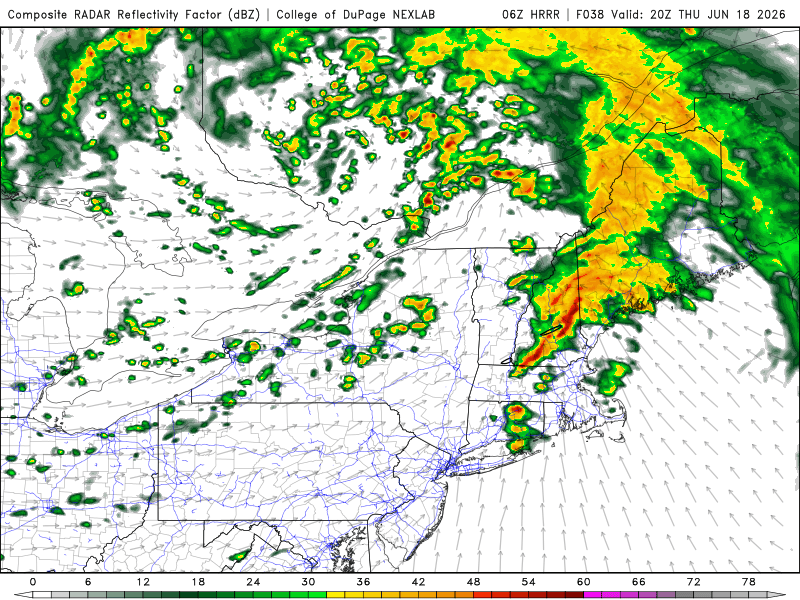
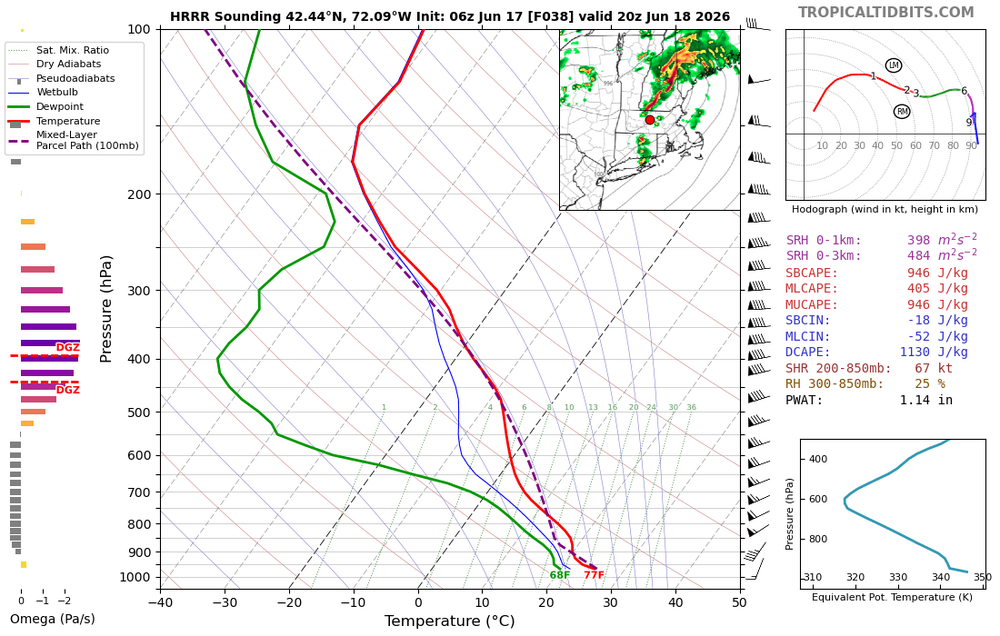
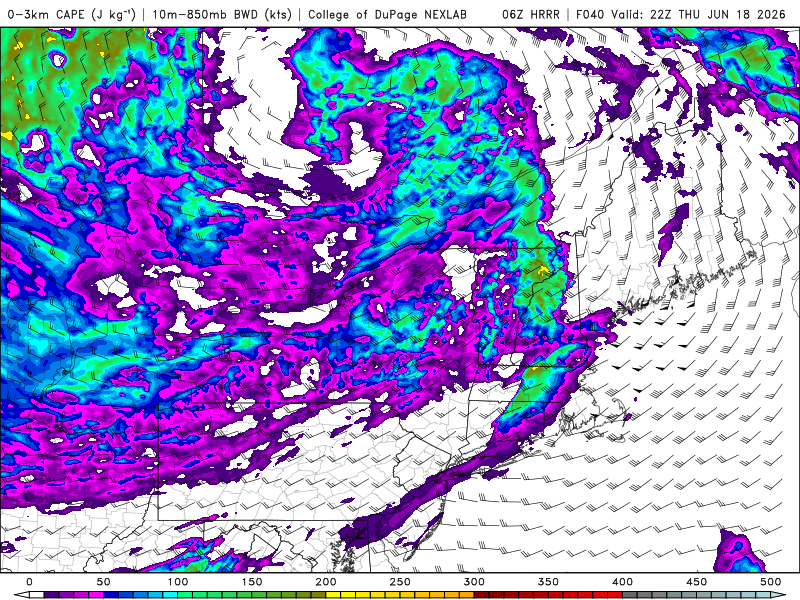
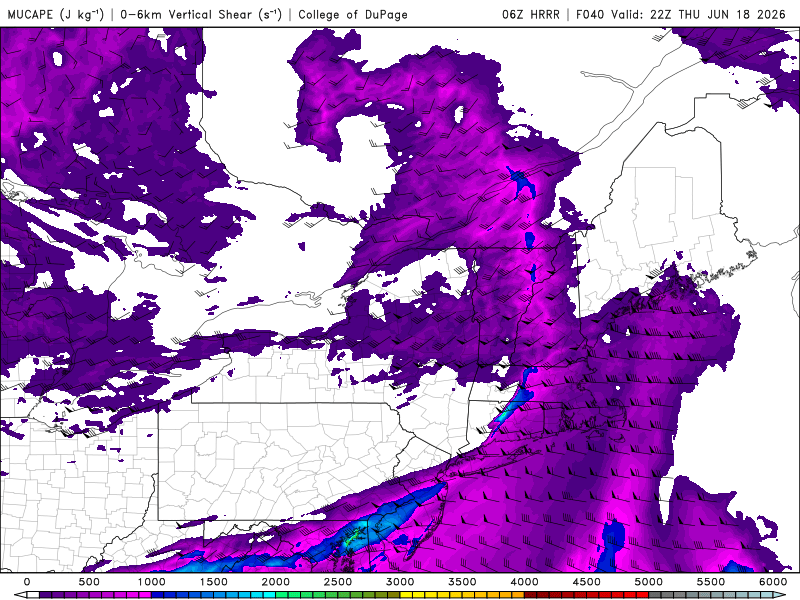
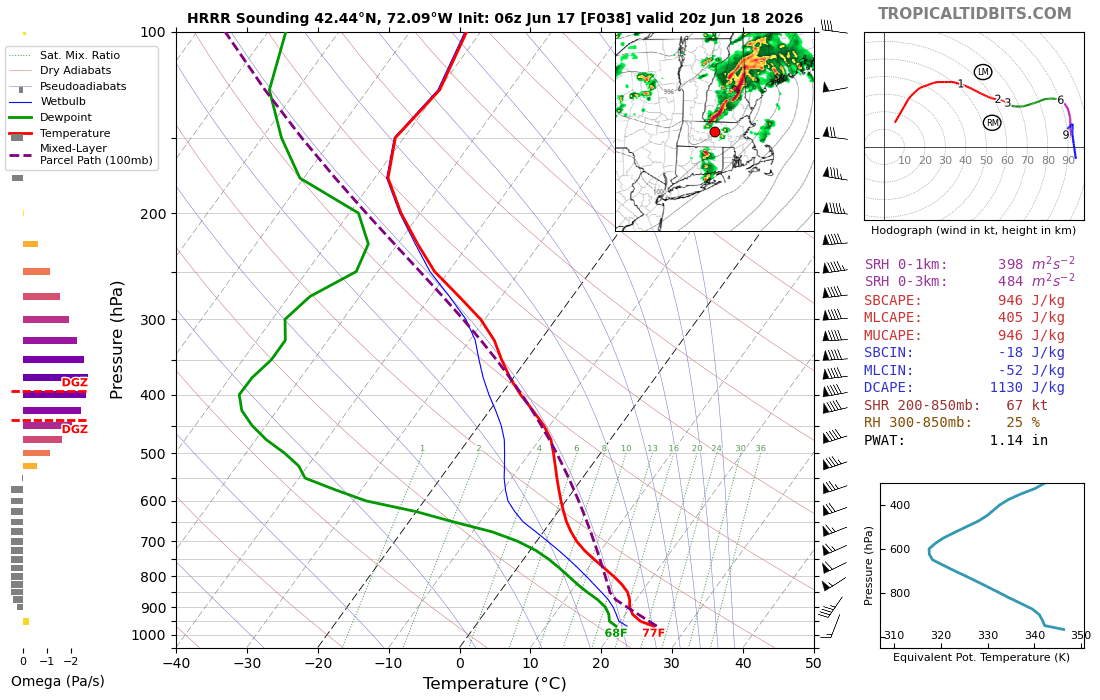
06z HRRR fcst sounding valid 20z Thu for central MA attached. Rhetorical question: Is that not a great hodograph for the NEUS? Nice long curve? CAPE is almost 1000. Yes it could be higher, but you can't just shake a stick at this sounding. Look at the shear values. Also, look at the 0-3km CAPE valid 22z. As high as 205. Anything above 75 is considered good for low-level vortex stretching and tors. Yes, SPC does not even has a 2% tor risk anywhere for E Coast, but that does not mean any can't occur. Also, HRRR fcst 22z, MU CAPE as high as 2100 over "WxWiz land." Hmmm. 1500-2000 CAPE w/ very high shear can and has "got it done" historically in the past for CONUS sig spinner days. Timing is ideal. Not trying to hedge or hype here, just calling it as I see it. The svr wx parameters look quite good to me. Coverage of svr I bet will be limited, but any individual storm could be nasty! "But we need an EML!!!!" Ugh, not every sig tor in New England has had a solid EML present!
-
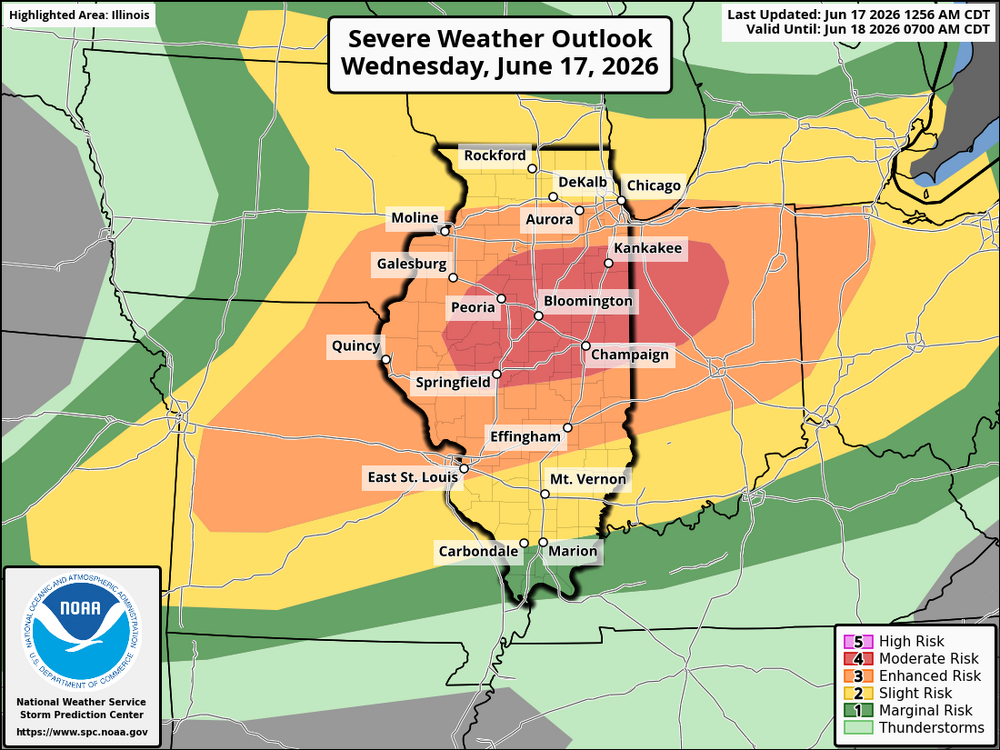
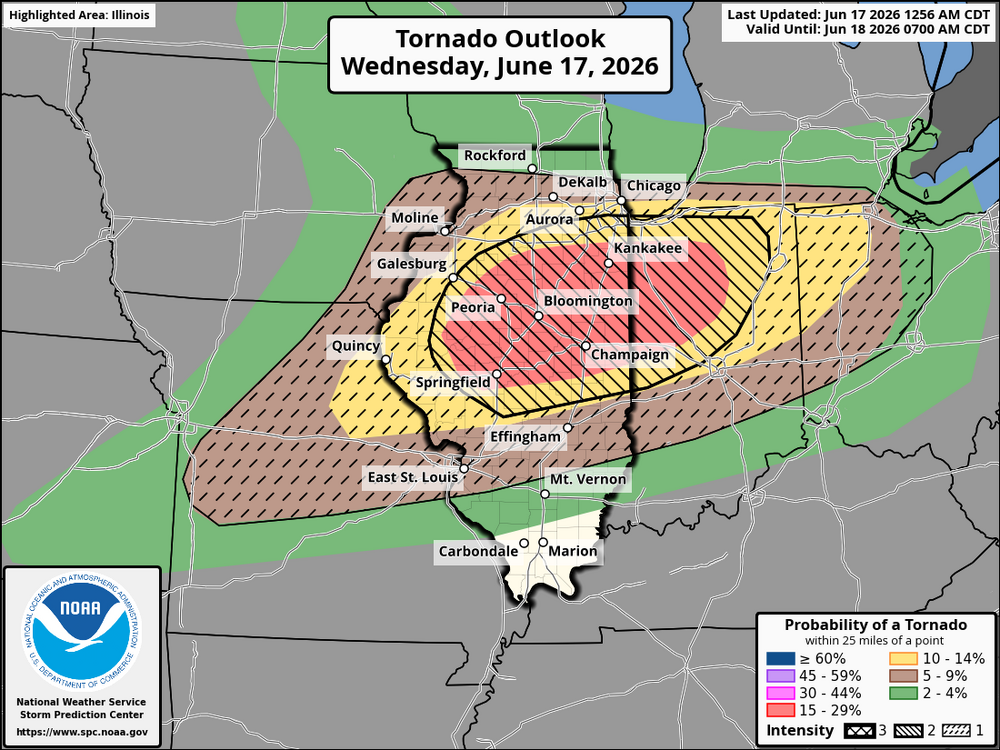
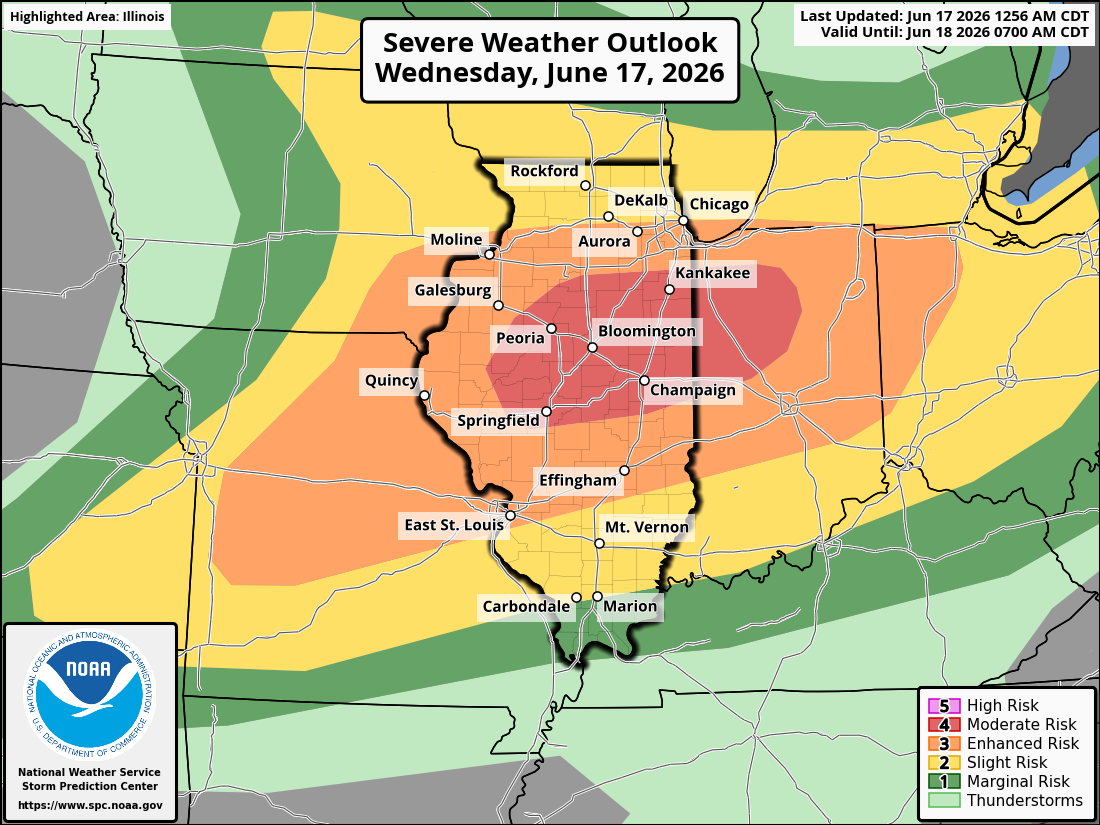
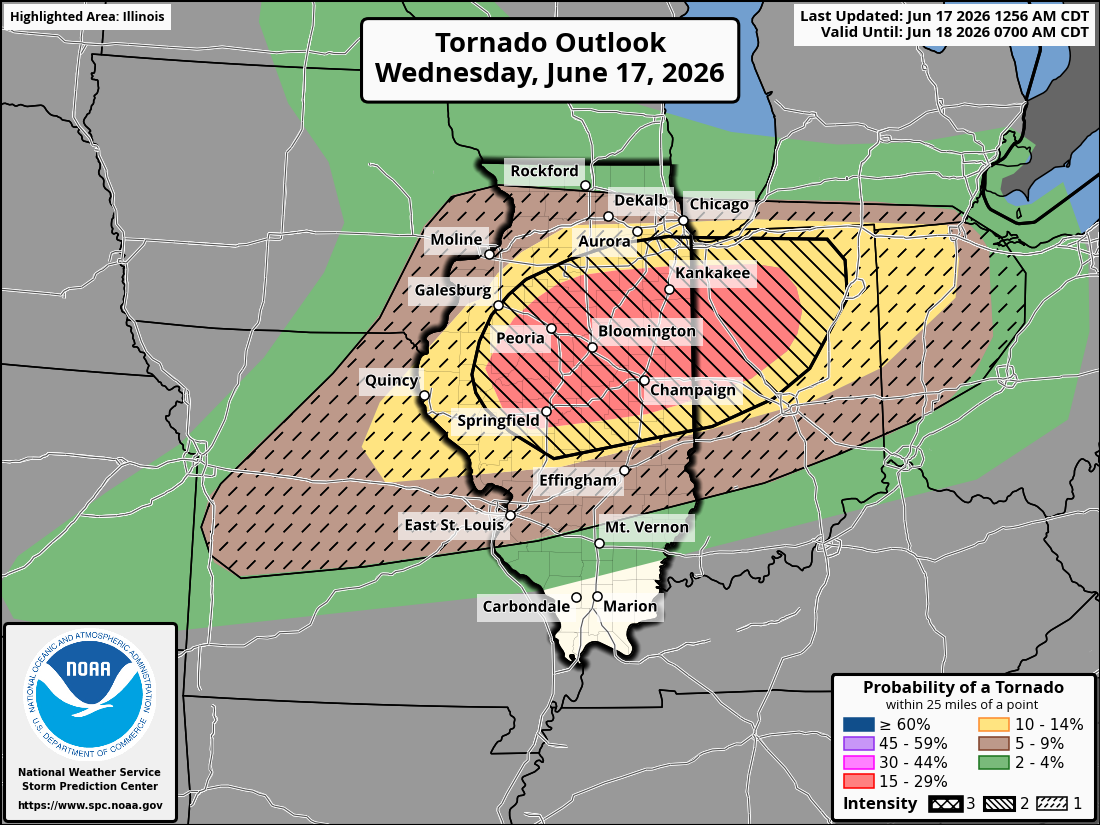
SPC not making many changes to the Day 1 forecast except extending the 10% tornado risk and CIG 2 north. There maybe more small changes but it’s too late to dig into it. A great read below. Day 1 Convective Outlook NWS Storm Prediction Center Norman OK 1256 AM CDT Wed Jun 17 2026 Valid 171200Z - 181200Z ...THERE IS A MODERATE RISK OF SEVERE THUNDERSTORMS OVER ILLINOIS AND INDIANA... ...SUMMARY... An outbreak of severe thunderstorms is expected today, with primary threat centered over Illinois and Indiana. Several intense tornadoes, swaths of damaging gusts over 75 mph and damaging wind-driven hail will all be possible. ...IL...IN...MO...OH... An intense mid and upper level jet will nose southeastward across the Midwest today, with a prominent leading disturbance moving out of IA and into IL through midday. Severe storms are likely to be associated with this early wave as a southwesterly low-level jet increases to 60 kt and rapidly bring instability into the area. This initial activity will bring damaging winds to eastern IA and northern/central IL. This system is expected to weaken later in the afternoon, but some remnants will move across IN. Ahead of this early activity, a warm front will push north across IN and OH. New severe storm development, perhaps transitioning out of the remnant activity and/or forming near the warm front, is possible across northern IN into northwest OH. Shear profiles will be excessive, with tornado risk only conditional on minimal instability being present. The result may be a isolated tornadic supercells. To the west, the air mass across northern MO, IL, and into central IN will easily recover and rapidly destabilize due to strong southwest winds. A 60+ kt low-level jet is forecast, with notably strong winds around 700 mb as well (surface to 3 km shear values may exceed 60 kt). A plume of 65-70 F dewpoints will likely extend from central MO into IL and western IN in the 21-00Z time frame, contributing to 2000-3000 J/kg MLCAPE. A broken line of supercells is likely to develop and mature roughly from northern IN into central IL and MO around 21Z and spreading east/southeast through early evening. Given the clearly supercellular shear profiles, linear storm mode is unlikely for most of the event. Long-tracked supercells producing tornadoes and damaging hail are likely. Finally, the warm frontal position will need to be monitored near the IN/MI border. Even if instability is elevated into MI, extreme shear and lift may still yield damaging winds and even a tornado risk. As such, probabilities have been increased into far southern Lower MI. ...Upper TX Coast into the northern Gulf Coast... The NHC forecast shows Potential TC One moving into southwest LA by 00Z. Wind fields associated with this system will strengthen out of the south ahead of it, resulting in areas of strong low-level shear from TX into southern LA, and possibly into MS. Mid to upper 70 F dewpoints will contribute to modest CAPE values, supporting embedded stronger cells with tornado potential. ..Jewell/Weinman.. 06/17/2026
-
EML for sig tor outbreak, yes, but it depends what we expect. SPC isn't going big, and I agree w/ how they are approaching it. However, I think the uncertainty is higher than usual due to the setup. When you have high-end anomalies, such as the wind fields here, that can lead to more surprises. I said earlier, I don't have a good analog for this particular setup, so that makes me nervous as to the surprise factor.
-
I wasn't comparing them like that-lol but both seem to be missing steep ml llase rates, and that is usually the one key missing ingredient in sne setups that fail.
-
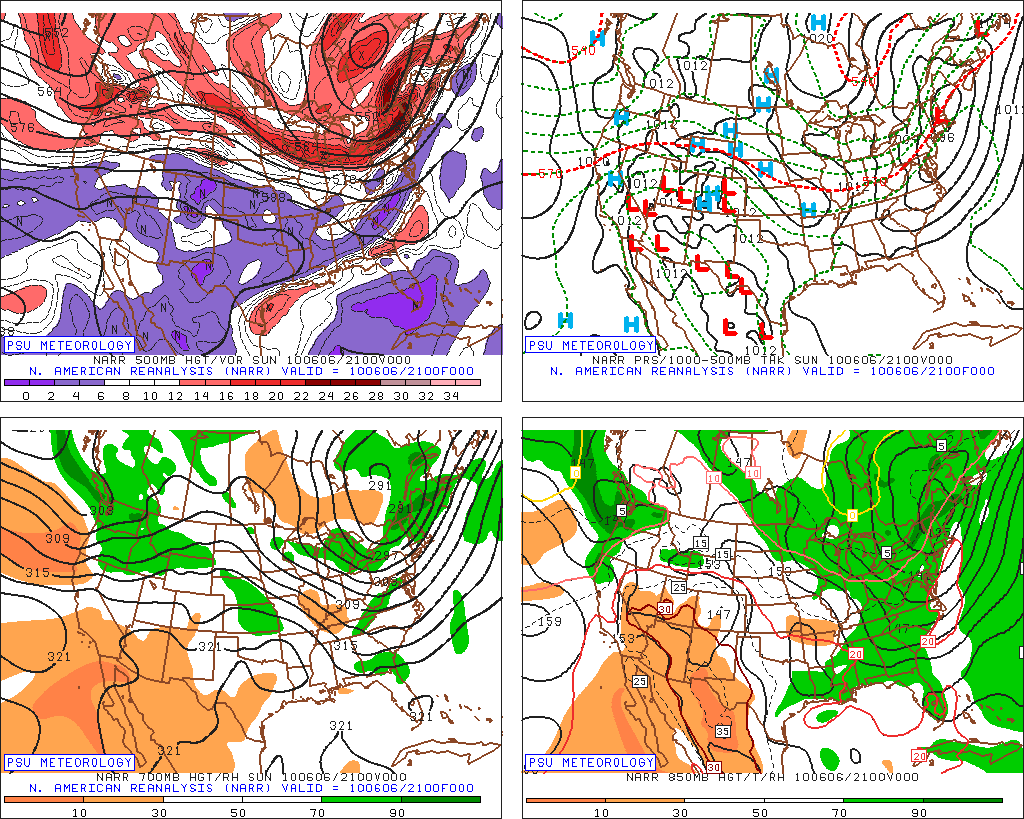
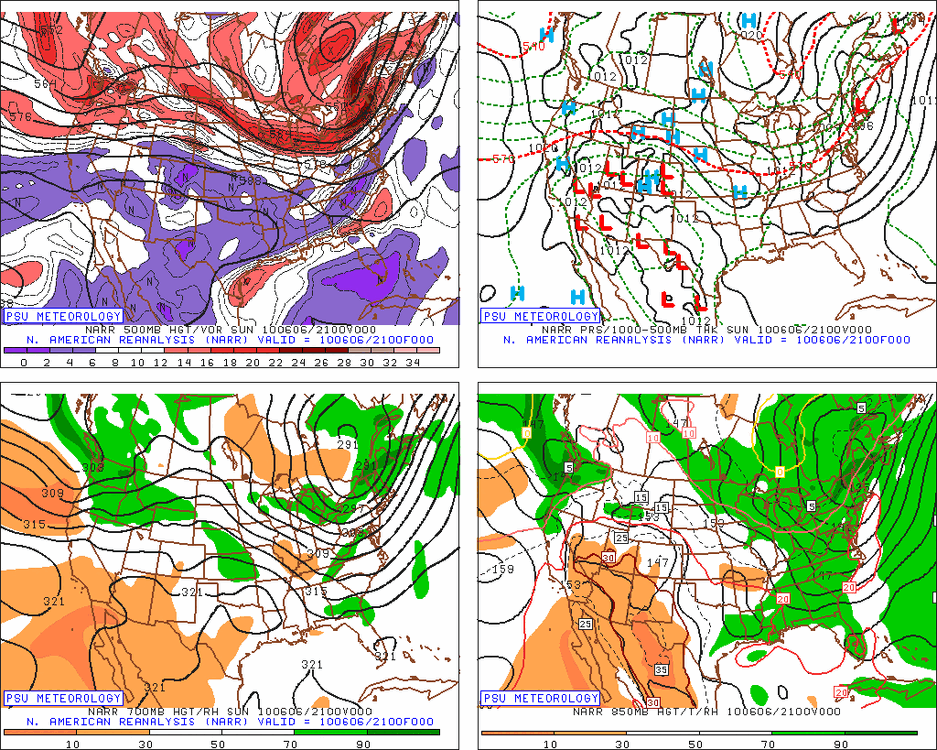
Took a look at it (attached). Not quite the same. Sfc low passed right over SNE rather than over srn Quebec. Also, sfc low Thu deeper than 2010 by 8-10 mb. Too much cloudiness in 2010? Even if this was very similar to 2010, minor differences can be a huge as to sensible wx when it comes to convective potential and the type of svr wx they produce, let alone how intense any given svr wx type may be. Also, I think we may be unimpressed by the SPC DY2 MRGL. Just b/c MRGL says zero about how intense any storm may be and the svr wx it produces. Maybe instead of three well-defined tornadic supercells that occurred on 7/10/89, they may be only one! But for ppl like WxWiz and CoastalWx who are always looking for the absolute max? One honkin' supercell is not enough!
-
I haven't given up on Thursday - 0z mesos look okay wrt potential
-
Yes, one of the most memorable ever, really. tremendous shear - weak/mid cape - terrible ml lapse rates/ml cape. SPC was at least a moderate hatch if not high risk? it was wild. Very little happened
-
I don't recall that day. Big bust?
-
funny because the very next year produced some of the highest end severe we've seen in a century ofc largely EML-driven
-
6/6/2010 ...forever gun-shy
-
Potential Tropical Cyclone One Discussion Number 3 NWS National Hurricane Center Miami FL AL012026 1000 PM CDT Tue Jun 16 2026 The center of the system is beginning to emerge into the northwestern Gulf. Surface observations do not show very strong winds over the area at this time, and the current intensity is held at 25 kt. This is consistent with a Dvorak classification from TAFB. There is significant westerly vertical wind shear over the disturbance, with most of the deep convection displaced well away from the center of the low. Given that there has been no noticeable increase in the deep convective organization of the disturbance, it is being maintained as a potential tropical cyclone for this advisory. Based on the center fixes, the initial motion estimate, 050/5 kt, is similar to that from the previous advisory. There has been little change in the track model guidance. The system is expected to accelerate northeastward in the flow on the southern and southwestern side of a broad mid-level trough over the eastern United States. The official forecast track shows the disturbance or storm moving just offshore of, and parallel to, the Texas coast during the next day or so. Then the system is likely to go back onshore late Wednesday or Wednesday night. No significant change has been made to the track forecast for this advisory, and the official forecast is fairly close to the corrected consensus solution. The center should move far enough offshore on Wednesday for some intensification to occur due to a combination of warm Gulf waters and upper-level divergence. However the SHIPS guidance diagnoses fairly strong shear over the area during the next 24-36 hours which should limit strengthening up to landfall. The NHC forecast continues to indicate the system becoming a tropical storm tomorrow, which is also shown in the IVCN intensity model consensus. Regardless of whether the system becomes a tropical cyclone, heavy rainfall and life-threatening flash flooding will be the primary hazards with this system. KEY MESSAGES: 1. Potentially life-threatening flash and urban flooding is likely through Thursday across Louisiana and southern Mississippi, and is possible near the Upper Texas coast. Flash flooding is also possible across Alabama, Georgia, and the Florida Panhandle through the end of the week. Prolonged rainfall may extend the flood threat into the weekend. 2. Tropical-storm-force winds are expected along the Louisiana coast on Wednesday from Sabine Pass to Morgan City where a Tropical Storm Warning is in effect. 3. Minor to moderate coastal flooding is expected along portions of the Upper Texas and Louisiana coastlines. FORECAST POSITIONS AND MAX WINDS INIT 17/0300Z 27.6N 97.1W 25 KT 30 MPH...POTENTIAL TROP CYCLONE 12H 17/1200Z 28.5N 95.6W 30 KT 35 MPH...TROPICAL CYCLONE 24H 18/0000Z 30.2N 93.3W 35 KT 40 MPH...INLAND 36H 18/1200Z 32.1N 90.9W 20 KT 25 MPH...INLAND 48H 19/0000Z...DISSIPATED $$ Forecaster Pasch/Adams
-
Concerning low CAPE and high shear, look at what happened on 4/1/2023 in DE. WxWiz in disbelief and CoastalWx proby "MEH!" LOL. https://x.com/riotrogerriot/status/1642347623733444609 This is a full-blown tornadic supercell, but it doesn't look like one b/c the CAPE was low and shear very high. The CB is tilted over almost 90 deg! 500-1000 CAPE this day, but want to know what the 0-6 km shear was? 100 kt! This storm produced a long-tracked EF3. Isolated storm all by itself in the Delmarva. https://www.youtube.com/watch?v=4esg-DNoO5s https://www.youtube.com/watch?v=FyVPX7-ZHhw Other cells this day in DC area (not svr - I witnessed personally), they were just like this, so ridiculously titled over, they did not look like CBs, just a TCU cloud line. The rain/hail from these storms was *way* downwind (5+ mi) from the rear updraft base (it was hard to tell these bases existed b/c of the extreme tilt!). One my co-workers who lives near BWI reported he just started getting 1/2" hail and no rain falling, or any idea there was a storm near b/c of the odd storm orientation and no LTG/T. Something you'd more typically see in the Plains or Desert SW. Quite atypical for the East Coast, but it shows it can happen. And what do we have coming up for Thu? Quite atypical. "Hope floats" WxWiz!
-
Potential Tropical Cyclone One
WxWatcher007 replied to WxWatcher007's topic in Tropical Headquarters
Potential Tropical Cyclone One Discussion Number 3 NWS National Hurricane Center Miami FL AL012026 1000 PM CDT Tue Jun 16 2026 The center of the system is beginning to emerge into the northwestern Gulf. Surface observations do not show very strong winds over the area at this time, and the current intensity is held at 25 kt. This is consistent with a Dvorak classification from TAFB. There is significant westerly vertical wind shear over the disturbance, with most of the deep convection displaced well away from the center of the low. Given that there has been no noticeable increase in the deep convective organization of the disturbance, it is being maintained as a potential tropical cyclone for this advisory. Based on the center fixes, the initial motion estimate, 050/5 kt, is similar to that from the previous advisory. There has been little change in the track model guidance. The system is expected to accelerate northeastward in the flow on the southern and southwestern side of a broad mid-level trough over the eastern United States. The official forecast track shows the disturbance or storm moving just offshore of, and parallel to, the Texas coast during the next day or so. Then the system is likely to go back onshore late Wednesday or Wednesday night. No significant change has been made to the track forecast for this advisory, and the official forecast is fairly close to the corrected consensus solution. The center should move far enough offshore on Wednesday for some intensification to occur due to a combination of warm Gulf waters and upper-level divergence. However the SHIPS guidance diagnoses fairly strong shear over the area during the next 24-36 hours which should limit strengthening up to landfall. The NHC forecast continues to indicate the system becoming a tropical storm tomorrow, which is also shown in the IVCN intensity model consensus. Regardless of whether the system becomes a tropical cyclone, heavy rainfall and life-threatening flash flooding will be the primary hazards with this system. KEY MESSAGES: 1. Potentially life-threatening flash and urban flooding is likely through Thursday across Louisiana and southern Mississippi, and is possible near the Upper Texas coast. Flash flooding is also possible across Alabama, Georgia, and the Florida Panhandle through the end of the week. Prolonged rainfall may extend the flood threat into the weekend. 2. Tropical-storm-force winds are expected along the Louisiana coast on Wednesday from Sabine Pass to Morgan City where a Tropical Storm Warning is in effect. 3. Minor to moderate coastal flooding is expected along portions of the Upper Texas and Louisiana coastlines. FORECAST POSITIONS AND MAX WINDS INIT 17/0300Z 27.6N 97.1W 25 KT 30 MPH...POTENTIAL TROP CYCLONE 12H 17/1200Z 28.5N 95.6W 30 KT 35 MPH...TROPICAL CYCLONE 24H 18/0000Z 30.2N 93.3W 35 KT 40 MPH...INLAND 36H 18/1200Z 32.1N 90.9W 20 KT 25 MPH...INLAND 48H 19/0000Z...DISSIPATED $$ Forecaster Pasch/Adams -
Yes, this is a significant concern. Too much shear and not enough instability. You can get "cannonball CU" -- the building CU gets sliced by shear and you get part of the CU horizontally shooting downwind abruptly w/ a small cloud trail back to the other part of the CU! However, this go/no go for any CB here "winning" or "losing" is a fine line. If any CB can get established, the mesocyclone should be intense, and then CAPE does not matter nearly as much. It's why you can have as little as 100-200 CAPE and get sig tors. Most often this is in a TC situation, but it can happen in an ET low situation. CB updrafts are maintained extremely well despite low CAPE due to dynamic pressure perturbations induced by the mesocyclones. It also is why when an intense supercell moves into a stable (no CAPE) air mass, it can still produce tors for a little while longer b/c the intense mesocyclone present just doesn't go "poof!" The ante Thursday here is high here either way. It will definitely be a wicked nowcast situation watching storm development and evolving
-
Loved the sky today, so many storm clouds encircling. Saw multiple anvils, a quick t-storm just 1 flash, then cloudy til 10pm when we got our delayed 1mm of rain. Multi lines in SON today. Heaviest rains in the coming historic days will be during night. 18z Euro has a 984mb low very close to me on Thurs morning, easily the deepest for June. TWN was using David Roth's maps showing the departures.







.thumb.gif.f92b16c631a1d15d405ed77b33f0710d.gif)