WolfStock1
-
Posts
255 -
Joined
-
Last visited
About WolfStock1

-
Occasional Thoughts on Climate Change
WolfStock1 replied to donsutherland1's topic in Climate Change
Yeah good point / info about the earthquakes. This kind of thing (glacier collapse) seems pretty similar to earthquakes in that there's just no way to know why or when a given one happened at a given time and place - the variables (essentially infinite number of land connection points / stresses) are just too numerous, and basically just not measurable. With meteorology at least the inputs - while still numerous - are actually *measurable*. -
Occasional Thoughts on Climate Change
WolfStock1 replied to donsutherland1's topic in Climate Change
Yes very true - it appears very evident that it did. Question is - was it a case of "hastening" (as in - it would have collapsed at some point, warming just made it collapse sooner than otherwise), or was it a case of "causing" (as in - if this level of warming hadn't happened - it would not have ever collapsed)? Probably will never know of course. Plenty of glacier collapses of course happened in pre-warming times, e.g. several big ones in the early 1800's in Switzerland, France, and Caucasus mountains. -
Occasional Thoughts on Climate Change
WolfStock1 replied to donsutherland1's topic in Climate Change
Why do you say that? Theoretically AGW could have actually *delayed* this collapse. (devil's advocate - bear with me) If we go with the freeze/thaw loosening theory (seems quite plausible, at least as a contributing factor): From what I read - there can be some freeze/thaw cycles that happen underneath glaciers, due to some cyclical nature of their movement; they accelerate and decelerate some with the seasons; the changes in friction then resulting in some temperature swings. In some cases I would imagine there are glaciers for which the ground (bedrock etc.) underneath is typically thawed more frequently than it is frozen. In some areas in such cases an overall increase in atmospheric temperature can result in *less* freeze/thaw cycling, rather than more. This can be true on the surface, but could also even be more true at depths due to dampening of the atmospheric effect. An increase in freeze-thaw cycles would actually only actually happen at places that are specifically on the thresholds where for any given season the ground under the glacier sometimes - but not always - thaws in any given season, and where the thawed period is less than the melted period. In general - it seems like folks are doing their damndest to try and pin any and all natural disasters on AGW, when mostly they're likely just, well, natural, and would have happened whether AGW was a thing or not. -
Occasional Thoughts on Climate Change
WolfStock1 replied to donsutherland1's topic in Climate Change
This stuff is complex enough, and the data incomplete enough, that I can't imagine anyone coming to a conclusion with any degree of confidence. I mean - we're talking about somehow mapping the details of the bedrock *beneath a glacier* no less, and trying to analyze the freeze-thaw cycles (if they existed in that location, under the glacier) over the past N years to determine if CC contributed to extra loosening that wouldn't have occurred otherwise without CC. That seems like an impossible task. The best we could do I think is to somehow measure the amount of these over time and see what is the trend. This is difficult of course due to the nature of the remoteness of the areas we're talking about; it would require a lot of satellite data details. -
Occasional Thoughts on Climate Change
WolfStock1 replied to donsutherland1's topic in Climate Change
OK - you were sounding sensible up until those last couple of paragraphs. Entire Greenland ice mass "sliding off" and causing 22-ft global tsunamis that would kill 3.8 billion people? Not even suspension-of-disbelief Hollywood goes to that lengths of ridiculousness. Sorry but it's crap like this that feeds deniers. They like to point to dire predications that didn't come true, and just deny the whole thing as a result. Suggest you revisit your strategy, because it's counter-productive, and very un-realistic/un-scientific, and it does your discipline a disservice. (assuming that you actually are a meteorologist) -
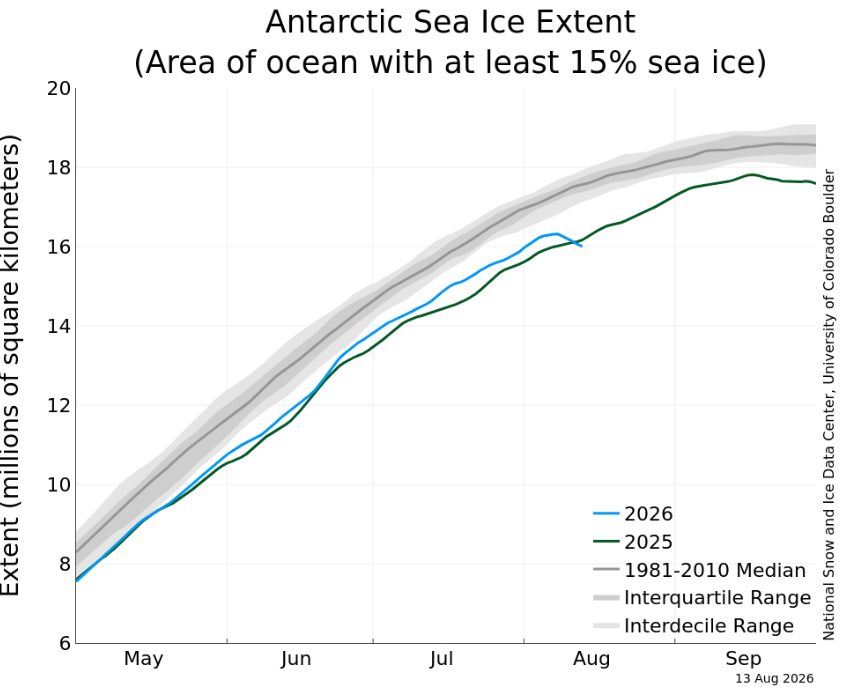
Yeah wow that's weird. Wouldn't a calving event though cause the level to go up, not down? (given that this a measure of sea ice, not land ice) I believe that this measure allows for ice that has broken free but is still within the area of measure. Perhaps a large berg just exited the area being measured, and thus is not longer considered "Antarctic sea ice"?
-
Occasional Thoughts on Climate Change
WolfStock1 replied to donsutherland1's topic in Climate Change
Re: Putin and Trump - that's politics, not science. Re: Observatories - these have *always* been in place high in the mountains, since long before CC became a thing. E.g. Mauna Kea in 1901, Kitt Peak in 1960, etc. Mountain air has *always* been known to be cleaner/clearer than seaside air since the beginning of time, and that has nothing to with CC. It's basic physics / meteorology, as well as where people live. It's actually the opposite of of what you claim - part of the reason why mountain air is so clear is ironically *because* for most people it's more desirable to live on the coast. So - perhaps try again with your reasoning. -
Occasional Thoughts on Climate Change
WolfStock1 replied to donsutherland1's topic in Climate Change
O....K.... Sorry, but lots of really wacked out stuff here. I'll happily buy land near sea level from anyone who happens to own it and shares your viewpoint. I kinda like the beach - good sunsets and waves and all that (to answer your "why" point). I won't, however, be investing in any boreal farmland futures. -
Occasional Thoughts on Climate Change
WolfStock1 replied to donsutherland1's topic in Climate Change
Look at the context here though - the climate change discussion thread. If this were a "weather events" thread - I would agree that there's no implication of a tie-in between the big France wildfire spike, and I wouldn't have made my point about having to look at the bigger picture. But since this is in fact a climate change discussion thread, and since there are lots of assertions out there that CC causes increase in wildfire activity - it seems reasonable that there's an assertion of implied tie-in with that set of stats that was posted; vis a vis France's big spike in wildfires being due to CC. My point then of course being that no - it's not due to CC (the context of the thread), it's due to a localized weather event (and possibly other factors such as bad fire control management). -
Occasional Thoughts on Climate Change
WolfStock1 replied to donsutherland1's topic in Climate Change
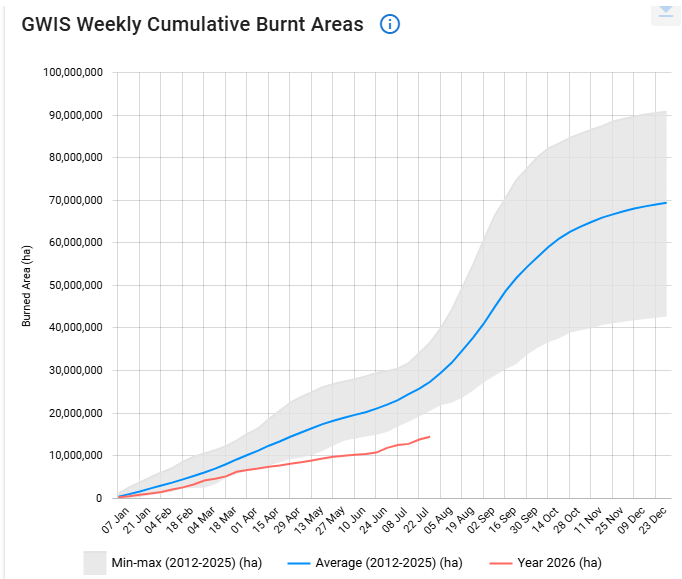
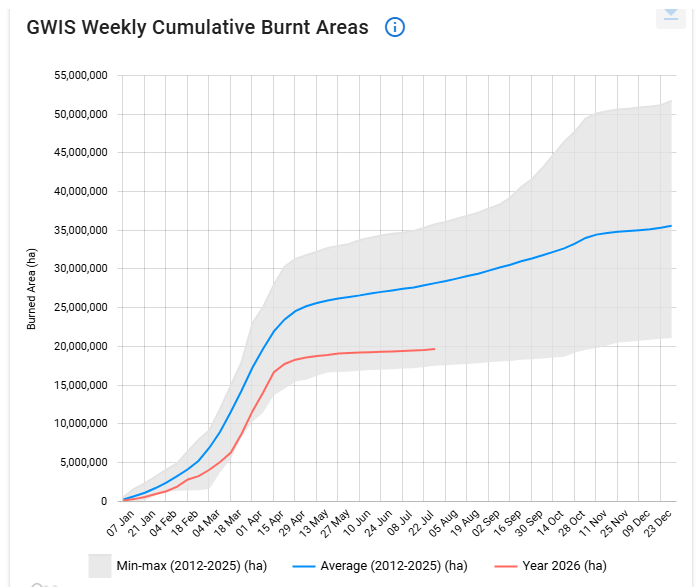
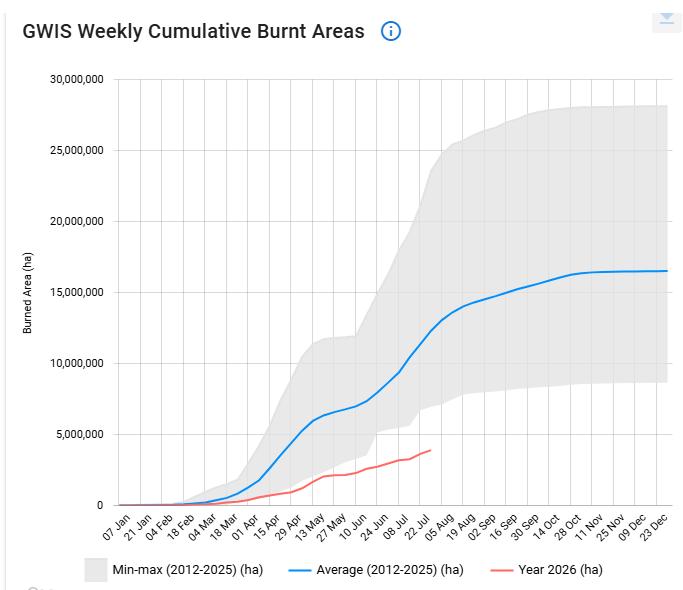
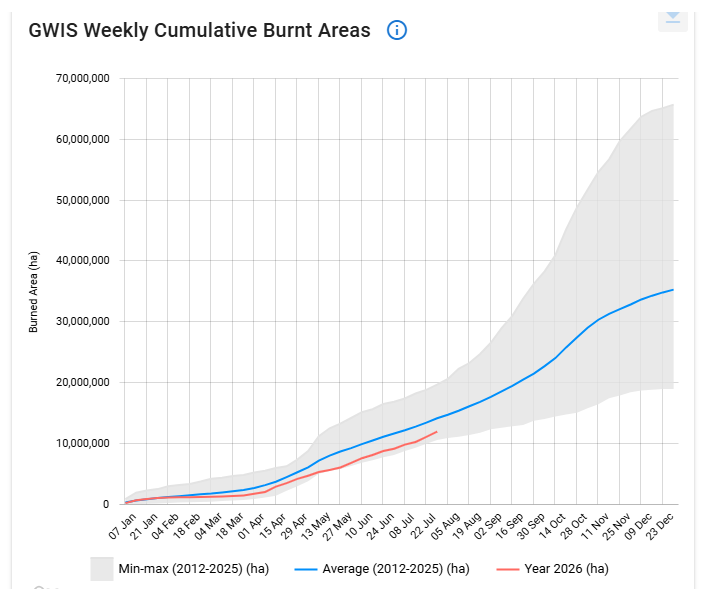
How about we look at *all* areas: Africa: Americas: Asia: Europe: Oceania: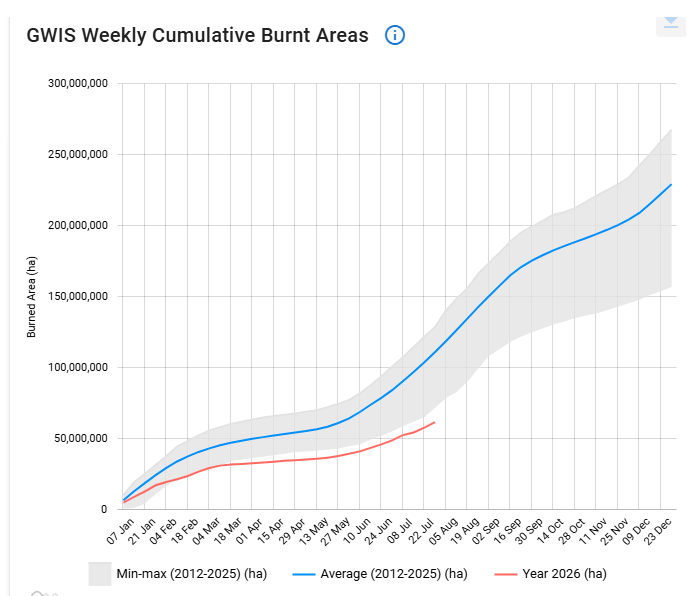
-
Occasional Thoughts on Climate Change
WolfStock1 replied to donsutherland1's topic in Climate Change
So you're saying CC's effect are somehow limited to the EU, and do not include Russia? Sorry - that's still cherry picking data. The more data you include, the better picture you get. Stop excluding data that doesn't fit your narrative. (Also Nature isn't exactly an unbiased reliable source. Also - "is expected to"? Since CC is already here - if it results in wildfire growth - shouldn't this already be happening? Why would this need to be a prediction, rather than an observation?) -
Occasional Thoughts on Climate Change
WolfStock1 replied to donsutherland1's topic in Climate Change
Indeed - not an expert on the subject but that's almost certainly the case. Not just better firefighting equipment so much, but better detection and tracking methods (primarily satellite). Of note is that, in the US at least, there are essentially no more manned fire towers - they're all just obsolete and for tourists these days. That plus there are more people living in areas that used to be remote, thus it's less likely that given fire will grow to unmanageable size before it gets noticed. To the subject at hand though - in general it's completely invalid to point to localized (time or region) flare-ups of wildfire activity and blame them on climate change, since the overall trend is downward. MMGW deniers will point to this and assume / assert that the data cherry-picking is done for all data. As such - my advice to anyone trying to use data to prove MMGW - don't use wildfire data, because it's not a valid indicator. -
Occasional Thoughts on Climate Change
WolfStock1 replied to donsutherland1's topic in Climate Change
Re: "Wildfire swept" - I hope people don't think that's due to CC. Because if so - look what Europe as a whole shows: It's an extremely low wildfire year across Europe as a whole. https://gwis.jrc.ec.europa.eu/apps/gwis.statistics/seasonaltrend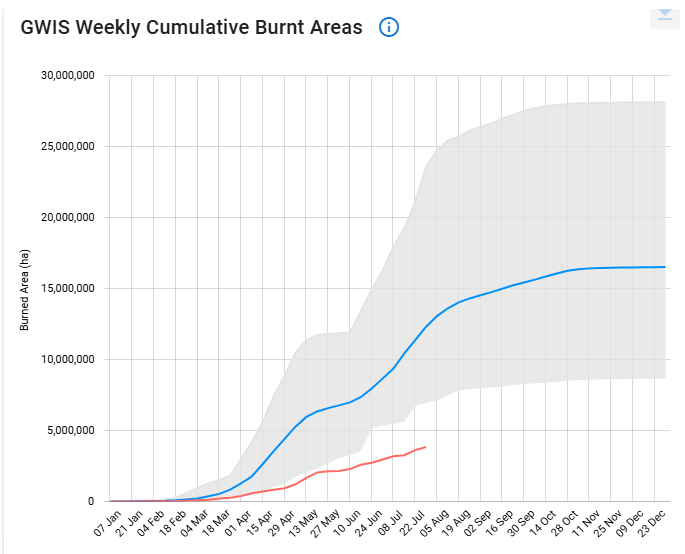
-
OK thanks. I see the description of the two: "Sea ice extent is the integral sum of the areas of all grid cells with at least 15% ice concentration, while sea ice area is the integral sum of the product of ice concentration and area of all grid cells with at least 15% ice concentration." I *think* I get the distinction but not sure. Is it the case that "extent" include 100% of every grid cell, for cells with > 15% concentration; whereas "area" includes only the area of ice itself within all those cells? (thus why extent is larger than area) (I had been using the NSIDC page which only shows extent - https://nsidc.org/sea-ice-today/sea-ice-tools/charctic-interactive-sea-ice-graph)
-
Guess I haven't seen the other - the actual area thing. Got a link? I'm wondering how they would define that. Presumably the 15% thing is because there's no well-defined line of the "edge of the ice" eventually the ice starts just breaking up into a bunch of floating icebergs, that extend out for hundreds or even thousands of miles (all the way down to Bermuda even sometimes); how would one measure the "area" of such a thing, especially on a daily basis? Would they just sum up the total of the surface area of all icebergs? (including "the big one in the middle") That seems like an impossible task.