Windspeed
-
Posts
4,791 -
Joined
-
Last visited
Content Type
Profiles
Blogs
Forums
American Weather
Media Demo
Store
Gallery
Everything posted by Windspeed
-
Sam is looking downright impressive this morning. Also crossing a region of higher OHC, with SSTs surpassing 29°C. Definitely going to keep pumping out that ACE at least thought tomorrow.
-
I mean, whatever. I am sure there are plenty that only follow for landfalls. I enjoy tracking them regardless. This has already been a better CV season than last year with Larry (which did landfall) and Sam, the strongest MDR system since Lorenzo. 2020 Paulette was kind of meh. Really, Teddy was the only quality MDR system last year. At any rate, it's far from dead or boring.
-
Meanwhile, Sam-Eye-Am there. Upper level cloud debris is clearing out...
-
What in the Sam HELL? A Michael Cat 5 debate? Really?! lol..
-
That seems to support this latest MW scan as well.
-
Gettings spoiled by these reconnaissance radar scans. This needs to become a thing. Bless the meteorology college dude providing these on his own time. Last scan looks like an ongoing merger to me. But of course there are multiple banding features around the core. Any continued VWS is going to help spur ongoing replacement cycles at this point.
-
954.5 EXTRAP on the last pass. Reintensification continues.
-
Sam has made a nice recovery this afternoon. SSTs are still a good margin above 28°C. Probably ~28.5 at its location. Plenty of OHC to support reintensification.
-
This is a low res scan from the onboard radar from most recent recon pass west to east through Sam. The author seems uncertain about the maturity of the outer band, but this looks very much like degradation due to strong subsidence off the SW quad outer eyeband/wall. Also explains the semi-trichoidal motion. We're probably halfway through the current EWRC (at this given scan).
-
Yes the CDO is giving strong hints of an outer eyewall. Recon has probably arrived at post-peak. Perhaps how low the pressure is now will be a good indicators of how strong it was four-to-six hours ago.
-
Sam's relative motion actually has not changed all that much over the past 3 hours. But the core is so small / compact that it appears the slow rate is still good enough for the eyewall to replenish over unspent surface heat content without upwelling itself too much. Recon will have better data soon but it does appear that Sam has intensified.
-
Hope this presentation can persist until recon gets there. Outer banding is intensifying but perhaps wouldn't be quick enough to mature an ERWC to weaken it prior to recon, but you never know.
-
Re: Forward motion, it does appear that Sam is slowing down. Will be interesting to see what recon find this afternoon. Upwelling may become an issue despite Sam having a relatively small core vorticity maximum. At present this is still a mighty impressive looking Atlantic hurricane.
-
We're in the midrange now. EPS and the Euro op which had been flirting with the idea of the cutoff trough hugging the inland interior is no longer resolving. So at this point I think it's pretty safe to expect that whatever troughing evolution occurs, it will be too far east to bring Sam back west towards an ECONUS threat. Can't entirely rule out ECAN yet but Sam is looking like a sole threat to Bermuda. So we'll just have to see how that evolves and if Sam comes into close proximity of the island. Sam looks really stable right now. It will be interesting to see how long the core can avoid an ERC. Forward motion is still good enough to avoid upwelling issues, but any slowdown could also induce some weakening. SSTs are still quite warm. I'm not ruling out recon finding a stronger hurricane, but it may be at peak for its life cycle.
-
Yeah I get the suspect meso/microvortices directtional changes and the 700mb 10% reduction but there was plenty of redundant data to support 130-135 kts / 155 mph on the advisory package. Either way, still an impressively intense Category 4 Cape Verde hurricane.
-
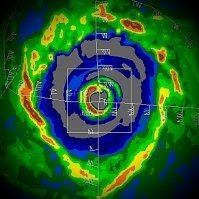 All excited about the intense Atlantic action, meanwhile the WPAC basin casually ushers out its third Cat 5 of the year. lol...
 -
Yeah, and just as you would have it, as reconnaissance leaves, a strong CB encircles the eyewall. That's the way it goes. lol...
-
2021 Atlantic Hurricane season
Windspeed replied to StormchaserChuck!'s topic in Tropical Headquarters
We're not in Storm Mode. If it relates to Sam and is anything meteorological like the question you pose, then just take this to the Sam thread. -
You think that's bad? My late grandmother's name was Ida. My father's name is Sam.
-
lol at that 921 mb wind. I suppose if the pressure falls any further or the wind / pressure gradiant had a little more time before any structural degradation of the eyewall, it might pull off Cat 5. Sam is a compact hurricane. I suppose we'll just have to see how long the core can maintain this structure without concentric banding getting the upper hand. Irma was pretty resilient to full cycle ERCs in this region back in 2017. It would pull off some some kind of absorption of the outer band before it could fully become concentric.
-
I'm a little leary of >140 kt SFMR readings without similiar flight level readings as well. But Sam is no doubt an intense hurricane. Especially in this region of the MDR. It's in rare company. Think Hugo and Irma. I'd be comfortable with 135 kts / 155 mph on the next advisory.
-
I'm not even sure why I typed CGs ( i.e cloud-to-ground). I wasn't even thinking CGs when I made the post. But, yes, just GLM remote sensing data.
-
Tidbits is back up for the moment. NOAA2 (Miss Piggy) is the current recon mission into Sam. There are also active data gathering missions to sample the atmospheric environment for the overnight model suites.
-
Lightning CGs.
-
Sam has most likely attained Category 4 intensity. Good time for recon to be en route. I suspect that is what they'll find.