Jump to content

EasternLI

Members
  • Posts

    3,479
  • Joined

  • Last visited

Everything posted by EasternLI

  1. Snow is falling here. We'll see what we end up with.
  2. Soundings aren't looking half bad... When the lift comes through it's smack in the DGZ. Should see a pretty good shot of snow growth with this. Not really seeing any dry layers to eat it up. That's on the nam. If the RRFS were to verify, would put my area right near average snow for the entire month of December. Something that hasn't happened here since winter 20-21.
  3. Check out what the top 2 clusters (left 1 to right 2) from this run end up with by the end of that same period...
  4. Well sure, a couple things about that though. I've seen those charts change very rapidly in the past for one. As they start picking up on any specific tropospheric pattern that are the drivers of said events. Which models aren't great with at extended leads as we all know. Or even 5 days for that matter . Also that chart is from yesterday's weekly run. I didn't see anything resembling what I posted about on any of the runs yesterday. This was something new today in the 00z eps members. Lastly, I didn't call for anything to happen. That was just perfect opportunity to bring it up as it's a good illustration. Plus seeing that within the 00z eps members is a little interesting.
  5. Hmm, this is an interesting chart depicted by last night's eps cluster analysis. Not for whatever it may be depicting in anyone's backyard. The leading cluster in the day 11-15 range is this one. That progression of the troposphere gets really close to something resembling EOF2 from the following paper. With the +NAO and Scandinavian block. The progression leading to it is even pretty close to what is depicted in the paper. The Scandinavian Greenland dipole. Worth keeping an eye out for that phenomenon in future runs. As it's not something that's well modeled in advance. But a depiction of something like that on a prominent piece of guidance is interesting. Representation of the Scandinavia–Greenland pattern and its relationship with the polar vortex in S2S forecast models https://rmets.onlinelibrary.wiley.com/doi/full/10.1002/qj.3892 From the abstract: "The strength of the stratospheric polar vortex is a key contributor to subseasonal prediction during boreal winter. Anomalously weak polar vortex events can be induced by enhanced vertically propagating Rossby waves from the troposphere, driven by blocking and wave breaking. Here, we analyse a tropospheric pattern—the Scandinavia–Greenland (S–G) pattern—associated with both processes. The S–G pattern is defined as the second empirical orthogonal function (EOF) of mean sea-level pressure in the northeast Atlantic. The first EOF is a zonal pattern resembling the North Atlantic Oscillation. We show that the S–G pattern is associated with a transient amplification of planetary wavenumber 2 and meridional eddy heat flux, followed by the onset of a weakened polar vortex, which persists for the next two months."
  6. Yeah, this warm pool facet of how things are evolving this year is pretty fascinating. Eric Webb had even made a mention of this idea near the beginning of the month too. I mean... we legitimately could be attempting to pull off something exactly like that... Already, over the last 7 days there's been warming and cooling of sst's in all of the right places (1st image). Plus with an outlook favoring some persistent wwb's right around the dateline (2nd image). In the near future and for the seemingly foreseeable future. With that warm pool currently leaning a little to the east already too. Sure sounds a lot like the proper recipe for continuing to see good things evolve out there in the wpac.
  7. I'm inclined to agree with that right now. For one, because of what we've already seen this season. But also, another nice group of ensemble members on last night's run showing that too. Possibly better than yesterday's group even. Also if you go loop some of the op runs out to the end. There's hints of some favorable wave breaks in progress in the Pacific... and some signs of that possibility within the eps members too.
  8. 12z EPS mean at hour 360: At face value, this looks like quite a huge ridge for the east is inevitable. Potentially a protracted one at that. Looks can be deceiving. Such as the cases when ensembles show epic patterns that fail to come to fruition. There's actually a lot going on under the hood in the model run when you take a little deeper look into it. Ensemble means will just blend everything together and give you whatever that looks like. As it stands right now, based off of this run, at this hour of the run. That likely doesn't verify verbatim. You're seeing a smoothed out mean of different solutions. Take for instance the cluster analysis from the same run at the same time. 3 clusters for that period today. Not what you would expect to see given the above image. Especially seeing the left one as the leading cluster, encompassing the greatest amount of individual members. This is all subject to change of course based on future runs. I'm simply suggesting to stay open minded. Also interesting to note from this run of the EPS is the situation with the MJO. Personally, I'm of the firm belief that any legitimate Phase 8 attempt has not occured. For reasons mentioned earlier in this thread. Regardless of what the RMM plots are showing/telling everyone. The signal was pushed there via the strong (aided by events in the stratosphere) kelvin wave but abandoned just as it got there while the kelvin wave had continued on. That kelvin wave went on to amplify the MC forcing in the near term which has been discussed and we will likely see ramifications from. Meanwhile, keep in mind this is/has been the slow moving variety of MJO. Kelvin waves move much faster and they are the high frequency component Paul Roundy makes references of from time to time. So on this 12z run today, there are finally some surprising hints of perhaps attaining an actual period of phase 8 forcing from this MJO event. As the kelvin wave moves on from the MC region and picks up the underlying original MJO signal that was previously abandoned in phase 8. Then re-amplifying that signal and potentially in the legitimate way this time. See the following velocity potential forecast from this run. Where I have circled is the key timeframe as to whether or not that happens. As myself and others here believe, we need this suppressed phase to take over the MC completely in addition to the western hemisphere enhanced phase in order to properly accomplish that. Looking over the individual members VP forecasts, there are finally a good cluster of members doing exactly what is needed. In the timeframe that is circled. Hence the look on this mean today. Will be interesting to follow future runs in light of this considering individual members were quite literally all over the place in previous runs. There's a group of them that are on board with this idea today though.
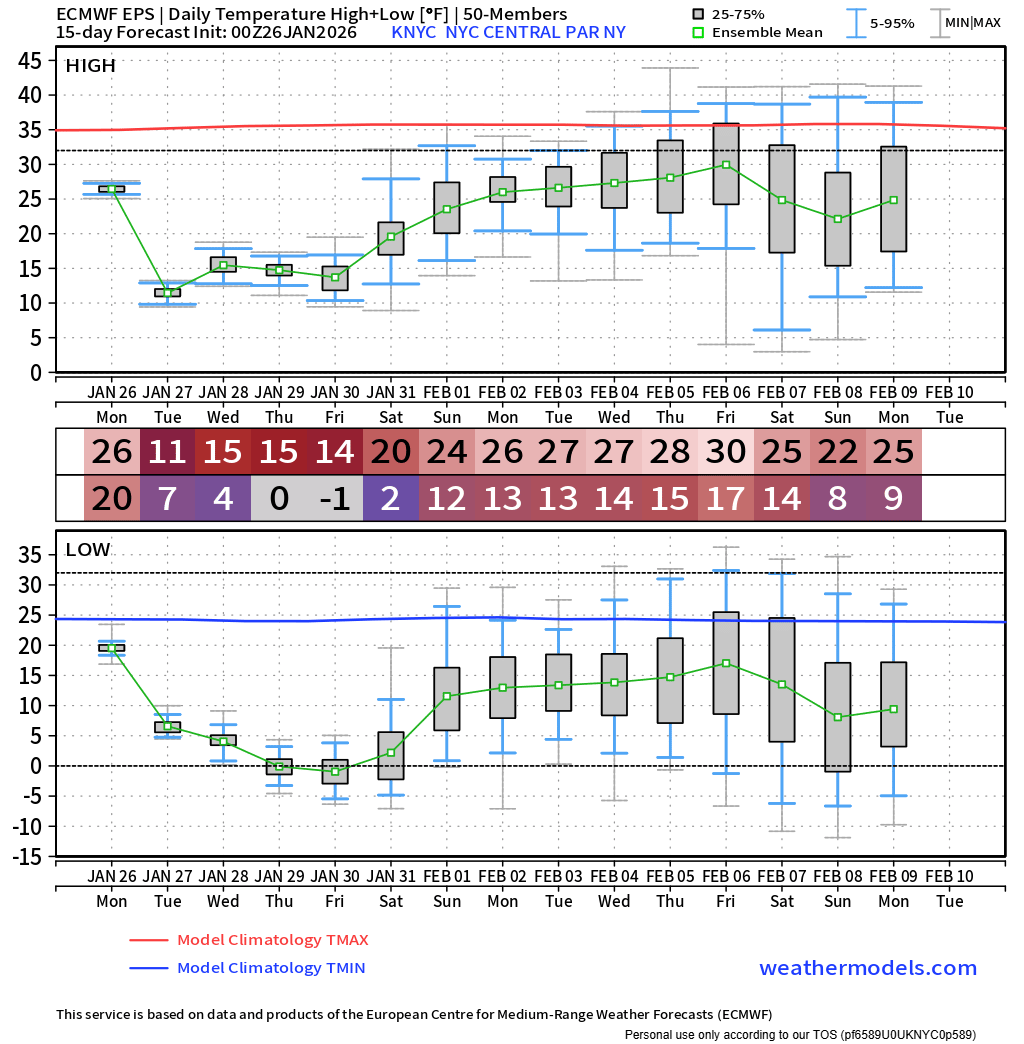
  9. I think I see where you're coming from with that. I could buy that. Fits in with the natural progression of similar past events well I think. Still really interested to see how this year ultimately handles matters.
  10. Yeah, that makes sense actually. With the Kelvin wave already discussed constructively interfering with the MC region while it passes through. So a break in the pattern is plausible, potentially. Not set in stone. But I could see that happening. Interesting about the base state favoring -wpo and -nao episodes. Seems any break in the cold wouldn't be long lived under these circumstances. Really interesting year we have here.
  11. I buy some sort of Pacific shake up. Not entirely sure to what though. The catalyst to force that looks to be an -EAMT set to take place in the day 10-15 period. This should do a few things. Retract the Pacific jet causing some wave breaks. This should force alterations to the Pacific. Perhaps this is the signal for this current WPO episode to wane. With a retrograding Pacific, not sure. But also this would be the driver of the fall in AAM that's been identified in the next 2 weeks. What I believe that means is an attenuation of this current MJO signal. Probably signaling the end of this current MJO event as well. Until the next one takes shape into January is my guess.
  12. Was just about to make a post regarding that. Yes, It's exactly for that reason that the anomaly charts should always be used and the reason they are the ones always referenced. For instance, you could take a year such as 2009-10. Very well known as a modoki el nino year. Well if you look at the raw velocity potential, one could say strong forcing stuck at the MC. While the anomalies will paint a different picture entirely.
  13. It's kinda interesting watching the migration of the west pacific warm pool since October. Now biased more to the east. That thing starts becoming more and more of a favorable feature, and less of a detrimental one, the closer you can move it towards the dateline. It doesn't even need to reach the dateline. Just have more separation between it and 120E than usual. With the ongoing wwb, and future ones seemingly slated throughout the month ahead in the Pacific near the dateline. This probably continues to evolve. It's a curious little aspect of how things are playing out. One can't help but wonder if the evolution throughout the month ahead with this feature holds any clues for later in the winter (or not ).
  14. Nice post. Thank you for your insight. I've been watching that period thinking we might be able to sneak a better western ridge amplification in there somewhere. On the 12z EPS clusters, 2 out of 3 of them in that timeframe are indeed attempting that ridge link up. One of them being the most populated cluster.
  15. Probably, but you never know. Those types of things are dictated more by nuances within any framework. One ingredient of a good storm though is a good baroclinic zone. Which we don't have if everything is warm. I like seeing the cold and then we'll see what happens.
  16. That's a frigid look just starting at the end of the eps last night... -WPO loading Canada with cold air. With SW US ridging is going to relay that SE... I'll roll the dice with that anytime.
  17. I don't believe one exists unless someone has done an extensive reanalysis effort? After all it was only just discovered in the early 70's. Would love to see it though if someone did.
  18. I think this whole process was slowed down a little by the original Kelvin wave coming in stronger than longer range guidance was suggesting. So a little after mid month now looks like a better bet. After that period of destructive interference this is a pretty nice look starting to show up. And with the next Kelvin wave about to constructively interfere with it just beyond this.
  19. What delightful thoughts these are to be pondering as I sip on some coffee early this morning. Yeah, let's get the MJO to shove that warm pool out to the dateline...
  20. I feel like it's worth a casual mention that the EPS has been seeing some new Siberian warming cropping up at the end of recent runs. Today's 12z has continued with that thought. GEFS however has not been showing much interest in this idea.
  21. There is, perhaps, something else to consider in the context of that. The IPO or Interdecadal Pacific Oscillation. Being an interdecadal phenomenon, it operates on timescales of multiple decades. This complicates matters. It's easy to perceive something potentially spanning over a decade as being permanent. It also encompasses the entire Pacific basin. Whereas features such as Enso and the PDO are more geographically focused and can fluctuate within the greater framework spanning multiple decades. There's a lot to read out there on the topic. 1st image below is from the NOAA Physical Sciences Lab showing the positive phase of the IPO and associated tripole signature. Interestingly, there have been some research done suggesting links between the record 2019-20 Australian wildfires and the IPO. Perhaps enhancing a negative phase along with playing a role in our most recent triple dip la nina event. By altering cloud physics. 2nd image is what we have currently. Showing a pretty clear -IPO on going to this day. One day this will shift again. My guess is that we'll see the marine heatwaves that we hear about shift as well when that happens. +IPO: Current conditions:
  22. I made some quick markups on the chart from the 6Z GEFS to better illustrate what you're seeing on those charts. This ties in to the post I made a couple of days ago regarding kelvin waves and the mjo signal. The true Phase 8 attempt will be right near mid month. Just out of range still but closing in. Effectiveness remains to be seen of course. Notice on this also how the la nina influence re-emerges in between passing kelvin waves causing the loops on those charts.
×
×
  • Create New...