
-
Posts
26,580 -
Joined
-
Last visited
Content Type
Profiles
Blogs
Forums
American Weather
Media Demo
Store
Gallery
Everything posted by psuhoffman
-
After looking over the 3 ensembles overnight... After the day 9/10 threat (that has been covered already) the EPS and GEPS both agree on developing a fairly favorable pattern. The GEFS is further east with the eastern trough but that could be its bias to press cold too much. We actually want the trough centered further back. We have been in this cycle of 10-15 day patterns with short transitional periods in between since November. That looks to continue. The next pattern is starting to show itself as one dominated by a central North American Ridge with the southern Jet undercutting across the US. That can work if we can time up a system with a 50/50 low. It's actually a pretty common look within snow analogs. It's not a very cold look but get a storm to track right under the blocking ridge and it can work. But like @C.A.P.E. said right now there are discreet warts showing that prevent that on guidance. Too much ridging extending to our northeast being the main one. I really debated even saying this because I do not want to send this thread off on a tangent... but it's something that I have been kicking around in my head. There were a LOT of snowstorms in the data set with a look close to what we have coming up. But they were mostly pretty warm storms...a LOT of storms where we managed to overcome marginal temperatures. It is not a cold pattern look. But...looking at some of those storms from the 50's, 60's, 70's, even 80's and 90s....I have to wonder if the atmospheric base state is cold enough right now for that to work. Without starting a debate about climate change, the fact is the base state is warmer right now...I am not getting into the why or what to do about it debate, there is another thread for that so save it. And you know who I am talking too. But would a storm from the 1970s that dropped 8" of heavy wet snow from 1.3 qpf on a day with a high of 35 and a low of 31 even work right now? And that is kind of the profile of a LOT of the storms in the "Hudson Bay +AO" snow set. Just a thought... As for where we go AFTER this...there are signs again of the pattern starting to shift towards day 15. Where is unclear though. There are signs of a trough in the north PAC...where exactly that ends up might be the key. If that sets up near the Aleutians we might shift into the typical EPO ridge pattern we kind of expected to be setting up this week. If that presses too far east into North America...we probably get flooded with pac puke unless the NAO flips and there is no sign of that. Of course phase changes up top tend to happen within 10 days so we probably won't know when its 15 days away. The MJO is sending conflicting signals in the long range but most of all it seems to be going somewhat dormant after this current wave fades. But I see no sign of a return to a strong MC signal so that is a positive. We still have agreement on the long range guidance of an EPO ridge +NAO pattern...but they were advertising that the next 2 weeks and totally missed so how reliable are they at 3-4 weeks? The only consistent theme this year is variability and a lot of conflicting signals. So I guess I am saying I have no freaking clue what happens after this coming 10-14 day pattern. I wouldn't be shocked if we end up with a favorable look...or end up in another no hope dumpster fire one.
-
Our fate isnt as dire as some of those snow means indicate. The guidance across the board did deteriorate wrt the day 10 threat but that is dependent on a single feature...getting a stronger 50/50 to knock down ridging to our northeast... that it could easily trend back on guidance if that one thing changes. Actually across guidance there was a trend towards squashing that wave because of "too much ridging" up top. But either way that isnt a high probability right now...but its not completely dead either. After that the snow means look pretty ho hum but part of that is due to a scatter shot in the day 11-15. There are a lot of misses to our south on the GEPS/EPS/GEFS. Some misses to the north (but not by much) and a few hits. That scattershot produces a mean that is unimpressive...but is not the same as a similarly unimpressive mean from a consensus that everything will go north of us. That is a bigger problem and much less likely to change in our favor. As the pattern day 11-15 gets closer the guidance will converge on where the waves within that period will track and once they do we will see somewhere benefit. It could end up NC. It could end up here...it could end up just north of us...but somewhere within that box will likely get snow in that period.
-
@Ralph Wiggum If we break down all the different combinations of patterns...the problem is only like 20% of them are "good for snow" here...and even in one of those "good for snow" patterns we need luck or we can waste it. The pattern we are going into isnt a "good for snow" pattern...but its not in the "bad for snow" either. It's kinda a "meh" look... and we sometimes score in those but it will take some things breaking our way. If your point is that our odds of a big snow within the next 10 days continues to be low... you are right. But that would be an accurate statement 95% of the time. But if you are implying the pattern is not really changing and everything remains the same...that is not accurate. Different doesn't necessarily mean snow though.
-
You clearly are implying some kind of continuity with the seasonal pattern this year...but in reality we have had none. The only constant has been consistent change. So far this winter season we have had 3 very distinct DIFFERENT 2 week patterns. And we are heading into another 4th different pattern that looks to last...get this.. about 2 weeks, on guidance. This pattern Dec1-15 WAS NOT LIKE THIS PATTERN... Dec 16-31 WAS NOT LIKE THIS PATTERN... Jan 1-13 Pattern 1: The pattern early December was dominated by a favorable EPO ridge but with a very positive NAO. Had that pattern continued into the core of winter we likely would have done OK. It's not the best look every but very workable. But it was a bit too early, we had a few threats and some minor snowfalls during that period but it was too early to really judge its effectiveness as a "snowy" pattern since we don't typically get much snow that early anyways. Pattern 2: Was dominated by -AO but a AK vortex that lead to a pacific puke airmass overtaking the CONUS. The Atlantic side was good during this period but the pacific took a dump on us and early in the season its almost impossible to overcome that look in pacific. Pattern 3: The worst pattern possible, it's amazing we scored a fluke snowfall (although it was a minor event and those can sneak into ANY pattern with a lot of luck) due to a well timed transient ridge out west... but dominated by a huge central PAC ridge and positive AO/NAO. This is one of the worst patterns for snow here. The coming pattern that looks to dominate the next 2 weeks or so looks like this... Pacific Trough, ridge across Canada (Hudson Bay Ridge) Atlantic Ridge displaced too far south for where we need it... This isnt a horrible look...it gives us a MUCH higher chance of a significant snowfall than the last 2 patterns did... (in the cities) but it has warts that could prevent that and right now they are showing on guidance. I will get into that in my next post.
-
@Ralph Wiggum the longwave pattern is completely different. It’s in transition now as the central pac ridge that has been the main driver begins to shift up through the epo domain and eventually ends up centered in central Canada. Just like late December was a different pattern from now. Both were bad patterns for snow here. If all you do is look out you’re window to judge then they might seem like the same pattern. But ask anyone in the pac NW and they will tell you how different the last 2 weeks were from the last 2 weeks of December! We can fail in lots of different ways because we are not in a location where snow comes easy. It’s not the normal. It’s an anomaly that only happens when we get several variables to line up favorably and even then we need luck. One commonality between this past pattern and the coming one is a positive AO. That going to make getting snow an uphill battle here even with other variables shifting around.
-
It’s ok. The 50/50 is fine. The blocking is fine. But the trough cuts off over Colorado then lifts up near Chicago. That’s the issue. There is cold in front available if it took a good track.
-
It won’t show up as a -NAO because of the lower heights near Iceland. It’s not a typical NAO. But that look is good. A block across Canada with a 50/50 is a good look even if it doesn’t show as an NAO block.
-
I was mostly analyzing how the gefs was trending towards the gfs op wrt what happens in the Atlantic. As for the op run I was analyzing what happens around day 5 that sets off the chain reaction after. I would never waste time analyzing specifics longer out than that on an op run unless it was just to have fun. But the op run is a look at one permutation of the atmospheres possible outcomes. Looking at how it got to that outcome to understand what we need to happen can be useful. Using an op run as a carbon copy forecast at day 10 or analyzing synoptic details at day 10 are a waste of time.
-
GEFS is trending the right way. Look at the changes the last 3 runs wrt the 50/50 and where the ridging is centered leading into the threat.
-
@Bob Chill @C.A.P.E. the way the gfs goes off on that beautiful tangent actually happens at only hour 120 or so. After the weekend storm instead of getting absorbed into the TPV that NS vort in Quebec dives in and phases with the fish storm early next week pulling it up into a 50/50. The wave break from that pumps the NAO ridge and sets to the crazy blocking across Canada that leads to everything after. That one thing sets off a chain reaction.
-
Yea I would much rather be analyzing a 24 hour plot of moisture convergence, fgen, vorticity etc to figure out where the death band is going to set up. But truth is in 90% of the time I’m stuck chasing long range unicorns or day 15 pattern changes. Even our rare amazing winters often have lots of dead space. 3 weeks after the second Jan 1996 storm. A month between storms in 2010. Even 2013/14 had a dead spot the second half of Dec and it was the most consistent non stop winter of my lifetime.
-
@frd there are so many variables it’s impossible to know them all. I know overall phase 7/8 in January are cold. But what does phase 8 correlate too when a purple polka dot unicorn does the Macarena while facing southeast on top of Mount Washington? Apparently there is some obscure reason why phase 7/8/1 actually suck whenever the mjo actually goes into 7/8/1! This would be 3 times in a row someone offered a reason why “in this very specific scenario” it’s not actually good. In 2018 things were delayed a week more than typical but an epic pattern did come in March. Yea it was March but it snowed in our area 3 times and one was significant! They wasn’t a fluke. Last year we never got a typical phase 8 response but the wave was very weak. And when I looked into what Furtado said there was a sample size of like 3 and 1 was cold, 2 not. So how that’s statistically significant? My guess is there are factors that can countermand the mjo or mute it. Especially when it’s a weak wave. But at some point it’s paralysis by analysis. You break down these pattern influencers into smaller and smaller categories and you don’t have enough examples to really know anything anymore. Besides what then happens in other phases? I asked Furtado what phases we want for cold in his specific scenario and he never answered. Was the answer we can’t get cold during low solar with a weak strat PV? They can’t be true! Do we want no mjo wave? Honestly I don’t know. He didn’t answer. Anyhow we can’t even predict the mjo very well at long range so it’s tool in long range predictions is limited. Remember last year it looked great then suddenly collapsed through the COD and cycled right back to the warm phases. Really screwed the unanimous calls for cold. Then after the fact a lot of people gave reasons but funny I don’t remember them saying anything before it became apparent.
-
The MJO in 7/8/1 is great, except when it ever actually goes into 7/8/1 and then it sucks.
-
Fringed
-
As of now the eps favors the warmer solution. But it’s not a case where there may or may not be a storm. The storm is there just the eps favors too much ridging in front and torches the temps. But watch that change in a dime if a future run decides to phase the ocean storm next week with the NS and suddenly there is a 50/50. Or it suddenly decides the NS vort in Canada next week is going to bomb. So imo it’s one of these situations that looks bad and isn’t likely but could flip on a dime if just one thing breaks our way. Ironically the gfs and euro flipped positions in the last 48 hours. Wrt the eps there was a huge spike in snow just southwest day 15. Looking at the members there were several “incoming” storms at day 15. Day 16 was going to be big. Lol
-
That’s some of the most redonculous blocking I’ve ever seen. All of Canada. Why it still manages to snow with a primary way west. I’d settle for just getting the 50/50 and have the storm stay under us. I like simple.
-
Last post for a while...have to get back to work This is the issue with the progression...EPS day 10 The timing of the ensembles is a little slower than the op but this shows the issue. The flow ahead of the trough is all out of the south. That is torching the mid levels. If we had some cold to work with in the mid's we could probably overcome the warmer surface temps...mix some cold down with a good track...but if we torch the mids and the surface...well its game over. So taking the 6z GFS that had snow as an example This wasnt perfect...it was still messy, the ridge would be better centered west not east of the Hudson Bay, but that 50/50 makes it work. Look at the flow now over us and to our northeast. Cutting off the southerly flow from torching us ahead of the trough. Plus it creates confluence to hold a high pressure in longer. This lead to the snowy solution on this run. The op euro though... That same feature is displaced where it can't help us and so the southerly flow torches us ahead of the system and there is no confluence to our north. It's close...but this isn't horseshoes or hand grenades. So how can we get to the look we need.... So there the energy that will be the day 10 threat is coming onshore in the west. We need to get one of those vorts numbered to amplify significantly and into the 50/50 spot. What happens on the euro op, 1 amplifies but remains cut off from the NS flow so its too far south, 3 gets absorbed into the TPV lobe and up into Greenland...2 washes out completely and 4 does end up where we need it but doesn't amplify enough and is way too weak to do much good. Get 3 and 1 to phase and pull them up into the 50/50 domain and that works. Get 2 and 4 to phase and amplify...get 4 to amplify by itself. None of those solutions would do us any good for snow BEFORE the day 10 threat... the flow is way to suppressive, could help give northern New England a light event...but any of those combo's would knock down the ridge to our northeast, create confluence and shunt the southerly flow ahead of the wave from destroying our thermal profile. Hope that explains what you were asking. Back to real life...
-
BTW wrt to the EPS, while the snow mean is unimpressive, there is a big spike just to our southwest day 14-15. A lot of members end day 15 about to blast us with a stj system, this time with cold locked in thanks to the lower heights to our northeast due to the storm day 10-12.
-
Euro depiction of slightly above normal temps between day 7-12 is reasonable given its stale cold air trapped under a ridge. But we can snow in that profile...especially if we can fix the ridge issue to our northeast allowing the mid levels to torch ahead of the wave. It's cooling again day 15 either way. GFS is too cold in the long range...we know that.
-
This look here day 13 actually fits the profile of our “positive AO big snowstorms”. Obviously we want a -AO. But when we scored snow with a +AO it was often in a look like this... Whatever happens with the day 10 threat the eps thinks that system migrated through the 50/50 region knocking down the ridge to our northeast. The fate of the day 10 seems to rest on the ability of some discreet wave before that to amplify just enough to knock down heights there ahead of the day 10 storm. A murkier proposition in the spread.
-
Eps isn’t there yet but trending the right way. Remember the Hudson Bay ridge look I posted wrt the 50/50. This is the h5 run to run change leading into the day 10 threat. This is exactly the trend we need. Lower the heights to our northeast and this becomes a classic snow look. After that the eps opens the door that the day 10 storm becomes a 50/50 for a threat later. Lots of possibilities with the current pattern progs. GEPS looked good day 10-15 also.
-
That is about as good a 5 day mean that far out will ever look. We see higher ens means but it’s always either a close range threat or over a longer period that includes multiple threats.
-
Yea but with a primary unto Pittsburgh and a secondary near Annapolis it wouldn’t matter. But the exact track at day 10 doesn’t matter either. The ingredients we need are all there. We just need them to come togterget properly.
-
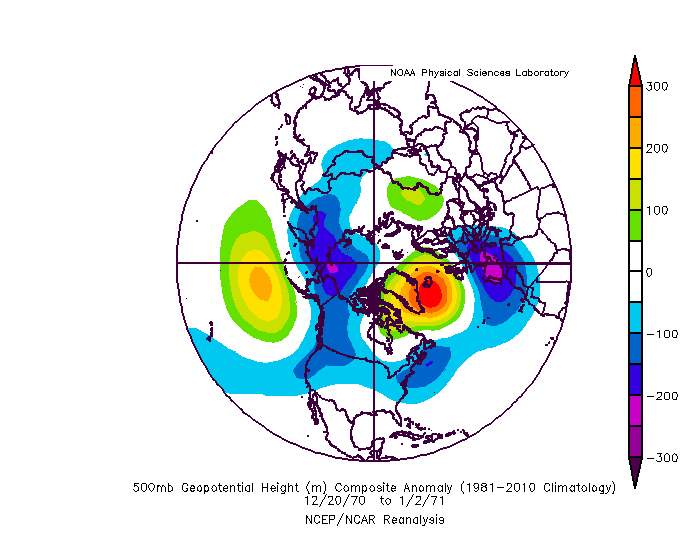
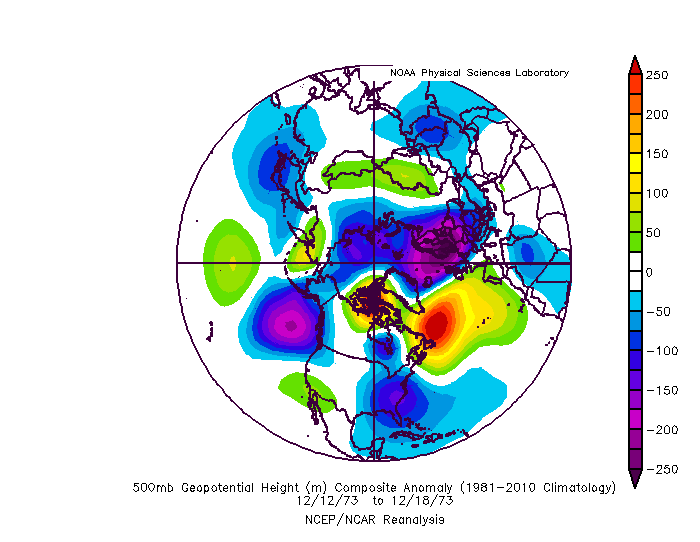
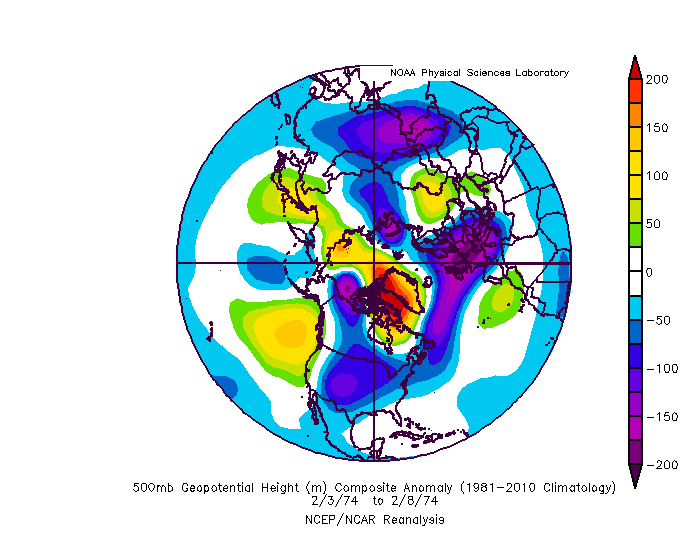
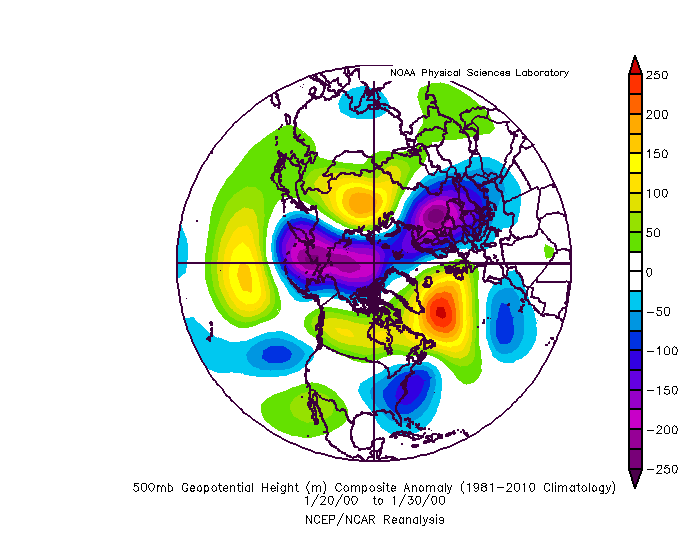
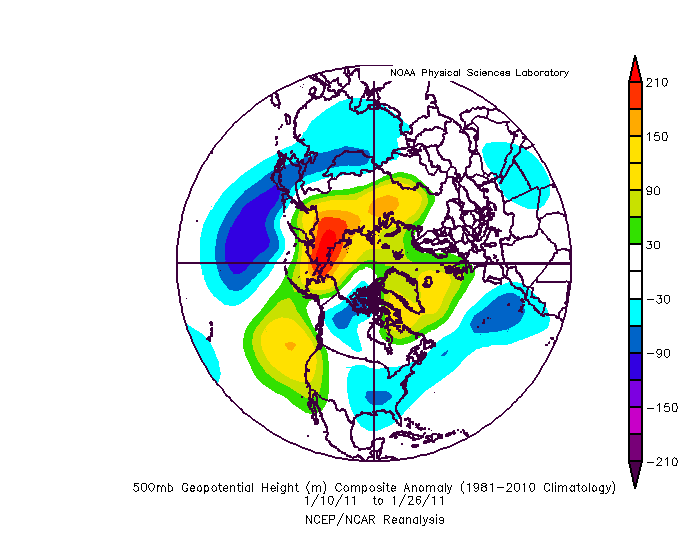
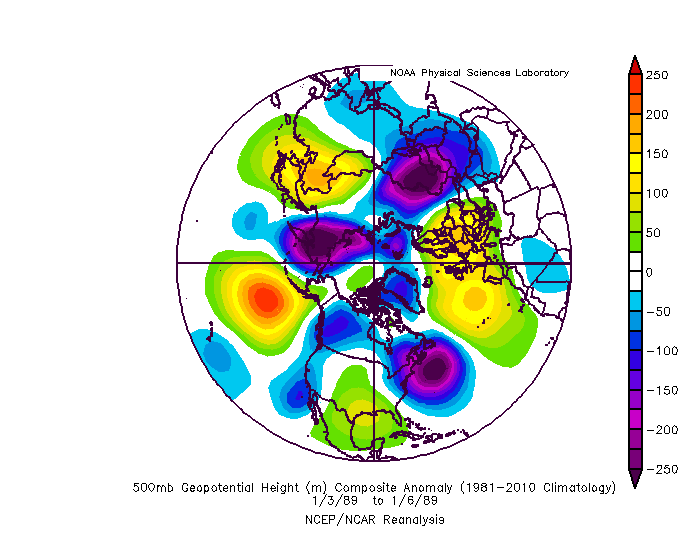
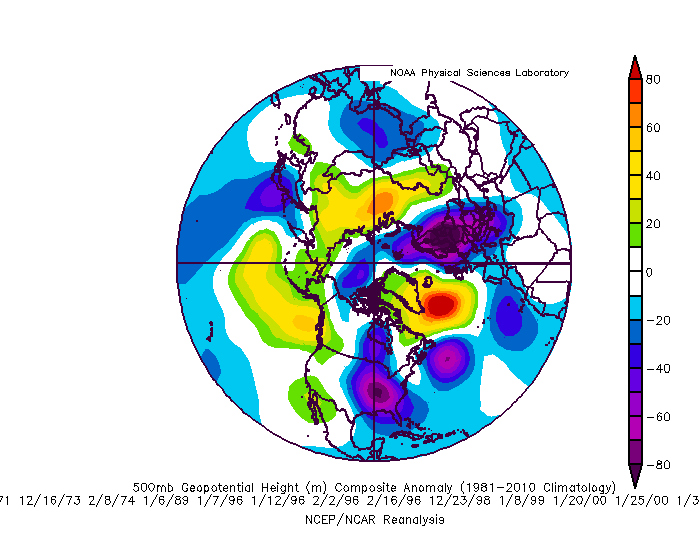
Here is how the look for around day 10-12 has shifted on the GEFS (EPS is similar). Now this time we are comparing a day 15 look to day 10..(last time it was day 10 to 7) so the shifts are going to be a bit more drastic...but still the large scale longwave pattern wasn't awful. GEFS from a few days ago This was a very cold look, big EPO ridge with cross polar flow directed right into the eastern US. But it's also a dry one, and I mentioned that a few days ago when this look was being tossed out. This was likely to be very cold but very dry. The other 2 major features were the PV situated across the NAO domain across the pole into the Kara region, eastern trough, trough in the Pac NE of Hawaii. This is how it has shifted So again it was too far west with the pac trough...this shift pressed the epo ridge into more of a Hudson Bay ridge. It was correct with its NAM depiction and the trough in the east. Now this has a positive and a negative. It cuts off the cross polar flow, so this is a much less cold look. But this is also much more likely to get something to amplify into the southeastern US. That blocking ridge across Canada will cut off arctic cold but there is a shot of cold into the east ahead of this...and so long as that is trapped under the block and not scoured out that usually is good enough in January. Ideally I would like a 50/50...that could end up being the big issue here if too much ridging in the northeast allows the system to cut... but this still has potential imo. This is a composite of 16 warning level snowfalls at BWI with a Hudson Bay centered ridge. The obvious thing missing is the 50/50 low. But that is a composite, not ALL 16 of those had a 50/50, but most hence the mean. But at this range a feature like that could be missed, perhaps an unseen vort next week, Ralphs clipper, can bomb out into the 50/50 space, or perhaps the day 11 storm does cut but becomes the 50/50 for the day 14 threat. Either way, this look is way closer to a big snow look than the one a few days ago. It's not nearly as cold...and it could end up a rain look also...but you have to play with fire to have a nice BBQ! If you did want a week of frigid cold dry weather...I apologize, things are not moving in the right direction for that.
-
@Ji @Ralph Wiggum Was going to post this earlier this morning then got distracted with work. But this is an example of how the overall long range guidance was right...but discreet features within the longwave pattern that are not discernible at long range will determine snow/no. For next week...the period Monday to Thursday...from long range it looked promising Ridge bridge across the top, western ridge, eastern trough...this look could definitely work The overall longwave pattern was pretty close but some details have shifted this to an unfavorable (for us) look Still have the ridge bridge over the top and eastern trough but the system crashing into the Pac NW is shifting the western ridge too far east and that shifts the eastern trough too far southeast...this is now a good look for a possible snow for places in the southeast, maybe the outer banks. Doesn't mean they get snow...but they have a chance which is super rare in itself. The slight error on a specific feature that will not be resolved at day 10-15 shifted this from a very good look for snow to a cold/dry one for us. The guidance wasn't wrong or bad...we just can't see the details that will determine our fate wrt snow from that range. Only the general longwave pattern. Even in a good pattern we need luck with the discreet features. Only a relatively narrow area will actually get snow in any given (short) time period. The coverage of snow with a storm isnt that large typically. Or the difference between a wave amplifying or getting squashed isnt that big on a hemispheric pattern scale. Too many people assume if we get the good pattern it means we get snow. Not the case.