
Powerball
-
Posts
14,486 -
Joined
-
Last visited
Content Type
Profiles
Blogs
Forums
American Weather
Media Demo
Store
Gallery
Everything posted by Powerball
-
Forecast temps may just bust today. Getting a nice garden variety t'storm this morning on the tail end of what's left of that MCS that tracked through NE / KS / OK. It's been raining cats & dogs for at least a good 30 minutes. Even got a decent pop of wind ahead of it (nothing severe, but a stiff breeze). As is typical with these ridge riders, it ended up tracking further SW than models projected. Something possessed FWD to issue a heat advisory yesterday evening for Dallas and Tarrant Counties. That obviously ain't happening todah (not even certain 90s will happen) and has been cancelled.
-

Texas/Oklahoma 2023 Obs and Discussion
Powerball replied to Ed, snow and hurricane fan's topic in Central/Western States
Alrighty then...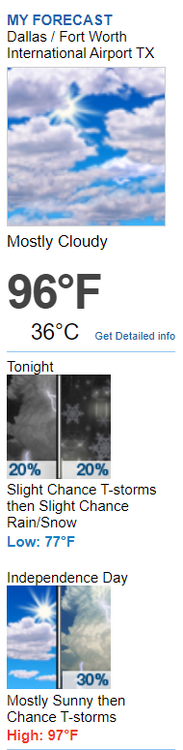
-
Texas/Oklahoma 2023 Obs and Discussion
Powerball replied to Ed, snow and hurricane fan's topic in Central/Western States
With an intra-hour high of 100*F today, DFW is back in business! -
Everything you've explained in your post is also why I remaim extremely skeptical about the extent of extreme heat that models are currently projecting for Dallas over the next few weeks (Houston, San Antonio and Austin, however, should continue to bake).
-
100s aren't happening for Palm dude's part of the country as long as those Canadian wildfires rage on.
-
-
Flood Advisory National Weather Service Detroit/Pontiac MI 255 PM EDT Sun Jul 2 2023 MIC163-022200- /O.NEW.KDTX.FA.Y.0005.230702T1855Z-230702T2200Z/ /00000.N.ER.000000T0000Z.000000T0000Z.000000T0000Z.OO/ Wayne MI- 255 PM EDT Sun Jul 2 2023 ...FLOOD ADVISORY IN EFFECT UNTIL 6 PM EDT THIS EVENING... * WHAT...Flooding caused by excessive rainfall is expected. * WHERE...A portion of southeast Michigan, including the following county, Wayne. * WHEN...Until 600 PM EDT. * ADDITIONAL DETAILS... - At 255 PM EDT, Doppler radar indicated heavy rain due to thunderstorms. Minor flooding is ongoing or expected to begin shortly in the advisory area. Between 0.5 and 1.5 inches of rain have fallen. - Additional rainfall amounts of 0.5 to 1 inch are expected over the area. This additional rain will result in minor flooding. - Some locations that will experience flooding include... Livonia, Taylor, Romulus, Flat Rock, Grosse Pointe, Canton, Downtown Detroit, Detroit, Dearborn, Wyandotte, Trenton, Grosse Ile, Northville, Belleville, Greenfield Village, Belle Isle, Westland, Dearborn Heights, Lincoln Park and Southgate. - http://www.weather.gov/safety/flood PRECAUTIONARY/PREPAREDNESS ACTIONS... Turn around, don`t drown when encountering flooded roads. Most flood deaths occur in vehicles. && LAT...LON 4203 8320 4204 8320 4209 8329 4209 8354 4243 8355 4245 8287 4239 8289 4235 8293 4232 8306 4229 8310 4223 8314 4212 8314 4203 8318 $$ KGK
-
Meanwhile, the initial MCS from this morning managed to track all the way down to Tuscaloosa before diminishing.
-
Texas/Oklahoma 2023 Obs and Discussion
Powerball replied to Ed, snow and hurricane fan's topic in Central/Western States
DFW should end June with around a +2 degree departure, maybe a hair warmer. -
Summer 2023 Medium/Long Range Discussion
Powerball replied to Chicago Storm's topic in Lakes/Ohio Valley
I mean, parts of Michigan did get a decent severe weather event this past Sunday (nothing earth shattering, but relative to climo, it was a solid outbreak). It just didn't happen in everyone's backyard. -
Texas/Oklahoma 2023 Obs and Discussion
Powerball replied to Ed, snow and hurricane fan's topic in Central/Western States
A fair amount of the low-hanging fruit was broken in 2022 as well (which, BTW, tied for the hottest MJJ on record). -
https://www.cnbc.com/2023/06/28/canadian-wildfires-are-causing-the-worst-air-in-the-us.html
-
Texas/Oklahoma 2023 Obs and Discussion
Powerball replied to Ed, snow and hurricane fan's topic in Central/Western States
On the whole, 1980 just wasn't as humid as this heatwave has been so far. -
Texas/Oklahoma 2023 Obs and Discussion
Powerball replied to Ed, snow and hurricane fan's topic in Central/Western States
They must have saw my post, as they finally pulled the trigger... -
Texas/Oklahoma 2023 Obs and Discussion
Powerball replied to Ed, snow and hurricane fan's topic in Central/Western States
I just can't understand for the life of me why FWD is being pedantic about an Excessive Heat Warning, especially given HOU has issued one despite relatively less oppressive ambient temps and heat indices. -
Texas/Oklahoma 2023 Obs and Discussion
Powerball replied to Ed, snow and hurricane fan's topic in Central/Western States
Jacuzzi...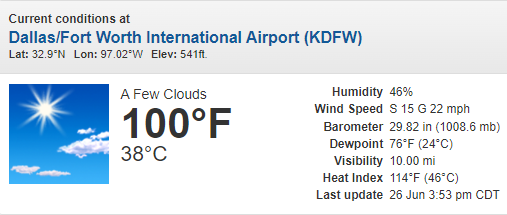
-
Texas/Oklahoma 2023 Obs and Discussion
Powerball replied to Ed, snow and hurricane fan's topic in Central/Western States
Perhaps the most impressive part about this heat wave is that were getting temps 100*F or greater while dewpoints hold in the low/mid 70s through peak heating. It's not often that happens, especially this far NW from the Gulf / swamp land (though maybe in Houston / Louisiana / Arkansas / Mississipi)... -
Texas/Oklahoma 2023 Obs and Discussion
Powerball replied to Ed, snow and hurricane fan's topic in Central/Western States
Official high yesterday at DFW was an intra-hour 101*F, warmest of the year so far.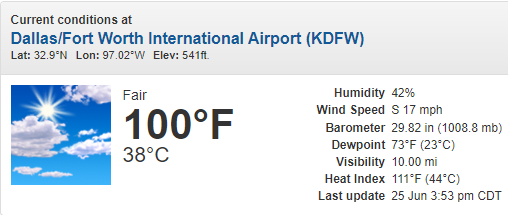
-
-
Yeah, definitely a solid event for that area (beggara can't be choosers).
-
FWIW, the special 20z DTX sounding had an impressive Inverted-V look.
-
That's not a bad-looking (as in it's ok) shelf cloud at all...
-
Nasty-looking bow echo. Will track right through the city if it holds...
-
Texas/Oklahoma 2023 Obs and Discussion
Powerball replied to Ed, snow and hurricane fan's topic in Central/Western States
At last...
-
Texas/Oklahoma 2023 Obs and Discussion
Powerball replied to Ed, snow and hurricane fan's topic in Central/Western States
Another 99*F for the books at DFW today. The first 100*F day of the year should finally happen tomorrow.