high risk
-
Posts
3,312 -
Joined
-
Last visited
Content Type
Profiles
Blogs
Forums
American Weather
Media Demo
Store
Gallery
Everything posted by high risk
-
2026 Mid-Atlantic Severe Storm General Discussion
high risk replied to Kmlwx's topic in Mid Atlantic
Let's fire up the severe thread for one last hurrah! SLGT for parts of the region tomorrow; MRGL for just about everyone else. Strong front approaches Friday evening with a good signal for a line of forced convection just ahead of it. Shear will be very strong, and some forecast soundings have a little bit of instability. The threat of a few damaging gusts seems legit. (I'm ignoring the 2% TOR for now.)- 2,566 replies
-
- 3
-

-

-
- severe
- thunderstorms
- (and 7 more)
-
LWX mentions the possibility of wind headlines over the higher elevations, but recent guidance suggests that wind advisories will be needed for most of the area Friday afternoon and Friday night.
-
Cams consistent with late evening heavy convection. Forecast soundings show elevated instability and support the possibility of thunder.
-
Pretty certain that the morning soaker will wrap up by midday or early afternoon. Then we go into scattered shower mode, and there is a clear convective threat around dinner time into the early evening. The low level shear will support rotation, but will any of the storms be surface-based? It still looks like the best chance at some modest instability will be over central and southern VA and possible the lower Eastern Shore. I'll be happy with some thunder and lightning.
-
My initial reaction was that tornado potential would be confined to southeast VA and the Eastern Shore, because widespread rain over the DC metro area would limit instability. Looking at CAMs, however, suggests that rain will likely end by early or mid afternoon for areas south and southeast of the warm front, and some decently high theta-e air will be available. With the intense shear forecasted, it won't take much instability to make things very interesting. The question, though, the track of the surface low. My money is still on a track that keeps the warm sector south and east of DC, but there are solutions that track the low further to the northwest which would put our area into the game later Sunday.
-
12Z Euro and our rapidly-aging uncle the NAM Nest definitely give credence to the idea that at least a chunk of our weekend will be messy.
-
Euro really wants to retrograde the coastal low and ruin the second part of the upcoming weekend.
-
Yeah, it's pretty clear that it won't be the 3-5 day event that guidance had been showing, but most of us should still get a nice soaking between now and Wednesday morning. (And there could even be a backdoor sneak attack from the coastal on Saturday if you want to buy into the ECMWF.)
-
Remarkably, the slower NAM timing yesterday seems like it’s going to be correct, and that hurts the setup here.
-
Besides the overall NAM Nest struggles this summer that you've documented, this looks to be a classic case of the NAM being too slow with the system, causing it to arrive at a very unfavorable time. Its timing is a clear outlier for now.
-
Morning CAMs suggest a heavy rainfall threat Saturday evening (timing unsurprisingly still somewhat in doubt). Good signal for convection spreading east ahead of a shortwave into an axis of very high PWs and some instability.
-
I was really surprised when this popped up on my Radarscope. The HRRR hates this event, and while WPC talked up the 850 mb confluence, it seems kind of subtle to me. That said, the RRFS likes it to some extent, as did some of the cams earlier today, and storms are indeed firing across central PA. I'll be surprised if anything makes it southwest of Baltimore, but it's worth monitoring for a while this evening.
-
2026 Mid-Atlantic Severe Storm General Discussion
high risk replied to Kmlwx's topic in Mid Atlantic
It’s actually more likely the storms firing out ahead over northeast Ohio. That would be better, because we want these storms to arrive as early as possible.- 2,566 replies
-
- 5
-
-
- severe
- thunderstorms
- (and 7 more)
-
2026 Mid-Atlantic Severe Storm General Discussion
high risk replied to Kmlwx's topic in Mid Atlantic
The front is slower than had been shown, so the updated Day2 has expanded the SLGT back to the north. Still tons of CAM disagreement (of course).- 2,566 replies
-
- 2
-
-
- severe
- thunderstorms
- (and 7 more)
-
2026 Mid-Atlantic Severe Storm General Discussion
high risk replied to Kmlwx's topic in Mid Atlantic
Sorry. Bad wording on my part. The southeast PA reference was regarding where the complex heads as it moves out of western PA.- 2,566 replies
-
- 2
-
-
- severe
- thunderstorms
- (and 7 more)
-
2026 Mid-Atlantic Severe Storm General Discussion
high risk replied to Kmlwx's topic in Mid Atlantic
There seems to be growing consensus that an intense MCS will form over northeast OH and western PA late this afternoon and move southeast. While it (shocker) appears that the best threat will be over southeast PA, at least some of the complex should make it into northern MD and potentially into the Baltimore-Washington corridor later this evening or overnight.- 2,566 replies
-
- 6
-
-
- severe
- thunderstorms
- (and 7 more)
-
2026 Mid-Atlantic Severe Storm General Discussion
high risk replied to Kmlwx's topic in Mid Atlantic
Certainly sounds like SPC is going to issue a new box over us soon.- 2,566 replies
-
- 2
-
-
- severe
- thunderstorms
- (and 7 more)
-
2026 Mid-Atlantic Severe Storm General Discussion
high risk replied to Kmlwx's topic in Mid Atlantic
Hard not to think that this cluster will persist south of the M-D line, although instability isn't what it could have been, given that the eastern half of the area has easterly winds behind that weak backdoor front.- 2,566 replies
-
- 1
-
-
- severe
- thunderstorms
- (and 7 more)
-
2026 Mid-Atlantic Severe Storm General Discussion
high risk replied to Kmlwx's topic in Mid Atlantic
I personally don't look at it very often, as it's still being tweaked. That said, it's the future, so as it matures, I'll definitely be looking more often.- 2,566 replies
-
- 1
-

-
- severe
- thunderstorms
- (and 7 more)
-
2026 Mid-Atlantic Severe Storm General Discussion
high risk replied to Kmlwx's topic in Mid Atlantic
Correct. HRRR, NAM Nest, RRFS, and the three Hires Windows (FV3, ARW, ARW2).- 2,566 replies
-
- 2
-
-
- severe
- thunderstorms
- (and 7 more)
-
2026 Mid-Atlantic Severe Storm General Discussion
high risk replied to Kmlwx's topic in Mid Atlantic
Even this evening has a lot of questions. While there is general agreement that a cluster of storms drops south through NJ/DE, some of the CAMs have storms building back to the west and catching much of central MD.- 2,566 replies
-
- 2
-
-
- severe
- thunderstorms
- (and 7 more)
-
2026 Mid-Atlantic Severe Storm General Discussion
high risk replied to Kmlwx's topic in Mid Atlantic
One complication for tomorrow is that some of the guidance pushes a front from the northeast through the area later tonight. If that pushes well to our southwest like shown in the NAM Nest, we'll be cooler and more stable, at least on the Maryland side. Less aggressive guidance puts the boundary somewhere between DC and Baltimore and has it retreat later in the day. This would in theory be a focus for afternoon convection. -
2026 Mid-Atlantic Severe Storm General Discussion
high risk replied to Kmlwx's topic in Mid Atlantic
I'd say that there isn't much doubt about it, especially in the East. We've had several derechos over the year die an ugly death over the mountains to our west when no EML was in place downstream. One event in 2000 led SPC to issue a rare PDS severe thunderstorm watch here due to an intense bow echo over southeast Ohio blasting east. Our environment did not have an EML, and the Appalachians shredded the system - we ended up with line of showers featuring gusts to 30 kt. -
2026 Mid-Atlantic Severe Storm General Discussion
high risk replied to Kmlwx's topic in Mid Atlantic
Not much to add to the ongoing discussion: trying to place and time particular events between now and the end of the week (best chances between Wednesday morning and Friday midday?) is likely to be futile, but higher end events in the Mid-Atlantic are certainly on the table. A taste of the potential.....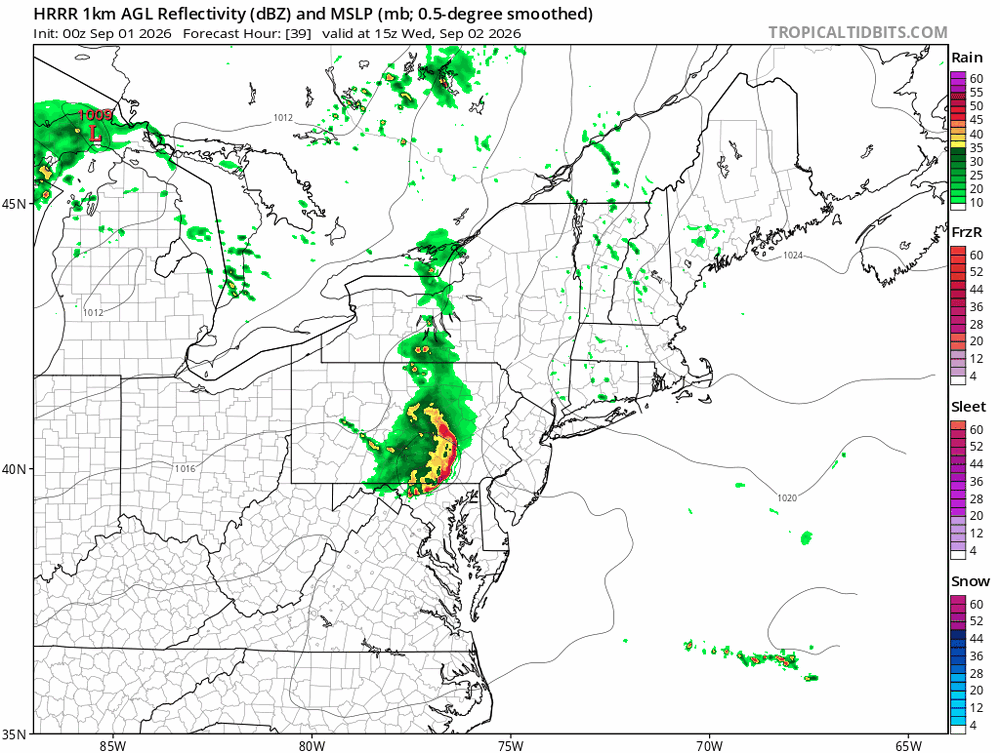
- 2,566 replies
-
- 1
-
-
- severe
- thunderstorms
- (and 7 more)
-
2026 Mid-Atlantic Severe Storm General Discussion
high risk replied to Kmlwx's topic in Mid Atlantic
I don't hate the Thursday severe setup. Parameters are not high-end for sure, but there is probably enough instability and shear to justify the SLGT risk. CAMs prefer areas to the east and northeast of DC. Several have an idea of initial storms in northeast MD backbuilding through the Baltimore area and eventually into Howard/PG/AA Counties before sinking south towards Charles/Calvert/St Marys. It's an odd evolution, but given that it shows up in multiple evening CAMs, I can't discount it.- 2,566 replies
-
- 6
-
-
- severe
- thunderstorms
- (and 7 more)