

Typhoon Tip
-
Posts
44,845 -
Joined
-
Last visited
Content Type
Profiles
Blogs
Forums
American Weather
Media Demo
Store
Gallery
Everything posted by Typhoon Tip
-
July has arrived ... the Meteorologically defined mid summer month
Typhoon Tip replied to Typhoon Tip's topic in New England
Jesus ... was there a super volcano when no one was looking? -
July has arrived ... the Meteorologically defined mid summer month
Typhoon Tip replied to Typhoon Tip's topic in New England
We had 3.1" averaged across multiple home sites within a mile or two of my location, yesterday. Then, we had .75" today, so far, from that batch that came through overnight. So... getting close to 4" in 24 hours does make it interesting if this cold tuck we got going is incapable of keeping the storms from forming ... Partially kidding there, but we are cool-afflicted by this plume that flooded S this morning up my way. -
July has arrived ... the Meteorologically defined mid summer month
Typhoon Tip replied to Typhoon Tip's topic in New England
Does it? this tuck up here is acting like a bona fide BD butt pump ... You watch vis imagery loops and think, 'okay now the back edge of at least partial sun'll be here in ...' but it never happens. You look again, and it just creating more clouds inside this cold pool. This is a perniciously chilly air mass, man. It's 63/62 here with mist droplet, and trees and flags with an active NNE breeze indication. It's almost like the fester of cold saturation into central NE yesterday "engineered" a local BD phenomenon. Maybe takes some science fiction to visualize, but it's like given enough time of that putridity in one place, it starts radiating some heat away and instantiates its own density/heat sink air mass that then comes flooding south - surrounding larger synoptic circumstance creates an environment where that can all take place and here we are with a substantial model bust. Days are long ... maybe it's just a 4-6 hour meso-beta scale restoring motion, and then we'll recuperate later? we'll see. But this is not "summer" anything. In fact, ...I gotta be honest. It's getting a little exhaustive defending the season - we may not get a summer this year. I've never seen so many least excuses imaginable materialize, among all dimensional aspects of reality and scale, in order to offset the word "warm" lol. It's kinda of amazing. Meanwhile, these global means/temperature curves are saying that June was the hottest ever since the Cognitive Revolution of humanity some 30,000 years ago. -
July has arrived ... the Meteorologically defined mid summer month
Typhoon Tip replied to Typhoon Tip's topic in New England
It's interesting to observe such a robust tuck jet formulate at this time of year. It's drilling 62 DP and chilly ( by summer standard) air into SNE now. You can see it punch in on hi res vis sat loopage -
July has arrived ... the Meteorologically defined mid summer month
Typhoon Tip replied to Typhoon Tip's topic in New England
Yup... 2.9" average at home sites within a mile of my location here in Ayer. -
July has arrived ... the Meteorologically defined mid summer month
Typhoon Tip replied to Typhoon Tip's topic in New England
Yeah ... you know, I'm wondering if this one of those deals where Gaia was hiding a wet month by deliberately only raining where ever the nimrod technology placement can lie the most about reality. LOL -
July has arrived ... the Meteorologically defined mid summer month
Typhoon Tip replied to Typhoon Tip's topic in New England
I don't mind... if the day's gonna be blown, make it worth it. Frankly was puzzled to see negative rain anomalies for June considering it seemed to be raining or within ear-shot of thunder for like 15 straight days but it is what is. I just wouldn't mind putting July out of reach with a ton of pan-dimensional thumping. -
July has arrived ... the Meteorologically defined mid summer month
Typhoon Tip replied to Typhoon Tip's topic in New England
I don't know what difference that makes. If one wants to consider 'distribution behavior' the last 8 or so days of the month were all modestly above normal.. between +1 and +3 at ALB/HFD/ORH. -
July has arrived ... the Meteorologically defined mid summer month
Typhoon Tip replied to Typhoon Tip's topic in New England
Frankly I'd advise usage of the operational model version with an extra degree of incredulity ... They are yawing dramatically between extremes in temperature. The GFS ( for ex.) has been flipping the upper MW/GL region between 72 with easterlies over a stalled warm front, with occasional rains/convection, vs 104 .. about every 3rd or 4th run. Back and forth... hugely massive diametric swings that make any kind of deterministic reliance non-existent. What is causing the giant gradient in the model(s) ... N vs S side of the ambient summer front is both as intriguing as it is suspect. It's probably that the model(s) are too happy to genesis cloud and rain interference on heating potential - I wonder if the ever growing WV density in an ever warming world, is beginning to show up in the guidance as extremes ... It's not a bad hypothesis if you ask me ( which no one did ..just sayn' ha!) because the 'climate impact models' have been honking big extremes as a consequence of CC - maybe it's just a operational forecasting manifestation. So at the end of the weeks and months ...the averages only show decimal bumps of increase over the long haul, yet we get 3-6 inch rain bombs right next to borderline drought this and that... Or, we get 76 at ORD and 108 at Springfield Ill. No problem... "totally normal" (now?) Anyway, if the summer version of the polar jet ends up moving across the U.P. of Michigan instead of Indianapolis, may mean absurdly large differences between a lower temperature futures, vs more lower wrung auxiliary housing morbidity heat. -
July has arrived ... the Meteorologically defined mid summer month
Typhoon Tip replied to Typhoon Tip's topic in New England
Yeah... who knows - specific perceived and/or legit errors with instrumentation, notwithstanding. right - Still, the degree/scale of actual negative anomalies was [likely ] not as deep as perceived. Personally? I find it interesting that it was negative at all, when the baseline [argumentative or not -] appears to lean positive as a result of CC. -
I wonder if anyone in your tribe suffers gout ?
-
Yeah that coastal region of Maine up there is getting bum packed by flow off the Gulf ..
-
yeah...I started the July thread with some discussion about this first two weeks. There's a modest heat signal toward the end of week 1 ( ~ 7 .. 9th). Later on in the long range, 'hints' for something more. The over-arcing theme though is not like where we were during much of June. In fact, the last 6 or so days of the month were all neutral to modestly above normal. I suspect that continues into the first 10 or so days of July, either way. I also like having the ambient summer gradient oscillating near by. So TCU production should around from time to time.
-
July has arrived ... the Meteorologically defined mid summer month
Typhoon Tip replied to Typhoon Tip's topic in New England
One upshot to this next week or two is that having the ambient summer front sort of wobbling around the eastern continent at our latitude should service occasional convection chances... And severe or just mundane, notwithstanding. This may offer some episodes of entertainment that way. -
The question is... how summery will it be? June left something for warm/season enthusiasts to be desired. But not as bad as some may think ... (speaking to the straw man ). Monthly mean as of this morning, June 30, were only very modestly cooler than normal, as provided by NWS' interactive online resource ( https://www.weather.gov/wrh/climate?wfo=box) ... ALB, (omitting decimals) -1 F -.4 for ORH. -.9 for HFD. BOS was -2 and PVD was -4. Boston(Logan), I suspect was more a result of a persistent on-shore flow anomaly. Providence may also have a combination of SEterly anomalies, together with instrumentation issues. As a very brief op-ed, climate change affects our 'acclimation curves' ... Basically, we perceive months that are actually not that too terribly far from normal, as being more negative than they really were - because we are over the longer span now more prepared/bias to 'feeling' a certain way in our common experience. I find this sort of an interesting psychological hypothesis for how weather and climate impacts perception... Anyway, looking at July ... the canonical warmest week of the year is this month ... roughly centered on the 21st. The next week to two weeks look different than where we've been. There is still a tendency to oscillate between troughs and ridging, but the troughs are not stagnating as much per guidance trends and other indicators ( ..the latter of which won't get read if this is written too long ). Just adding that the entire synoptic framework is also situating higher in geopotential hgt depths, which doesn't lend to CAA events very readily. Much of this should result warmer than normal, and more humid ... but it is unclear how extreme either will be - pistol to head, not very extreme with the temperature side for the time being. There is some hints that more important heat will materialize toward the end of the first week and throughout the 2nd week, but it's just hinted.
-
Not when you posted earlier - there is more now...
-
00Z this last Wed 336 hours from 12z this morning in the operational GFS ... Hard to knock persistence, huh ... That's what you call a stuck pattern -
-
There isn't much smoke in the area right now. there is however a band of clouds that's a bit denser running N-S over your region - https://weather.cod.edu/satrad/?parms=local-Rhode_Island-02-24-1-100-1&checked=map&colorbar=undefined
-
Front came through just in the last 1/2 hour. wind around to WSW though very light. Temp down to 70/68 after being 75/72 all day with intermittent sun steam followed by thunder. We're really racking up an impressive convection summer so far. Granted nothing severe ...at least here. But, I've counted 13 thunderstorms in my vicinity in the last 4 days alone. Stops raining... sky gets dark all over again... heavy rain with rumbles...moves on...rinse repeat
-
NOAA should just create a headline called "Apocalypse" and give the present status a Watch
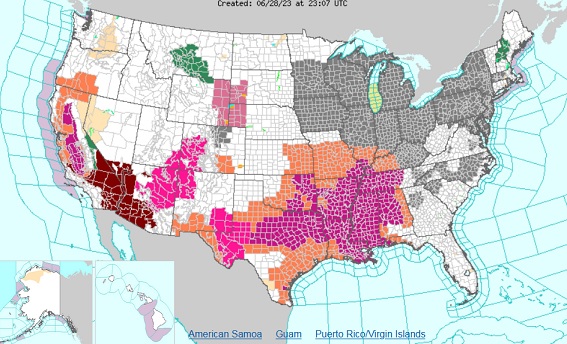
-
that sounds like a - stroke actually. Impressive though.
-
Just happened here... Most likely a very powerful positive CG. There were 5 evenly spaced, rapid pulsed very loud pop sounds, followed by the main percussive sonic explosion... then fading booms along with that effect of the sound waves echoing off in the distance. Within just short moments my buddy texts me, 'hey bro, you just almost got nailed!' .. But the actual strike map placed it a little over a mile away. Weird. I'm wondering if there was a leader in the area where I am, and the main channel hit at the other location - hence the pops... btw, sun was shining when that happened
-
This gonna be an interesting battle as summer slams into winter's cache - A significant warming trend Friday through the holiday weekend will lead to more rapid snowmelt in the high Sierra which will enhance already high runoff along the east slopes of the southern Sierra into the Owens Valley. - http://www.weather.gov/safety/flood
-
Yesterday that generality (10 days..) looked vacant of any excessive heat, and still does. But was suggestive of daily thunder ... sometimes widely scattered, some days more pervasive, the whole way. As of this morning (since) ... neither really. There's more like a chance of showers every 36 hours, with dry conditions amid summer banality of temperature in between. Boring is the best way to put it. Not much 'entertaining' about average highs in elevated lows from unremarkable DP elevation, and only at worst middling convection. I don't see a lot of continuity in that day-to-day model performance, though. I also don't see much in the way of any kind of pattern coherency - probably why the former. Typically in summer we lose coherence as you know, but this is really bad. There's virtually 0 correlative usefulness with telecons - not merely seasonally reduced. The operational runs are decoupling from their ensemble means about every 3rd run or so. It's like, can the Earth maintain a health ecosystem without any weather pattern? - that's actually an interesting question. Meanwhile, have we ever seen such a vast area under concurrent hazard headlines for air quality? Gee, ya wonder if there's a relationship there. Historic heat in east TX to Arkansa - 500 mb heights say it gets more intense but 108 high at Little Rock ...? not sure the sun has enough power to actually dump into that enough to raise any further ( sarcasm). This heat ( btw ) hinted at being more of a problem NE across the continent about 10 days to two weeks ago (when in extended signals), but the leitmotif since the end of May has been to shunt. It may in fact be a shunt summer. Either way, we are more latitude challenged than other summers - so far - "weather" by vagarious chance of that nebular organization or not.
-
DPs are falling... nice. more 64-66 as opposed to 69-71 ...