Windspeed
-
Posts
4,785 -
Joined
-
Last visited
Content Type
Profiles
Blogs
Forums
American Weather
Media Demo
Store
Gallery
Everything posted by Windspeed
-
We may still have some bouts with a PV streamer, possible TUTT and some shear dependant on timing and positioning during the onset of an uptick in activity, aside from whatever 99L does here in the coming week.
-
Well 10-14 days is when I thought things would kick up. The current surprise MDR system is just an example of how you can still get activity in a mediocre and typically unfavorable environment. Yes, the timing convectively-coupled Kelvin moving out of the EPAC into GOM/WCARIB next week could be critical to 99L (potential Gonzo), etc.; however, the middle-to-upper MDR is still quite hostile. 99L just got lucky with its very low latitude with TCG here. We'll see how it all plays out.
-
New ASCAT. Vortex signature looks even better than last night. At this point, I'd be surprised TAFB didn't pull the trigger in the next hour.
-
Looks like a depression to me. Especially with that ASCAT pass last night confirming the closed low. All it needed was sustained convection and a bit more organization. Interesting how even a quiet stretch with most meh environmental conditions can still produce surprises. But 99L is an especially strong wave born out of a favorable environmental bubble thanks to the WAM and ITCZ boundary. Looks like if things continue, we'll get a NS. Questions remain if it can become anything substantial in the long term / Caribbean. It still has to deal with a lot of unfavorable possibilities.
-
Well then...
-
Considering that ASCAT pass, if we get any sustainable convection over that center, we'll probably get a classification. Clearly there is a closed low. Perhaps it doesn't survive the potential hostile environment in a few days, but it may still get named. Interestingly, this feature might spell trouble with the Western Caribbean next week. The favorable coupled Kelvin may be timing just right off to extend east off of Central America by then.
-
-
AL90 in the NW GOM looks too sheared over the potential weak circulation due to strong southeasterly flow. It's not got a lot of time remaining over water.
-
-
Hrmm...
-
RE: A potential switch is currently crossing the central into EPAC. A very intense convectively coupled Kelvin wave. This will be making its way over the Atlantic Basin in the 10-14~ day range. Surprisingly there are no signs of blossoming activity in mid-to-long range modeling yet, but that could easily change. Something to keep an eye on..
-
Meh...
-
It came off the lower 48 on a SSE track off the coast. Yes, you're correct, the feature is not moving SSE now. More S to SSW on a long bend into the southern periphery of building heights to the NW. It also needs to pulse up new convection relatively soon or the possibility of generating a LLC vort max will fade. The MCV may very well dissipate. At any rate, it was worth the mention. We've seen these little systems develop often enough after rolling off the lower 48 and SE.
-
An MCS moved SSE off of the ETX/LA coast into the NW GOM. It does have a weak MLC. This feature will turn SW, WSW and then W into the Central or Southern Texas coastline in about 36-48 hrs. So not a lot of time to develop; that being said, if convection persists and a low level vort can develop, there is potential for a TC to form prior to landfall. The upper pattern is favorable enough. At least something to keep an eye on...
-
-
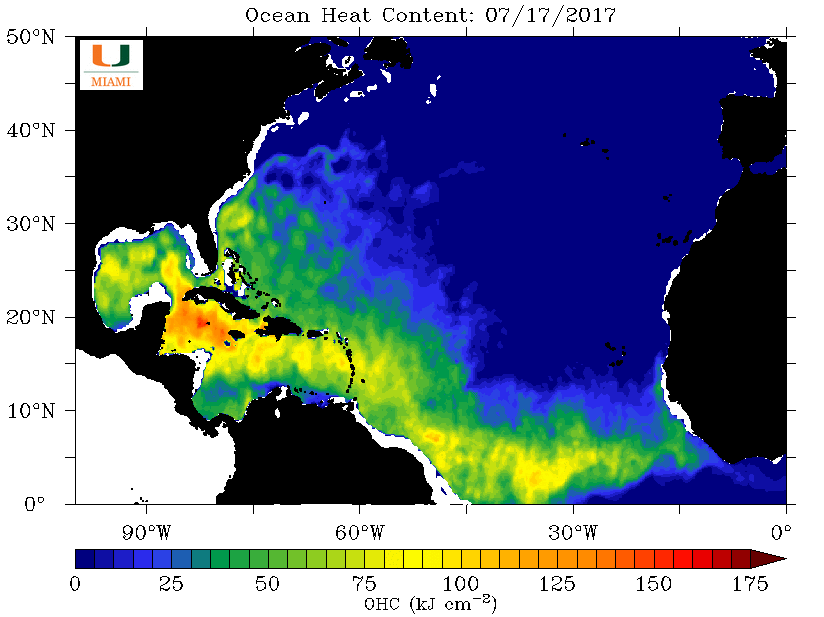
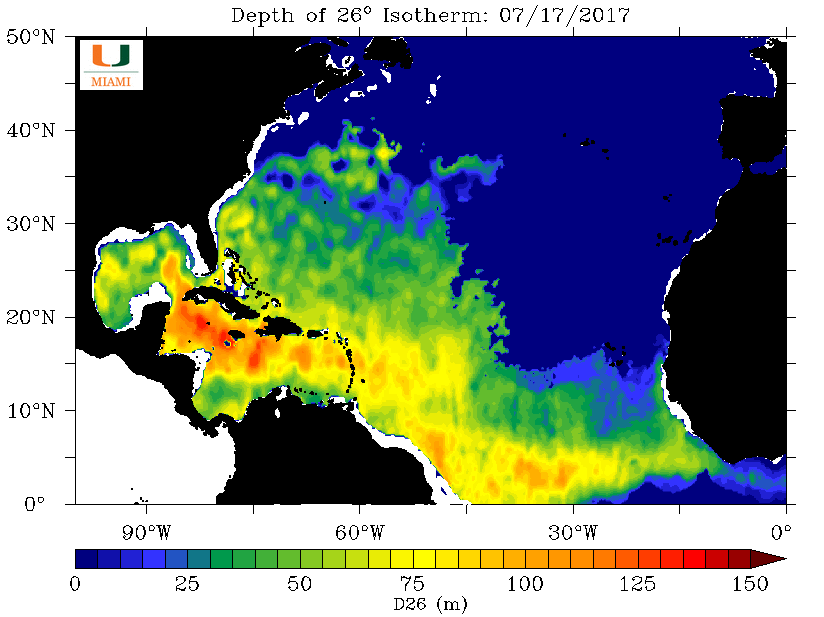
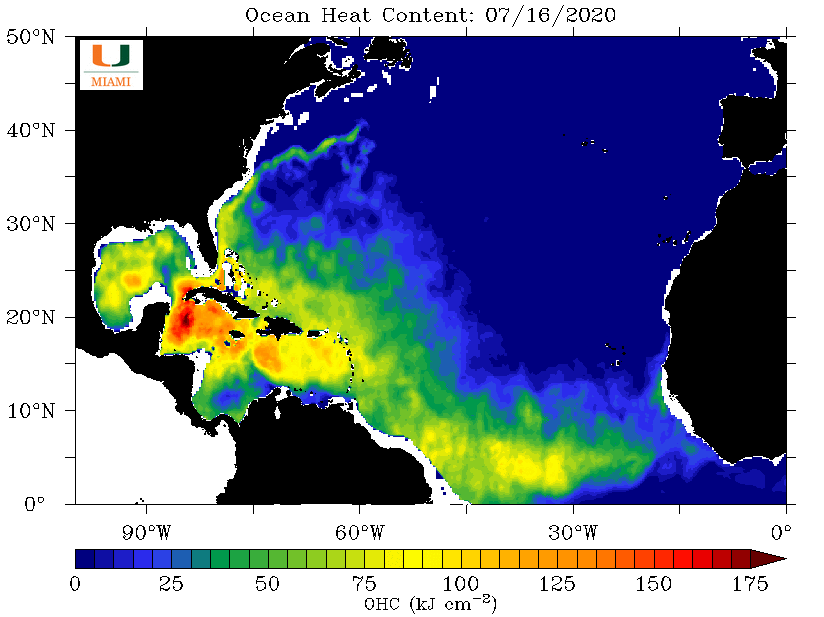
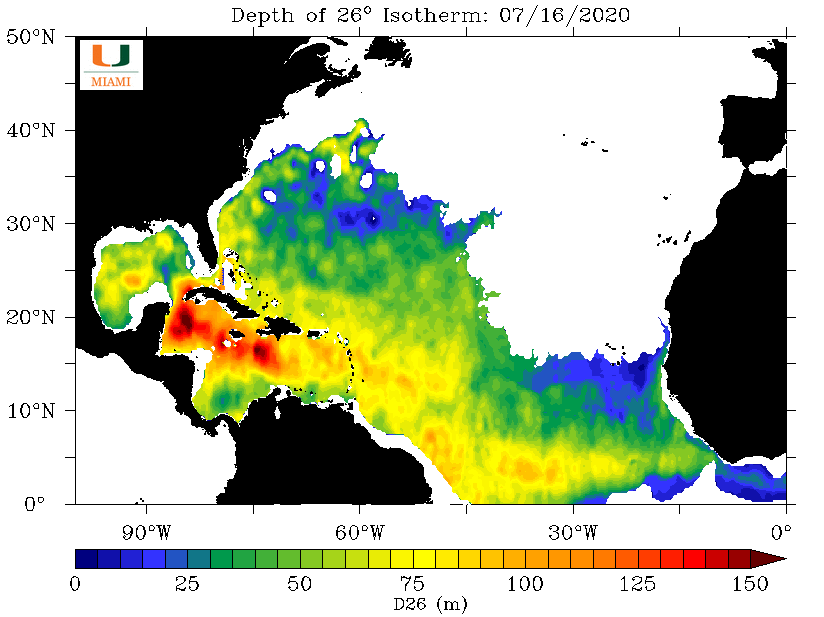
Current Atlantic oceanic heat potential compared to 2017, the last hyperactive season on record. Obviously heat potential and depth of 26ºC isotherm is only part of the equation. You need an anomalously favorable atmosphere and steering pattern. That being said, if the atmosphere over the Atlantic Basin does become more favorable in the coming weeks, the basin does look primed. July, 17th, 2017: Current: Now the question remains what atmospheric patterns will be in place for the last half of the Atlantic Hurricane season? 2017 had a relatively neutral ENSO but a positive AMO. NAO trended positive and IOD trended negative by September when all hell broke lose. Interestingly, a similar scenario may be unfolding by then but with an actual negative ENSO in place. We do not have a full blown negative ENSO yet, but it is trending that way.
-
-
Vertical profiles for most of the Caribbean and MDR are on point right now for TC support, however, SAL in the mid-to-lower levels and sinking air is keeping things quiet in the short-term. This is an ominous sign for when more favorable 200 mb support and 900 to 500 hPa lift begins to creep in by August however. I do expect things to go active and ramp up in a hurry when they do.
-
Late July into the first week of August just might be the kickoff. Signs of a favorable MJO coming into play. Easterly winds will dominate the tropical Pacific region, reinforcing La Niña; at the same time, due to a robust standing wave over the Western Indian Ocean and East African highlands, convection should continue to propagate westward with persistent wave breaking, which will feed tropical waves into Eastern Atlantic and MDR:
-
JMA on board for an active Aug-Oct throughout the Atlantic Basin and MDR.
-
The proverbial calm before the storm?...
-
The naming of Winter storms has always been controversial due to unwarranted exemplification of ETs/mid-latitudinal storms, their frequency of occurrence, and hype that overwhelmingly isn't required from a human impact and safety standpoint. The naming of Tropical Cyclones, on the other hand, is entirely warranted due to those same phenomenon. We name them because they can be inherently dangerous. Sure, some are just a maritime nuisance. Also, sure, with better RS technology, better satellite resolutions and data gathering, we classify TCs that likely wouldn't even get noticed several decades ago. But sticking to the rules of what gets classified, it would be silly to keep them unclassified merely because they are weak, less substantial/impactful events, or even subtropical. We name TCs for important reasons, hard to argue against that. But we also need to stick to the rules. If a system meets the criteria, it gets classified, period. I realize the tongue-in-cheek on the off-topic here. But it's worth reminding and pointing out why NOAA/NHC handles TC classifications the way they do, and also why private companies naming mid-latitudal ETs is ridiculous and of little credence beyond attention generation and money for their service platforms. It's hardly a matter of public safety and science. Major differences in mission strategy and purpose here.
-
Another healthy wave south of the Verdes. Easterlies are still a bit lopsided towards the 700 hPa level. But the wave train continues. Eventually easterly trades are going to better align as Azores ridging takes its seasonal build/shift westward into an ECONUS WAR/SER; we already have ENS support for strong interior CONUS 600 dm heights incoming; and if these waves continue training, ITCZ wave breaking and an axii is inevitably going to close off at the surface and stack. The vigor in the WAM and ITCZ needs to be paid attention. We are mere weeks away from modeled increasing MDR favoribility. If that happens sooner, expect one of these waves to develop into our first MDR TC before August.