
weatherwiz
-
Posts
81,819 -
Joined
-
Last visited
Content Type
Profiles
Blogs
Forums
American Weather
Media Demo
Store
Gallery
Everything posted by weatherwiz
-
Tomorrow is going to be quite interesting. Biggest challenge is going to be where that sfc low develops and tracks which is going to be heavily influenced by the Ohio Valley/Tennessee Valley convection. I would think the most favorable track for this would be just south of southern New England, but is it across Long Island or just south of Long Island? In terms of any severe weather potential, this track is key because if the track is across Long Island, the true warm sector and triple point will likely scoot across southern Connecticut, Long Island, Rhode Island, and Cape Cod. There would be potential for some brief tornadoes. If the track is south of Long Island, severe potential is nada (except maybe Nantucket and the Vineyard). Regardless, I think we're in line for some flash flooding rainfall. upper-level dynamics are pretty strong and we look to be in a very favored position for enhanced upper-level divergence. Looks like H7 warm front pushes well into the region which will aid in lift as well. In addition, we'll have the nose of a strong low-level jet and a very moist airmass.
-
That is some bow the 3km NAM has tonight going into northwest Tennessee. Holy bowie
-
Going to be some severe event in the Ozarks into the Tennessee Valley today. That's some wild dynamics and stout EML above a very hot and humid airmass.
-
EF-1 tornado confirmed https://www.weather.gov/media/box/Public_Information_Statement.pdf
-
With our past experiences with these events they've become much easy to sniff out!
-
Agreed on all this 100% IMO too they require much more attention in terms of forecasting. Remember the fall events of 2018? A few of those went completely under the radar. These setups typically are driven by large 3km CAPE with the high shear/strong shortwaves. So if you're just looking at the general SBCAPE or even MLCAPE you'll completely miss the potential.
-
I did a presentation on that event at the TriState Weather Conference at Western Connecticut State University last October. One theory discussed too (I think it was Nick Gregory and I briefly discussed) was how dews may have spiked even more just out ahead of the main storms traversing Long Island and how rapidly rising dews can lead to vastly lowering LCLs and a surge of instability and that could have enhanced tornadogenesis with this stuff on Long Island.
-
Like Ryan said, warming SST's a few degrees is a big deal in these setups, especially the late summer/fall setups. We've had some pretty impressive fall events over the past several years where the warm SSTs helped build late spring/early summer instability under fall like dynamics.
-
These storms DEW mean business
-
Looks like some flash flooding rains Thursday
-
There has certainly been an uptick. Have to wonder what role dual-pol is playing in this too. How many more tornadoes are now being detected from (even brief) TDS that maybe nobody would ever know about and whether NWS would use resources to send someone out b/c someone's house got blown off.
-
we done outside of a few pop up showers
-
nahhh I don't think we see much around today. Probably just some isolated showers and thunderstorms at best.
-
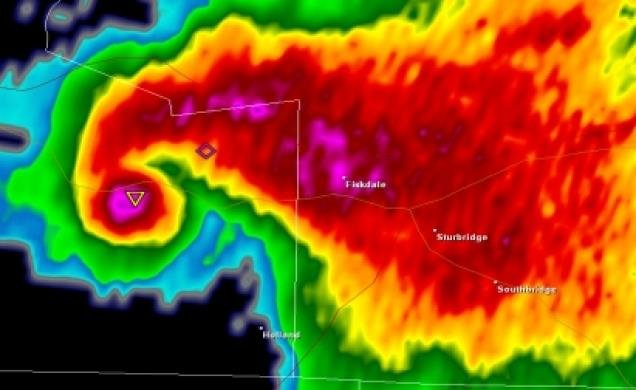
Yes, good call. I remember seeing something similar around that area before with some past events and thought TDS but it is not.
-
EDIT: Not a TDS
-
I'm guessing it was on the ground for like 9-12 minutes or so based the number of scans the TDS was present with each scan I think updating every 3-4 minutes (though the scans may be closer to 2-3 min).
-
Another TD near Sagmore
-
Worst screw job since the Montreal screw job in 97
-
Yeah it's been looking solid for quick a while.
-
TDS
-
and there's the TOR
-
Here come the FFW's
-
Probably no FFW because there are flood warnings out?
-
The fish getting sucked up must be getting dizzy. Looks like sushi hour coming early.
-
pretty solid velocities with that. definitely the best area of the day thus far.