

vortex95
-
Posts
2,208 -
Joined
Content Type
Profiles
Blogs
Forums
American Weather
Media Demo
Store
Gallery
Everything posted by vortex95
-
That's an excellent question! Each tropical basin has it own list of names, and the names are a mix of types of names from all countries in that particular region, so you are not going to get traditional names you'd see in the U.S. all the time. The CPAC has its own list of names and almost all of them are derived from Hawaiian culture. It is pure coincidence that Polo in the EPAC, which has its own set of names, and Nolo, in the CPAC are occurring at the same time. That just how things have worked out as to what has gone on for TCs. Inconvenient, yes, but they are not going to change the lists for something like this. You can't account for every variance in the atmosphere! These name lists are set years in advance, and cycle through the same single large list for each tropical basin. For NWPAC names, you see the variety there, and it is not always a person name, some names are of animals, plants, and inanimate objects. The only time you get change is when a name gets retired b/c that TC was of serious impact and a new name is inserted. What constitutes "serious impact?" For a U.S. landfall, typically a hurricane of Cat 3 or greater, it gets retired b/c of impact. However, strength of a TC is irrelevant really, it is all about impact. TSs can get retired. Allison in 2001 and Imelda in 2019 b/c even though they were only TSs, you got record rains and flooding. One oddity is Emily from 2005. It was the first Cat 5 on record in July in the Atlantic, and made two Cat 3 landfalls in Mexico, but it was not retired. Since impacts were all in Mexico, they held the reins as to requesting it to be retired or not, and they did not do so. No idea why. Bret in 1999 made landfall as Cat 3 in TX, but that location was the very sparsely populated area between CRP and BRO, so impact was minimized and thus Bret was not retired.
-
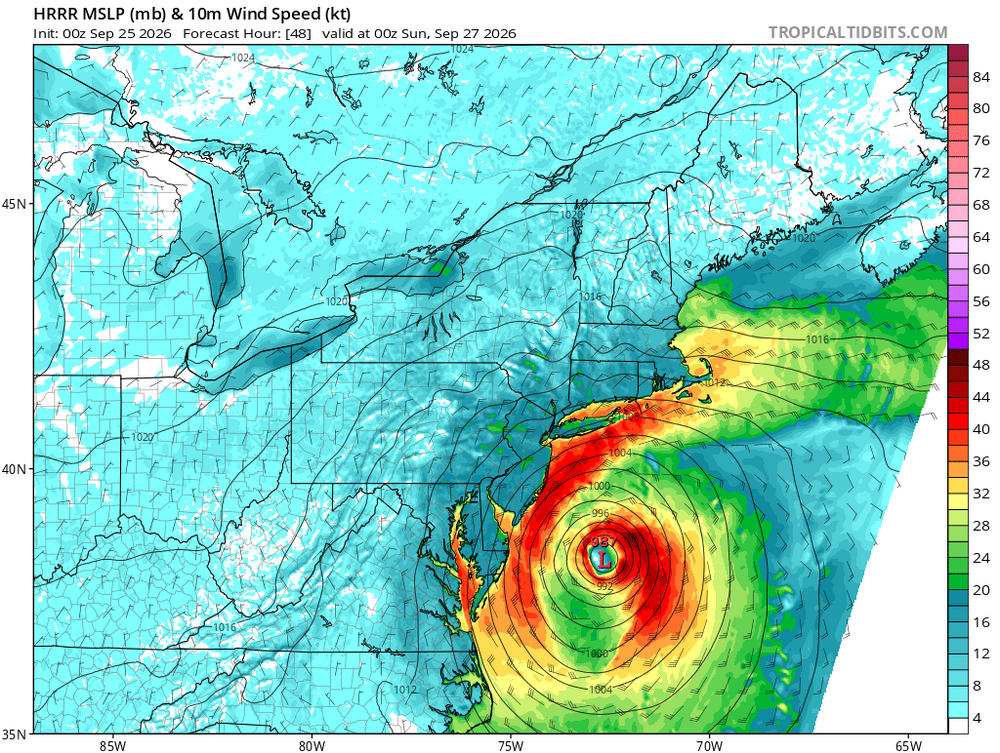
40-48 hr the 00z HRRR shows it taking on more ST characteristics w/ a more focused core wind field. RRFS does this but it take more than 24 hr after this time, and the low just meanders around to the S of us for the entire 84 hr period! Lots of time to do odds stuff! @WxWatcher007 I know will be closely tracking the exact sfc low position relative to the SSTs!
-
Get them here! https://www.ncei.noaa.gov/gibbs/
-
2026 Atlantic Hurricane Season
vortex95 replied to Stormchaserchuck1's topic in Tropical Headquarters
00z HRRR shows the E Coast low taking on more ST characterists 40-48 hr as a inner core contracted wind field develops. RRFS it take over 24 hr longer to do this.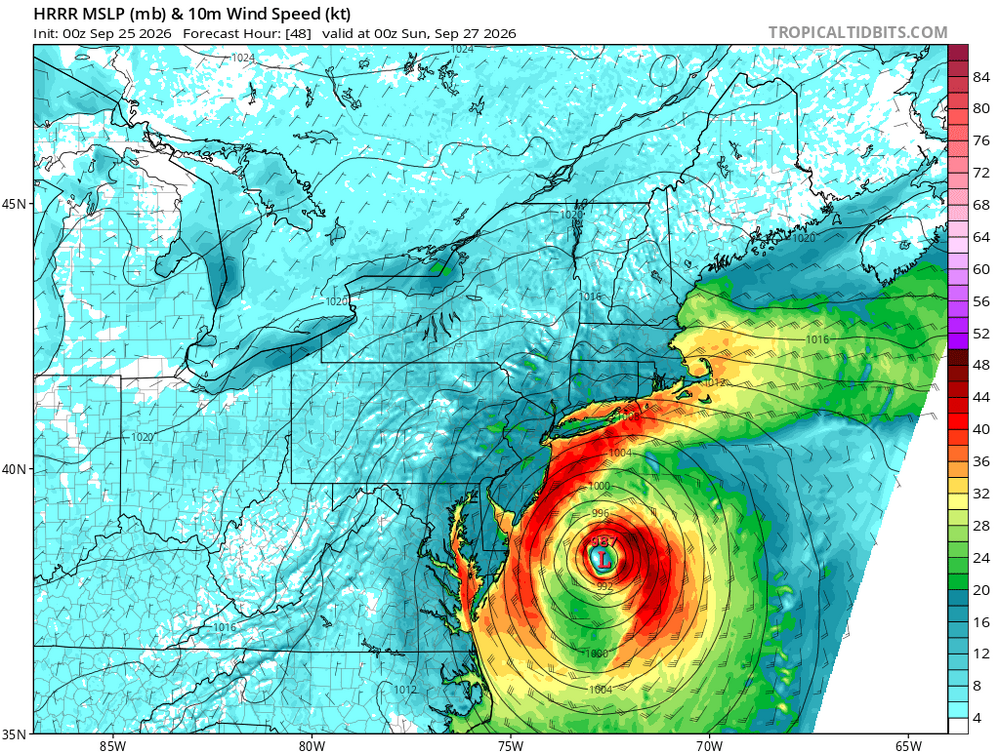
-
On Wed, five sites in ME/Quebec set all-time record high pressures for Sep. @CoastalWx take note. It's an exceptional pattern! Frenchville Montreal Quebec City Val D’Or Chibougamau-Chapais.
-
Just a nit from the 25/03z discussion for Nolo: Nolo is expected to pass near or just south of the Big Island of Hawaii on Saturday as a major hurricane. It's closet approach is about 125 mi S of the srn tip of the Big Island. Is that really "near or just S" for such a distance, esp. for an avg size TC? The wording makes it sounds closer than it really will be. That's a big deal when it comes to winds in a TC, esp. a strong one.
-
Don't even get me started w/ Sandy! I'll spare you all a rant write-up on that! One thing I will say, at a SNE conference I think 12 years ago, one of the BOX mets who is the resident WFO TC expert was talking about the reanalysis of big HUs that hit New England. And Sandy came up. He was asked if he thought it was still a TC at landfall, and he said, w/ his boss (MIC) on stage w/ him, "offline after a few beers, I say yes it was!"
-
Did I get @WxWatcher007 as pumped as @ineedsnow here? See what I am saying here? My "rants" are not w/o merit as to NHC not acknowledging legit TCs. The Jan 2023 event is perhaps the most glaring I have ever seen, and this is when they have long broaden the definition of a TC (2005 forced everyone too!) and declare them more. This is good as we are calling things for what they are, but still, you get odd stuff like this that gets ignored operationally. Yes, I know the Jan 2023 thing got included in post-season analysis, but that's not the point. Why was it not declared operationally? My guess is that they did not want to name something in Jan close the East Coast b/c the media would freak, and NHC would have been overrun w/ calls and inquires, so they just deferred to post-season analysis. Sorry, that isn't an excuse. It's your job to monitor and designate TCs in the Atlantic and EPAC in real-time. The atmosphere doesn't care what the calendar says or about our rules or policies, it does what it does! So you see my concern about this current storm and how it may evolve and what may or may not be done from authority. This ST or T evolution is not a low-prob or far-fetched scenario, whether you look at it from a meteorological objective or subjective POV!
-
10 to 50 times more likely than *what*? I see this often and there is no reference context and perspective given! Here's the problem w/ such stats. Atmospheric state variables (e.g. temp, vapor pressure, pressure, etc) are integrated into a highly complex, multi-variate, non-linear system. Axiomatically, meteorological variables exhibit non-Gaussian characteristics. That is, they don't follow a normal (Gaussian) distribution. “Unlikely events” like intense heatwaves, as it turns out, aren't as “unlikely” as it might seem in a non-Gaussian world. The wx in the real world doesn’t follow a Gaussian/normal distribution curve. Extreme events are far more common in a non-Gaussian distribution that reflects the physical world we live in. Bell curve graphs are an inappropriate use of statistics. Not only not Gaussian, but also the shape of the distribution changes w/ warming depending on location. So they apply stats/numbers that do not apply to reality (Gaussian vs non-Gaussian). When scientifically illiterate ppl try to normalize non-Gaussian disturbed data, you get the current nonsense. And we go back to the ever present issue, "how to lie w/ statistics" And while on the subject, concerning "sigma values" and those "1-in-a-million year events." Normalized anomalies used to be a good technique in meteorology to compare events by removing the mean and variance calculated from long-term gridded reanalysis data (30 yr), but now it's the hottest thing in climate activism. Normalized anomalies should not be interpreted as return periods in this way. The distribution of atmospheric variables, including 500 mb geopotential height, is not normal, and the climatology used for these normalized anomalies only contains 30 yr at each grid point w/ a 15-day centered mean and standard deviation. You can verify this by scanning the globe at any given time looking at this quantity. Say there is a Kona low at -5.5 sigma near HI for 500 heights. Obviously, that's not a 1-in-a-million yr event. 500 heights get extremely low in intense hurricanes in the tropics, and you'll see sigmas like -15. So that would mean a return rate longer than the Earth has existed. See how ridiculous this gets? But you get ppl parading these stats are as if they have any clue as to what they actually mean and how to apply them! Also, in reference to the above avg SSTs. You don''t need above avg SSTs to get an intense or record Nor'easter or any baroclinic storm. What matters most by far is baroclinicity in the atmosphere and jet structure. They have this vapid notion that things work linear 1-2-3 in the Earth's system, and *one* variable, like air temp or ocean temp, dictates everything else, and all else is trivial. And feedbacks are rife, furthering the complexity. An example of this is SSTs and TCs. All the increased SSTs in the world do not matter of the atmosphere does not cooperate, as in TPW values and wind shear. TC formation alone by far is dictated by atmospheric parameters, not ocean parameters. If SSTs were the biggest factor, we'd have far more TCs globally each year and they would not be confined to particular times of the year in each ocean basin.
-
Don't be too focused on the 26 C SST line. STS can occur w/ SSTs as low as 15 C, and the Jan 2023 event (a hurricane IMHO) formed a nice convective ring w/ a persistent eye over 21-23 C SSTs and retained this structure remarkably well to 40N, and still looked really good and tropical-like when it passed Sable Island where SSTs were 7 C. I posted the sat loop earlier, and you'll see what i mean. HU Alex in Jan 2016 way out in the Atlantic was like this, It actually look best when it accelerating N over cooler SSTs w/ a distinct eye!
-
-
This is fascinating evolution and not something that occurs that often. @CoastalWxneeds to broaden his wx horizons a bit, in addition to within 5 mi of Weymouth! Regardless of what the sfc low becomes, yes, it is irrelevant to the sensible wx impacts, unless it get "cute" and retains core TC characteristics as drifts near the S Coast!
-
Excellent point. I know of no sub-990 mb case in September for baroclinic deepening alone. Not that there has not been Nor'easters in Sep before, heck we get them in the summer sometimes, but the sfc low typically doesn't get too deep. 995-1000 usually is the limit. This event from July 22, 1983 stands out as one of the more impressive sfc lows for mid summer close to New England. 15z satellite image -- low was about 990 mb at this time.
-
@CoastalWx is by far lopsided and the fully versed weenie guru for winter wx. He's kinda weak in svr local storms and TCs! When we worked at WSI, he would always defer to me for those topics! And his typical reply after I would explain a situation? "WE'LL SEE!" LOL. The biggest contribution I recall I did for him that he has actually acknowledged? We we discussing the 6/1/11 TOR event and the problem/issues w/ the Springfield warnings, and I said to Scott, "no excuse to hesitate, this day was screaming big a classic spinner day for New England -- situational awareness is huge leading up to such an event!" And he liked the term "situation awareness!"
-
Wow, I had no idea there were STS in HURDAT2 that had winds in excess of 60 kt. Since NHC started declared ST systems regularly in the late 1990s, the has never been a "subtropical hurricane." The reasoning I heard is that if a ST system gets winds strong enough to reach hurricane-strength, it is can called fully tropical, which doesn't make any sense really. 65 kt is not some magic number that changes the structure of a storm. Many ET storms have sustained winds well over 65 kt, and there is nothing says they can't still have 65 kt when they go ST!
-
Concerning @CoastalWx's "garbage model" and how it handles TCs... Given the RRFS is new, I am not sure it handles TCs. I asked the modeling group if it handles TCs well. They said it should, but they said ti defer to the HAFS and the like. This event will be a good test at least when it comes to ET to ST/T transition. The RRFS is about 10 mb deeper than the other models, and shows a tight inner core pressure gradient eventually. That indicates tropical structure.
-
This is a much "warmer" type ET to ST/T suggested transition. The ET surface low has developed in a more tropical-type atmosphere. As noted earlier, the low is located S of the 576 dm 1000-500 thickness line, and as it develops, a pool of 576 closes off over it. Also, initial ET development to ET peak to ST/T transition can occur very quickly at times. The system off the Mid-Atlantic/New England coasts in mid-January 2023 went ET to ST rather fast (personally I think this was tropical and a hurricane), developing a distinct, persistent eye and remarkably deep convection for a winter atmosphere. See sat loops here: https://x.com/WxTca/status/1615532584016162822 https://x.com/burgwx/status/1615099242728628231 If this can occur in January, there is no reason to think this can not occur here in September over significantly warmer SSTs and a less overall sharp baroclinic environment! The point being extraordinary/outlier patterns often result in extraordinary/outlier individual wx events, so we need to adjust/adapt for that and think outside the box in such cases.
-
2026 Atlantic Hurricane Season
vortex95 replied to Stormchaserchuck1's topic in Tropical Headquarters
This is a much "warmer" type ET to ST/T suggested transition. The ET surface low has developed in a more tropical-type atmosphere. As noted earlier, the low is located S of the 576 dm 1000-500 thickness line, and as it develops, a pool of 576 closes off over it. Also, initial ET development to ET peak to ST/T transition can occur very quickly at times. The system off the Mid-Atlantic/New England coasts in mid-January 2023 went ET to ST rather fast (personally I think this was tropical and a hurricane), developing a distinct, persistent eye and remarkably deep convection for a winter atmosphere. See sat loops here: https://x.com/WxTca/status/1615532584016162822 https://x.com/burgwx/status/1615099242728628231 If this can occur in January, there is no reason to think this can not occur here in September over significantly warmer SSTs and a less overall sharp baroclinic environment! The point being extraordinary/outlier patterns often result in extraordinary/outlier individual wx events, so we need to adjust/adapt for that and think outside the box in such cases. -
2026 Atlantic Hurricane Season
vortex95 replied to Stormchaserchuck1's topic in Tropical Headquarters
Given the RRFS is new, I don't know how it handles TCs. I asked the modeling group if it handles TCs well. They said it should, but they said ti defer to the HAFS and the like. This event will be a good test ast least when it comes to ET to ST/T transition. The RRFS is about 10 mb deeper than the other models, and shows a tight inner core pressure gradient eventually. That indicates tropical structure. -
2026 Atlantic Hurricane Season
vortex95 replied to Stormchaserchuck1's topic in Tropical Headquarters
Odd sucker! Just go to shows the true vagaries of these things. -
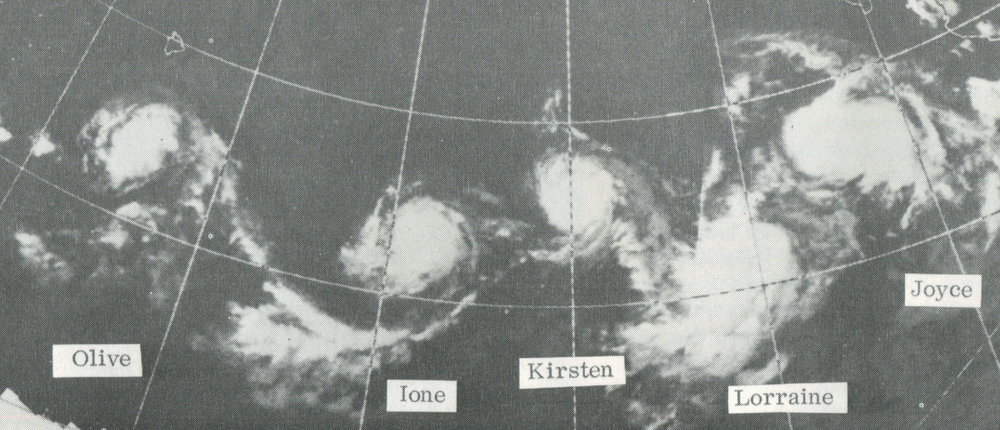
Here is a remarkable satellite image from Aug 23, 1974 from the C and EPAC! And it was weak La Nina.
-
No, the biggest question is if NHC will ever acknowledge this thing as potential ST or T transition and name it operationally if it does what some models are showing!
-
Notice how tight pres gradient is near the center and it wanes outside of that? That's tropical structure.
-
Yes, inconsistent operational TC forecasting here. The fact a system is close to land or not should be irrelevant. The atmosphere does not abide by our rules and policies, it does what it does, and we need to do things according to it! And as noted, people in the field notice these things, and are valid concerns/complaints. And w/ social media these days, that can result in a PR disaster. You can't brush such things under the rug anymore hoping ppl will not notice. And in this case, it is not a low probability event. Some models are showing it clearly, and when you combine that w/ practical empirical fcst skill/experience?
-
On the tropical forum, it was pointed out the high 1000-500 thk. The initial low pressure center currently is S of the 576 thk line, and it wraps up and pools this value into a discrete closed contour! That's what Sandy had offshore E of ORF the day of landfall. 576+ is more than enough for a solid warm core that is not shallow (500 and below).