
vortex95
-
Posts
2,209 -
Joined
Content Type
Profiles
Blogs
Forums
American Weather
Media Demo
Store
Gallery
Everything posted by vortex95
-
2026 Atlantic Hurricane Season
vortex95 replied to Stormchaserchuck1's topic in Tropical Headquarters
Great questions and critical thinking above. That's the right thing to in practicing good science -- asks lots of questions! See this paper 2011 paper (pdf attached): On the Classification of Extreme Atlantic Hurricanes Utilizing Mid-Twentieth-Century Monitoring Capabilities* A methodology is created to determine how many of these 10 recent Category 5 hurricanes likely would have been recorded as Category 5 if they had occurred during this period using only the observations that likely would have been available with existing technology and observational networks. Late-1940s and early- 1950s best-track intensities are determined for the entire lifetime of these 10 recent Category 5 hurricanes. It is found that likely only 2 of these 10—both Category 5 landfalling hurricanes—would have been recorded as Category 5 hurricanes if they had occurred during the late-1940s period. The results suggest that intensity estimates for extreme tropical cyclones prior to the satellite era are unreliable for trend and variability analysis. So it virtually certain due to limitations of tech, esp. prior to the satellite era, many cat 4s even some cat 3s documented were actually cat 5s. The hurricane reanalysis project has found solid evidence of cat 5sifor some system, and that has been corrected in HURDAT, but due to the mesoscale nature or the inner cores of these beasts, you just can't tell many times. Also, hurricanes do not remain at cat 5 strength very long, so that makes them even harder to detect historically. Even today, some are missed in the absence of recon since Dvorak estimates work best for systems 60 to 105 kt. This means two things. One, many TDs are actually weak TSs and two, many intense HUs are underestimated. There is very little difference on satellite what a strong cat 4 and a minimal Cat 5 looks like, and Dvorak cannot account for storm size, RMW, environmental pres gradient, storm forward motions, and other factors that go into actual wind speed of a TC. As an example, take HU Patrica from 2015. If not for recon, it likely would have been capped at 160 kt. I have yet to see NHC assign a HU in their AOR above 160 kt in the absence of recon or other in situ data. Even JTWC rarely goes above 160 kt. Patricia was rather small, and Dvorak does not do well for small TCs (underestimates). Now we did have recon, and initial obs were 175 kt. when it was 880 mb. However, the next recon, over 6 hr later, and it found 879 mb, but the satellite signature had weakened a bit, so recon missed Patricia’s absolute peak intensity. They gave Patricia and estimated 872 mb pressure, but it could have been lower. And on post-season analysis, the found Patricia peak winds were actually 185 kt! So you see how tricky and elusive these beasts can be, even when recon is available! I know Patricia was a cat 5 all along, but see the margin of error there w/ in actual in situ obs? The first official cat 5 in the Atlantic is not until 1924. Does that mean there were none prior? Of course not, just it was very hard to get actual obs to verify something that intense the further you go back, An unfortunate ship would have to survive getting into the core of these things or a land station would have to be at the just the right location and the instruments survive to verify a cat 5. Also, GFS dropsondes were not put into used until 1998, and the SFMR not until 2004. These were game changers as to recons to get a much better idea of the winds sfc and aloft in a TC. They way they got sfc winds prior? They would take about 90% of the FL (700 mb) winds, and go w/ that that. That works often, but not all the time. It can vary quite a bit as GPS dropsondes and the SFMR have shown! So really, using data prior to the 1990s for overall trends in intense hurricanes is not an apples to apples comparison. Our detection and documentation, technology, and knowledge/understanding has improved immensely in the last 30 years alone, giving us a much better idea of reality for TCs, esp. for the intense ones! And 30 years is too short of period to determine TC trends, esp. the in Atlantic since the AMO cycles are approx 25-45 years in length. And the idea that hurricanes are getting stronger overall? That notion is partially artificial b/c of the above. Non-wx/climate factors play a big role here. We are better than ever in observing and measuring the wx, getting better all the time, so we have been seeing things in recent decades due to better tech that were always there, just not able to be detected prior (go back to how the first cat 5 in the Atlantic is not until 1924). And the odds of seeing more absolute extremed and setting new records go up b/c of this tech factor as well. jcliD1100420 4461..4475 - hagen-landsea-jclimate-2012.pdf -
2026 Atlantic Hurricane Season
vortex95 replied to Stormchaserchuck1's topic in Tropical Headquarters
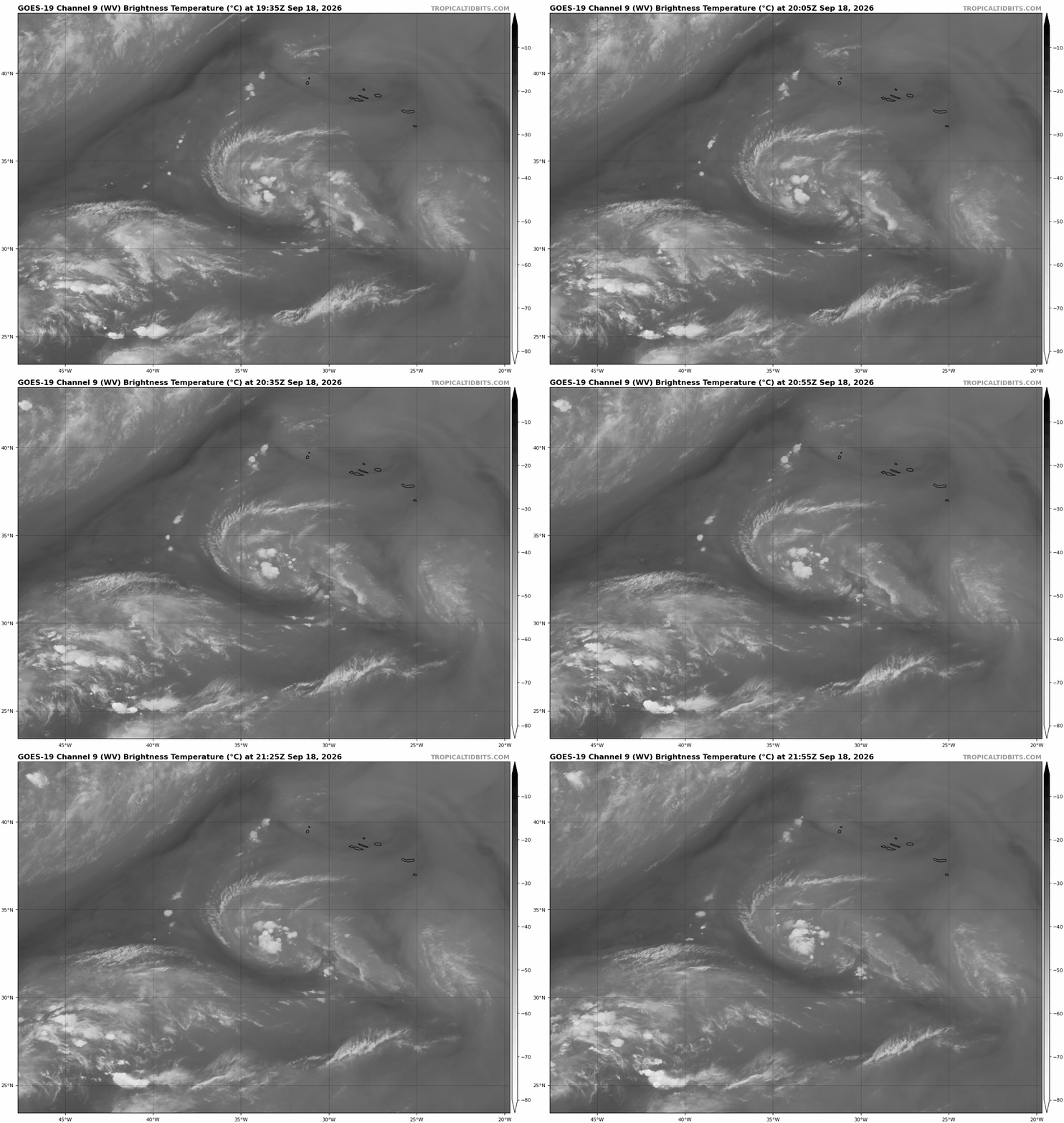
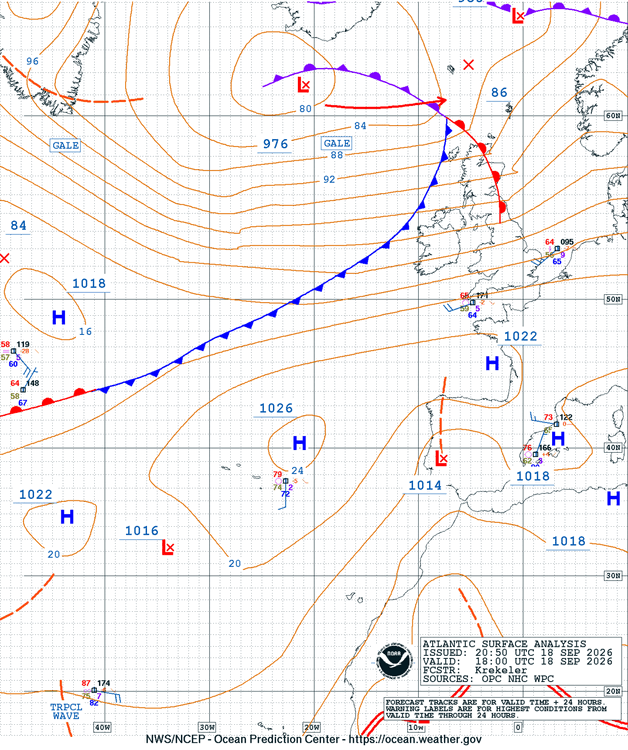
Convection has not been persistent enough. For developing systems, you do not want irregular blobs pulsing. There has been no curved banding evident yet for the system. 1016 mb c.p. shows a high environmental pressure field w/ synoptic gradient weak from the high centers to its NE and W 99L is in a very narrow margin area. Look at the WV loop attached, Strong shear evident t toe S, more starting to press in from the NW, and deformation zones N-W-S. 18z SHIPS output environment is not good. Shear is high and 700-500 RH quite low.. https://hurricanes.ral.ucar.edu/realtime/plots/northatlantic/2026/al992026/stext/26091818AL9926_ships.txt Intensity models usually for nascent systems are bullish in taking them to min TS quickly, but about half of them currently do not even do that. A testament to this Atlantic season I suppose when nothing can go "right!" TD status appears mdt-high, but TS is more of challenge.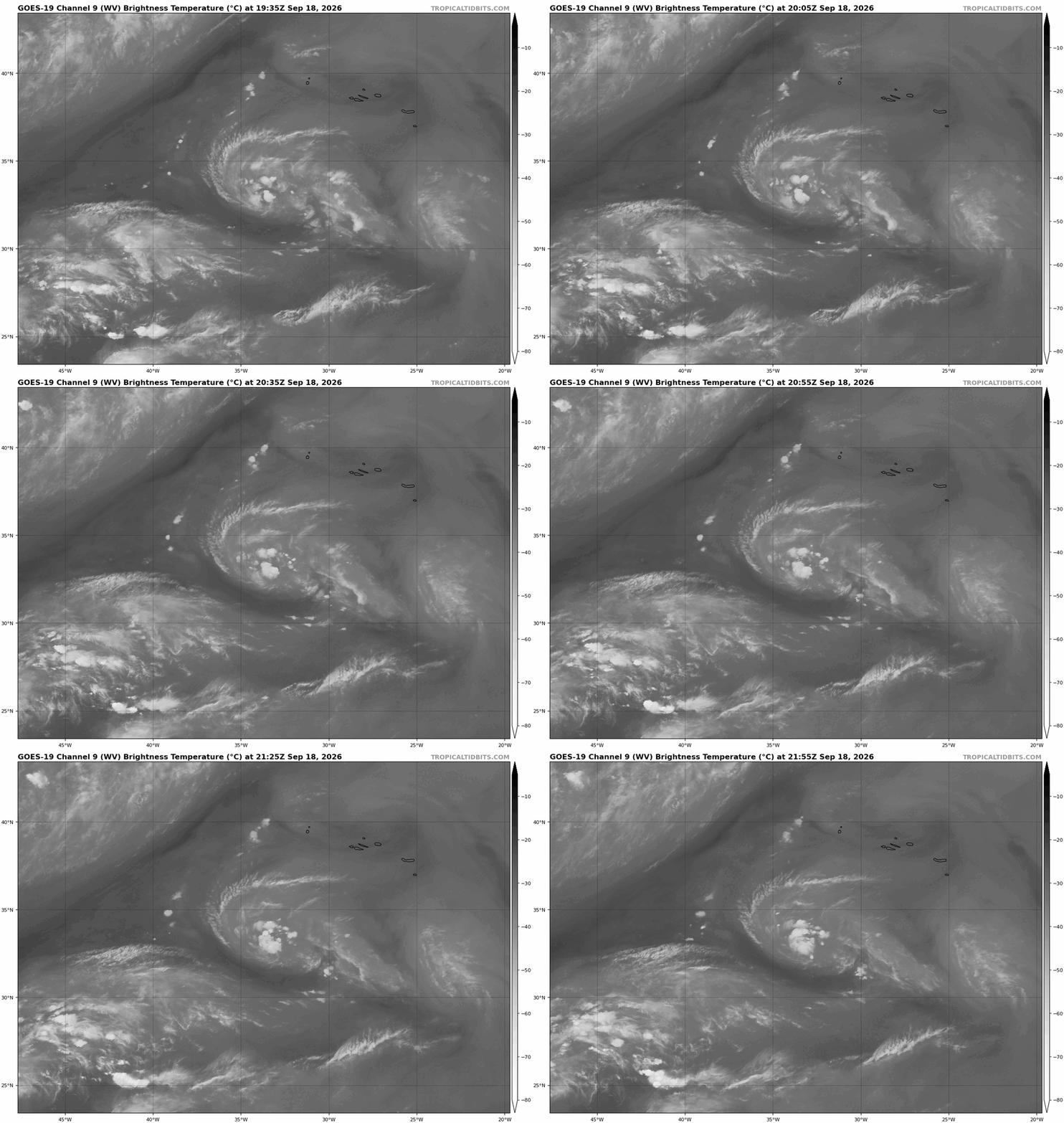
-
Septorcher 2026 Discussion - Endless Summer
vortex95 replied to Damage In Tolland's topic in New England
They are reachin' stating it never really went away. And parsing it down to just cntrl NH,as if adjacent watersheds that flow into the area mean nothing and ignoring the overall no drought state of much NNE at the time. -
Septorcher 2026 Discussion - Endless Summer
vortex95 replied to Damage In Tolland's topic in New England
They had "SKEWL" that day? After Andrew and esp. the Bliz of 93, the wx hype train has arrived for good, and you'd think a HU as intense as Floyd coming up the coast (yes, I know it weakened a lot, but that's not how the media acts!), across the board cancellations! Any tropical watches or warmings, the do not hesitate these days! I thought by 1999 that would have been the case as well. When TS David impacted New England in early Sep 1979, schools were not closed that day. Even though it was way W tracking up through cntrl NY, it was the best TC duration wind I have ever seen in New England outside a HU landfall, and surprising windy all the way to ern MA w/ gusts to 70-75 mph. I recall how windy it was at recess, and how much stronger the winds were second recess! And the trees whipping right next to the recess area. Branches could have easily fallen on us! And its turns out my observations from that event had something behind it. Check this paper out. Not you typical evolution for a TC at this latitude! @weatherwiz be like, "WE NEED THIS AGAIN!!!" Postlandfall Tropical Cyclone Reintensification in a Weakly Baroclinic Environment: A Case Study of Hurricane David (September 1979) https://journals.ametsoc.org/view/journals/mwre/123/11/1520-0493_1995_123_3268_ptcria_2_0_co_2.xml -
Septorcher 2026 Discussion - Endless Summer
vortex95 replied to Damage In Tolland's topic in New England
Time to nit... 1) "North East"?? 2) 55N/Gulf of AK is not "Arctic" 3) "new Polar stream high" - random improper capitalization It's bad enough you have all these "social-meteorologists" who lack basic wx knowledge, but add on sloppiness in their actual wording in posts? -
Septorcher 2026 Discussion - Endless Summer
vortex95 replied to Damage In Tolland's topic in New England
-
Septorcher 2026 Discussion - Endless Summer
vortex95 replied to Damage In Tolland's topic in New England
A common fallacy I see on many social media posts is that they show the 500 mb heights and its anomalies as always "hot." 500 heights only serve as a *proxy*, and we do not live at 500 mb. What is the sfc pressure and 1000-500 thickness? What is the nature of the air mass and 925 temps? Also, the location of interest, where is it relative to the ridge center? -
Septorcher 2026 Discussion - Endless Summer
vortex95 replied to Damage In Tolland's topic in New England
@CoastalWxcalls the recent wx in the NEUS "boring?" He has no context of the word apparently. Try the current Atlantic hurricane season out for size. And you know this record inactivity is squashing ratings for places like TWC and stations in the South. Relying on wx for consistent ratings is foolhardy. I recall the 96-97 winter, marketing and execs at many stations along the E Coast seemed "shocked" ratings were not like the previous winter. Clueless.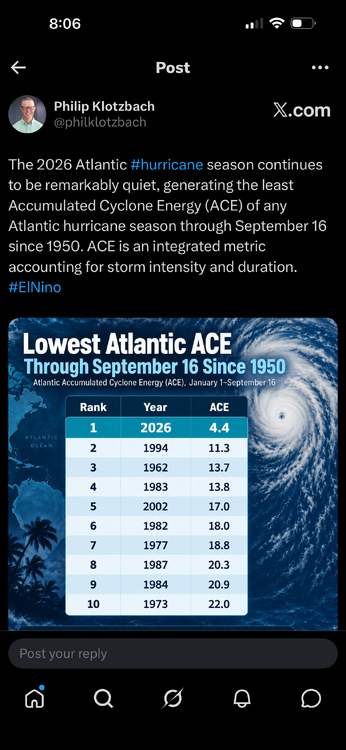
-
Septorcher 2026 Discussion - Endless Summer
vortex95 replied to Damage In Tolland's topic in New England
Now we are seeing 14-day forecasts? Yes, I know AccuWx has had even further for some time, but it just shows you how ppl keep trying to one-up each other when the fcst science simply does not support it or has advanced. Like one could tell w/ *any* real skill the temp would be exactly 70 on day 14. Also, "pattern predictions?" It's a freakin' wx forecast! Call it as such! Branding marketing, nothing more. Ooo, wait, alliteration, that's KEWL! It reminds me how on some radio stations in BOS a number of years ago, the "news" suddenly became, "what's trending!" Doublespeak! -
2026 Atlantic Hurricane Season
vortex95 replied to Stormchaserchuck1's topic in Tropical Headquarters
Updated for completed reanalysis 1971-75. https://www.aoml.noaa.gov/hrd/data_sub/re_anal.html 14 new tropical/subtropical storms (11 upgraded from tropical depressions) 21 tropical depressions were removed 1 hurricane downgraded to a tropical storm (Dawn, 1972) 2 tropical storms upgraded to hurricanes (Delia, 1973; Amy, 1975) 2 hurricanes upgraded to major hurricanes (Ginger, 1971; Doria, 1975) 86 total systems now in HURDAT2 for 1971-1975, comprising over 3000 revisions to genesis, track, intensity, central pressure, landfall, status, and dissipation. Note: The 21 TDs removed. In the early years of NHC, the would literally call any mass of convection associated w/ a tropical wave a TD! This practice ended by the later 1970s. Some ppl (not here) have said, "revisionist history!." No. We take our technology and immense observation networks for granted now, but it wasn't always this way. Also, our knowledge and understanding have increased tremendously for TCs in just the last 30 years alone, and we can apply this to historical seasons to get a better picture overall,. Also, standard and practices on what we call a TC have changed (expanded) over time. All this equates to a general underestimation of TC strength and numbers in the past, and the further you go back, the more we "missed." And these reanalyses are done by many ppl, and changes go to a committee of TC experts before it gets finalized. The amount of work that goes on here is amazing, given the shear amount of data to go over! Also, it shows that even after the advent of the satellite era, TCs were still missed or not handled the best way. I think they plan to go to 2000 w/ this reanalysis. It has been going on for 25 years now starting w/ 1851 season. Also, check out this: https://x.com/FerragamoWx/status/2100729487038308516 List of changes: https://docs.google.com/document/d/1H5OwX26ay09jGO6mrXRS3qS5G8fVohne5KLpHYnuQUQ/edit?tab=t.0#heading=h.4b2gybhe44qu -
2026 Atlantic Hurricane Season
vortex95 replied to Stormchaserchuck1's topic in Tropical Headquarters
Ugh.
-
2026 Atlantic Hurricane Season
vortex95 replied to Stormchaserchuck1's topic in Tropical Headquarters
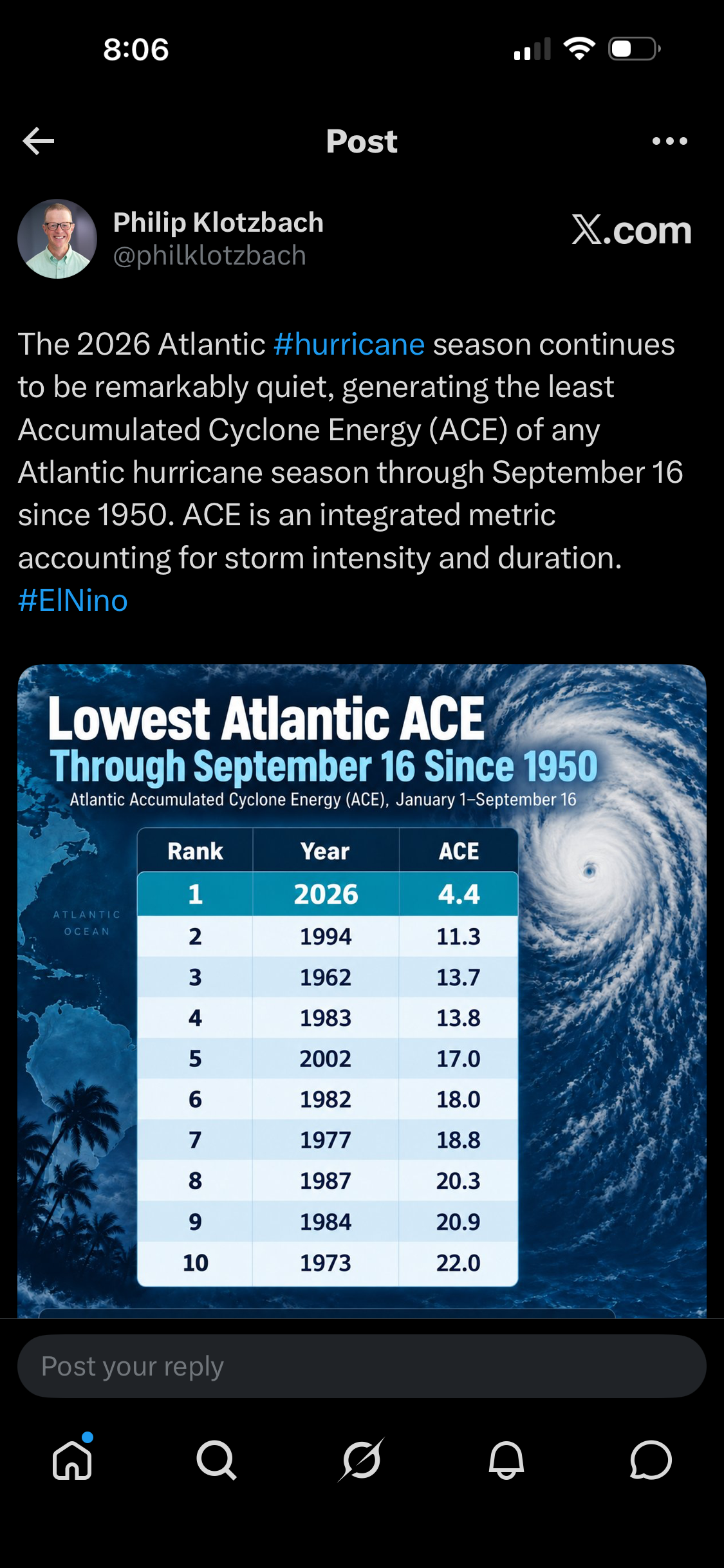
The fascinating thing about this season, and the last two for that matter, is that either unexpected factors has squashed the peak climo period (Aug 20-Sep 10) (2024/25) or an well-known factor (very strong El Nino) has resulted in record suppression overall (it is not just a new record for low ACE season-to-date and no HUs, it is beginning to get in the high-end territory or as @Windspeed said "shattered.". This is non-trivial, to say the least. Sure, it does not have the wham-bang of TCs non-stop or wicked intense, but that not really relevant to the actual hard met science of it all. As I have mentioned I think, what suppresses TCs is just as important as what favors them, and everything in between. The last 3 Atlantic seasons have aided in furthering the TC science from their oddities are to how the peak climo part of the season has been "taken out.". I know it may not seem that way in general sense, but you can't let what is popular or not on social media or in the MSM skew the facts or contaminate the science. What has occurred the last 3 seasons is significant/not just some isolated anomaly. One could state or ponder, If going forward the MDR has these kind of issues more often or trends up, this has implications on many fronts, meteorological and otherwise. One thing I like is that we are *still* seeing things we have not seen before, at least in the modern age when we have much better observations overall. We are pushing the boundaries as to what is possible, which is a good thing b/c that expands the knowledge base. For a wx weenie, this is pure gold IMHO, b/c it shows "the more you know, the more you realize you *don't* know" and "the more you learn, the more you realize you have a *lot* to learn." The atmosphere/Earth's system is among the best things out there that exemplifies these statements! -
Septorcher 2026 Discussion - Endless Summer
vortex95 replied to Damage In Tolland's topic in New England
No way. It not like you missed out on the big rain mid-summer completely. Do you have actual pcpn stats to back the up for Weymouth? Otherwise, it is anecdotal and whining b/c of "boredom!" A drought w/ 3 month totals like this? I don't think so. Not a meteorological one. Drought monitor shows abnormally dry SE MA Recall what it was 2 months ago? CMI and Palmer show neutral conditions currently. For your immediate area, the map plot shows very close to avg rainfall for the summer.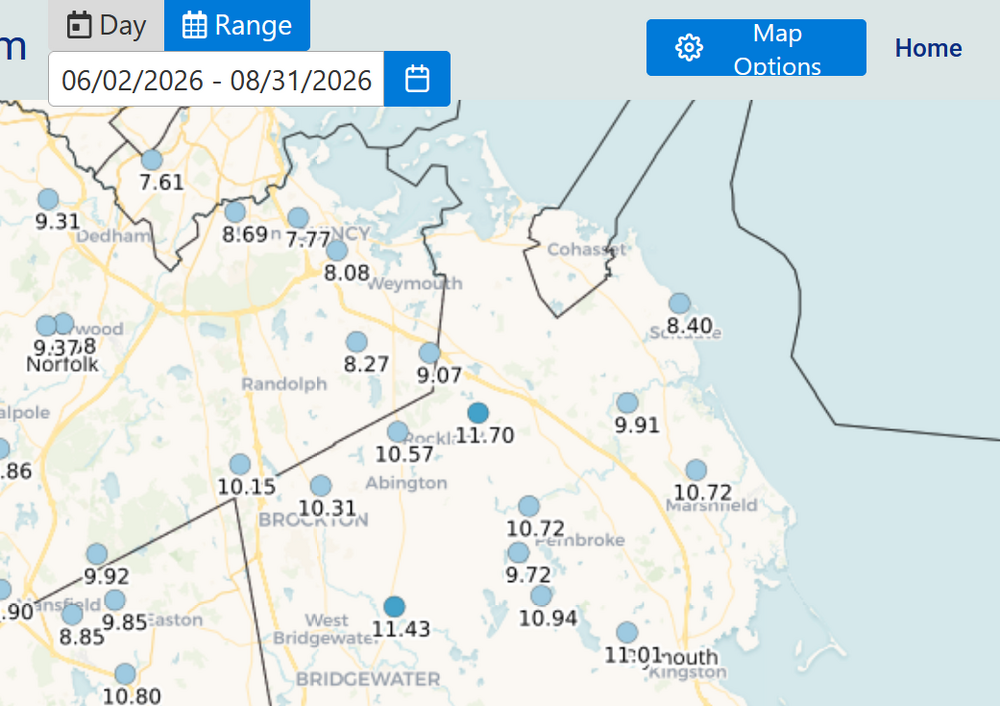
-
Septorcher 2026 Discussion - Endless Summer
vortex95 replied to Damage In Tolland's topic in New England
After what happened today across CT/RI/SE MA, it shows the shortcomings of such forecasts! The past few months for the S Coast and esp. swrn CT have been like the blitz of Jan-Feb 2015, except rain! And @CoastalWx calls the pattern "boring"?! -
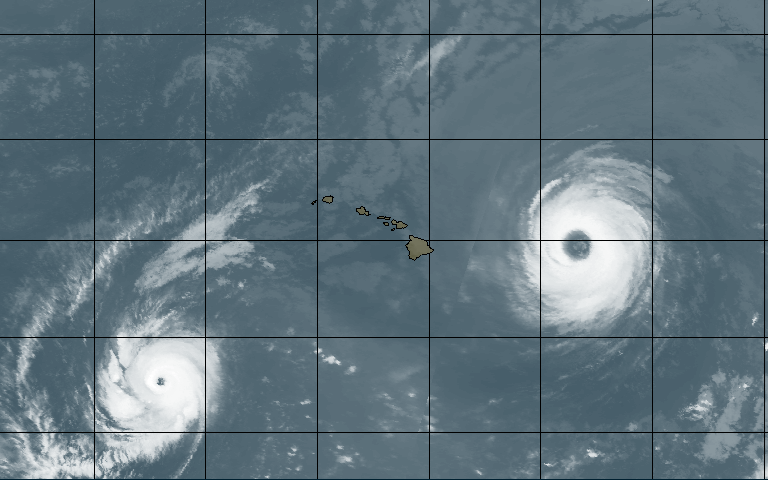
The HI area had some sig activity 1993 and 1994. Polar image attached from Aug 15, 1993, showing annular HU Fernanda to the E and HU Keoni to the SW. And in 1994, the CPAC was very active. HU Emilia became the strongest CPAC HU (140 kt) up to this time in mid-July. Then a week later, Gilma attained peak intensity roughly the same as Emilia in the CPAC. Then in Aug, HU John peaked at 150 kt to again break the CPAC record for the strongest storm, and became the longest-lived TC globally until 2023. The three Cat 5s in 1994 all passed well S of HI, so no direct impacts, but to have that kind of activity is remarkable. SSTs were running about 2.5 C above avg in the region as mdt El Nino was in taking shape. Another item that stood out during this time was a very large area of dry air on WV in the central southern Pacific in the tropics/subtropics, so subsidence here implies rising motion synopticly on the other side of the equator in at similar latitudes.
-
2026 Atlantic Hurricane Season
vortex95 replied to Stormchaserchuck1's topic in Tropical Headquarters
And to round things out about trends in TCs,.one item that seems to have slipped under the radar since so much focus on the very active Atlantic in recent years, for the NW Pacific, 2020-2025 was below average ACE each year, as low as 51% for ACE in 2020. In fact, the total ACE for this 6-year period was only 66% of average, which is the lowest 6-year ACE on record for this basin going back to 1950. https://tropical.atmos.colostate.edu/Realtime/index.php?arch&loc=northwestpacific Given our detection and documentation of TCs is better than ever these days, this makes this record more impressive. Since the NW Pacific accounts for about 38% of annual global ACE (more than twice any other basin), this quite significant overall when talking about trends. The notion that when the Atlantic is active, the NPAC is not, seems to be still holding true overall. And we see this year w/ the Atlantic suppressed, and the NPAC is very active. -
2026 Atlantic Hurricane Season
vortex95 replied to Stormchaserchuck1's topic in Tropical Headquarters
Attached is a paper about change of power dissipate index (PDI) for the South Indian Ocean since the 1990s. It also shows a map of trends in all tropical basins. A significant decrease in power dissipation index has been detected in the South Indian Ocean basin since 1994, which is almost entirely due to a decrease in both tropical cyclone frequency and duration in this basin. The decrease in tropical cyclone frequency is influenced by increased atmospheric stability. The decrease in tropical cyclone duration can be attributed to the changes in tropical cyclone locations. So the decrease is due to a decline in frequency and duration, noting about absolute peak intensity. And if you look at the all basins combined the PDI trend is down. Why 1994? Well, two reasons I think this was picked. One, full geostationary converge did not exist for the Indian Ocean until 1989, and many TCs prior to that we way underdone for intensity. Yes, we have polar imagery, but the delay to transmit those images to TC centers was delayed by several hours in those days, and could not be used operationally. Second, 1994 was the last year in a quiet period for the Atlantic that started in 1970. It also marked the end of an overall active period for the NPAC. The AMO flip occurred around this time, so it appears that there could be TC basin impact globally from the AMO cycle. The Southern Indian Ocean contributes the second most annual ACE of the TC basins. tcpaper.pdf -
2026 Atlantic Hurricane Season
vortex95 replied to Stormchaserchuck1's topic in Tropical Headquarters
It's definitely among the most fascinating microcanes. Does anyone remember Iris? That's my all-time favorite. Iris among the smallest eyes on record and triple concentric eyewalls at one point near landfall! -
No season prior has had two very close passes to any of the islands w/ both at hurricane-strength. All areas "pay the piper" sooner or later when it comes to hurricanes. HI now, FL 2004 and other years, New England 1938-1960, the GA coast in the 1890s (3 hurr landfalls, 2 in one season!), etc. Why is Hawaii generally not favorable for TCs most of time? Got this write-up some years ago. Very strong El Nino disrupts the typical flow/circulation regime, and makes it more favorable. ----- A TC approaching the Hawaiian Islands will often get sheared due to strong upper southwesterlies putting too much stress on the vertical structure of a TC moving westward in the slower but more dense trade flow over only marginally warm water. The shape and size of the NPAC basin means that, particularly in summer w/ the shorter wavelengths of the upper westerlies, there is usually room for more than one ridge or one trough in the middle and higher latitude flow. The Gulf of AK therefore often becomes home to a strong vertical high pressure cell, while troughing may prevail farther to the W near the coast of Asia and Japan. The rounded shape of the Gulf of AK fits well w/ the shape of the high w/ the high usually centered close to 45N latitude. A strong high at that latitude over the oceans can be considered a type of blocking high of great vertical extent. A strong blocking high tends to induce a cutoff low centered 15 deg S of the high center, which would place the low at 30N. This low pressure circulation in the weaker flow of summer is often not easy to detect in the surface flow except for a slight cyclonic shear w/ the easterlies increasing going northward and a slight curvature in the isobars along w/ increased clouds and showers. The longitude of these pressure features w/ the high at 45N and the low at 30N is usually near 160W. Thus, by extension, over the Hawaiian Islands still farther to the S and SE at 20N between 155W and 160W, this area experiences during this very common flow pattern of summer and fall a broad band of southwesterlies aloft, which is detrimental to TCs.
-
2026 Atlantic Hurricane Season
vortex95 replied to Stormchaserchuck1's topic in Tropical Headquarters
Some EPS members are bullish on the medicane (see attachment). Why they refuse to call these for that they are is perplexing, They have been documented since the 1940s, and some clearly have become fully tropical in nature. Like this one from 2020 (strongest medicane on record I think). https://en.wikipedia.org/wiki/Cyclone_Ianos Contrary to what this post says (link below), medicanes are not extremely rare, not are they rare, not when you go back and look history of them. There have been 92 systems documented since the 1940s, and counts prior to 1990s are likely too low. https://x.com/MatthewCappucci/status/2098869390833807409 /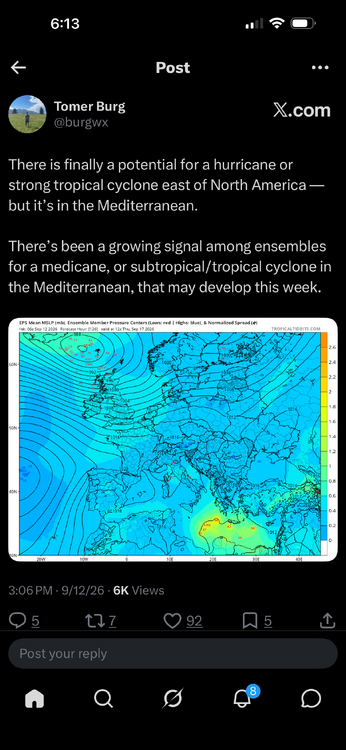
-
2026 Atlantic Hurricane Season
vortex95 replied to Stormchaserchuck1's topic in Tropical Headquarters
Excellent point and observation. It shows 2024, for instance, when it was so suppressed during the peak, wasn't just fluke. It now has happened 2 more times, all in a row? That is non-trivial, and definitely warrants a lot of study. And all 3 seasons w/ the peak squashed, it all has been for different reasons. Are the more reasons why this could happen? Not necessarily happens again next year, but what is the true range of possibilities here? I would argue there are more. This all goes into understanding TCs and environments more, and eventually leads to better forecasts! -
2026 Atlantic Hurricane Season
vortex95 replied to Stormchaserchuck1's topic in Tropical Headquarters
What part of an ocean basin is warmer or cooler than avg is a factor for TC b/c it impacts the general atmospheric circulation, and I bet for each tropical basin, it is a different configuration that aids or knocks down TC development/maintenance! Yes, the El Nino is very impressive, but I would be a bit reserved as to "El Nino is the strong on record, that means everything associated w/ it as to regional sensible wx is made more intense or worse." The atmosphere does not work on a linear curve, and unexpected deviations in parts of the globe occur more often that it is thought, but many focus on the more "classic" impacts historical and run w/ that. Given we are in uncharted territory, that may mean atypical results in certain cases. -
2026 Atlantic Hurricane Season
vortex95 replied to Stormchaserchuck1's topic in Tropical Headquarters
I do not think it works that way, at least in a linear fashion. OHC is dissipated by other means in the season transition. All the OHC in the world is meaningless for TCs if the atmosphere does not cooperate. Look how how things were leading up to the 2024 season, and yes, it was active, but far from the 220+ ACE forecast (161 for the season). The peak climo of the season was taken out big time by unusually warm mid-level temps in the MDR along w/ the lack of instability, and the ITCZ unusually far N which negated robust tropical waves off Africa. Failure mode can come from things outside the traditional wind shear/TPW/SST when it comes to TC seasons, so using a single parameter or two will give limited forecast skill. Also, 1982-83 was a very strong El Nino year, and 1982 was suppressed, and 1983 was even more suppressed (lowest # of NS in the satellite era w/ 4). So would caution thinking next season is "all set." -
2026 Atlantic Hurricane Season
vortex95 replied to Stormchaserchuck1's topic in Tropical Headquarters
In the large picture, it just goes to show there is a *lot* more to TC genesis than low wind shear, high TPW, and warm SSTs. The 3 alone are not enough. Some questions, the larger circulations that modulate things, like the MJO, Walker Circulation, subtropical high, and Hadley Cell, as some examples. Small deviations in these can mean big for sensible wx as far as TCs go, and they are not all fully understood esp. how they interact w/ each other, and alongside the most dominate cycles/circulations El Nino/La Nina. We know why the MDR is shutdown now, but outside of there? I do not think there have been much study as to cycles/more or less favorable for the subtropics and mid-latitudes. There have been some Atlantic seasons not nearly as suppressed as this one, and atypically large amount of ACE for the season is from TCs that form outside the tropics. -
2026 Atlantic Hurricane Season
vortex95 replied to Stormchaserchuck1's topic in Tropical Headquarters
That quite impressive for Sep. Major dust outbreaks are usually done by early August in more typical seasons. Throw this in w/ wind shear?