psuhoffman
-
Posts
27,418 -
Joined
-
Last visited
Content Type
Profiles
Blogs
Forums
American Weather
Media Demo
Store
Gallery
Everything posted by psuhoffman
-
Almost every one of those factors is opposite what we want. That’s “average”? I guess lately...
-
Yea it’s hard to find good global sst matches anymore. 1942/3 is intriguing as it was one of the best Nina outcomes we’ve had. I would be VERY happy if it went down that way. But it’s dangerous using analogs from such a different time period.
-
Excellent write up. Only problem in application of those analogs is how drastically different they were for our area. 1971 and 2000 both featured at least one period of blocking which allowed us to cash in on a respectable snowy period. 2008 did not and so was a pretty awful non winter wall to wall. I think the general pattern is known but whether we can salvage some snow here in the mid Atlantic depends on how much if any blocking help and I see no reliable tells to tip that hat. Your area can work without it but Baltimore has never had a warning (5”) event during a moderate or strong Nina without blocking. Furthermore when I did a pattern analysis of every warning event back to 1948 Baltimore never even lucked into a warning snow in a Nina like central pac ridge pattern in a non Nina year without blocking. So imo for our area as the high latitudes go so goes our snow chances and I’ve yet to identify a strong indicator other than pure persistence.
-
It's an extremely difficult situation. I have my son who is in K set up next to me with his headphones on and I do my best to assist him throughout the day as I teach my classes. My wife is a social worker so she is working crazy hours too meeting with her high needs cases, mostly trying to assist them with this same stuff. Since I use almost every minute of what little free time I get during the day to assist him or take care of my 2 year old I end up having to do most of my non direct instruction related school responsibilities at night. I am typically up until around 2am grading, lesson planning, answering emails and google class messages, and completing documentation and forms. I am not getting enough sleep and its definitely wearing on me. It's hard to pinpoint what is causing this to be more stressful (other than the obvious multi tasking issues) but its a combo of several factors. My students need a lot more support on this platform. It's a lot harder to find time during the day to take care of tasks. The district has us doing a lot more documentation since we can't see the kinds face to face. A lot of our tried and true curriculum resources are useless in this setting so we have to design lessons from scratch instead of pulling out and editing our files from past years. For me the most stressful part is that I can not possible complete everything being asked of me, and that is not something I am used to or feel comfortable with. But its just not possible. Even if I worked 100 hours a week its just not possible. Everyday I go to sleep at 2 or 3 am and I still know someone is going to be upset at me. There was SOMETHING or often more than one something I just couldn't get to that day. All that said...I have a job and am healthy and so I am doing better than many people so it feels like this isn't the time for a woe is me type thing. I just have to suck it up and get though this...there are millions of people in way worse shape then me.
-
One of those was a weak Nina (2018) and the other was actually cold neutral (2017). It was looking like a Nina in fall but ended up neutral but since it was kinda a Nina ish pattern and not so great winter most just think of it as a Nina. But there are lots of examples of weak cold enso seasons including some decent periods of cold and snow absent blocking. In a weak Nina the pac ridge can fluctuate and weaken enough at times. Unfortunately that isn’t true of strong cold enso. So if we’re heading for a strong Nina, and everything indicates such, we probably will need blocking or we’re unlikely to get much luck like those years you reference. That doesn’t mean I am canceling winter. Persistence is hard to ignore but the NAO can flip on a dime. We could get blocking help this year. But if we get a positive NAO all winter like last year...it’s probably going to be very similar. lastly, when I say very similar it doesn’t mean we all get the exact same results as last year. 2 points. First let’s say DC lucks it’s way to a 2” clipper in Dec and then some fluke lucky timed wave like last January is 20 miles further south and there get a 3” wet snow event in January. And that’s it. The rest of winter is 50+ degrees. DC gets 5” which puts it more in line with its common crap winters. But it wasn’t significantly different from last year. Just slightly luckier. And I have my doubts the people that get 5” vs 1” are really going to look back when it’s over and feel good about it! Lastly I am probably even more pessimistic because I didn’t get 1” I actually lucked my way to about 16” up here. And I got 7.5” over 2 days in January. And I knew that was likely “it” and so I enjoyed the crap out of it! But when I pull the analogs to strong Nina with a +NAO more are actually WORSE for me than last year!!! 2 of them are literally the worst 2 winters here in over 125 years of records and another is the 4th worst!!! Only 1 in the set is better. So actually statistically if we see a strong Nina with a + NAO I am likely to get less snow than I did last winter. As you said it’s and IMBY thing.
-
That’s what I found. Nina’s for us (excluding 1996) range from totally awful or just mediocre and the other factors that determine that differentiation (EPO/NAO) have very little correlation or reliable predictive tells. We know it’s likely to be a NS dominant winter so big snows are unlikely. But we could have a colder close to normal winter or a warm clone of last winter and it’s very difficult to predict which variant of Nina is coming ahead of time. This year even more so because of conflicting signals.
-
I don’t know what they did. The strategy also has to be tailored to the team. If you are a defensive team with a limited offense being hyper aggressive would be stupid. The eagles defense is pretty awful so...
-
Got to remember Doug learned under Andy both as a player and a coach and he once started a division game against the cowboys with an onside kick. Lol. I doubt he will ever be a conservative coach. I like it. Imo they have way bigger problems than Dougs aggressive style.
-
It wasn’t a decision based on the specifics of the game wrt time and score. It was a decision based on larger scale probabilities. They don’t always do this. If Doug calculates a game is likely to be low scoring he calls it slightly more conservative. But sometimes when he suspects the defense isn’t capable of keeping it a low scoring game he plays the odds that say going for 2 every time will work in your advantage in the long run. So long as you convert half the of them you break even. Convert more than half and you beat the chalk. He is aggressive with 4th down calls also. And again sometimes when it costs then people get upset. But over the course of a season it almost always ends up a net positive. In his 5 seasons as coach I can remember a few games where his aggressiveness cost then a win. But I can remember way more examples where they won because Doug squeezes an extra possession or a few extra points out of the game that way.
-
Actually they scored 4 TD. They didn’t get it on the first attempt but did the next 2. That means they got 22 instead of 21 pts from their first 3 TD. That was the only reason they had a chance to tie at the end. Even with that failed conversation they still ended up with 28 from 4td. They have done this hyper aggressive thing for years and it works in their favor way more than it costs us. Not that it hasn’t ever blown up in our face but you have to take those exceptions. IMO the criticism of Doug from Eagles fans is ridiculous. The team he has on the field right now is a mess. Backups and backups to backups all over. Receivers that drop easy catches. A line that can’t block. A QB that’s lacking confidence and shell shocked such that even when he has an easy throw often misses it. Then if he makes it they drop the pass. I’ve seen plenty of bad coaching. This is a player problem. Matter of fact each week (including their 1 win) they got badly outplayed in every way and the only reason their even in the game is opportunistic coaching and trick plays that somehow keep it close. Replacing Doug won’t fix anything.
-
Please my team is a hot mess.
-
To be more optimistic if we do get some blocking help the better analogs become 1955/56, 1973/74, 1999/00, 2010/11. They all features some respectable cold periods and some decent snowstorms. We’re still not looking at a blockbuster but those years felt like we had a winter at least.
-
Just to illustrate my point. Even if we do get some NAO help were still not likely to get a great winter. But history suggest something close to median and maybe avg if we’re lucky. Not too bad. But let’s say we get another wall to wall +NAO. The best analog matches are then 1949/50, 1975/76, 1988/89 and 2007/08. I am not going to run the numbers for every location but 2 of those 4 years were WORSE here than last year! And the other 2 were only marginally slightly better. And only better due to flukes. 1976 all the snow came from a big mid March save. And 2007/8 almost all the snow came from an early December clipper that somehow dropped 7” on only .25 qpf. Otherwise those 2 years were just as awful with virtually no snow here the rest of winter. So history says if we don’t get NAO help it’s likely to be just as bad as last year. Last year wasn’t bad luck. It wasn’t a fluke. It was exactly what a strong Nina pac pattern looks like with a +AO/NAO. (Yes I know it wasn’t a strong Nina but the atmosphere behaved like one so my point is valid).
-
This part of the equation is where my pessimism lies. We can and have had decent snowfall in a strong Nina. But every instance took high latitude blocking. Not some. Not most EVERY SINGLE one. I can’t stress that enough. Since 1948 Baltimore hasn’t had a single warning level snowfall during either a strong Nina or a central pacific ridge (predominant effect if said Nina) without blocking. Even when we include non Nina years that featured a Central pac ridge I found not one single significant snowfall with that pac pattern that didn’t include blocking. I get the sense some people think we might luck our way into a snowstorm even with a strong pac ridge and +NAO. But history suggests we won’t. That if we do get the currently expected pacific and Atlantic patterns we are just as much toast as we were last year. I’m not saying we won’t get snow. But I’m saying we need one of those two patterns to break our way. Not the whole winter. Look at 2000. We only got the high latitudes to cooperate for a few weeks but that was enough to save us. But if we do get a wall to wall +NAO like we’ve seen for years now...I am not optimistic “luck” saves us.
-
Simply the fact the Nina is strong doesn’t necessarily mean a torch winter. There have been some cold or somewhat snowy strong Nina’s. However, there are plenty of other factors that in conjunction with a strong Nina aren’t good.
-
I had 8” here in October 2011
-
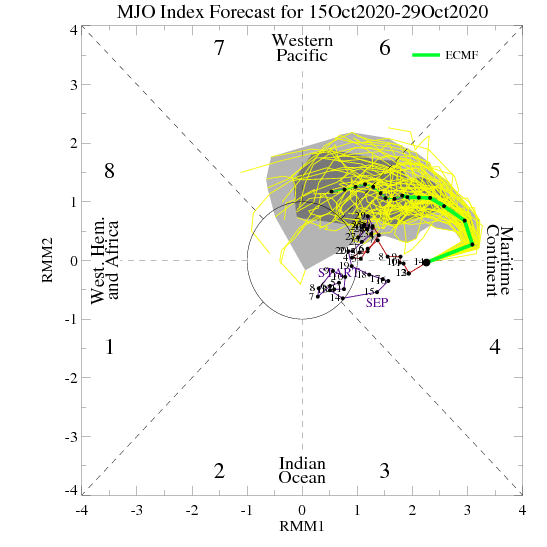
@frd that would bode well for this winter. Still not great as we typically struggle even in a better Nina but it would suggest we might avoid total pac ridge hell like last year. I’m still not sold one way or another. Lots of conflicting tea leaves.
-
So....
-
I'll say a prayer for you
-
so you like to compare a day 5 smoothed ensemble mean to an actual h5 verification?
-
paging @stormtracker
-
Yes a negative NAO October is inversely correlated with a -NAO winter. You know what else is inversely correlated with a -NAO winter? EVERYTHING!!! There have only been 3 negative NAO winters in the last 30 years. Anything you run a correlation against a -NAO winter will come back as an inverse relationship simply because the odds of a -NAO winter are so extremely low regardless of whatever else is happening. This is another example of correlation not being the same as causality! But lets look at the data to see if there IS anything meaningful to this October/Winter correlation debate. So first of all there are 2 different ways to calculate winter NAO. Some use D/J/F and some use J/F/M (because that is when the NAO has the most impact on the sensible winter weather). But regardless of which you use there are 3 years...just 2 of those 3 is different in each set. But since we have so few truly negative NAO years lets use all 4. 1996 and 2010 are truly negative years regardless of the way you calculate. 2011 and 2013 flip flop depending on how. 2011 is a neg year if you use D/J/F and 2013 is if you use J/F/M. 3 of the 4 negative NAO winters in the last 30 years came following a negative NAO October. The other came following a neutral NAO October (1996). For what its worth 1996 turned severely negative later in October but numerically it was washed out by positives earlier. So purely statistically -NAO Octobers had a 21% chance of leading to a -NAO winter. All other Octobers had a 6% chance of leading to a -NAO winter! But those numbers are from way too small a sample size to have true statistical significance. And besides...the problem with using the seasonal NAO, besides the fact the base state of the NAO is so positive that you get too rare an occurrence to glean any meaningful correlations, is that we don't need the NAO to be negative for 3 months (or even 1 month) to get snow. We just need some periods of blocking. And sometimes that blocking is bootleg and doesn't even show up in the numerical NAO. And a period of positive can negate a period of negative. Who cares if it snowed right! So...lets look at what we all really care about...snowfall. Averaging the 3 major recording stations in our region (DCA/IAD/BWI) together gives us an average snowfall of 18.1" over the last 30 years. The avg snowfall in the 14 winters following a -NAO October is 21.0" The avg snowfall in the other 16 winters is 15.6" So...we have averaged 5.4" more snowfall following a -NAO October in the last 30 years.
-
We live in a simulation so
-
Kinda like your predictions lately
-
Unfortunately a -NAO in December without PNA or AO help is unlikely to save us. We typically need multiple things to line up to get much snow before Xmas.