
donsutherland1
-
Posts
24,322 -
Joined
Content Type
Profiles
Blogs
Forums
American Weather
Media Demo
Store
Gallery
Everything posted by donsutherland1
-
Occasional Thoughts on Climate Change
donsutherland1 replied to donsutherland1's topic in Climate Change
Here's where I think the issue lies. The graph is based on where the collapsing rock/glacier hit the valley (around 4,300 meters above sea level). The bedrock, glacier was about 5,200 meters. So, the graph is correct in that the region has been warming, but it is not the mean temperature of the actual glacier. Nevertheless, preceding the collapse, temperatures had reached 90° or above in Kathmandu. At standard lapse rates, that would suggest readings in the middle 40s at the altitude of the glacier. During the June 1-August 25 period, Kathmandu had 77 days with highs of 80° or above. At standard lapse rates, that would amount to highs of 35° or above at 5,200 meters. So, at least using the standard lapse rates and Kathmandu's data, most of the summer days saw at least some melting where the collapse took place. -
Occasional Thoughts on Climate Change
donsutherland1 replied to donsutherland1's topic in Climate Change
It is, but both sites are in different Himalayan subregions with different topography and wind exposure. -
Occasional Thoughts on Climate Change
donsutherland1 replied to donsutherland1's topic in Climate Change
The Everest base camp is about 160 km from the site of the bedrock/glacial collapse that occurred last month. -
Occasional Thoughts on Climate Change
donsutherland1 replied to donsutherland1's topic in Climate Change
Florac, France, where September records go back to 1861, has recorded its three hottest September temperatures on record during the current heatwave. September 4, 1966 saw its first 30C (86F) or above September temperature on record.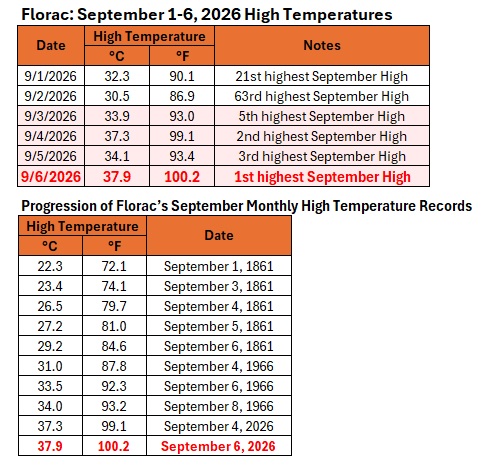
-
A cool Labor Day weekend has commenced. Temperatures will generally peak in the middle and upper 70s. Readings in New York City could fall into the lower 60s with widespread 50s outside the City. The cool weather will likely continue into the middle of next week. By midweek, readings could return to the lower 80s. Another push of cooler air could arrive by Friday or Saturday. The ENSO Region 1+2 anomaly was +4.2°C and the Region 3.4 anomaly was +2.6°C for the week centered around August 26. For the past six weeks, the ENSO Region 1+2 anomaly has averaged +3.93°C and the ENSO Region 3.4 anomaly has averaged +2.50°C. The ongoing strong El Niño, which has reached super El Niño threshold, will continue to strengthen through the summer. The SOI was -16.70 today. The preliminary Arctic Oscillation (AO) was +0.627 today.
-
A few areas could see an evening shower. Most of the region will remain dry. Cooler air will move in overnight. A cooler air mass will cover the region for the Labor Day weekend. In its wake, temperatures will generally peak in the middle and upper 70s. Readings in New York City could fall into the lower 60s with widespread 50s outside the City. The cool weather will likely continue through at least the middle of next week. The ENSO Region 1+2 anomaly was +4.2°C and the Region 3.4 anomaly was +2.6°C for the week centered around August 26. For the past six weeks, the ENSO Region 1+2 anomaly has averaged +3.93°C and the ENSO Region 3.4 anomaly has averaged +2.50°C. The ongoing strong El Niño, which has reached super El Niño threshold, will continue to strengthen through the summer. The SOI was -7.78 today. The preliminary Arctic Oscillation (AO) was +0.293 today.
-
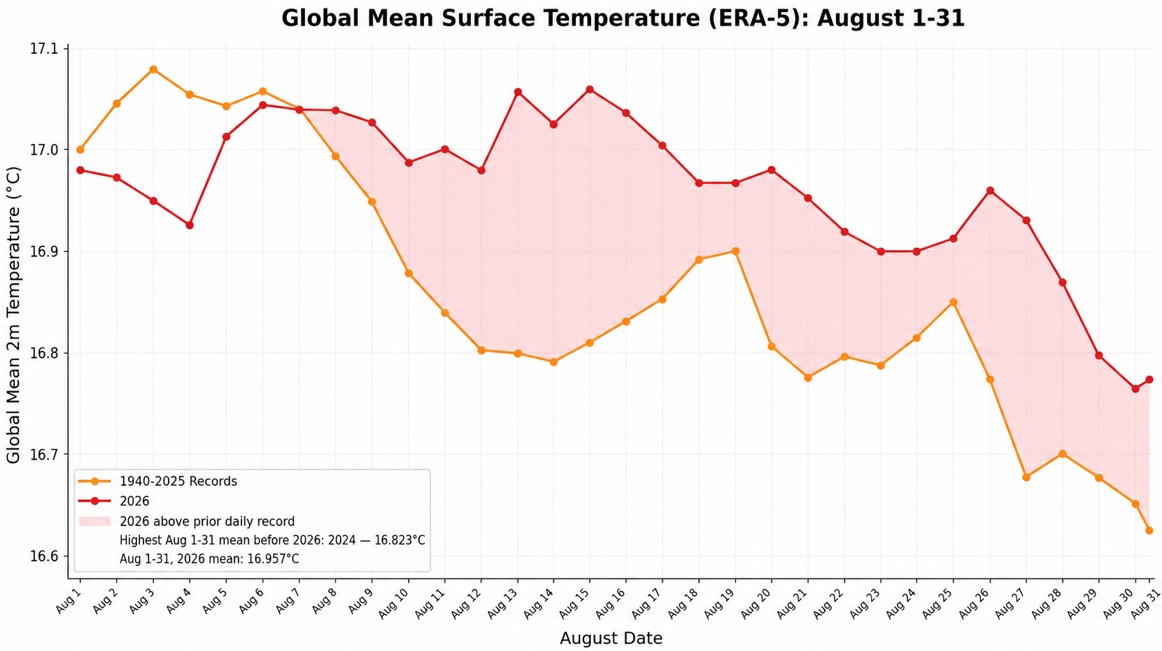
Highest daily values for each month and highest monthly and seasonal averages on ERA-5:
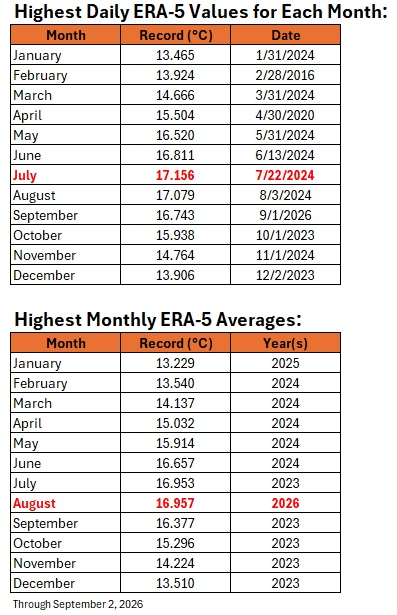
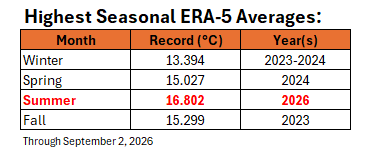
-
In advance, have a very happy birthday.
-
Occasional Thoughts on Climate Change
donsutherland1 replied to donsutherland1's topic in Climate Change
Here’s a reasonable substitute: https://www.pyreweather.org I hope the shortsighted decision to stop updating the PSL site will be reversed in the future. -
Occasional Thoughts on Climate Change
donsutherland1 replied to donsutherland1's topic in Climate Change
The idea that the bedrock collapsed leading to the glacial collapse and subsequent debris flow has gained increasing support. However, one can't automatically suggest that because the bedrock collapsed, climate change wasn't involved. The literature links a warming climate to destabilization of high mountain terrain. One recent study noted: The study found that rising temperatures are destabilizing high mountain terrain in India’s Kinnaur district and creating conditions that could trigger chains of disasters, including avalanches or landslides that spill into glacier lakes and produce destructive flooding downstream. A quick assessment by University of Colorado researchers also linked climate change observing: Satellite and drone images suggest that softening permafrost, or perennially frozen rock, ice and soil, on Langtang Lirung peak likely caused a massive bedrock failure and glacier collapse. An estimated 50 million metric tons of ice, rock and water—roughly 13 billion gallons, or about three times the capacity of Boulder Reservoir—fell 6,500 feet into the valley below, unleashing a slurry of mud and water that inundated bridges, hydropower facilities and villages along the way. According to the United States Geological Survey, the force of the initial debris flow hitting the ground was equivalent to a magnitude 5.2 earthquake... Since the 1850s, changes in high-altitude permafrost have contributed to dozens of these cascading disasters in Nepal and parts of India, in which bedrock and glaciers break off, and trigger massive flash floods and debris flows. For example, in 2012 a slurry flood in central Nepal, similar to what happened in Nepal last week, killed 79 people along the Seti River. The University of Reading also provided the following account: Researchers from the HiRisk project, which investigates cryosphere-related hazards in High Mountain Asia, suggest that longer-term glacier retreat and permafrost degradation may have contributed to slope destabilisation. The failed glacier retreated by approximately 450m between 1990 and 2020, potentially reducing the mechanical support provided by the glacier to the underlying rock slope. Permafrost degradation may have further contributed to instability. The warmer than average temperatures observed in the area this summer might have contributed to the glacier collapse too, although observations at these elevations remain limited. As a side note, this assessment also refers to "warmer than average temperatures" during the summer. That's something the maps I posted showed in contradiction to JB's cropped map. Based on the evidence and literature: 1) A climate link is highly likely, but the magnitude of the contribution from climate change is uncertain. 2) The absence of a climate link is probably close to zero Considering the literature and emerging assessments, the burden of proof rests with those such as Martz to support the argument that climate change played no role. Arguing that climate change played no role (Martz's proposition) is quite different from suggesting that the extent of contribution by climate change remains to be determined. As noted previously, there had been record heat in the region for several days prior to the catastrophe. Moreover, frost-wedging can lead to the fracturing of rocks over long periods of time, and in the warming climate of the altitude Himalayas, this form of weathering has increased in frequency. -
Occasional Thoughts on Climate Change
donsutherland1 replied to donsutherland1's topic in Climate Change
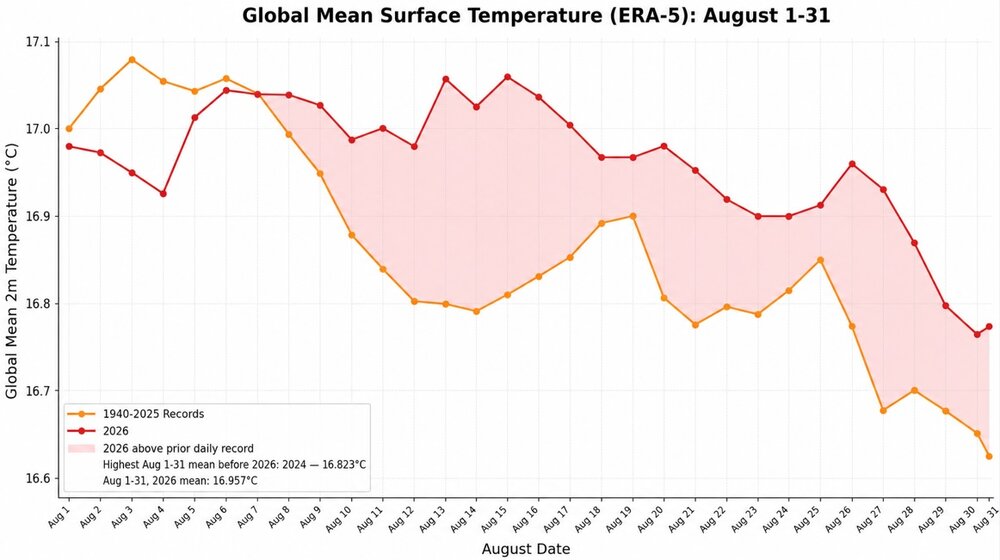
Following the warmest August and warmest month on record in the ERA-5 dataset, September 1 started with a global mean temperature of 16.739C. That destroyed the monthly record of 16.607C from September 1, 2024. The preliminary 0.132C difference between the new mark and the old record is the largest difference between any first and second highest monthly values. -
Tomorrow and Friday will see temperatures top out mainly in the lower 80s. Showers and thundershowers are possible. Excessive heat with highs in the middle and upper 90s will be just south of the region in such cities as Baltimore and Washington tomorrow and Friday. A cooler air mass will move into the region for the Labor Day weekend. In its wake, temperatures will generally peak in the middle and upper 70s. The ENSO Region 1+2 anomaly was +4.2°C and the Region 3.4 anomaly was +2.6°C for the week centered around August 26. For the past six weeks, the ENSO Region 1+2 anomaly has averaged +3.93°C and the ENSO Region 3.4 anomaly has averaged +2.50°C. The ongoing strong El Niño, which has reached super El Niño threshold, will continue to strengthen through the summer. The SOI was -10.63 today. The preliminary Arctic Oscillation (AO) was +0.219 today.
-
August 2026 finished with a preliminary monthly mean temperature of 16.957C. That would shatter the August mark of 16.823C from 2024. It would also edge past July 2023's 16.953C to become the warmest month on record in the ERA-5 dataset.
-
Occasional Thoughts on Climate Change
donsutherland1 replied to donsutherland1's topic in Climate Change
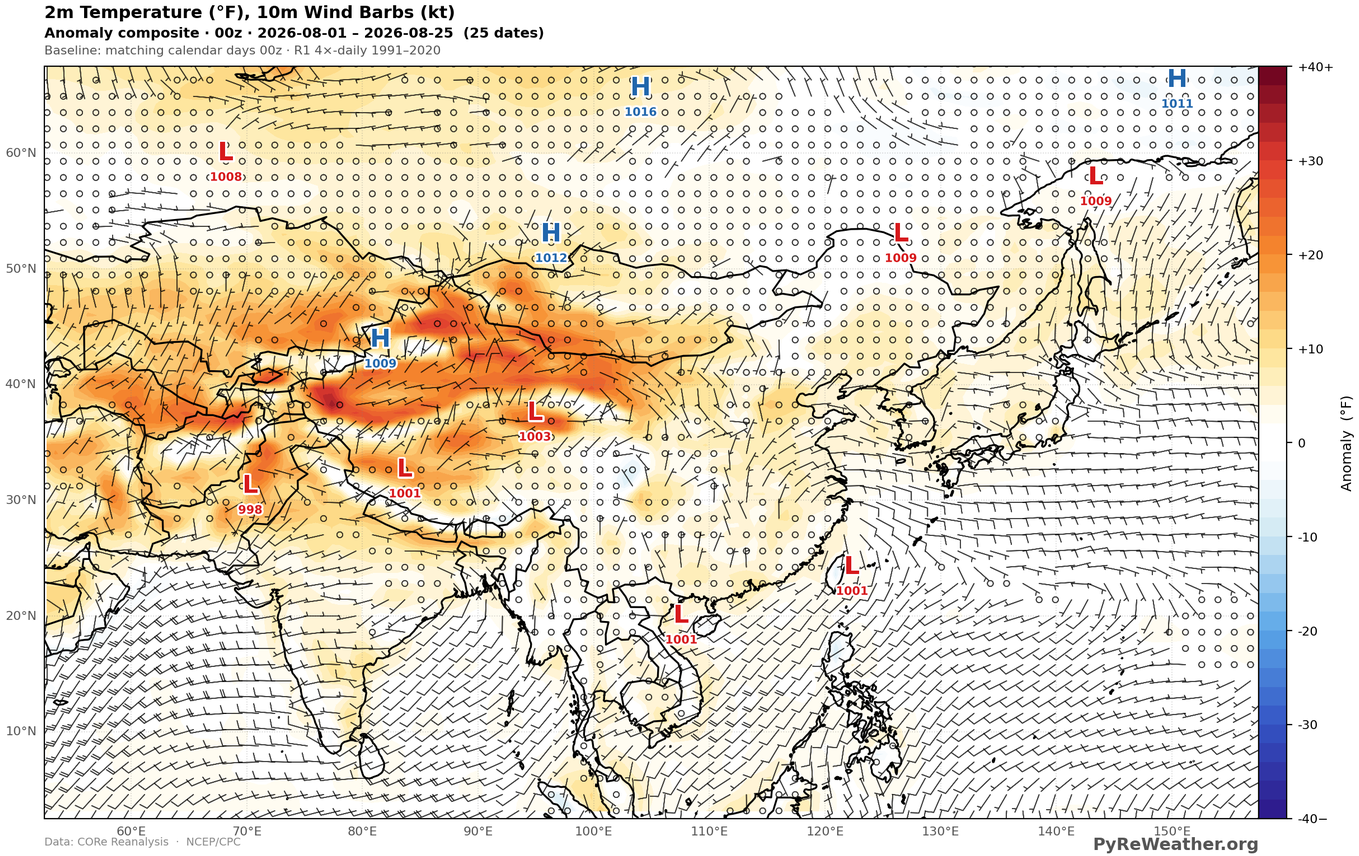
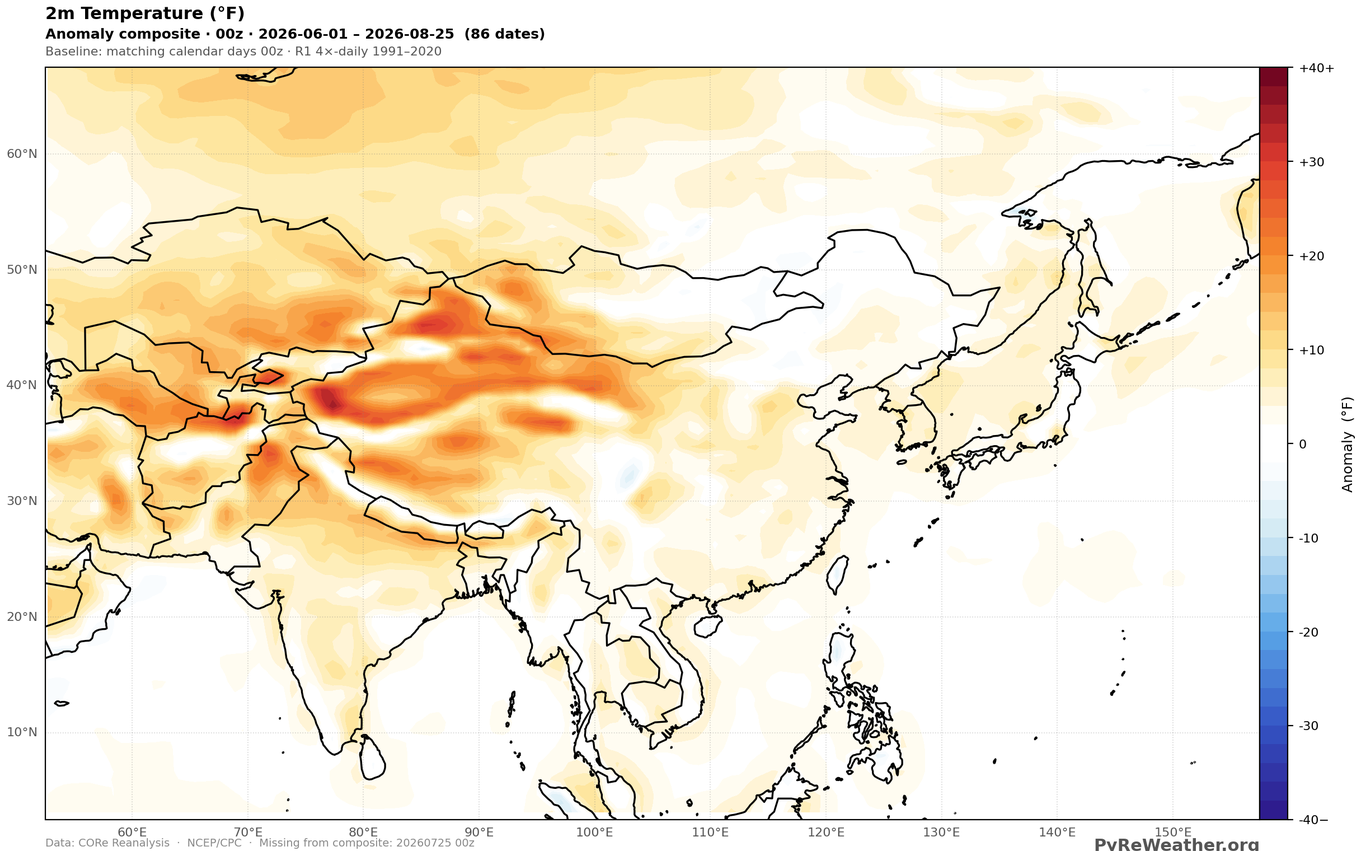
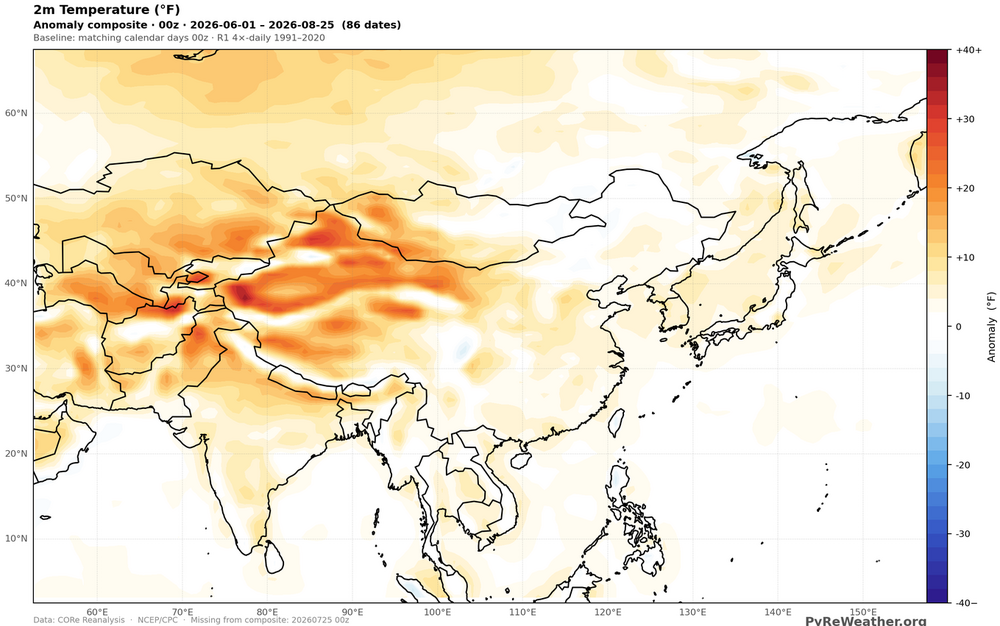
Here are the temperature anomalies for the Nepal/Tibet area. If Copernicus confirms this data for August, that will raise questions about JB's maps. Perhaps, just as with the CFSv2, they have a cold bias? August 1-25, 2026: Summer (June 1-August 25):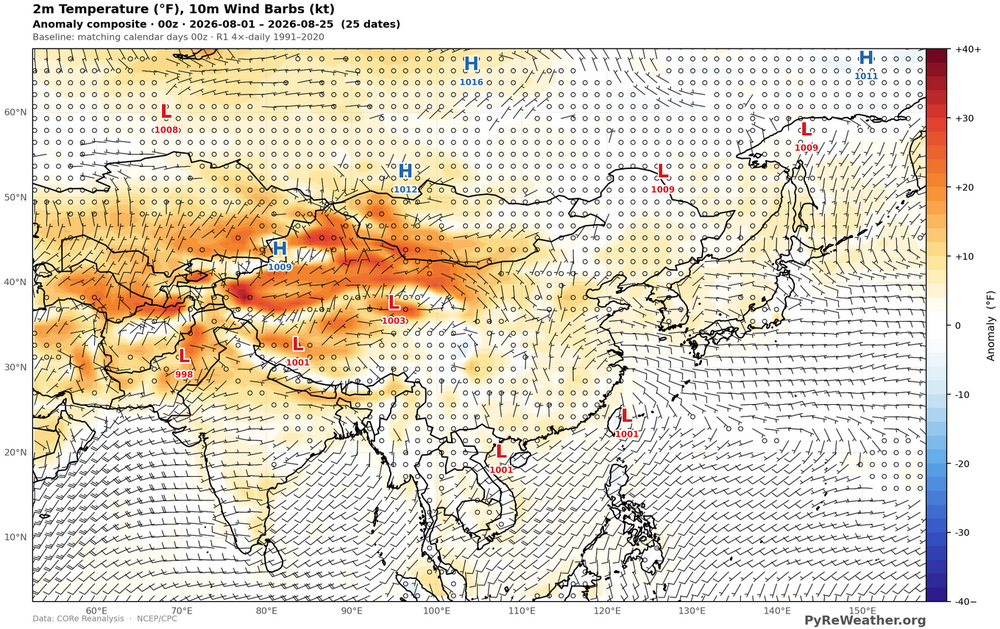
-
Parts of the region could experience a strong thunderstorm this evening or tonight. Tomorrow through Friday will see temperatures top out mainly in the upper 70s and lower 80s. Showers and thundershowers are possible. Excessive heat with highs in the middle and upper 90s will be just south of the region in such cities as Baltimore and Washington tomorrow and Thursday. A cooler air mass could move into the region for the Labor Day weekend. The ENSO Region 1+2 anomaly was +4.2°C and the Region 3.4 anomaly was +2.6°C for the week centered around August 26. For the past six weeks, the ENSO Region 1+2 anomaly has averaged +3.93°C and the ENSO Region 3.4 anomaly has averaged +2.50°C. The ongoing strong El Niño, which has reached super El Niño threshold, will continue to strengthen through the summer. The SOI was -0.79 yesterday. The preliminary Arctic Oscillation (AO) was +0.320 today.
-
Occasional Thoughts on Climate Change
donsutherland1 replied to donsutherland1's topic in Climate Change
For reference: The first report on the Nepal glacial collapse event: https://hirisk.org/wp-content/uploads/2026/08/RHA_NP3_RasuwaFlood-1.pdf -
Occasional Thoughts on Climate Change
donsutherland1 replied to donsutherland1's topic in Climate Change
Given the literature, a climate change contribution appears likely. As I replied to Larry, that doesn't mean that climate change was the main or leading cause. A lot more research will be needed for that determination, as well as to estimate the magnitude of climate-related contribution. Your theoretical point is a fair argument. My conclusion is based largely on the body of literature. -
Occasional Thoughts on Climate Change
donsutherland1 replied to donsutherland1's topic in Climate Change
Climate change is likely a contributing factor. It's too soon to know whether it was the main cause. A lot for research will be needed to pin down the main cause. The only thing that appears extremely unlikely given the literature is Martz's contention that it had no impact. -
Occasional Thoughts on Climate Change
donsutherland1 replied to donsutherland1's topic in Climate Change
A look at Phoenix's just-concluded summer (3rd hottest on record). Summers 2020-2026 have averaged 96.4F (35.8C). Prior to 2020, the hottest summers were 2013 and 2015 with mean temperatures of 95.1F (35.1C). The extreme has become routine.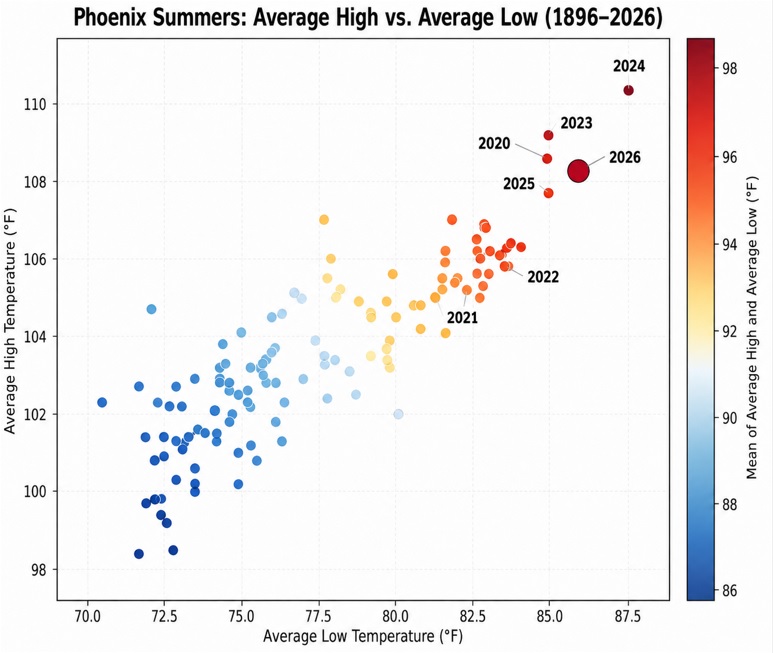
-
Occasional Thoughts on Climate Change
donsutherland1 replied to donsutherland1's topic in Climate Change
That's part of the reason I suggested that the precise role of climate change remains to be determined. Given the body of literature, there was likely a role. The least likely scenario is none. Further study will be needed to gain a better understanding. Even if there is a flash attribution study, the full picture probably won't be available for several years until research findings are published. -
Occasional Thoughts on Climate Change
donsutherland1 replied to donsutherland1's topic in Climate Change
When one's narrative is destroyed by the facts, some accept reality. Others, however, resort to conspiracy theories.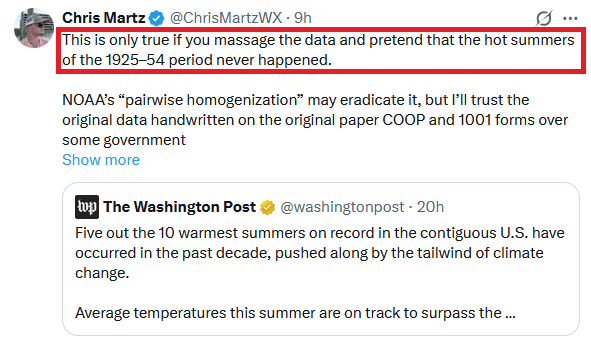
-
Occasional Thoughts on Climate Change
donsutherland1 replied to donsutherland1's topic in Climate Change
So, he created a fairy tale on video. As I provided a link and full context to the article he referenced, there's no need to comment further on his video. -
Occasional Thoughts on Climate Change
donsutherland1 replied to donsutherland1's topic in Climate Change
He's flailing in a desperate attempt hold onto an unsustainable explanation. First, he claimed that it was an earthquake, even hours after the USGS revealed that the glacial collapse and debris flow triggered the shaking. Then it was past earthquakes that led to destabilization. Now he spins the latest development hoping to evade any climate links, but only exposing his lack of knowledge of both climate and geological processes. As noted yesterday, frost-wedging can lead to a fracturing, disintegration, and breaking of rock over time. Water finds its way into cracks and microfissures and expands as it freezes. The ice then melts when temperatures warm. This repeated cycle eventually causes larger cracks to develop and, ultimately, the rock to split or break. The warming climate in the high alpine regions of the Himalayas has accelerated this form of rock weathering. Finally, notice that he didn't provide a link to the actual story. He wanted to limit his audience to his opinion, depriving them of the full contents. Here's why: the story goes on to state: Mountain geographer Alton Byers of the University of Colorado Boulder has linked the disaster to climate change. He said permafrost, which has helped hold together high-altitude rock, ice, soil and glaciers for thousands of years, is weakening and becoming increasingly unstable. However, Cook and Shugar have not established a direct link between global warming and the bedrock failure. While they believe permafrost is melting and may be contributing to the destabilisaton of mountain slopes, they said further analysis is needed to determine the precise cause of the collapse. In sum, the article he references to dismiss any link to climate change actually does not rule out the role of climate change. All said, based on the full body of evidence and the insights from existing literature, climate change likely played a role, probably through a cascading set of complex processes (glacial melt, rock weathering, permafrost melt, etc.). Its precise role remains to be determined. The least likely scenario is zero impact from climate change. Further analysis will provide greater insight. -
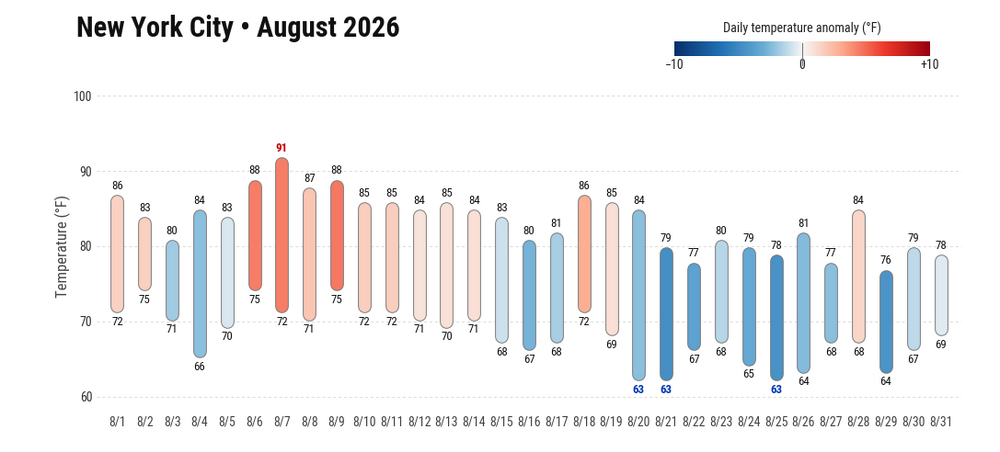
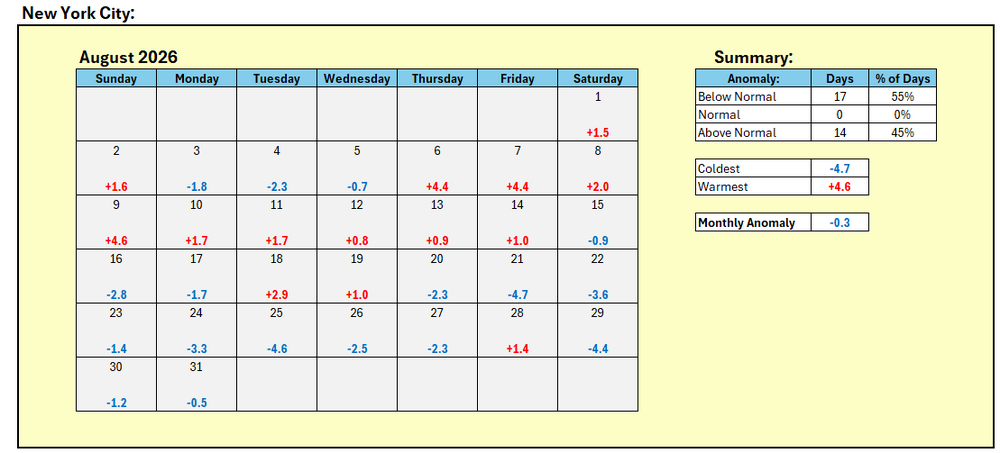
JFK had two such days and LaGuardia had five. There have been 21 years where Central Park had none in August. The most recent such year was 2023.
-
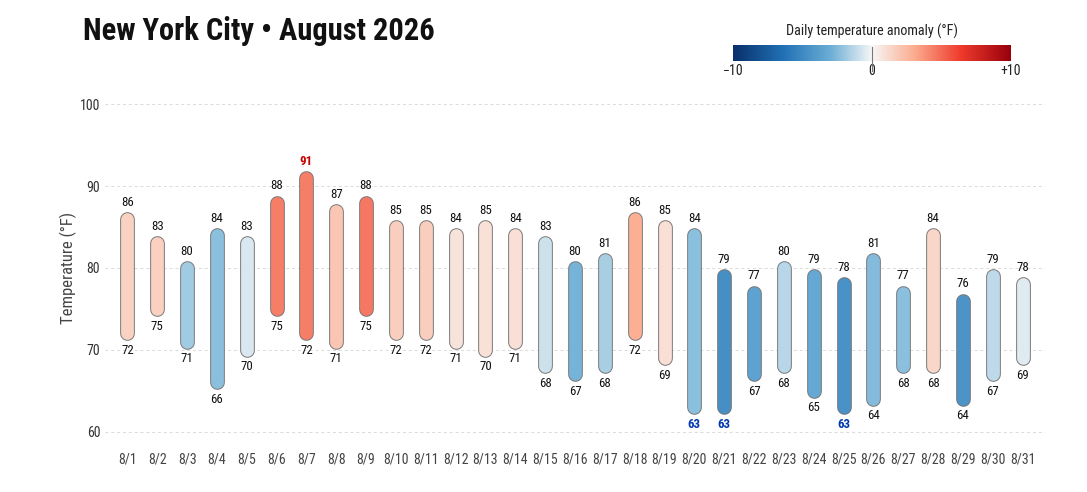
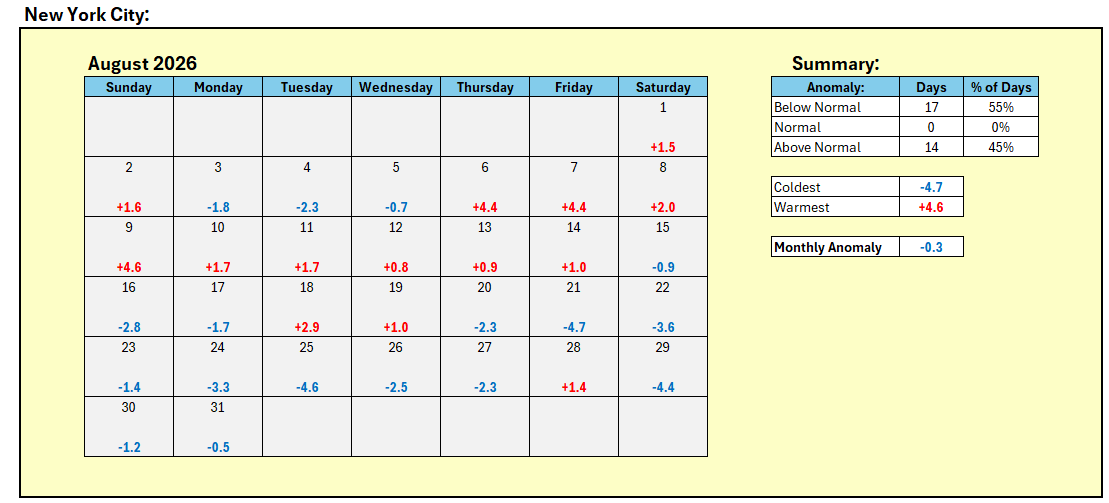
August finished with a monthly mean temperature of 75.8° in New York City (Central Park). That was 0.3° below normal (1991-2020).