frd
-
Posts
7,285 -
Joined
-
Last visited
Content Type
Profiles
Blogs
Forums
American Weather
Media Demo
Store
Gallery
Everything posted by frd
-
Similar to last year, the Chukchi Sea presently has extremely low sea ice extent. . This my have some role in our late Fall weather. Another thing to look for regarding clues to the upcoming winter is what phase(s) the MJO mostly travels in during the month of October. As bluewave and Don S. have referenced there appears to be a connection to the following winter's EPO and AO state. From Don S. < In addition, from the larger pool of La Niña winters following El Niño winters, there were four cases where October saw the MJO in Phases 4-6 for 20 days or more: 1983-84, 1988-89, 1998-99, and 2016-17. All four cases featured an EPO+/AO+ winter. Three cases saw the MJO in Phases 4-6 for less than 20 days: 1995-96: 12 days, 2007-08: 6 days, and 2010-11: 6 days. Both 1995-96 and 2010-11 featured a predominantly negative AO. The latest ensemble guidance favors October 2020 falling into the former pool. Among that pool, October 1983 and 2016 featured above normal and near normal rainfall respectively. October 1988 and 1998 saw below normal and much below normal rainfall respectively. > Meanwhile the West Pac warm pool appears to be at near record temps. If you recall there was a study posted last winter https://www.nature.com/articles/s41586-019-1764-4 Here is a tidbit from the abstract. Here we show that rapid warming over the tropical oceans during 1981–2018 has warped the MJO life cycle, with its residence time decreasing over the Indian Ocean by 3–4 days, and increasing over the Indo-Pacific Maritime Continent by 5–6 days. We find that these changes in the MJO life cycle are associated with a twofold expansion of the Indo-Pacific warm pool, the largest expanse of the warmest ocean temperatures on Earth. The warm pool has been expanding on average by 2.3 × 10⁵ km2 (the size of Washington State) per year during 1900–2018 and at an accelerated average rate of 4 × 10⁵ km2 (the size of California) per year during 1981–2018.
-
Nina or Nino simply does not matter. As mentioned before the small area of cooler Pac waters is nothing compared to the HUGE global ocean impact specifically the Pacific. And the CFS sucks. Even the monthly CFS is horrible until you get to the 20 th of the present month for the next month's forecast.
-
I believe there are -NAO cycles or periods when winter blocking in the NAO domain continued for several winters in a row. Lately as you know the -NAO during the heart of winter has been lacking. The real game changer for us and for a large part of the country has been the fast Pac jet causing warmth to dominant and responsible for a lack of phasing storms ( think East Coast , and Miller A s ) and the breaking down of West Coast ridging.
-
I know it is early, but I go with 2015-2016
-
Are we not in a new era ? In my opinion winter analogs present little value currently, and there is a tendency for the warmer climate to our South to be nudging North. Saying we are due for an average winter, or there is no history of something is not a wise train of thought. We could go multiple years with a few inches of snow or a fluke blizzard may hit us.
-
I see no real reason why it has to be better than last year. Could be another very poor winter if you are after cold and snow. Of course, as we have seen the last few years, there could be a fluke event within a period of cold that turns the stats toward , "wow that winter wasn't so bad,we got a lot of snow" , I give you 2016 for example. A one hit wonder, or fluke if you may. It would certainly appear more likely that if you want to venture a forecast going with a false start to winter seems a decent idea at the moment. I would think maybe something along the progression of last year. Whether it is in November or December, remains to be seen. Would have to think earlier versus later. I based this on upon SST forcing to our North, ie. less sea ice, and the still evolving and growing Nina. Whatever favorable elements can happen , would occur early in my opinion. There is talk among some mets, and seasonal modeling, that the coming winter will be back loaded. We thought that would happen last year but it did not , blocking came together too late and brought a cold portion of spring. In March 2018, that was back loaded with the mother of NAO blocks and brought us a memorable late period of snow and cold to our region.
-
2 weeks of winter in late November to early December then we firmly get implanted on Nina pattern and roast . Accuweather with similar thoughts. As you might have read they feel winter could come in early and then moderation. They are going with typical Nina Climo. Nothing we didnt know already.
-
The GEFS and CFS both keep the pv along the normal growth trajectory during the next 35 to 45 days . Just saying, because it means very little, but interesting to follow along and see how this turns out a month from now.
-
Latest CanSIPS To be expected in a Nina , whether it is correct not sure.
-
Another interesting reflection from grit regarding AO and the NAO both being negative ( .40 or lower ) during the period Dec to March since 1990.
-
Simon just added this to his cool reference site. GEFS: 35-day 10 hPa 60°N The new GEFSv12 now features a 35-day run every day at 00Z. Shown here is the output from the previous day’s run, due to the time taken for the data to appear on NOMADS. Note that, because of the length of the forecast, systematic model biases are more likely to impact the output. These are not accounted for here.
-
I read a couple posting from TIP that events in a general shotgun area of the NE can be more extreme, in the winter, for example ....I think the idea was a fast PAC flow all the time, but when we funnel that energy into an extreme low pressure area it slows and it becomes one for the ages. So to me that implies, and seems backed possible by the last 10 years, that we are getting more intense storms.
-
Granted the seasonal models, Glosea included, all have what appears to be a + NAO. Not as robust as last winter, but I place little faith in long range and medium range NAO domain outlooks. All about timing, etc. I look forward Tom's NAO outlook. I enjoy your insights as well.
-
Sample size is small and we would require a - NAO , especially in our region here for any hopes of significant snowfall. But, the idea of a poleward High during the winter and even extending into the EPO regions has been mentioned by a few pros and mets. Of course, as you know, being in a Nina combined with the location of the Northern Mid Atlantic will take some divine intervention for significant snowfall opportunities.
-
Great post by @bluewave this morning, I wanted to share it here. As mentioned in the post here, a very small sample size indeed, but still worth following to see what transpires with the Western Ridge during the month of October. I wonder if we enter a feedback loop and how the evolving Nina will effect long term Western ridging later in the year. Here is bluewaves's post: < The sample size for La Niña Octobers with a Western Ridge and Eastern Trough is very small. So we will have to see if the strong ridge to start the month persists like it has in September. There was only 1 La Niña year since 1950 with a pattern like this. It was October 1988. The dominant Pacific feature that winter was that the NEPAC ridge extended north into Alaska. Main problem for us in 88-89 was the very strong +NAO. 08-09 had an almost identical Pacific La Niña pattern with a better Atlantic and more snowfall. So maybe a strong ridge out West in October would be hinting that the Pacific Ridge will extend into Alaska.This would be unlike the last 2 winters with the flat La Niña Ridge North of Hawaii. But we would have to wait and see how the NAO evolves . Still too early to know if any of this pans out. Just something to think about. >
-
@CAPE Interesting
-
Speculation on my part that maybe the pattern is possibly showing a tendency for a different outcome at times during the winter regarding the North Pac ridge and Western ridging. Again not sure how things evolve as we get deeper into the Fall season. It seems the last 3 years were all November and EARLY December head fakes, as the real winter pattern did not take hold until post December 20th.
-
We are getting our winter now and in early October. By the way, Western fires are not the only location in the NH spewing aerosol and other elements into the atmosphere.
-
I could be mistaken, but I believe he was attempting to match the progression that could be possible this late fall and the upcoming winter . Granted it was a feeble Nino last winter, but I believe that was his goal. Future QBO numbers will be very interesting as we move deeper into the Fall season. Are you looking at where the IO forcing set ups later this month, and in October, for any winter clues? I ask because bluewave posted a week or so back that depending where the forcing sets up, it has a role in the upcoming winter's temperatures and I imagine the background state. I have to go back and locate it . Well worth the read. I found it , here you go : < We would need to see all that IO forcing shift east toward the Maritime Continent in October. The big amped up MJO 5 in October 2017 came before the snowy La Niña 17-18 winter. The strong IO MJO 1 in October 2011 preceded the 11-12 La Niña winter. There is some research that early IO forcing can excite the PV like we saw last winter. >
-
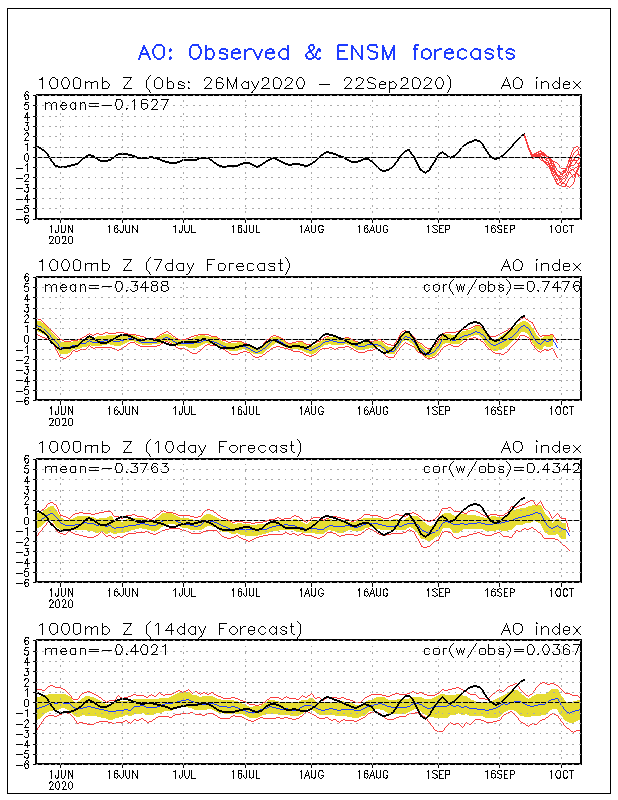
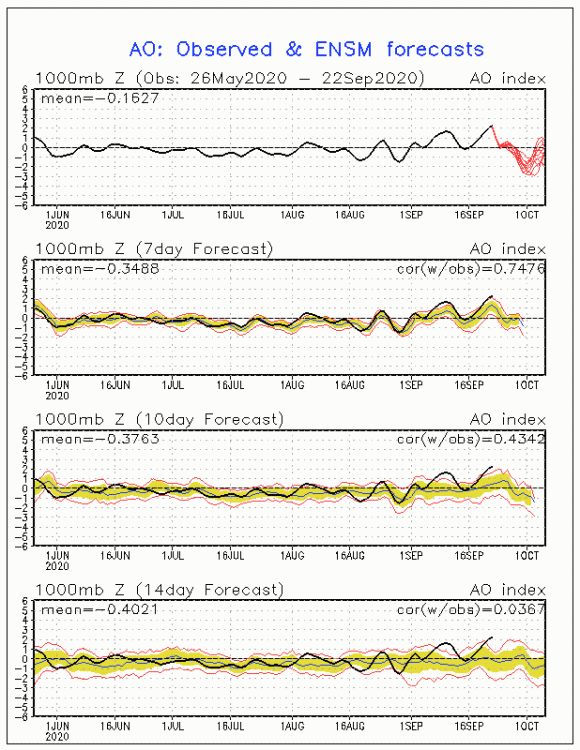
@CAPE remember what we learned the last two years........ no matter the perceived clue and no matter the head fake , especially good ones that might entice your positive winter vibes, don't be fooled! Ha ha...... I know you know this, but here we go again. And we are talking it is September 22 nd. How things evolve remain uncertain. Saw this last year in October and especially that November period, when postings here commented and reflected that maybe we would get - AO periods and HL blocking, even though the NAO look was not that great.
-
We have new records.
-
I believe Ninas may tend to have colder Decembers versus Jan. and Feb. Means nothing, and I am not endorsing a cold December at this point. However, exposed waters above Alasaka and general SST forcing way up North may have a role in our sensible early winter weather before the most powerful and direct pattern weather drivers take hold for the East.
-
Does make sense. The exact location of anomalies and how strong in mid to late Fall will be very important in attempting a December forecast.
-
BAMWX put together a very detailed and research based presentation rich with relevant data and analogs for the winter outlook of 19-20. The presentation was over 30 minutes long, given in November of 2019 for the winter of 19-20. Guess what, they blew it, they had to back pedal until stating they were wrong. They were very confident in a cold winter. Going too cold and too snowy overall. Of course they spin it, by stating they adjusted their winter forecast to counter their early seasonal forecast. In my opinion, that is still a fail. No one really knows what is going to happen. After two years of incredible busts regarding winter outlooks by everyone, the bottom line is that you should never put faith in a winter seasonal forecast that depends on cold air intrusions. It is a different climate now, with new evolving drivers on a global scale. You can even share the insights and opinion of tip over in the New England forum, whom states that regardless of Nina or Nino it does not matter at all, because a small area of the Pacific cannot counter the global warmth and the corresponding accelerating global warmth drivers.
-
In the short term yes. As in today, temps in this region will average 2 to 5 degrees lower versus without the smoke effect on solar energy. However, this is an interesting thread below discussing the effects of Western fires on the stratosphere. As Anthony points out some interesting outcomes on the winter AO and even the development of the early season PV. The thing that interests me the most is that in the Nature. com abstract below it discusses the 2017 " Pacific Northwest event " . Keep in mind that the current fires on the West Coast and other areas are far more impressive in terms of release. Also, keep in mind the similarities , as mentioned in the abstract of volcanic intrusions. Also there is this literature https://www.nature.com/articles/s41612-018-0039-3 Abstract Intense heating by wildfires can generate deep, smoke-infused thunderstorms, known as pyrocumulonimbus (pyroCb), which can release a large quantity of smoke particles above jet aircraft cruising altitudes. Injections of pyroCb smoke into the lower stratosphere have gained increasing attention over the past 15 years due to the rapid proliferation of satellite remote sensing tools. Impacts from volcanic eruptions and other troposphere-to-stratosphere exchange processes on stratospheric radiative and chemical equilibrium are well recognized and monitored. However, the role of pyroCb smoke in the climate system has yet to be acknowledged. Here, we show that the mass of smoke aerosol particles injected into the lower stratosphere from five near-simultaneous intense pyroCbs occurring in western North America on 12 August 2017 was comparable to that of a moderate volcanic eruption, and an order of magnitude larger than previous benchmarks for extreme pyroCb activity. The resulting stratospheric plume encircled the Northern Hemisphere over several months. By characterizing this event, we conclude that pyroCb activity, considered as either large singular events, or a full fire season inventory, significantly perturb the lower stratosphere in a manner comparable with infrequent volcanic intrusions.