Terpeast
-
Posts
6,756 -
Joined
-
Last visited
Content Type
Profiles
Blogs
Forums
American Weather
Media Demo
Store
Gallery
Everything posted by Terpeast
-
There’ll be two camps. Some will go warm and snowless, and others will call for at least one HECS event. Toss up, but I may go the former and then later root against my own forecast.
-
Let cape mix for once, bring that death band a bit west
-
2026-2027 Record-breaking El Nino
Terpeast replied to Stormchaserchuck1's topic in Weather Forecasting and Discussion
Odd, it seemed to have backed west -
0.92” with driving rain and strong wind gusts. Probably around 50 mph
-
Yeah he generally does better than the hype-y social media mets, and he still has a strong following. Amazing. If we get a blizzard this winter, he will triple his follower count for sure!
-
I agree with this. Although its getting warmer everywhere on average, we’re also seeing a lot more variance with wavier jet streams and stronger ridges that act as a double edged sword - bringing extreme heat underneath, and pulling down colder air from the upper latitudes of the ridges. This is a well researched and documented artifact of AGW. If we get periods of -AO/-NAO during this super nino, they should be very interesting.
-
0.91”. Missed it, was in a meeting and it got dark in my room
-
0.46" today so far, 2.33" MTD. Ashburn
-
2026-2027 Record-breaking El Nino
Terpeast replied to Stormchaserchuck1's topic in Weather Forecasting and Discussion
I think there's been some conflation between the SST PDO pattern and the atmospheric pattern that drives this SST pattern. Many of us refer to the atmopsheric pattern that's driving the SST configuration as the PDO. I'm guilty of it, too. -
2026-2027 Record-breaking El Nino
Terpeast replied to Stormchaserchuck1's topic in Weather Forecasting and Discussion
It's not the absolute temperature of the water. It's the atmospheric pattern above it that's been the driver. -
2026-2027 Record-breaking El Nino
Terpeast replied to Stormchaserchuck1's topic in Weather Forecasting and Discussion
I think there has been a repeated pattern of the -PDO diving in the warm season with the marine heat wave off Japan through south of Aleutians as a result of the 500mb pattern, and then it abates through the fall and early winter as the NH cools. It will be very interesting to see if the NH atmosphere fully couples with the El Nino once the NH cools, or if the -PDO remains deeply negative. I would not be surprised if the PDO rises to near-neutral levels, but if it doesn't, then we would enter uncharted waters with super nino + super negative PDO. I'm not sure that's ever happened before, at least not at this level. -
Wanted to share that I've changed jobs recently and this time I'm a fed contractor. Sadly, I won't have faster access to model maps before they're publicly accessible, so I'm back to being a pivotal/TT consumer just like many on here.
-
2026-2027 Record-breaking El Nino
Terpeast replied to Stormchaserchuck1's topic in Weather Forecasting and Discussion
Southern hemisphere appears to be better synced with the el nino, though. Not perfectly, but close. Troughs and ridges look to be approximately in the same places, albeit slightly off. S Pac looks like split flow, aiding those record snows in the Chilean Andes. -
super el nino banter thread
Terpeast replied to forkyfork's topic in Weather Forecasting and Discussion
I was here through 97-98, and we had multiple perfect track driving 38 degree rainstorms. How close was it to being snow? When it’s 33 degrees in Buffalo hours before the storm starts, you can safely write it off outside of the apps. 2,000 feet and up scored big for sure, but the polar jet was so far north that we didn’t have a real shot at getting a big snow. -
That’s what we’ve seen happen in the last several years. In this el nino, we don’t need the PDO to be super positive. We just need to get it to neutral, then we’re in play. Stays at -2 or close to it? Might as well sell the snowblowers.
-
2026-2027 Record-breaking El Nino
Terpeast replied to Stormchaserchuck1's topic in Weather Forecasting and Discussion
Likely has something to do with that warm blob south of the aleutians. Not a typical pattern in a growing el nino, but as the NH season cools, that blob should get slowly shunted east as the north pac jet strengthens. We’ve seen the PDO dive in the spring and summer, and then slowly climb in the fall and winter, time and again and this year probably will be no exception. We may even break positive this time with the super nino.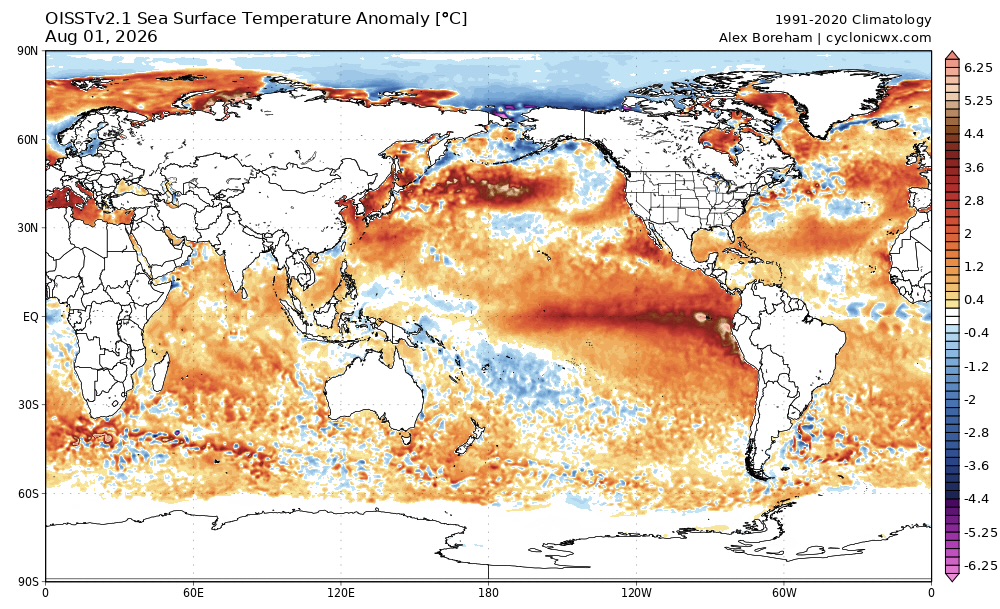
-
Yeah, this winter we will either hit one out of the park, or strike out spectacularly.
-
2026-2027 Record-breaking El Nino
Terpeast replied to Stormchaserchuck1's topic in Weather Forecasting and Discussion
I think it’s almost a given that the east coast winter will not be a cold one. For the MA, I’m thinking 2-4 AN vs 1991-2010 climo, warmer north and a bit cooler south. STJ will be very active, launching one storm after another across the south. If we can time even marginal cold air with one of them, we could score big. Most of them will probably be rainstorms. -
2026-2027 Record-breaking El Nino
Terpeast replied to Stormchaserchuck1's topic in Weather Forecasting and Discussion
At this time last year it was -3, so not as extreme as recent years. It will be interesting to see if we break into positive territory by December. -
Not to toss a wet blanket on this - I love this look, and while it points to a relatively stormy winter for is - I think the ridges will verify stronger and troughs weaker. The more important interpretation of this map is the placement of the troughs and ridges. The trough placement for us is perfect (TN), western ridge axis over Idaho. The E Canada ridge may verify in the same place, but would be more extreme - double digit warm anomalies with blocking that may give us some interesting storm tracks. Please, please just have it cold enough for us.
-
353 AQI imby. Not going outside. Staying home with my merv-13 filter.
-
Hit 97 today, underperformed the forecast high of 100-101. But dews were higher
-
93 imby. I think the smoke/haze is limiting heating at the surface despite high 850mb temps
-
Pouring! 1.4” in 30 min
-
When its cold, we can always layer up for it. Not so with heat. And I've spent time in places that are plenty hot. But usually they have some mitigating factors, like a daily sea breeze flowing through Houston in the afternoons, or extra cloudiness in Asia. In the desert SW, it's very dry and stepping in the shade actually feels refreshing. The heat wave we had just hit differently. No sea breeze, no cloudiness to give us shade, and humidity off the charts. Just straight up baking. Our mitigating factor is that these heat waves usually only last a few days to a week.