
psuhoffman
-
Posts
27,481 -
Joined
-
Last visited
Content Type
Profiles
Blogs
Forums
American Weather
Media Demo
Store
Gallery
Everything posted by psuhoffman
-

Feb 22nd/23rd "There's no way..." Storm Thread
psuhoffman replied to Maestrobjwa's topic in Mid Atlantic
@SnowenOutThere nice synopsis. People were saying it merges the two, Not really it just partially phases them early on enough that the main energy rounds the base and is focused on the lead SW. At 72hr you can see the trailing SW still there but unlike all other guidance because of what happened around hr24-36 the lead SW is the more amplified one and taken on a negative tilt. The trailing wave being the main one is useless because the timing is all wrong. The lead wave takes the surface low way OTS with it and there’s nothing for the trailing wave to amplify. It does activate the IVT connected to the departing coastal and we could score a consolation that way but unless the lead SW becomes the main player any surface wave will be long gone OTS. -
Feb 22nd/23rd "There's no way..." Storm Thread
psuhoffman replied to Maestrobjwa's topic in Mid Atlantic
The real skilled Mets here aren’t predicting a blizzard. No one is buying that crazy gfs run. -
Feb 22nd/23rd "There's no way..." Storm Thread
psuhoffman replied to Maestrobjwa's topic in Mid Atlantic
I think you have a misunderstanding. No one thinks the models are perfect and don’t need to continue to improve. But what’s the alternative? They’re just a tool. A good forecaster also factors in historical knowledge and sound meteorological principles. But they didn’t start using models because they’re lazy. They did because other methods are even worse! One day forecast used to bust horribly using pre model methodology. Forecasts and warning times have improved substantially because of the utilization of models. So while they are flawed what’s your method that would be better? Most non model methods wouldn’t even work beyond a couple days! -
Feb 22nd/23rd "There's no way..." Storm Thread
psuhoffman replied to Maestrobjwa's topic in Mid Atlantic
But what I don’t like is other than the gfs everything is IVT related and that feature is bleeding northeast across guidance which seems to be what usually happens. They are very rare down here. They more commonly end up impacting to our northeast. My fear is the coastal is a non thing and the IVT trends northeast and ends up a Philly thing and…well ya -
Feb 22nd/23rd "There's no way..." Storm Thread
psuhoffman replied to Maestrobjwa's topic in Mid Atlantic
If a low gets too intense and vertically stacks the moisture transport is cut off to its west and everything is focused on the intense but compact qpf field. We saw it somewhat with that coastal bomb in 2018 -
Feb 22nd/23rd "There's no way..." Storm Thread
psuhoffman replied to Maestrobjwa's topic in Mid Atlantic
Oh I know just pointing out how rare it is…also noting it because assuming we don’t get a gfs solution it shows how difficult it would be to win from the coastal here we need the low tracking up the bay basically. -
Feb 22nd/23rd "There's no way..." Storm Thread
psuhoffman replied to Maestrobjwa's topic in Mid Atlantic
It was off on its own 2-3 days before Jan 25 but not this far. This is odd. But it does suck. -
Feb 22nd/23rd "There's no way..." Storm Thread
psuhoffman replied to Maestrobjwa's topic in Mid Atlantic
Obviously this doesn’t matter but it took a track of the slp to the mouth of the Potomac to get the deform band back across our area. All the runs that have a bomb wind up the storm so tight it’s unusual. A track that close usually has precip type issues all the way to the blue ridge and heavy snow to state college. -
Feb 22nd/23rd "There's no way..." Storm Thread
psuhoffman replied to Maestrobjwa's topic in Mid Atlantic
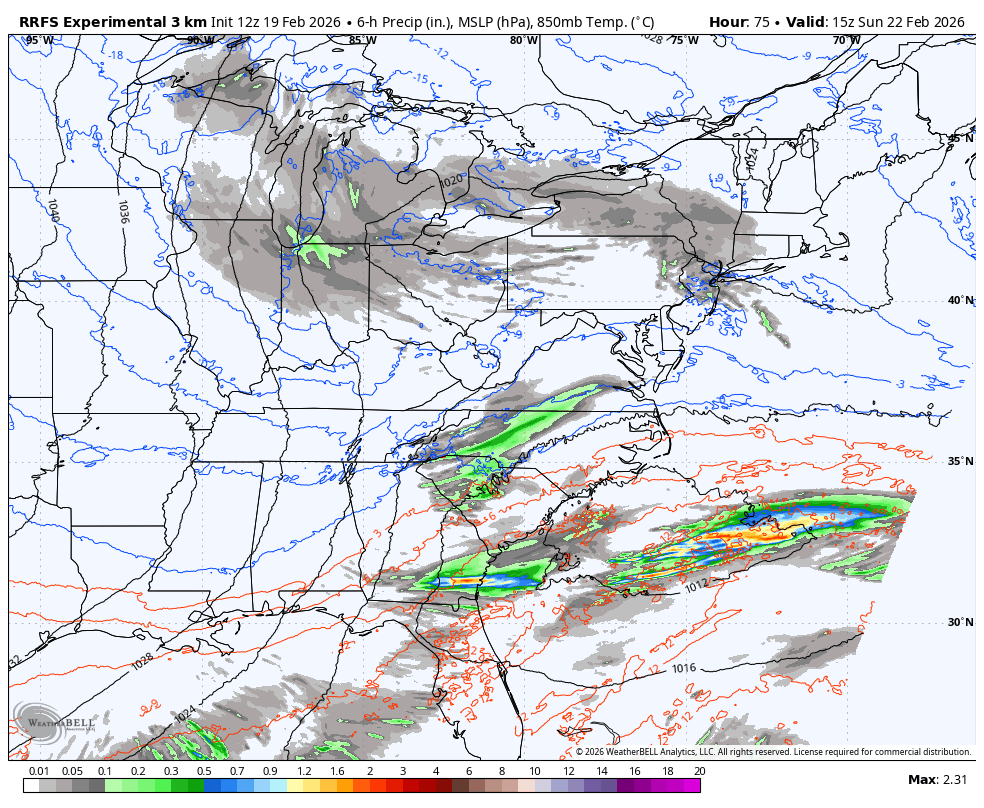
It’s crap. Most of that snow is light and associated with the mid level instability. Look at the stuff to our south here. That’s the stuff that was back over KY when we were excited. That’s what will become the developing wave. Everything NW of that is just instability or INV trough related.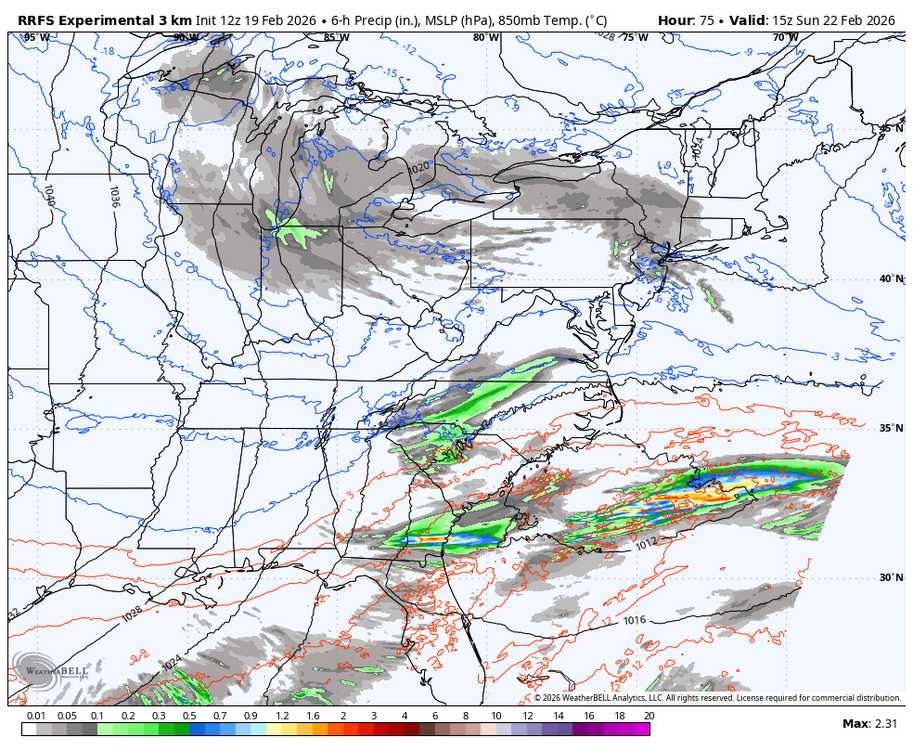
-
Feb 22nd/23rd "There's no way..." Storm Thread
psuhoffman replied to Maestrobjwa's topic in Mid Atlantic
For Bermuda? That thing is WAY easy -
Feb 22nd/23rd "There's no way..." Storm Thread
psuhoffman replied to Maestrobjwa's topic in Mid Atlantic
My fear is the inverted trough keeps trending east and we end up west of everything. That’s my “how we get screwed” vision. -
I nominated it for @Maestrobjwa since he is so interested in this week every year
-
Thank you, you did an excellent job. Now rest up so you're ready when we need you to post the 0z UK kuch maps showing 27"
-
Some people act stupid. Others aren't acting.
-
This is true of the Euro also... when it's Dr. no it's great but when it shows snow it isn't.
-
This is much less confusing once you all accept my conclusion that we are living in a simulation built by the jilted lover of a mid atlantic snow weenie.
-
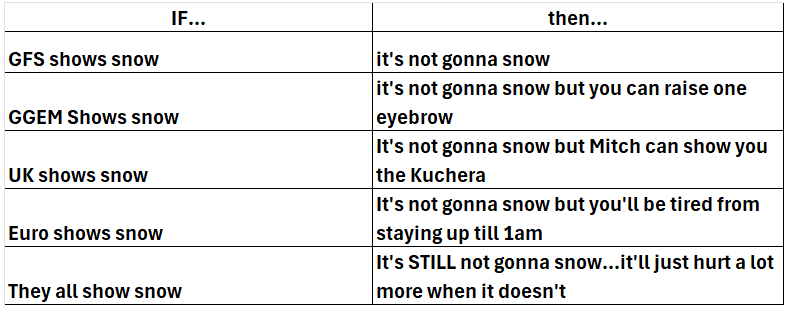
AGAIN...the chart...
-
I guess if you don't differentiate between 24" and 4" lol
-
No I don't know...every single model has shifted quite a bit...Euro had been the only steady one and then it shifted last run...
-
Things are still trending...this is not the final outcome we are seeing today. But everything is trending the way we want for now. That's all I'm taking from this. UK was nice except freaking torched at the surface...would have been a nice 4-8" snow across the area if it wasn't so damn warm at the surface.
-
that is exactly what happens...and yea not worried YET although for a long time now whatever can go wrong does go wrong
-
a lot of changes still happening...but I need to know how a sub 990 low tracking INSIDE Hatteras ends up mostly missing us!
-
it looked good early but somehow wound up so tight it ended up a pretty bad run other than down south
-
Everything trends a certain way...except when we need it that way
-
The difference is minor but there...take whatever the GGEM ends up showing and develop the storm a little sooner and amp it up a bit more and that's what the RGEM was showing...which isn't to say one is more right lol