
Jump to content

TriPol

Members
  • Posts

    1,700
  • Joined

  • Last visited

Everything posted by TriPol

  1. We are following the trend on a group of computer models. If only one of them said this, once, then you would be correct to throw it away. As it is, several models have shown this for a substantial period of time.
  2. And your professional credentials that make you smarter than a global computer model using AI are...
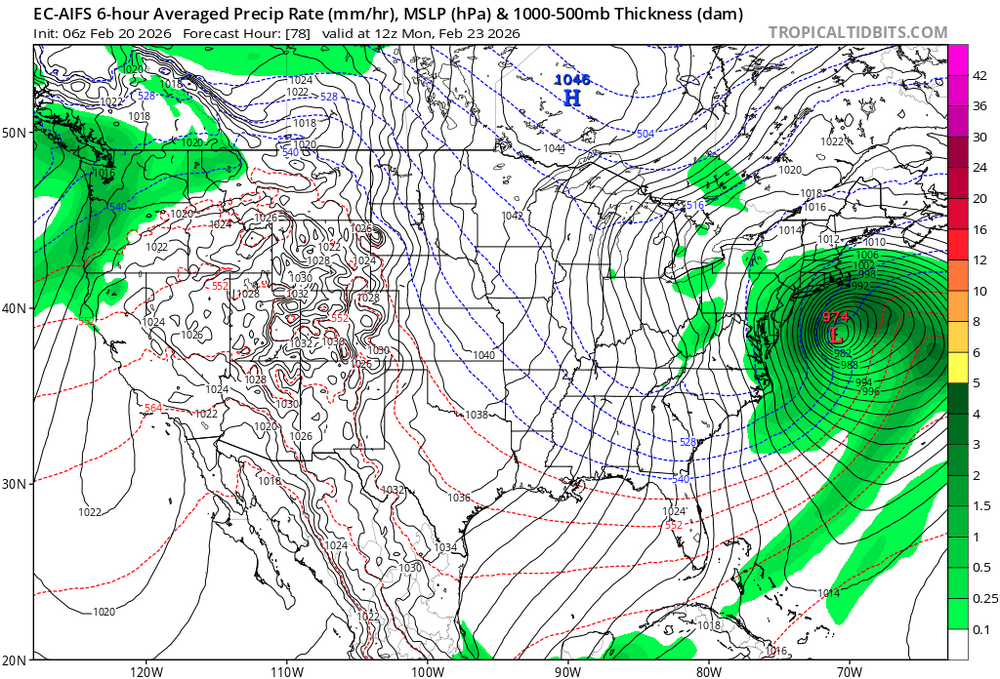
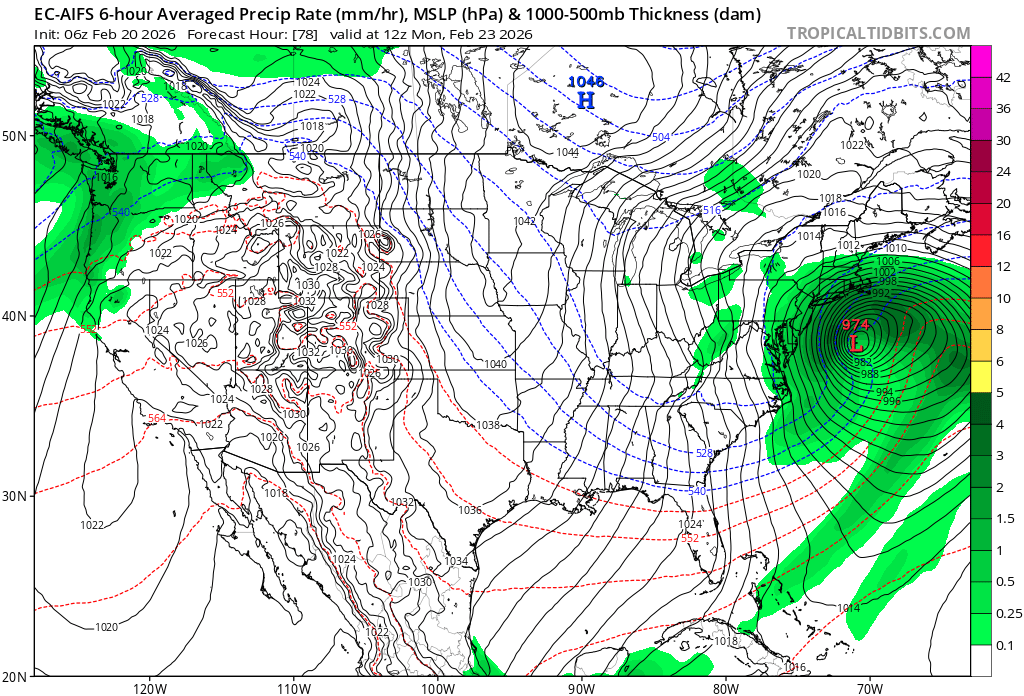
  3. Really seems to be three components here: How strong is the high pressure to the north and when does it move north? How strong is the surface low to the south? How do these two interact? Could we get in between them? If so, we could get some insane winds out of these and if enough snow falls, we could in fact get blizzard conditions.
  4. My man... you go back and forth with every model run. Following weather is not live by the model, die by the model. It's the trend. You follow trends made over multiple days by multiple models. You also look at WHY, exactly, the GFS went south. Does it make sense or did it do something wrong? This is why we're on a forum with professional meteorologists. If it hits, it hits. If it doesn't, it doesn't. Either way, we get extremely cold, dense air.
  5. There's nothing showing that the high pressure gets much stronger or moves south. All show that the high pressure leaving saturday into sunday.
  6. Alright. I'll do that. Hope I'm not pissing off any mods.
  7. The hype machine doesn't end until the middle of April. There's always that mid-february/early march storm, the mid march storm, the moderate event in the beginning of april... still a shot at snow around easter... Every year. I think we got a shot toward the end of next week though. We'll see.
  8. I do not think this weekend will give several inches of snow. It will be extremely cold, yes. I think we will get some snow, another nickel and dime event. But then... into next week... that's our shot. Should I start a thread on the threat 12 days away? (ducks)
  9. A 1053 mb Arctic high to the north absolutely guarantees cold and it does press the baroclinic zone south, but it does not automatically choke off coastal systems. In fact, highs of that magnitude often enhance the setup by sharpening the thermal gradient and strengthening the coastal front. Suppression becomes a real concern when the high is not only strong but also poorly positioned, centered too far west with confluent flow flattening the downstream wave. That is not what this pattern suggests. Here, the high acts more like an anchor than a lid. Cold air is locked in, the storm track is displaced south and east, and lows tend to ride the boundary offshore rather than cut inland. That favors snow and keeps systems close enough to matter. You can still miss if a wave stays too far offshore, but that is a track issue, not classic suppression. With a high this strong, the outcome is not rain or nothing. It is snow or a near miss, and NYC sitting near the gradient is exactly where small adjustments can pay off.
  10. The primary signal this upcoming weekend is for potentially record-breaking cold driven by a deep, anomalous trough settling over the region. Guid2-meter temperatures solidly in the single digits, with readings near 5°F to around 11°F across much of the city and immediate suburbs at 12z Sunday. That places the region well below climatological norms and indicates a deeply entrenched Arctic air mass rather than transient radiational cooling. Inland locations just north and west of the city are even colder, reinforcing a strong low-level cold pool draining southward. The coastal influence is visible but limited. While the nearby ocean slightly moderates temperatures, it is not enough to prevent NYC from remaining firmly in the freezer. The tight temperature gradient just offshore highlights how marginal changes in low-level flow could matter, but as depicted here, the city remains locked into dangerously cold conditions that would be capable of challenging daily record lows and producing dangerously low wind chills if even modest winds persist. Cold air is firmly locked in, so any precipitation shown here would fall as snow for the NYC area. With a deep Arctic air mass in place, there are no thermal concerns. The EC-AIFS total QPF signal of roughly 2–4 inches liquid over the period would translate efficiently to snowfall, potentially with higher-than-normal ratios given the cold column. Even lighter events could accumulate quickly in this regime. The larger takeaway is that this looks like a sustained cold, active pattern rather than a single storm threat. Storm tracks favoring the coast with NYC near the western edge of the precipitation shield suggest multiple chances for accumulating snow. Individual event details will matter, but precipitation type is not in question. In this setup, the cold does the heavy lifting; the only variables left are track, timing, and frequency. With extremely cold temperatures in place, snowfall efficiency becomes a major factor. In an Arctic air mass like this, snow-to-liquid ratios can easily exceed climatological averages, meaning even modest liquid amounts translate into greater snowfall depth. The ECMWF Kuchera output already reflects enhanced ratios, but if the cold column deepens further or dendritic growth is maximized, actual ratios could run higher than modeled. For NYC, that means the depicted ~6 inches is not a hard ceiling. In a very cold, well-saturated column, snowflakes tend to be fluffier and accumulate more efficiently, especially if rates increase under banding. In this setup, depth is driven less by raw QPF and more by how effectively the atmosphere converts that moisture into snow, and extreme cold tilts that equation in favor of higher totals.
  11. No one gives me credit on this forum. Whenever I start a thread, we either get hit by a hurricane or a blizzard. It's called the TriPol analog.
  12. Nothing going on here in the bronx. Maybe a snowflake or two? Pretty boring.
  13. I mean yay that we have another nickel and dime event, but I'm ready for the main course.
  14. I still can't believe Central Park only got 10 inches out of that storm.
  15. I remember February 2006. Warm winter. Then, the post on Eastern. "For entertainment purposes only..." They showed the JMA. It worked out. All we need is one storm.
  16. At least with the upcoming warm up, all the old snow will melt so when our next storm hits, it won't be new snow on top of ice.
  17. Snow squall warning! Great way to start off the new year!
  18. Think it'll reach the immediate NYC Metro area?
  19. Happy New Year everyone. May we get 40 inches of snow in Central Park in a 24 hour time period.
  20. Central Park got 4.3 inches. They predicted 4 - 8 inches. Not sure how this is wrong. Other parts got less, sure, but other parts got more. Snow prediction maps are not supposed to be 100% accurate.
×
×
  • Create New...