Windspeed
-
Posts
4,715 -
Joined
-
Last visited
Content Type
Profiles
Blogs
Forums
American Weather
Media Demo
Store
Gallery
Everything posted by Windspeed
-
Sure, it's one of many internal structure processes that can cause an eye to wobble. Obviously concentric eyewalls may produce the most evident trichoidal variety. Hurricanes wobble wobble. But it's back and forth micro perturbations within the macro steering flow/motion.
-
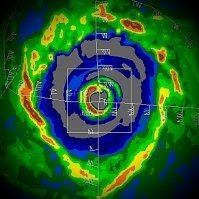
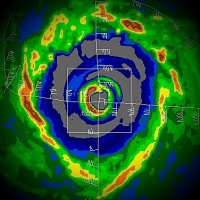
I mean, not to be repetitive here with the radar shots, but even at a distance, this is a very impressive eyewall. Ida is putting on a show. Not to sound happy about it either. Just from a meteorological perspective. Obviously this is a dire situation developing for landfall. We're, what, 9 hrs away?
-
Visually, Ida is essentially text book for an intensifying eyewall at present. You get deformation from isolated intense cells bursting within the eyewall and as such can lead to meso vortices. Also radar is still long range with the beam height above ~25 k ft at this time; so it is possible the reflectivity dbz of the core band will become more of a bright ring as Ida gets closer and the beam reflects from lower in the eyewall. We're essentially limited to the higher/most intense elongated cells at this height.
-
Ida currently has an eyewall suggestive of meso vortices developing. Also this is still at ~25k ft beam height so these are intense cells rotating around the eye at present.
-
Strong and steady rate intensification all evening and some time just before midnight CDT that must have ramped up into a rapid deepening rate of intensification.
-
Beam height is ~30k ft at this distance from KLIX tower. That's already an impressive looking closed eyewall with notable strong cells imbedded within the eye band.
-
Just want to chime in to remind that the TCHP maps are derived from depth of 26° isotherm. That particular gulf loop eddy that stands out has a very deep 29-30°C circulation. However, the surface layer NW of Ida is still 30°C over the shallow shelf right up to the coastline. Ida is not moving slow enough that it would be capped from further significant intensification after it moved beyond the deep eddy as it is not forecast to stall or move slowly. Oceanic heat content remains high in the shallow shelf for Ida's rate of motion and has a high MPI.
-
Really nice analytical imagery from CIMSS on the evolving upper pattern over Ida.
-
Was just about to post this. Looks like we're in wobble mode with evolution via strong convective bursting around the eyewall. That being said, it looks as if Ida is still on the east side of the ensemble guidance.
-
There is no guarantee Ida will be a small-sized hurricane in 24-48 hours range. Yes, Katrina was unusually large. But based on angle of approach, if Ida rapidly intensifies tomorrow and evolves moderate-sized core, it will have a full day to build wave action and increase fetch. It is an exponentially more dangerous surge threat than Charley. That hurricane only had a 5 nm wide eyewall, 15 nm outer eyewall and very little (6 hrs) of maximum intensity lead time to build significant surge. It's sharp turn / angle of approach also mitigated surge. We cannot downplay the surge potential here. This is a very dangerous situation for anyone outside those flood walls. It is hopeful they work as designed and Ida tracks far enough west to mitigate the highest surge there.
-
Yeah the core is holding together fairly well. Could there be a bit of lag after it moves off the coast? Sure. But it likely won't take too long to ramp up.
-
RE: KBYX (Key West) Radar...
-
Humans...
-
A PRE may be setting up over SE LA ahead of Ida. The upper trough is increasing lapse rates with significant ice particles bring detected due to strong updrafts. 2-3"/hr rates is going to kickoff a big head start for inland and coast flooding for low lying areas well before Ida outer bands begin their impact.
-
-
These things are chaotic and hard to pin down. Certainly too unpredictable to forecast structure and size with accuracy. I mean, interaction with Western Cuba could also backfire by increasing/broadening the size of the core vortex, leading to a larger eyewall during intensification over the east-central GOM. Anyone's guess and it would just be that, a guess.
-
Isla de la Juventud / Isle of Youth is very low elevation. It is also surrounded by the warmest SSTs in the Atlantic Basin. It might slow intensification but the core bands will be able to pull sufficient evaporation that it should avoid disruption. The western region of Cuba would be more of a deterrent to intensification or at least halt it until it clears it and moves into the SE GOM. There could be some disruption over Western Cuba.
-
-
Horrid timing...
-
Is that one of your petPVs?
-
Pretty impressive organization since last night. Deep convection over the LLC. Appears to be stacked. Core appears to be developing. Wonder how much intensification Ida can undergo prior to Isle of Youth and Western Cuba here? Good odds of being a hurricane by first landfall. Also looks like the GFS operational runs the past few days were not overdoing intensification trends prior to Cuba.
-
I usually am lit. But mine wrath for the NAM all these years was just too much to contain. Everyone have a good night. I'll post more thoughts tomorrow when time allows. Peace.
-
STOP POSTING THE NAM. kthx.
-
No, it is 100% misleading and unwarranted if you understand that model's purpose and use. Yet you still posted it. This is on you. Period.