
Windspeed
-
Posts
4,731 -
Joined
-
Last visited
Content Type
Profiles
Blogs
Forums
American Weather
Media Demo
Store
Gallery
Everything posted by Windspeed
-
 To reiterate the previous points, a nice snippet from Dr. Levi Cowan on any structural changes and intensity fluctuations tonight and tomorrow:
 -
We should also remember that the MPI in Beryl's location based solely on SSTs and OHC is much higher than what atmospheric conditions would support. Obviously, Beryl is now an intense Category 4 cyclone; however, it is still fighting moderate mid-to-upper easterly flow in position to the strong SPHS cell to its north. These conditions were not enough to prevent Beryl from rapidly intensifying, but such flow can interrupt intensification or at least prevent MPI from occurring. Brief ingestion of dry air due to this flow can erode the eyewall or perhaps allow a faster onset of EWRC if outer banding is already strong. Again, as has been repeated, structural evolution is hard to predict. EWRCs do also fail to complete or get interrupted by such an environment as we have found out with other swiftly tracking CV systems like Irma. The HAFS-B simulations that show an EWRC completing tonight are interesting but must be taken with a grain of salt. It's a chaotic process in a nutshell.
-
RE: EWRC ... Some discussion ongoing right now between Webb and Hazelton about any potential for this. Ahhh... @WxWatcher007 beat me to it. lol..
-
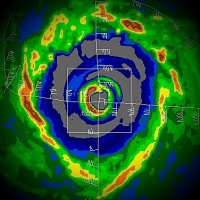
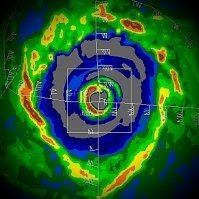
The eye has moved into an attenuated section of returns on the radar beam, blocked by a mountain to the SE of the tower on Barbados. However, there is definitely good banding outside the eyewall right now that might be consolidating into an outer ring.
-
2024 Atlantic Hurricane Season
Windspeed replied to Stormchaserchuck1's topic in Tropical Headquarters
The basin really does look and feel like late August. We will still have a seasonal lull here and there between MJO phases and temporary pattern shifts, but overall, confidence is high on a hyperactive season. -
The biggest concern is for the northern eyewall raking across one of the Grenadines. There are a number of communities, port and resort towns located on these islands.
-
Recon just punched the weaker western and southern eyewall.
-
Tropical Storm Chris—40mph/1005mb
Windspeed replied to WxWatcher007's topic in Tropical Headquarters
This is a way more positive development for the central altoplano volcanic region of Mexico as they are in dire need of the beneficial rains this TC will provide. Whether it attains weak TS status or remains a depression only matters for numbers and record-keeping. Folks along the Campeche coastline will hardly blink at 40-50mph winds. They need the rain, however, and this could be a drought buster. Hopefully, not too much at once to avoid flooding issues. -
960 mb is a pretty high observed central pressure for a Category 4 hurricane. However, 1) Beryl has a very tight core of gradient-driven winds and 2) is embedded within higher overall background pressure regime influenced by the strong SPHS cell positioned directly to the north of the hurricane. Essentially, this means that if the central pressure continues to fall, Beryl could attain high-end Category 4 with only another 10 millibars of pressure drop and would hypothetically attain Category 5 windspeeds in the 940s hPa. I am not saying that it will, but background pressures and the core riding such a strong easterly low-level jet means that the northern eyewall could be very destructive if it encounters any of Windward islands.
-
There are some outter bands, but like you said, dry air to the north is keeping them from consolidating into an outter ring. Irma went days with partial ERC failures due to the same scenario. However, moist southerly flow could abate drier stable airmass and allow an outter ring to form by the time Beryl reaches the islands. So we can't rule out an EWRC starting prior to land interaction. We still have a full 24 hour window.
-
I've not anything to say that hasn't already been added. Pretty unbelievable events unfolding. Got to hope Beryl's eye threads the needle between islands to mitigate eyewall impacts as much as possible. Also, as is typical with intense TCs, hopefully, Beryl has maxed out early enough that an ERC would limit any further intensification. However, structural changes are difficult to predict. Never thought we'd see a Cat 4 in this part of the Atlantic in June, even if we are on July's doorstep. Usually, climatology wins out, and it still may win out by the time Beryl reaches the central Caribbean to allow windshear to counter MPI there, but we have several days to figure that out still.
-
Of note...
-
24 hours from classification to hurricane aint too shabby...
-
I would rather just pour through the landfall record each year to be sure, but perhaps my guess of 20-25 is probably too high. Cat 1 & 2s, sure, but major landfalls are obviously rarer and, more often than not, get retired. I'll look into it when I've more time.
-
You referenced the islands, and assuming NA plus central/Latin, that number has names that didn't strike the contiguous US.
-
The strong E to ENE 700-600hpa flow is allowing some SAL-influenced airmass into Beyrl's core, hence the microwave structure. Still a steady strengthening rate but perhaps deters any rapid intensification until that flow can ease up or Beryl's core structure can expand some and better shield against it.
-
That's a question that would take several hours of research to answer. We started naming storms in the 1950s. Every few years, there is such a scenario. I'd guess there are two to four per decade. Perhaps 20-25 major unretired landfalls since naming began.
-
Shrimp mode...
-
A low-level reconnaissance flight will be investigating on Saturday.
-
I think we will have Beryl by 5AM AST, if not the 11PM. Even with easterly mid-level flow displacing/tilting the core convection slightly west of the LLC, TD2 has strong convection wrapping the vortex. It's not an excellent upper level environment through the core of the depression's column yet, but it appears to be improving with time. Certainly, there is not enough hindrance to prevent steady intensification, which clearly appears to be ongoing. It would not be a stretch to imagine TS force winds within the northern and ridge interacting side of the circulation.
-
TAFB AL, 02, 2024062818, , BEST, 0, 90N, 410W, 30, 1007, TD The first forecast package is coming out at 5PM AST.
-
But the ensembles don't have a pretty simulated IR map of a Category 4 to hype out!
-
Latest ASCAT pass, which is now a bit behind the last few hours of most recent satellite images in this animation.
-
95L's axis is only at 38°W longitude right now. The system has the bulk of the MDR remaining to continue organizing prior to land interaction in the Antilles. However, persistent pulsing CBs this evening do appear to be evolving a new MLC. This is evident in the overall cloud pattern and perhaps is allowing better alignment in closer proximity to the surface low within the wave axis, just to the canopy's NE, versus the old MLC that is down around 7-8N° latitude -- mostly devoid of convection. A new low-level vort max could form on Friday and I do think 95L has a great shot at TCG in the next 24 hours.
-
Nice convective burst going up where an MCV should be located. There may not be a closed LLC yet, but if this persists, it may not take long for one to develop. A depression and eventual tropical storm looks more likely than not at this point. We may have Beryl before the weekend.