


chubbs
-
Posts
4,229 -
Joined
-
Last visited
Content Type
Profiles
Blogs
Forums
American Weather
Media Demo
Store
Gallery
Everything posted by chubbs
-
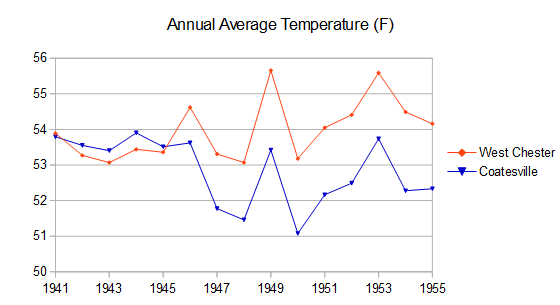
Yes, you can find a reason to dismiss the evidence; but, as usual you aren't providing any data analysis or statistics to back up your argument, just handwaving. You haven't shown that "The data is clearly materially and statistically close enough to all other available county data to validate the raw data as is." On the contrary, the biasing effect of the station moves is clear in the Chester County raw data. For instance, there is a roughly 2F shift in Coatesville relative to West Chester due to the 2 moves in 1946+47. The Coatesville station locations in 1945 and 1948 fully support the raw temperature data.
-
It's interesting that you make this point; because, I've shown over and over again that the Chester county data is sufficient to show bias in the local data. For instance in the case of the two big cooling moves: 1) After its move in 1948, Coatesville cooled by roughly 2F relative to Phoenixville and West Chester, and 2) after its move in 1970, West Chester cooled by roughly 2F relative to Coatesville and Phoenixville. The timing and nature of the moves fully support the in-county data. Data from outside the county isn't needed; but, does fully support the bias determination. There is a 100% ironclad case for bias in the raw Chesco data. You are helping to make bdgwx's point about confirmation bias.
-
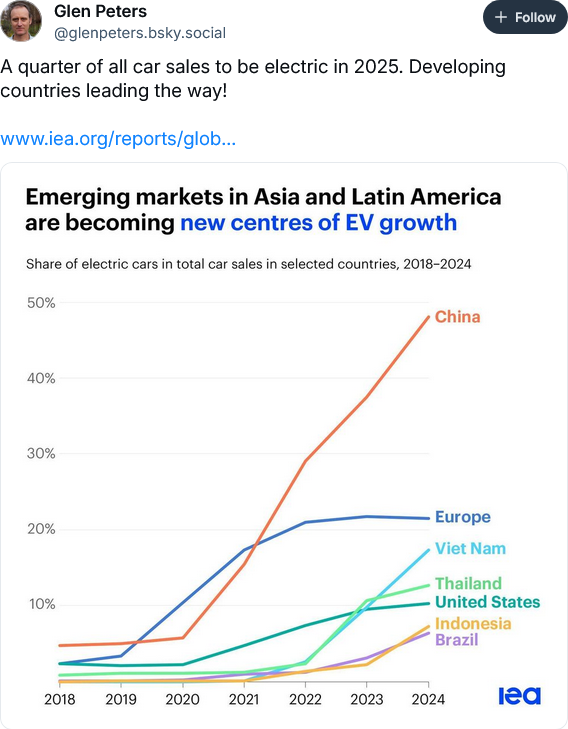
Agree its not altruism. They've also flipped the competitive script in cars. China wasn't going to catch up quickly to other countries in engine technology, but have gained a big advantage by switching to EV. The EV/batteries spurring growth in Vietnam, Thailand, Brazil and Indonesia all come from China.
-
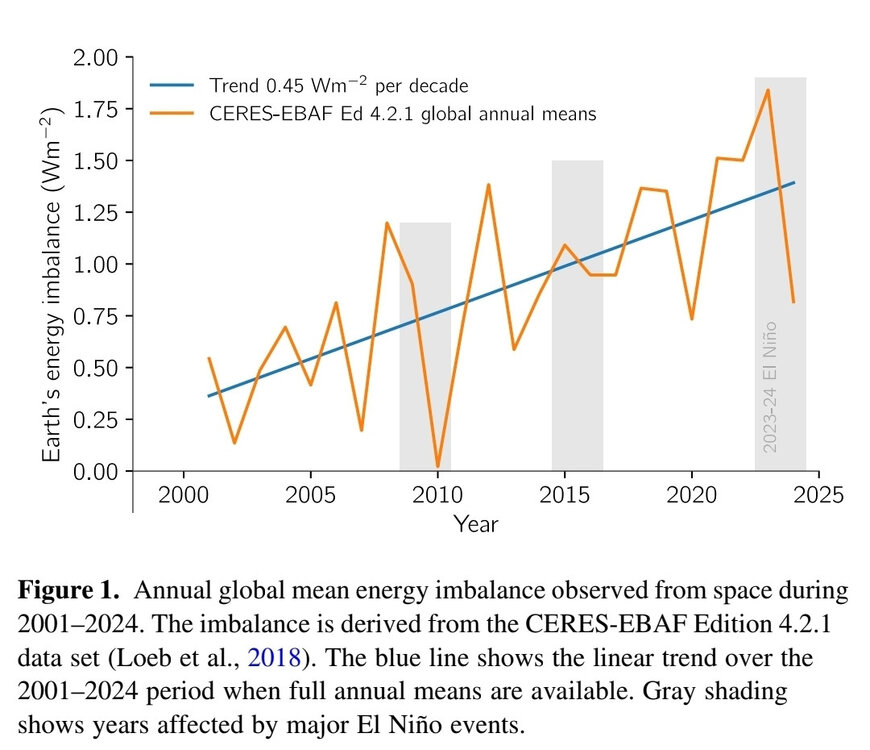
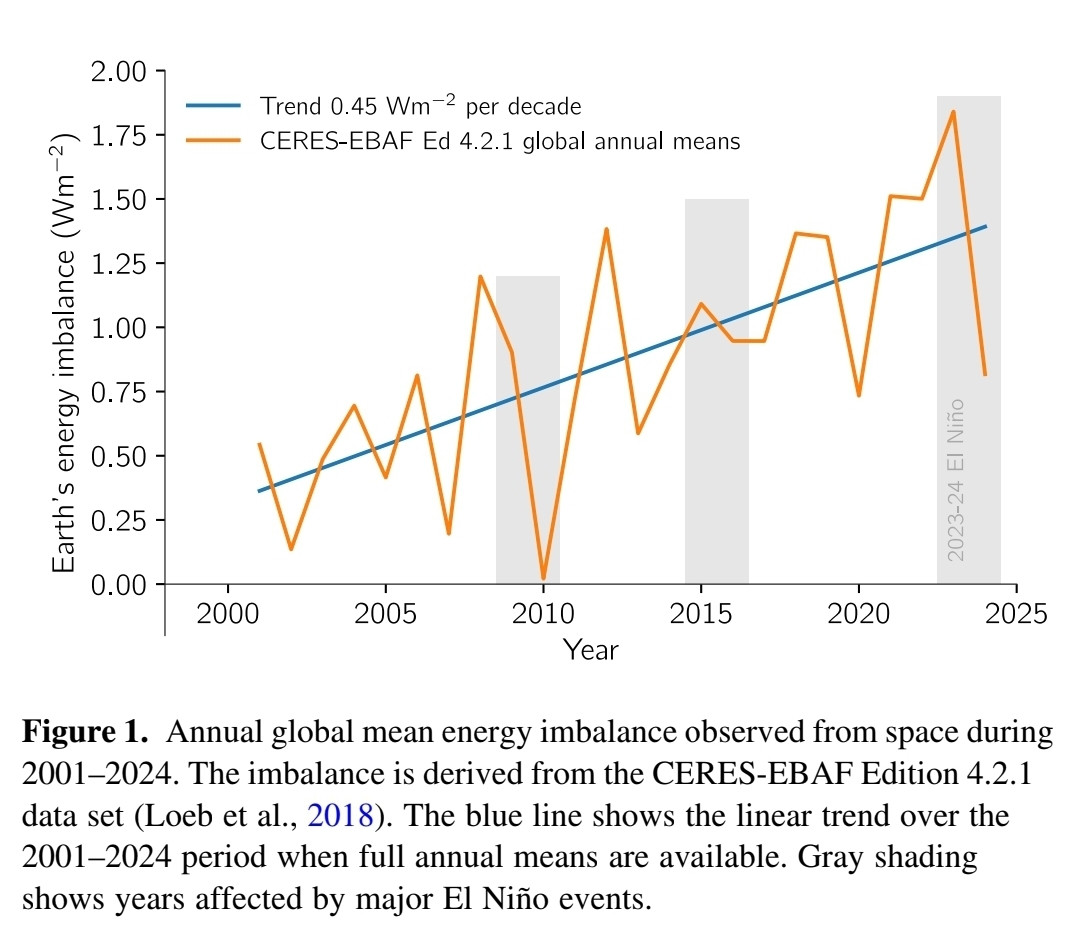
Shows the guy is in serious climate denial. When it comes to climate, the sun swamps the earth. Always has and always will. The big problem we have now is more energy coming in from the sun than is radiated away. A large and growing imbalance at the top of the atmosphere, roughly 0.5% of the suns energy, year after year after year. Crazy when you consider that the energy leaving the earth is rising rapidly as the world warms. If seismic was warming the earth, the earth would be warming from the inside out not the outside in.
-
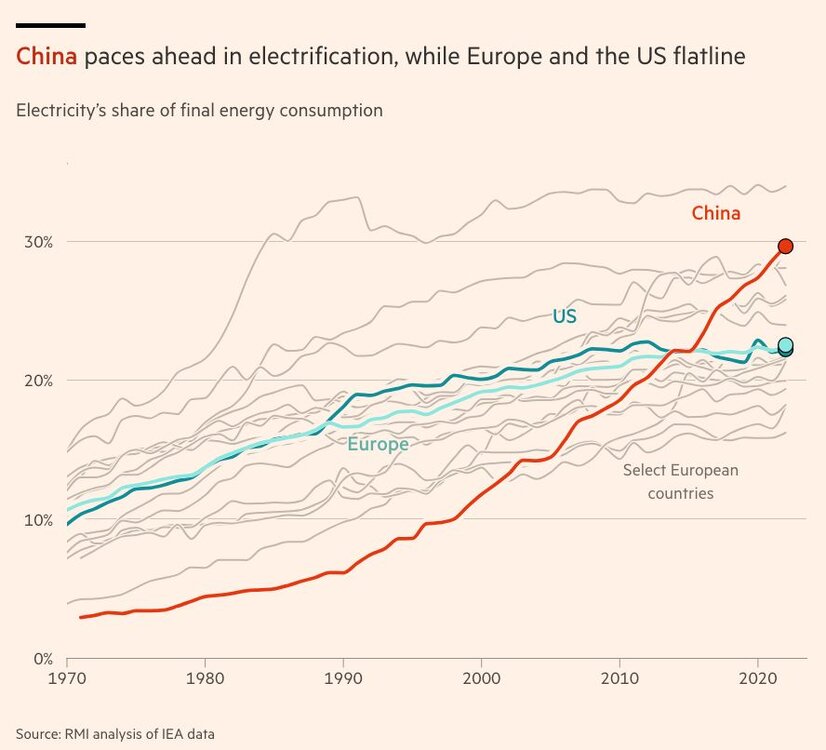
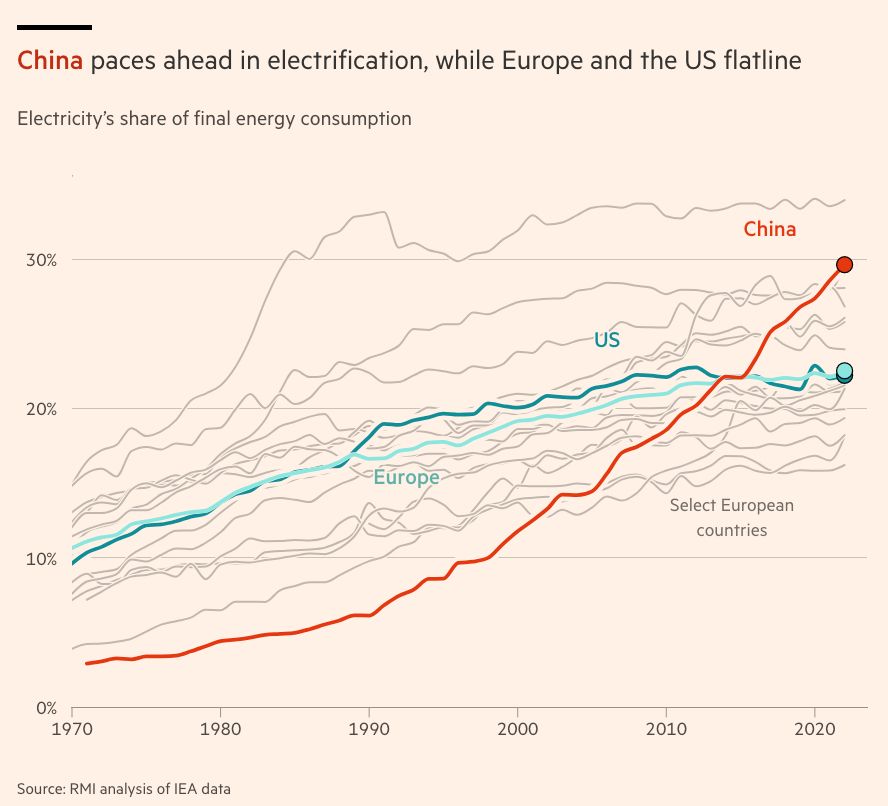
This is a good news /bad news chart. The world is moving quickly to clean energy technology, but the US is lagging and policy support in the US is being removed. We will be left with an outmoded energy system.
-
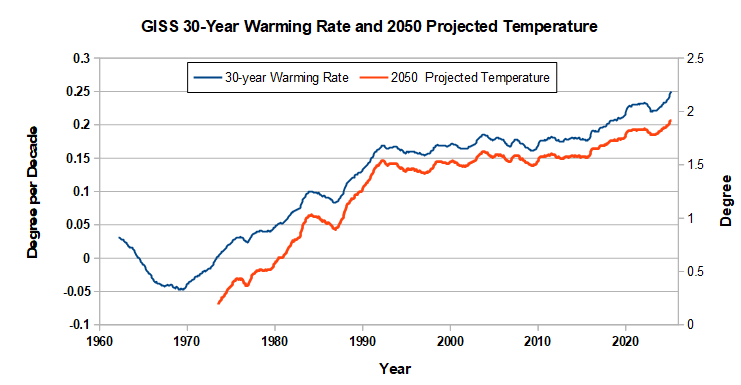
This chart shows how the recent increase in warming has changed the 30-year warming rate and projected temperatures in 2050 based on the 30-year warming rate. The past decade has sped up our journey to a new climate. A little over a decade ago we were going to hit 1.5C around 2050. Now it will be close to 2C by 2050 if we warm as we have in the past 30 years. Note that if the warming in the past decade is maintained, the 2050 estimate is conservative. Of course this is just a rough projection, a lot can change in 25 years to change our warming rate. Getting off fossil fuels for instance.
-
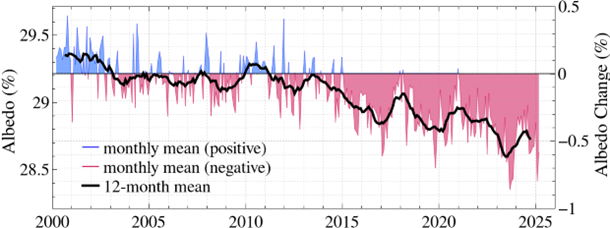
Hanson's latest mailing. The earth has gotten much dimmer in the past decade. The change is large, unexpected, and has big implications for our climate future. Hanson gives his side of the ongoing debate. Abstract. Earth’s albedo (reflectivity) declined over the 25 years of precise satellite data, with the decline so large that this change must be mainly reduced reflection of sunlight by clouds. Part of the cloud change is caused by reduction of human-made atmospheric aerosols, which act as condensation nuclei for cloud formation, but most of the cloud change is cloud feedback that occurs with global warming. The observed albedo change proves that clouds provide a large, amplifying, climate feedback. This large cloud feedback confirms high climate sensitivity, consistent with paleoclimate data and with the rate of global warming in the past century. https://mailchi.mp/caa/large-cloud-feedback-confirms-high-climate-sensitivity
-
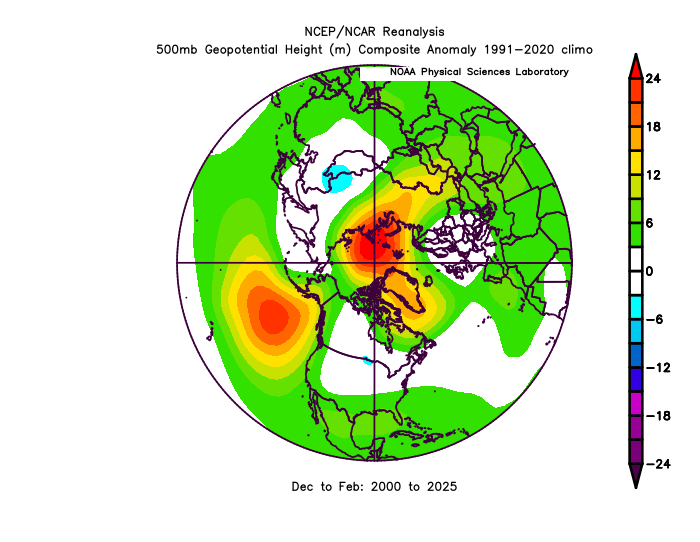
A better pattern for cool weather in US if you restrict to the winter months. It could have been worse.
-
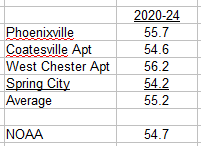
No I don't agree. below are the current county stations that I have data for, the non-DEOS stations. Spring City is cooler than any of these corrent stations, consistent with its location in the far northern part of the county. Unlike your results, NOAA is cooler than the average of the current stations that I have. Shows how changing the station population changes the simple average. The non-NOAA DEOS stations cool the present on balance without adding any climate information due to their short period of operation. Results from your simple averaging method merely reflect the changing station population: relatively warm in the past and relatively cool now. You've obtained the "climate change isn't happening" result you are looking for. As I have said in the past you will be the last person to realize that Chester County is warming.
-
Only Phoenixville and Spring City are NWS COOP stations and used by NCEI. The others are not used by NCEI.
-
Chester County PA - Analytical Battle of Actual vs. Altered Climate Data
chubbs replied to ChescoWx's topic in Climate Change
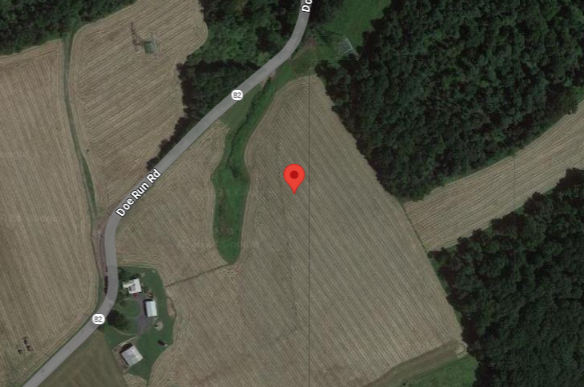
Once again you aren't addressing my criticism: the county stations have changed. According to NCDC here's the Coatesville station in 1945 and 1948. Big difference in local land-use on Chestnut St vs Doe Run Road. We don't have to guess or hand wave about the impact of the station moves. The nearby stations allow the impact to be determined. I have shown you the plots over and over again. Between 1945 and 1948 Coatesville cooled 2F relative to West Chester and other stations. The evidence is overwhelming.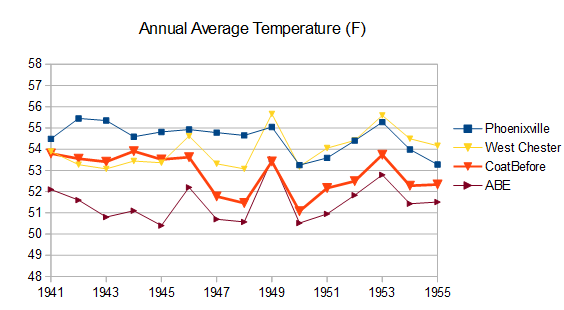
-
Here's another chart (from Financial Times) which shows how our fossil-fuel energy system is falling behind China's. Energy use and emissions are reduced with electricity due to higher end-use efficiency. For instance a gasoline car is 15-20% efficient while an EV has 90+% end-use efficiency.
-
Chester County PA - Analytical Battle of Actual vs. Altered Climate Data
chubbs replied to ChescoWx's topic in Climate Change
You aren't addressing my criticism. Yes, the new stations do a good job of covering the county, I never said they didn't. The problem is the older stations that make up the bulk of the county climate data. The older stations are located where people lived at the time: in towns, valleys, mainly in the east. We know the older stations are warm because when the Coatesville and West Chester stations moved a short distance to less built-up areas they cooled by roughly 2F. The DEOS stations that make up the bulk of your current station line-up are located in parks, nature preserves or similar, very different from the older coop stations. -
Most of those stations are giving you zero climate information because they don't have long records. Only Phoenixville has data before 2007.
-
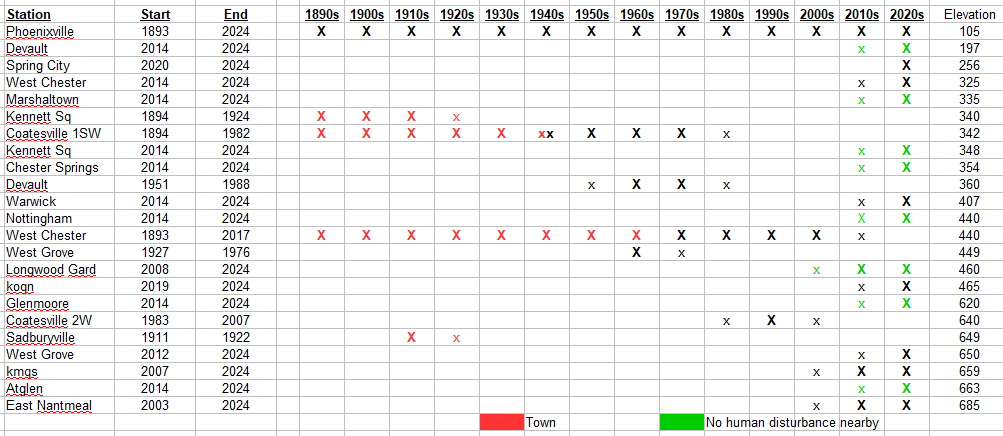
The main point is that the stations have changed. Taking a simple average skews the data. The 1900 station network (City Of Coatesville, Kennett Square borough, West Chester Borough, and Phoenixville) is completely different than the current. Mainly towns in the early days. No towns now.
-
There were no stations in the northwest part of the county back in the day.
-
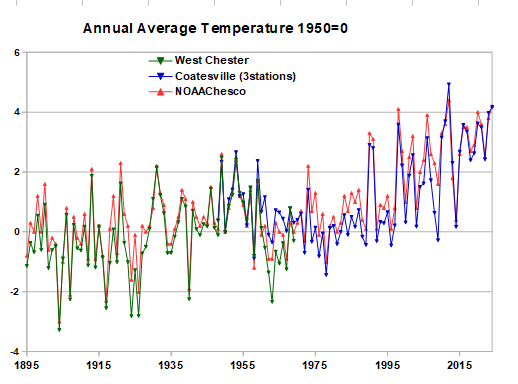
Here's another way of comparing NOAA to the raw data. Easy to normalize the data using a common year, 1950 in this case. This removes differences between stations to better isolate the long-term trend. Again NOAA and the raw data are in complete agreement on the long-term trend, roughly 4F of warming in Chesco.
-
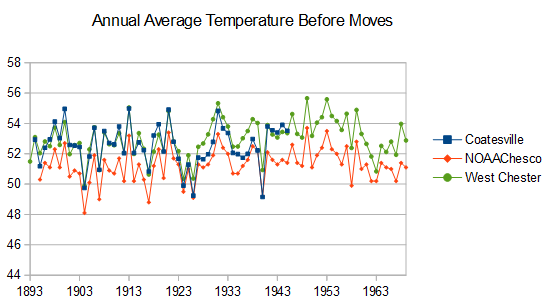
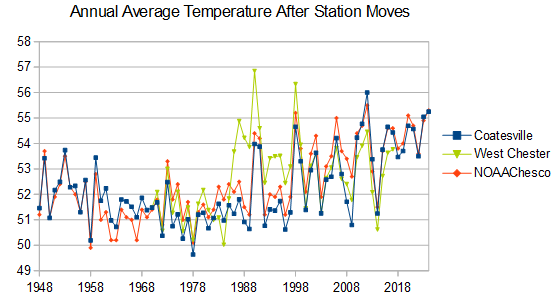
NOAA is in complete agreement with the raw data when you keep the station population constant and separate out the major station moves. Per chart above there are only a handful of long-term climate stations in Chester County. Both West Chester and Coatesville moved from towns to cooler rural locations and cooled by roughly 2F. It is easy to remove the station moves by plotting the before move and after move data separately. Before the moves West Chester and Coatesville are both about 2F warmer than NOAA.Not unexpected because these the town locations were warm sites, similar to Wilmington De. NOAA matches the year-to-year and long term trend of the before move data at both stations. After the stations moves, West Chester and Coatesville were more representative of the county close to NOAA . Like the before move data, NOAA matches the long-term trend and the year-to-year of the after move datra. The only exception is a warm spike at West Chester in the 1980s and 1990s. Which is clearly bad data. Chesco's claim that NOAA doesn't match the raw data is a complete strawman. He's the one who doesn't match the raw data. Why should NOAA match his faulty analysis?
-
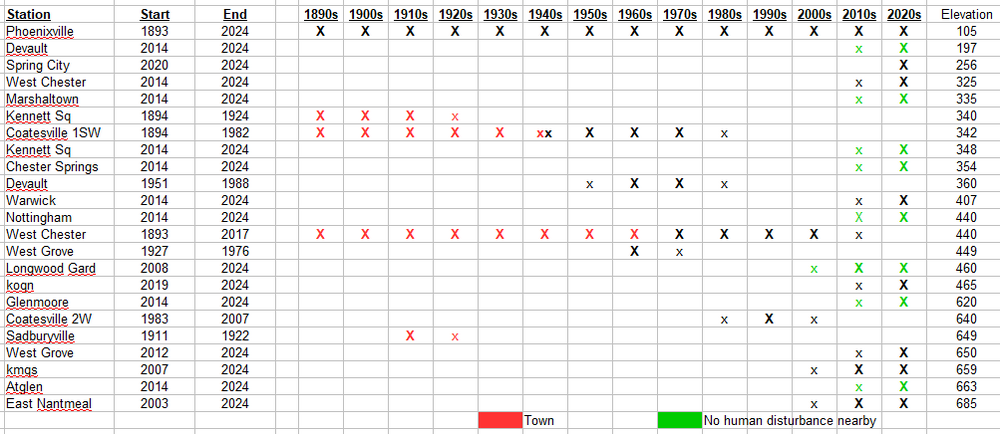
Here are the stations by year. What Chesco call's "Actual" is far from it. There is a big change in the station population from warm to cool, towns to rural, south and east to more centrally located, with more stations in the cooler north and west section. Most of the stations have short records and don't provide any climate info.
-
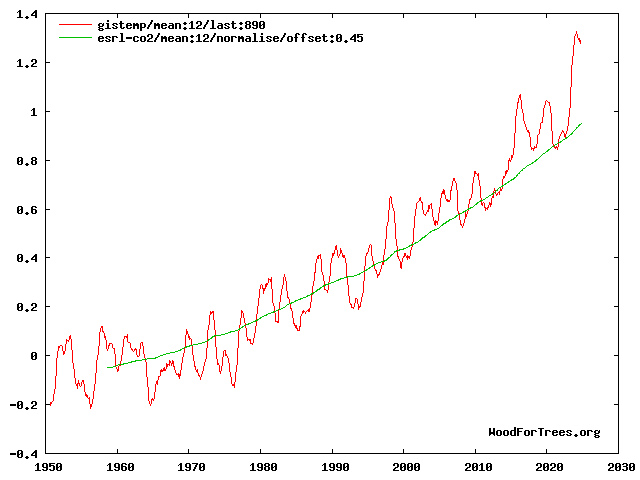
It's interesting to see the junk science/propaganda that circulates among climate deniers. Sure you can choose a yaxis that minimizes warming. Expanding the yaxis shows there's a close relationship between temperature and CO2. The chart is misleading for another reason. We are far from experiencing the full effect of CO2 yet. Temperature lags CO2 for 2 reasons: 1) It takes a long while to warm the ocean, melt ice sheets, shift forests etc.; and, 2) man-made aerosols have masked CO2 warming. Before 1970, aerosols masked almost all the warming from CO2. In the last 15 years we stepped-up the unmasking, mainly due to air pollution controls in China and on shipping, and temperature has responded. The other scientific message implicit in the denier chart. We don't need much of a rise in temperature to change our climate. A 1% change in absolute temperature will send us back tens of millions of years to a completely different world. Contradicts all the denier talking points which portray CO2 as a "trace" gas with minimal effect. The atmosphere already contains more than enough CO2 to change our climate.
-
Fusion could easily solve the climate crisis, the giant fusion reactor in the sky. Human power is roughly 1/100,000 of the energy available from the sun. Unfortunately China is getting close to the solar and battery finish line and we're not aware of the race.
_X.thumb.png.47ca5c2e0afbbf336f75bcc5966fc69d.png)
-
Report: Another Year of Record Heat for the Oceans
chubbs replied to donsutherland1's topic in Climate Change
I wonder if Viterbo understood the paper. Virerbo's focuses on wind speed but the paper finds that the jet stream shifted not that winds are increased. Winds decreased in the subtropics and tropics between the two jet streams. Viterbo's bottom chart covers a very small part of the world (39.5-40.5 N, 70W - 10W) so also doesn't shed much light on the paper imo. There's some validity to the narrow baseline period comment. That ia a consequence of the relatively short period studied, 2000-2023. Means that the results are affected by decade-to-decade natural variability. That isn't surprising. The strong rate of warming in a narrow latitude zone is unusual and needed unusual conditions to develop. Note that a competing explanation for the recent mid-latitude ocean warming is a decrease in aerosol emissions. -
This year is #2 in sea ice volume at the start of the melt season, beyond 2017 another post nino year. Will need favorable weather, like 2017, to avoid a low September minimum.
-
Long-term temperature trends in the US are very well determined. There are thousands of stations and well proven methods for detecting non-weather-related station changes, heat islands, etc. 1970 was the only start date I had. Yes, warming would be a little less starting from 1950; but, warming would be even larger starting in 1900. Doubt the starting date would have much impact on the relative stance of the midwest, which is the point I was addressing.
-
Yes the NE coast and parts of the upper midwest have had increased snow since 1970. That's consistent with the paper I posted upthread (relinked below and added a second). As expected the snowfall signal is emerging much slower than the temperature signal due to offsetting precipitation and temperature effects and natural variability. https://journals.ametsoc.org/view/journals/clim/26/20/jcli-d-12-00832.1.xml https://agupubs.onlinelibrary.wiley.com/doi/pdfdirect/10.1029/2018GL079820



_X.png.afecad4cb2907fa41d3aba436bb9b9a9.png)