donsutherland1
-
Posts
24,327 -
Joined
Content Type
Profiles
Blogs
Forums
American Weather
Media Demo
Store
Gallery
Everything posted by donsutherland1
-
One such storm: December 14-15, 1969: Boston: 3.4"; Philadelphia: 1.5"; Baltimore: 2.0"; Washington, DC: 0.3"; New York City: None
-
12/20-21 Clipper/Coastal Nowcast and Obs
donsutherland1 replied to Boston Bulldog's topic in New England
With 4.4" (11.2 cm) of snow, Boston has seen its record streak without daily snowfall of 4" or more finally come to an end.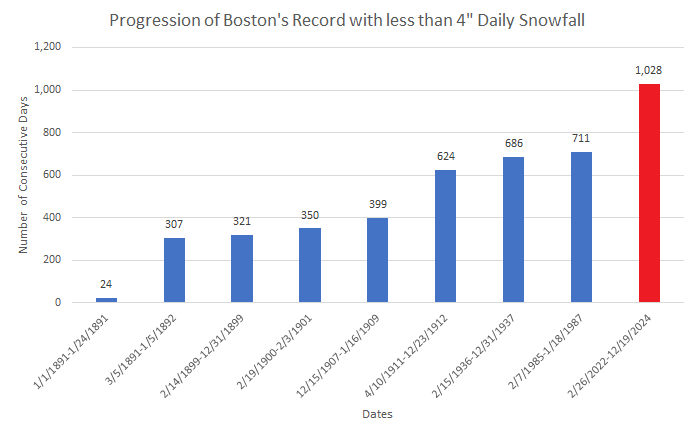
- 620 replies
-
- 15
-

-

-
Parts of the region experienced light snow. Into this evening, snowfall amounts included: Boston: 0.5" Bridgeport: 0.4" New York City: Trace Newark: Trace Philadelphia: Trace Light snow is likely tonight into tomorrow. A coating to an inch of snow is likely in the Philadelphia to New York City region overnight into tomorrow. Boston will likely pick up a storm total 1"-3" of snow. Last winter, New York City's first measurable snowfall occurred on January 6, 2024. The prior winter, it occurred on a record late February 1, 2023. The last earlier first measurable snowfall occurred on December 16, 2020. Normal is December 13th. Afterward, the coldest air so far this season will pour into the region. The temperature will fall into the teens for the first time this season in New York City and Philadelphia on Sunday morning and then again on Monday morning. Many areas outside those cities will likely experience single-digit lows. The cold will begin to recede around the middle of next week. December will likely close with above normal temperatures. The opening days of January will likely also begin with above normal temperatures, but it will start to turn colder. Snowfall prospects will remain limited through the end of December. On account of a lack of snowfall, 2023-2024 will likely set a new records for the lowest snowfall over a two-year period for Boston and New York City. Boston: 2023-2024 Total to Date: 21.5"; Record: 38.2", 1979-1980 New York City: 2023-2024 Total to Date: 9.8"; Record: 17.4:, 1997-1998 In past days, an occasional run of the operational GFS showed a significant snowstorm from Washington, DC to New York City. However, the pattern makes such an event very unlikely for this region. Since 1950, there were 5 December snowstorms that brought 6" or more snow to all three of these cities. Four (80%) occurred with a PNA+/NAO- pattern. The NAO is forecast to be positive. In addition, three (60%) occurred when the MJO was in Phase 8, which is not likely over the next 10 days. Only the December 23-25, 1966 event produced 6" or more snow in all three cities with a positive NAO, but the AO was strongly negative (< -2.000), which is not likely during the next 10 days. In sum, the interior sections will be far more favored for an appreciable or perhaps greater snowfall than the Washington-Baltimore-Philadelphia-New York City area over the next 10 days. A smaller snowfall remains plausible. One example will be the ongoing light snowfall in parts of the region. The NAO fell to a preliminary -2.751 on September 24th (all-time September record: -2.371, September 12, 1971). That was the 9th lowest value on record. La Niña winters following September cases where the NAO fell to -1.900 or below featured a predominantly positive NAO. The most recent such winters were 2016-2017 and 2022-2023. The mean temperatures for those winters in New York City were 39.3° and 41.0° respectively. The 1991-2020 normal value is 36.2°. A warmer to much warmer than normal outcome is favored by the November run of the ECMWF for Winter 2024-2025. The ENSO Region 1+2 anomaly was -0.2°C and the Region 3.4 anomaly was -0.6°C for the week centered around December 11. For the past six weeks, the ENSO Region 1+2 anomaly has averaged +0.17°C and the ENSO Region 3.4 anomaly has averaged -0.27°C. Neutral ENSO conditions may still evolve into a La Niña event during the winter. Uncertainty as to whether a La Niña will actually develop continues to increase. Currently, 47% of dynamical models and 22% of the statistical models forecast the development of a La Niña. The SOI was +24.81 today. The preliminary Arctic Oscillation (AO) was +0.671 today. Based on sensitivity analysis applied to the latest guidance, there is an implied 81% probability that New York City will have a colder than normal December (1991-2020 normal). December will likely finish with a mean temperature near 37.4° (1.7° below normal).
-
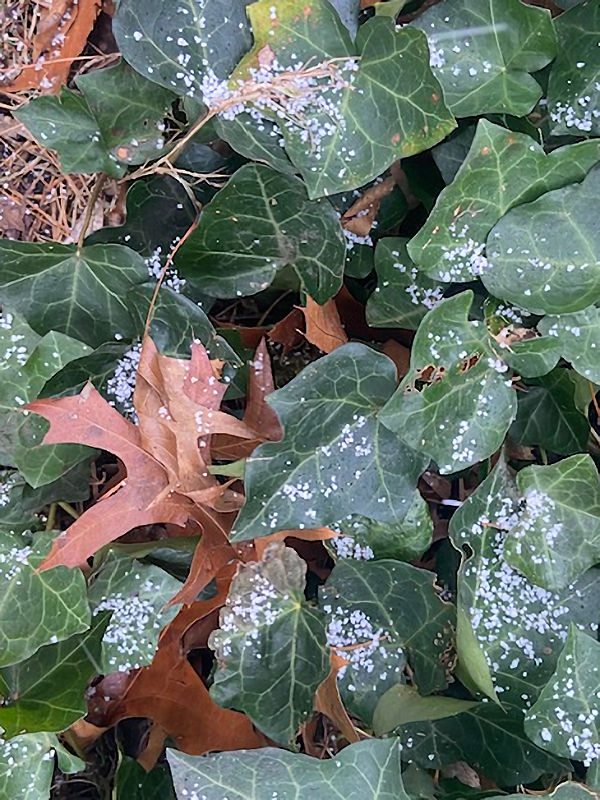
Coating in southern Westchester County. Snowing lightly.
-
They are. They've gone a record 1,028 consecutive days without 4" or more daily snowfall (through yesterday). They've also gone 338 consecutive days without 1" of daily snowfall (5th longest snow drought).
-
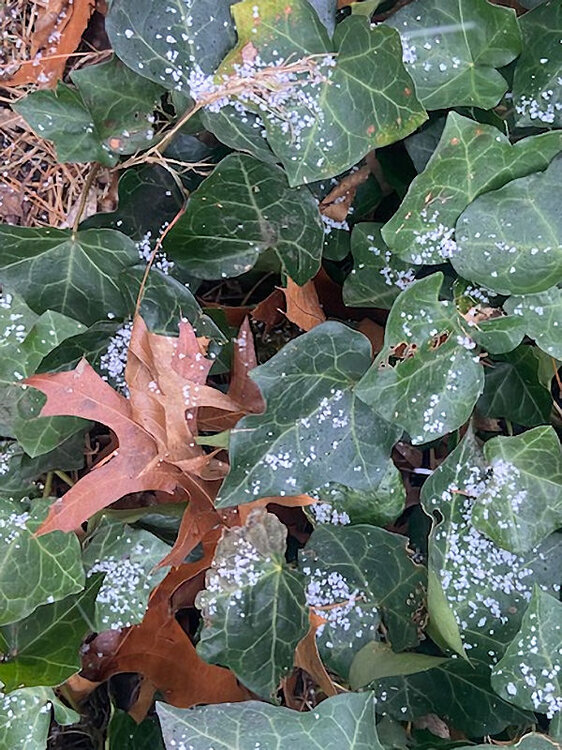
Graupel and rimed snowflakes are now falling in Larchmont, NY. The ground is dusted. I still think NYC is on track for its first measurable snowfall of the winter (coating to an inch).
-
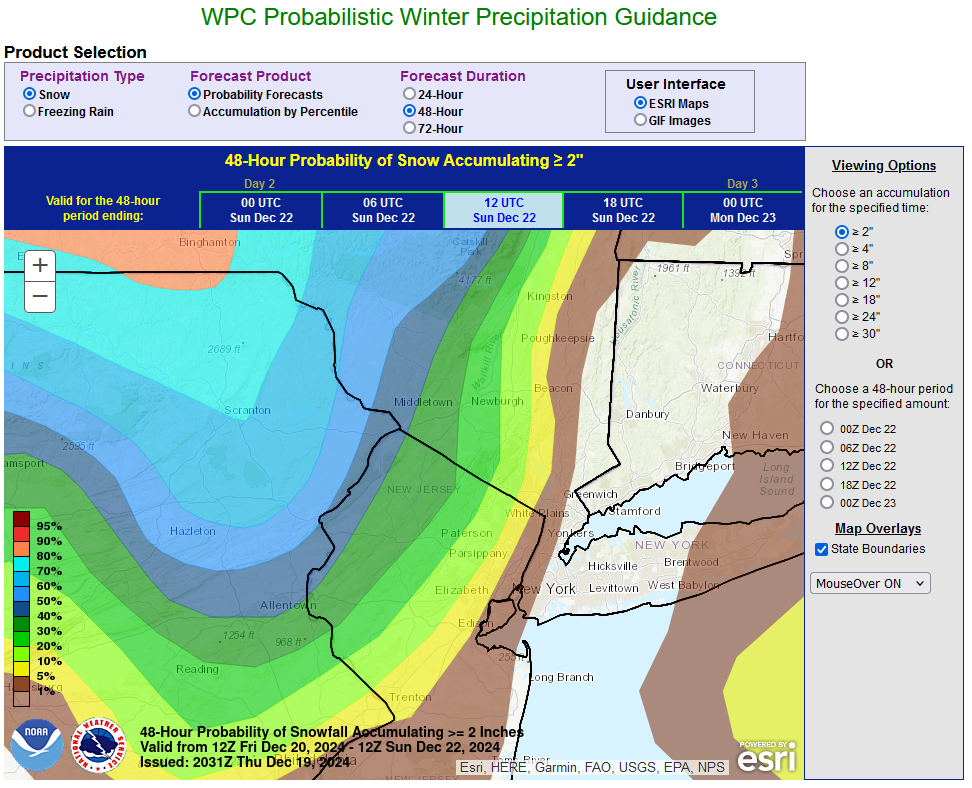
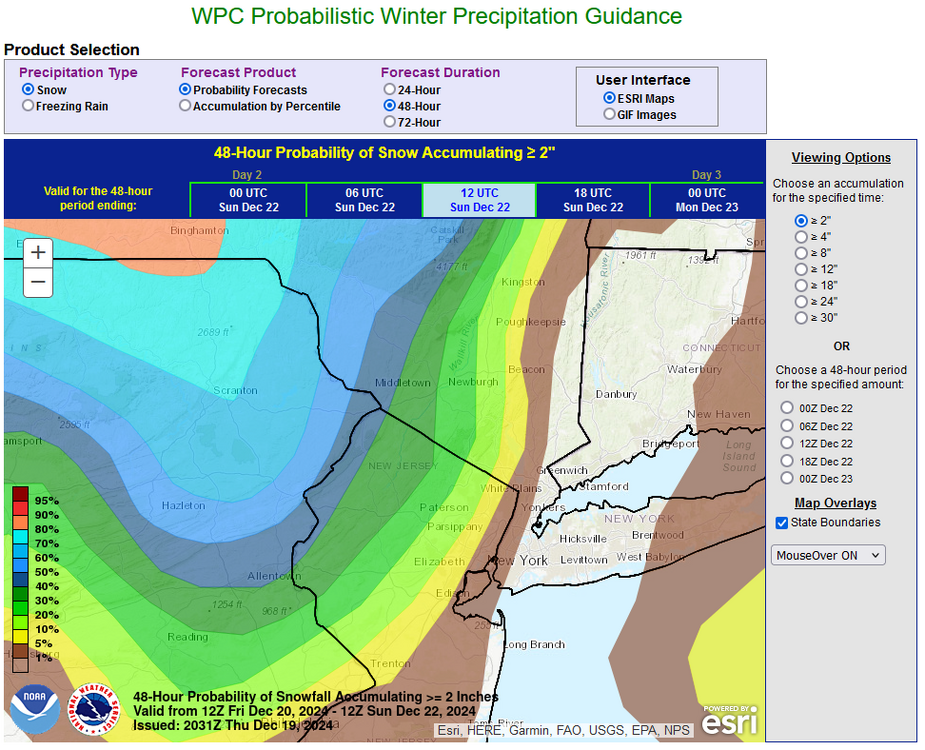
Latest probability map:
-
A cooling trend is underway. That trend will culminate with a sharp shot of cold will during the weekend. The temperature will likely fall into the teens for the first time this season in New York City and Philadelphia. Many areas outside those cities will likely experience single-digit lows. A system will bring some periods of light snow to the region late Friday into early Saturday morning. A coating to an inch of snow is likely in the Philadelphia to New York City region. Boston will likely pick up 1"-3" of snow. There could be an area of enhanced snowfall in parts of the northern Mid-Atlantic or southern New England areas should an inverted trough develop. The cold will begin to recede around the middle of next week. December will likely close with above normal temperatures. The opening days of January will likely also begin with above normal temperatures. Snowfall prospects will remain limited through the end of December. On account of a lack of snowfall, 2023-2024 will likely set a new records for the lowest snowfall over a two-year period for Boston and New York City. Boston: 2023-2024 Total to Date: 21.5"; Record: 38.2", 1979-1980 New York City: 2023-2024 Total to Date: 9.8"; Record: 17.4:, 1997-1998 In past days, an occasional run of the operational GFS showed a significant snowstorm from Washington, DC to New York City. However, the pattern makes such an event very unlikely for this region. Since 1950, there were 5 December snowstorms that brought 6" or more snow to all three of these cities. Four (80%) occurred with a PNA+/NAO- pattern. The NAO is forecast to be positive. In addition, three (60%) occurred when the MJO was in Phase 8, which is not likely over the next 10 days. Only the December 23-25, 1966 event produced 6" or more snow in all three cities with a positive NAO, but the AO was strongly negative (< -2.000), which is not likely during the next 10 days. In sum, the interior sections will be far more favored for an appreciable or perhaps greater snowfall than the Washington-Baltimore-Philadelphia-New York City area over the next 10 days. A smaller snowfall remains plausible. One example will be the upcoming Friday-Saturday snowfall in parts of the region. The NAO fell to a preliminary -2.751 on September 24th (all-time September record: -2.371, September 12, 1971). That was the 9th lowest value on record. La Niña winters following September cases where the NAO fell to -1.900 or below featured a predominantly positive NAO. The most recent such winters were 2016-2017 and 2022-2023. The mean temperatures for those winters in New York City were 39.3° and 41.0° respectively. The 1991-2020 normal value is 36.2°. A warmer to much warmer than normal outcome is favored by the November run of the ECMWF for Winter 2024-2025. The ENSO Region 1+2 anomaly was -0.2°C and the Region 3.4 anomaly was -0.6°C for the week centered around December 11. For the past six weeks, the ENSO Region 1+2 anomaly has averaged +0.17°C and the ENSO Region 3.4 anomaly has averaged -0.27°C. Neutral ENSO conditions may still evolve into a La Niña event during the winter. Uncertainty as to whether a La Niña will actually develop continues to increase. Currently, 47% of dynamical models and 22% of the statistical models forecast the development of a La Niña. The SOI was +29.79 today. The preliminary Arctic Oscillation (AO) was +0.686 today. Based on sensitivity analysis applied to the latest guidance, there is an implied 75% probability that New York City will have a colder than normal December (1991-2020 normal). December will likely finish with a mean temperature near 37.5° (1.6° below normal).
-
There are more models than what is shown on Pivotal, Tropical Tidbits, etc. Here's a link when the NBM was being developed: https://www.weather.gov/news/200318-nbm32 Some of the guidance updates hourly, hence the NBM also updates hourly.
-
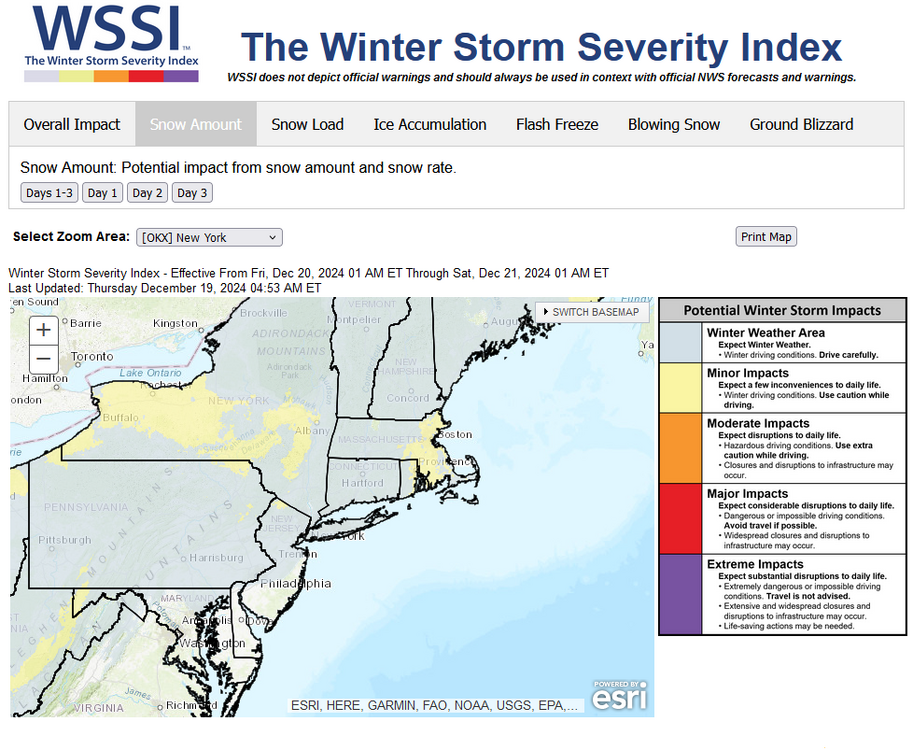
The Friday-Saturday light snow event should give Central Park its first measurable snowfall of the season. In fact, the share of ECMWF ensemble members showing 1" or more has decreased since 12/18 12z. Overall, it continues to look like less than 1" of snow in and around NYC and also Philadelphia. Colder suburbs should see a bit more.
-
A cooling trend is getting underway. That trend will culminate with a sharp shot of cold will during the weekend. The temperature will likely fall into the teens for the first time this season in New York City and Philadelphia. Many areas outside those cities will likely experience single-digit lows. Before that, a system will bring some periods of rain tonight into tomorrow. Afterward, another system will likely bring some periods of light snow to the region late Friday into early Saturday morning. A minor accumulation is possible in the Philadelphia to New York City region. Boston will likely pick up 1"-3" of snow. Beyond that, the cold will recede beginning around the middle of next week. December will likely close with above normal temperatures. The opening days of January will likely also begin with above normal temperatures. Snowfall prospects will remain limited. On account of a lack of snowfall, 2023-2024 will likely set a new records for the lowest snowfall over a two-year period for Boston and New York City. Boston: 2023-2024 Total to Date: 21.5"; Record: 38.2", 1979-1980 New York City: 2023-2024 Total to Date: 9.8"; Record: 17.4:, 1997-1998 In past days, an occasional run of the operational GFS showed a significant snowstorm from Washington, DC to New York City. However, the pattern makes such an event very unlikely for this region. Since 1950, there were 5 December snowstorms that brought 6" or more snow to all three of these cities. Four (80%) occurred with a PNA+/NAO- pattern. The NAO is forecast to be positive. In addition, three (60%) occurred when the MJO was in Phase 8, which is not likely over the next 10 days. Only the December 23-25, 1966 event produced 6" or more snow in all three cities with a positive NAO, but the AO was strongly negative (< -2.000), which is not likely during the next 10 days. In sum, the interior sections will be far more favored for an appreciable or perhaps greater snowfall than the Washington-Baltimore-Philadelphia-New York City area over the next 10 days. A smaller snowfall remains plausible. One example will be the upcoming Friday-Saturday snowfall in parts of the region. The NAO fell to a preliminary -2.751 on September 24th (all-time September record: -2.371, September 12, 1971). That was the 9th lowest value on record. La Niña winters following September cases where the NAO fell to -1.900 or below featured a predominantly positive NAO. The most recent such winters were 2016-2017 and 2022-2023. The mean temperatures for those winters in New York City were 39.3° and 41.0° respectively. The 1991-2020 normal value is 36.2°. A warmer to much warmer than normal outcome is favored by the November run of the ECMWF for Winter 2024-2025. The ENSO Region 1+2 anomaly was -0.2°C and the Region 3.4 anomaly was -0.6°C for the week centered around December 11. For the past six weeks, the ENSO Region 1+2 anomaly has averaged +0.17°C and the ENSO Region 3.4 anomaly has averaged -0.27°C. Neutral ENSO conditions may still evolve into a La Niña event during the winter. Uncertainty as to whether a La Niña will actually develop continues to increase. Currently, 47% of dynamical models and 22% of the statistical models forecast the development of a La Niña. The SOI was +17.33 today. The preliminary Arctic Oscillation (AO) was -0.109 today. Based on sensitivity analysis applied to the latest guidance, there is an implied 79% probability that New York City will have a colder than normal December (1991-2020 normal). December will likely finish with a mean temperature near 37.3° (1.8° below normal).
-
I agree regarding the Continent. Yaakov's tweet referenced the Northeast.
-
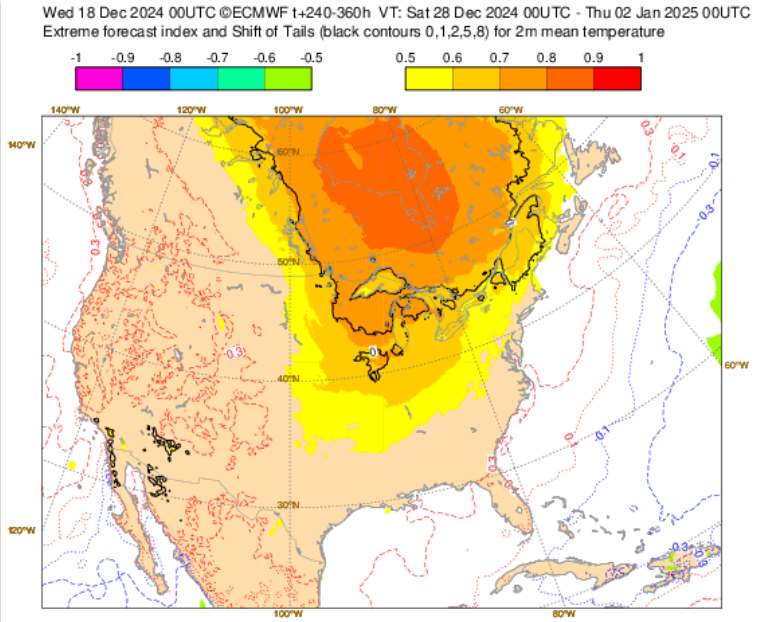
The "torch" will be in the vicinity of the Hudson and James Bays. The days 10-15 EFI does well in highlighting the risk. The Northeast and Great Lakes will probably be on the mild side of normal but widespread record-challenging warmth doesn't appear likely at this time in most of the CONUS. Wisconsin and Minnesota could see records challenged.
-
Clouds gave way to sunshine and the temperature surged into the upper 50s and lower 60s across much of the Northeast. In places, the temperature approached daily records. Highs included: Atlantic City: 619 Baltimore: 64° Bangor: 57° Boston: 60° Caribou: 50° Hartford: 60° Islip: 60° New York City-Central Park: 59° New York City-JFK Airport: 58° New York City-LaGuardia Airport: 60° Newark: 61° Philadelphia: 63° Portland: 56° Providence: 61° Richmond: 71° Washington, DC: 65° (tied record set in 2021) A cooling trend will commence tomorrow. A much sharper shot of cold will then aarive during the weekend. The potential exists for the temperature to fall into the teens for the first time this season in New York City. In addition, a system will likely bring some periods of light snow to the region late Friday into early Saturday morning. A minor accumulation is possible in the Philadelphia to New York City region. The potential exists for a 1"-3"/2"-4" snowfall in the Boston area. Beyond that, the pattern will likely remain changeable through much of the rest of the month on account of a fast jet stream. December will likely close with above normal temperatures and January will likely see at least its opening days turn out milder than normal. In past days, an occasional run of the operational GFS showed a significant snowstorm from Washington, DC to New York City. However, the pattern makes such an event very unlikely for this region. Since 1950, there were 5 December snowstorms that brought 6" or more snow to all three of these cities. Four (80%) occurred with a PNA+/NAO- pattern. The NAO is forecast to be positive. In addition, three (60%) occurred when the MJO was in Phase 8, which is not likely over the next 10 days. Only the December 23-25, 1966 event produced 6" or more snow in all three cities with a positive NAO, but the AO was strongly negative (< -2.000), which is not likely during the next 10 days. In sum, the interior sections will be far more favored for an appreciable or perhaps greater snowfall than the Washington-Baltimore-Philadelphia-New York City area over the next 10 days. A smaller snowfall remains plausible. The NAO fell to a preliminary -2.751 on September 24th (all-time September record: -2.371, September 12, 1971). That was the 9th lowest value on record. La Niña winters following September cases where the NAO fell to -1.900 or below featured a predominantly positive NAO. The most recent such winters were 2016-2017 and 2022-2023. The mean temperatures for those winters in New York City were 39.3° and 41.0° respectively. The 1991-2020 normal value is 36.2°. A warmer to much warmer than normal outcome is favored by the November run of the ECMWF for Winter 2024-2025. The ENSO Region 1+2 anomaly was -0.2°C and the Region 3.4 anomaly was -0.6°C for the week centered around December 11. For the past six weeks, the ENSO Region 1+2 anomaly has averaged +0.17°C and the ENSO Region 3.4 anomaly has averaged -0.27°C. Neutral ENSO conditions may still evolve into a La Niña event during the winter. Uncertainty as to whether a La Niña will actually develop continues to increase. Currently, 47% of dynamical models and 22% of the statistical models forecast the development of a La Niña. The SOI was +9.76 today. The preliminary Arctic Oscillation (AO) was +0.109 today. Based on sensitivity analysis applied to the latest guidance, there is an implied 80% probability that New York City will have a colder than normal December (1991-2020 normal). December will likely finish with a mean temperature near 37.0° (2.1° below normal).
-
Areas well to the north and west of New York City saw some snow and freezing rain this morning as warmer air pushed northward. New York City and its nearby suburbs saw only rain. Milder air has now returned to the region. The peak warmth will be shortlived. It will be unseasonably mild tomorrow with temperatures rising mainly into the upper 50s and perhaps even the lower 60s. Additional rain is likely, as well. Following the rain, it will again turn somewhat colder before a much sharper shot of cold arrives for during or after the next weekend. The potential exists for the temperature to fall into the teens for the first time this season in New York City. Beyond that, the pattern will likely remain changeable through much of the rest of the month on account of a fast jet stream. December will likely close with above normal temperatures and January will likely see at least its opening days turn out milder than normal. In past days, an occasional run of the operational GFS showed a significant snowstorm from Washington, DC to New York City. However, the pattern makes such an event very unlikely for this region. Since 1950, there were 5 December snowstorms that brought 6" or more snow to all three of these cities. Four (80%) occurred with a PNA+/NAO- pattern. The NAO is forecast to be positive. In addition, three (60%) occurred when the MJO was in Phase 8, which is not likely over the next 10 days. Only the December 23-25, 1966 event produced 6" or more snow in all three cities with a positive NAO, but the AO was strongly negative (< -2.000), which is not likely during the next 10 days. In sum, the interior sections will be far more favored for an appreciable or perhaps greater snowfall than the Washington-Baltimore-Philadelphia-New York City area over the next 10 days. A smaller snowfall remains plausible. One possible light snowfall could occur late Friday into Saturday morning. Any accumulations would be minor in and around the New York City area. The NAO fell to a preliminary -2.751 on September 24th (all-time September record: -2.371, September 12, 1971). That was the 9th lowest value on record. La Niña winters following September cases where the NAO fell to -1.900 or below featured a predominantly positive NAO. The most recent such winters were 2016-2017 and 2022-2023. The mean temperatures for those winters in New York City were 39.3° and 41.0° respectively. The 1991-2020 normal value is 36.2°. A warmer to much warmer than normal outcome is favored by the November run of the ECMWF for Winter 2024-2025. The ENSO Region 1+2 anomaly was -0.2°C and the Region 3.4 anomaly was -0.6°C for the week centered around December 11. For the past six weeks, the ENSO Region 1+2 anomaly has averaged +0.17°C and the ENSO Region 3.4 anomaly has averaged -0.27°C. Neutral ENSO conditions may still evolve into a La Niña event during the winter. Uncertainty as to whether a La Niña will actually develop continues to increase. Currently, 47% of dynamical models and 22% of the statistical models forecast the development of a La Niña. The SOI was +7.21 today. The preliminary Arctic Oscillation (AO) was +1.003 today. Based on sensitivity analysis applied to the latest guidance, there is an implied 85% probability that New York City will have a colder than normal December (1991-2020 normal). December will likely finish with a mean temperature near 36.7° (2.4° below normal).
-
Considering the warmth of the Week 3 outlook and snap back on the Week 6 outlook, it's possible that the coldest period might be right around the days leading up to and then following January 13th.
-
This is happening more and more frequently as winters continue to warm. The Arctic shot next weekend/early next week will probably bring an end to the blooms.
-
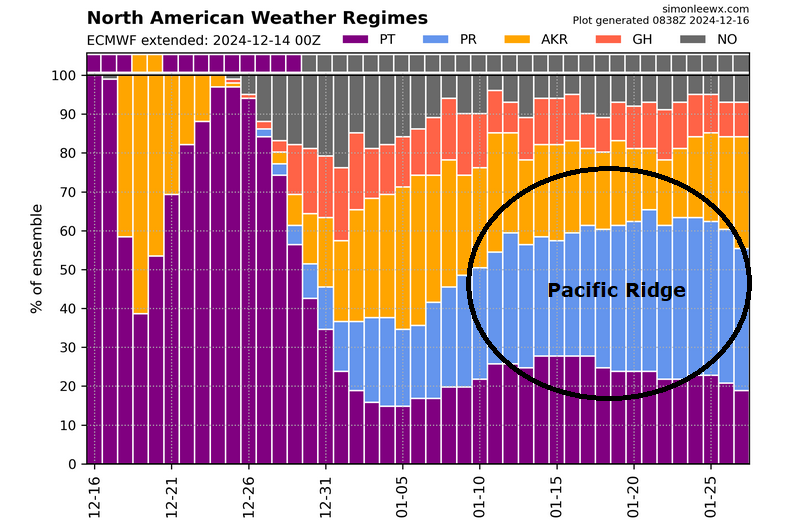
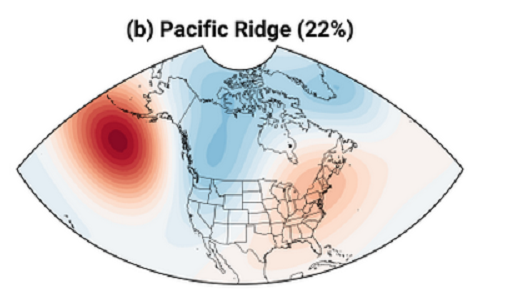
The ECMWF is indicating that a Pacific Ridge pattern could develop toward mid-January. If so, any cold that develops during the first week of January could last 1-2 weeks before a warmer pattern begins to develop, assuming that the ECMWF is correct. Recent ECMWF ensemble 46-day forecasts suggested that a PNA- pattern could develop approaching mid-January, so the outcome above is a plausible scenario. Fortunately, all of that remains well in the future, so significant changes are possible.
-
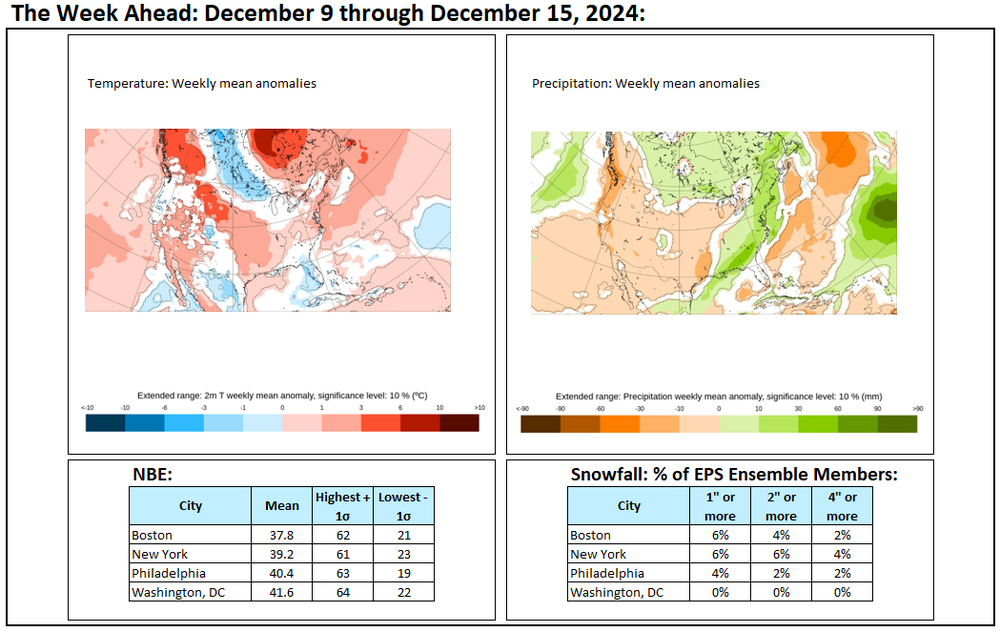
Final weekly outcome:

-
Yes. The 1991-20 baseline is quite a bit warmer than the 1981-10 one.
-
New York City, Philadelphia, and Washington, DC have seen their coldest December 1-15 period since 2010. Boston has seen its coldest such period since 2013. Baltimore saw its coldest since 2017. Despite the cold, snowfall has been lacking. As a result, Boston has now gone 1,024 consecutive days without a 4" or greater daily snowfall (old record: 711 days). Richmond has gone 1,064 days without a 1" or above daily snowfall (old record: 725 days). Significant snowfall remains unlikely in this region for the foreseeable future. Much milder air will return starting tomorrow. It will be unseasonably mild tomorrow and Tuesday. Additional rain is likely, as well. Following the rain, it will again turn somewhat colder before a much sharper shot of cold arrives for during or after the next weekend. The potential exists for the temperature to fall into the teens for the first time this season in New York City. Beyond that, the pattern will likely remain changeable through much of the rest of the month on account of a fast jet stream. The probability of a mild end to the month and mild start for the first few days of January has increased. In recent days, an occasional run of the operational GFS showed a significant snowstorm from Washington, DC to New York City. However, the pattern makes such an event very unlikely for this region. Since 1950, there were 5 December snowstorms that brought 6" or more snow to all three of these cities. Four (80%) occurred with a PNA+/NAO- pattern. The NAO is forecast to be positive. In addition, three (60%) occurred when the MJO was in Phase 8, which is not likely over the next 10 days. Only the December 23-25, 1966 event produced 6" or more snow in all three cities with a positive NAO, but the AO was strongly negative (< -2.000), which is not likely during the next 10 days. In sum, the interior sections will be far more favored for an appreciable or perhaps greater snowfall than the Washington-Baltimore-Philadelphia-New York City area over the next 10 days. A smaller snowfall is plausible. The NAO fell to a preliminary -2.751 on September 24th (all-time September record: -2.371, September 12, 1971). That was the 9th lowest value on record. La Niña winters following September cases where the NAO fell to -1.900 or below featured a predominantly positive NAO. The most recent such winters were 2016-2017 and 2022-2023. The mean temperatures for those winters in New York City were 39.3° and 41.0° respectively. The 1991-2020 normal value is 36.2°. A warmer to much warmer than normal outcome is favored by the November run of the ECMWF for Winter 2024-2025. The ENSO Region 1+2 anomaly was +0.1°C and the Region 3.4 anomaly was -0.3°C for the week centered around December 4. For the past six weeks, the ENSO Region 1+2 anomaly has averaged +0.12°C and the ENSO Region 3.4 anomaly has averaged -0.20°C. Neutral ENSO conditions may still evolve into a La Niña event during the winter. Uncertainty as to whether a La Niña will actually develop continues to increase. Currently, 47% of dynamical models and 22% of the statistical models forecast the development of a La Niña. The SOI was +0.52 today. The preliminary Arctic Oscillation (AO) was +1.573 today. Based on sensitivity analysis applied to the latest guidance, there is an implied 83% probability that New York City will have a colder than normal December (1991-2020 normal). December will likely finish with a mean temperature near 36.9° (2.2° below normal).
-
It probably won't be as impressive as 2022, which saw two single-digit lows and a high temperature of just 15° on December 24th in NYC. It will still be fairly impressive.
-
The ECMWF has had this cold shot for several days with the temperature falling into the middle teens in NYC. We'll whether this run is actually colder once the higher-resolution figures come out on Wxmodels or Wxbell. Regardless, this will likely be December's strongest cold shot.
-
Almost certainly, it was a turboprop and the red lights were beacon lights. Westchester County Airport has a lot of turboprop air traffic (mostly corporate planes). To be sure, there are some drones being flown. One story: https://www.cnn.com/2024/12/15/us/drone-boston-airport-arrest/index.html
-
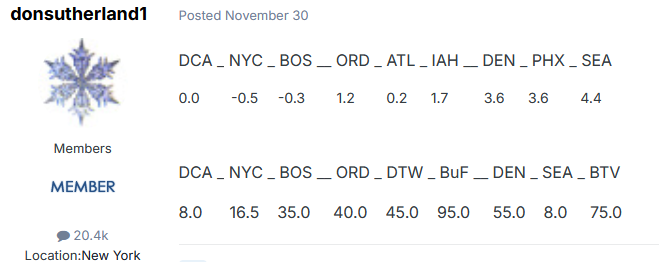
I'm leaning somewhat warmer than normal for NYC, Philadelphia, Washington, DC, Chicago. The exact values will be posted on 12/31 and I can change my mind based on the latest guidance. Putting ideas for January out on December 15th ignores the stochastic changes that can occur. My final idea will be posted in the January forecast contest. My December thinking is below (temperatures in the first set of numbers and seasonal snowfall for the second set of numbers):