


OHweather
-
Posts
5,042 -
Joined
-
Last visited
Content Type
Profiles
Blogs
Forums
American Weather
Media Demo
Store
Gallery
Everything posted by OHweather
-
Looks like a very potent event for the primary belt later tomorrow and Tuesday, with a very heavy band likely impacting the metro area during the Tuesday AM rush.
-
2-2.5” in Macedonia. Roads were slush covered at 6:30 when I left. Not a bad start!
-
Here are my comments from the other Ohio thread regarding this winter...I think there's a reasonable chance that we locally see more snow than last winter, but it's hard to expect average or above snowfall IMO. "Off the cuff, I've had some mixed feelings but unfortunately am leaning pessimistic for our region. Now, could it be somewhat better than last winter? Sure. But much more than that probably is asking a lot. It is looking increasingly likely that this winter will feature a strong, east-based or traditional El Nino. Water temperature anomalies are already near +1.5C in Nino region 3.4, and don't appear likely to start cooling anytime soon. And the warmest anomalies are closer to South America, making this a more traditional El Nino. This likely means the sub-tropical jet will be quite active and that Pacific air will frequently flood the continent, making it hard to build up true cold air over Canada. This will be an El Nino with a -QBO (easterly wind anomalies in the stratosphere), which is a good combination for possible disruptions to the stratospheric polar vortex. That could lead to a -AO/-NAO trend later in winter. So, if we do see a period of blocking and the sub-tropical jet is active perhaps there's some potential for a larger system to produce snow out of the sub-tropical stream. However, I think the strong El Nino and lack of Arctic air will lead to fewer clippers than normal and generally less snow than normal, unless we get lucky with some sub-tropical jet help. There has been a lot of talk that this isn't a winter to use strong El Nino climo for the winter outlook, and I understand some of the reservations as the pattern hasn't acted like a developing strong El Nino this summer. I think the lingering affects on the atmospheric circulation after 3 years of La Nina, aided by a strong -PDO, and the anomalous warmth of the Atlantic offset the atmospheric response to the developing El Nino...however, I believe we're starting to see the atmosphere respond to the borderline strong El Nino and strong positive Indian Ocean dipole. Tropical forcing is beginning to become more persistent over the western Indian Ocean and the Pacific. While perhaps the lingering oddities can lead to a random cold shot in later November or December if we briefly get some help from the MJO before the El Nino pattern truly locks in, I'm thinking this winter does act like an El Nino, leading to my overall pessimism. With that said, I've been wrong about these things for sure, and I'll try to look more in-depth over the coming weeks." As for the LES event Tuesday night into early Wednesday, the instability is extreme and the synoptic support is quite good. I think a band of very intense precip, with plenty of lightning, will come crashing onshore late in the evening from the Cleveland metro points east and slowly sag inland. It'll be moving but it'll be very intense. Capable of multiple inches of snow in an hour or so of time, especially in the higher terrain. Model soundings show very strong lift in the DGZ, along with cold 925mb temperatures of -2 to -4C and surface dew points a bit below freezing. I think this argues for locations more than a few miles away from Lake Erie seeing the bulk of this precip fall as snow. It'll be a quick burst with the trough. Instability remains strong into Wednesday morning, and there are hints winds get aligned out of the NNW for a few hours around sunrise, which may allow for a few narrow multi-bands to develop after a lull behind the initial trough passage and burst of snow. There will be a Huron connection somewhere in NE OH that may be a bit more organized/intense Wednesday morning. Activity should weaken more substantially and change back to rain or a mix by Wednesday afternoon. I think it'll be a general 1-3" deal, with up to an inch of slop near the lake but generally struggling to change to snow near the water. Accums should get as far south/west as Lorain/Medina/Wayne Counties and down into the Akron/Canton/Youngstown areas. With good synoptic support, the activity should persist well inland though it will lose some intensity as it gets farther from the lake. There may be spots where the band hangs up a little longer, or where the narrow multibands set up early Wednesday. If these aligns with the higher elevations, hi-res models all spit out upwards of 0.75" of QPF in spots. Even if that is somewhat overdone, there's enough QPF to play with to get 4 or 5" of wet snow where bands are most persistent away from the lakeshore. Hopefully enough leaves have come down to mitigate tree/power-line issues, but there may be a few.
-
Let’s talk winter!! Ohio and surrounding states!!
OHweather replied to Steve's topic in Lakes/Ohio Valley
I haven't put one out yet. I will try to over the next few weeks, or at the least post some medium-long range thoughts in the long range thread. Off the cuff, I've had some mixed feelings but unfortunately am leaning pessimistic for our region. Now, could it be somewhat better than last winter? Sure. But much more than that probably is asking a lot. It is looking increasingly likely that this winter will feature a strong, east-based or traditional El Nino. Water temperature anomalies are already near +1.5C in Nino region 3.4, and don't appear likely to start cooling anytime soon. And the warmest anomalies are closer to South America, making this a more traditional El Nino. This likely means the sub-tropical jet will be quite active and that Pacific air will frequently flood the continent, making it hard to build up true cold air over Canada. This will be an El Nino with a -QBO (easterly wind anomalies in the stratosphere), which is a good combination for possible disruptions to the stratospheric polar vortex. That could lead to a -AO/-NAO trend later in winter. So, if we do see a period of blocking and the sub-tropical jet is active perhaps there's some potential for a larger system to produce snow out of the sub-tropical stream. However, I think the strong El Nino and lack of Arctic air will lead to fewer clippers than normal and generally less snow than normal, unless we get lucky with some sub-tropical jet help. There has been a lot of talk that this isn't a winter to use strong El Nino climo for the winter outlook, and I understand some of the reservations as the pattern hasn't acted like a developing strong El Nino this summer. I think the lingering affects on the atmospheric circulation after 3 years of La Nina, aided by a strong -PDO, and the anomalous warmth of the Atlantic offset the atmospheric response to the developing El Nino...however, I believe we're starting to see the atmosphere respond to the borderline strong El Nino and strong positive Indian Ocean dipole. Tropical forcing is beginning to become more persistent over the western Indian Ocean and the Pacific. While perhaps the lingering oddities can lead to a random cold shot in later November or December if we briefly get some help from the MJO before the El Nino pattern truly locks in, I'm thinking this winter does act like an El Nino, leading to my overall pessimism. With that said, I've been wrong about these things for sure, and I'll try to look more in-depth over the coming weeks. -
Let’s talk winter!! Ohio and surrounding states!!
OHweather replied to Steve's topic in Lakes/Ohio Valley
Probably won't stick more than some grassy coatings here and there, but it looks like most of the state will see their first flakes with a potent trough passage Tuesday evening. Maybe even the bursty convective stuff in a few spots. -
Looks like a nice burst of lake enhanced snow Tuesday night as a shortwave moves through. SW winds will shift NW, so probably just a gradually moving burst with the trough axis transitioning to weaker multi-bands behind the trough. It looks like activity shuts down pretty quickly into Wednesday morning. Instability with the setup is extreme, with lake to 500mb temperature differentials of about 50C along with good synoptic support. The band/burst that crashes ashore with the trough axis probably will be accompanied by some lightning. It seems like this burst could affect much of the snowbelt in NE OH/NW PA (both primary and secondary), along with the Cleveland metro and perhaps some counties farther west along the lakeshore. Most areas probably only see a couple hours of good precip, though sometimes these bands can pivot a bit and last a little longer in a localized area as they work through. Temperatures will be marginal, though with dew points away from the lake falling into the 20s and 925mb temps dipping to -2C I think it will be cold enough for this burst of precip to fall as mainly snow and graupel away from the lake and probably more graupel with some rain and wet flakes mixed in closer to the lake. Forecast soundings suggest there will be good flake production aloft. Along the lake it may be tough to accumulate much as the ratios will be very low, but inland a bit from the lake could see a 1-3" type accumulation across much of the metro area and snowbelt. There may be enough QPF to play with for some of the highest hills to get a little more than that, but they'd have to get lucky and have a band sit over them. It won't last long, but I'm pretty optimistic many of us wake up to some snow on the ground Wednesday morning.
-
We haven’t made the map yet. Hopefully before the flakes start flying at this rate (the data isn’t going anywhere)
-
I will check and see if we produced one. We tallied up all the snow spotter totals but I'm not sure if there's a map to go with it.
-
Was wondering how that band performed when it sank into your area. It snowed hard for a couple hours in Chardon very early this morning, and while accumulations weren't much into Cuyahoga County the heavy snow/graupel in the band made 271 slick during the commute and caused accidents. Luckily the band was moving because if it would've sat in one spot for its duration it may have dropped several very dense inches...we would've needed at least an advisory if not more due to what would've happened to the trees. Pretty impressive setup for May. No accums anywhere between the office and my house (Brooklyn Hts/Reminderville) but we had a nice graupel shower yesterday afternoon and wet flakes did mix in this morning. We've seen snow in the month of May in recent years much more than what I remember up through about 2015. I believe in 2016 we had some May snow that stuck a bit in parts of the snowbelt and then again in 2020, 2021 and 2023. With that said, it's snowing less in the months it is supposed to snow in recent years, probably a trade none of us want to make.
-
Congrats! I have been wondering if we can get into consistently above normal temperatures again anytime soon...just has been an impressive tendency the last couple weeks for blocking/a -NAO pattern which keeps forcing a trough over eastern Canada and the NE US. I do think we'll gradually warm up through May (after the next 7-10 days it shouldn't be a s bad as it is right now) but it'll probably be tough to get prolonged warmer than average weather for a good portion of the month. 6" in Columbus on April 30th is pretty hard to imagine!
-
After the 70s and 80s earlier this month the showery weather with snow flakes mixing in over the last couple of days has been unwelcome. But, nothing has stuck and I think I’m ready to call it a “winter” in Reminderville. My final tally is 33.7”, which is 40-45% of average. The driveway was plowed twice. Definitely feels even more underwhelming than my previous personal “low water mark” in NE Ohio of 2011-12.
-
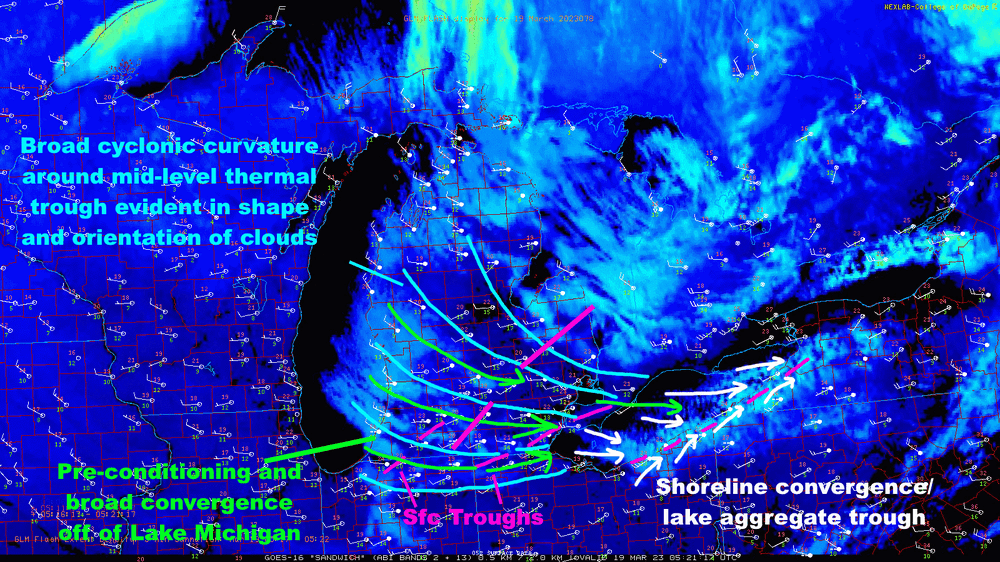
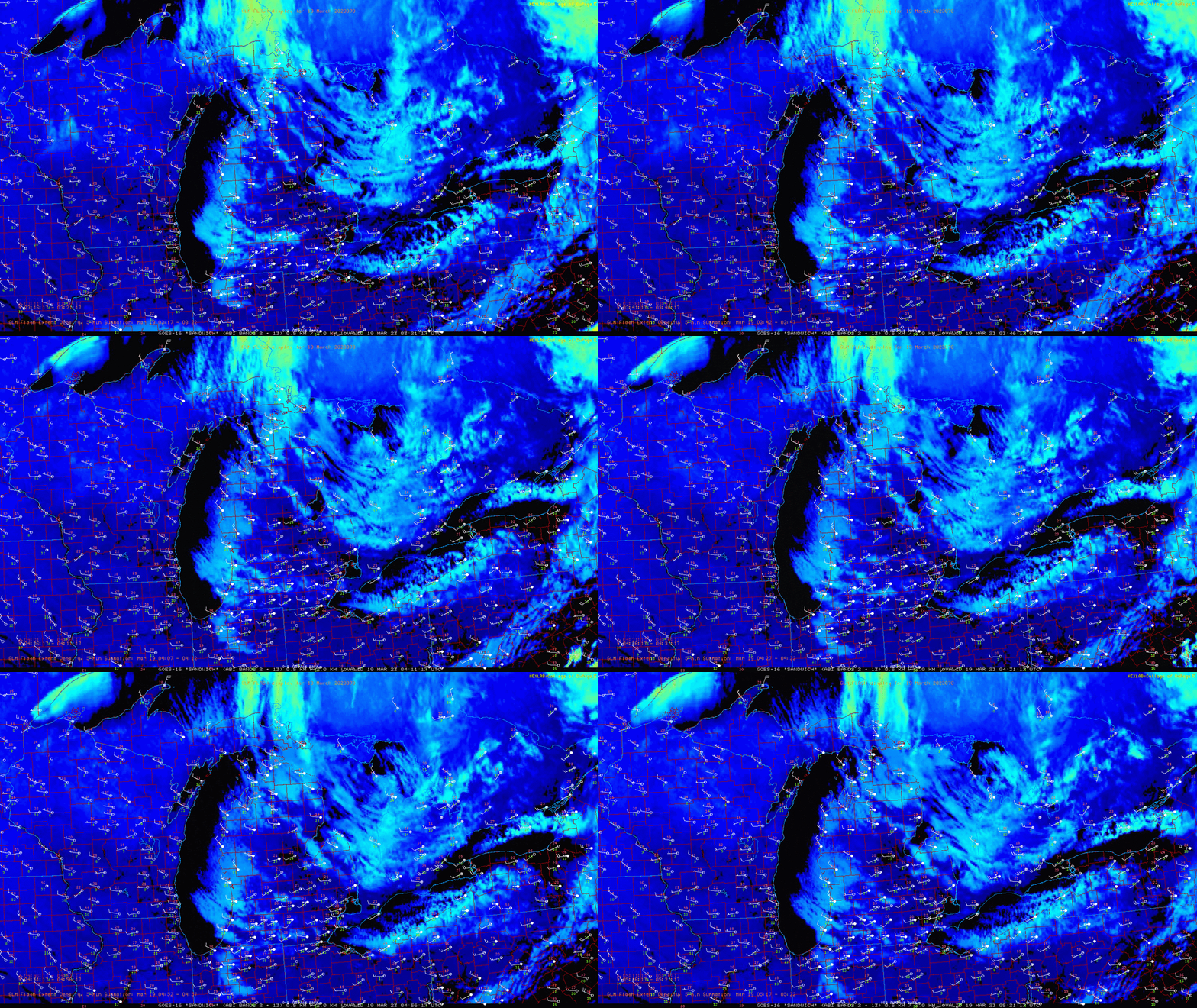
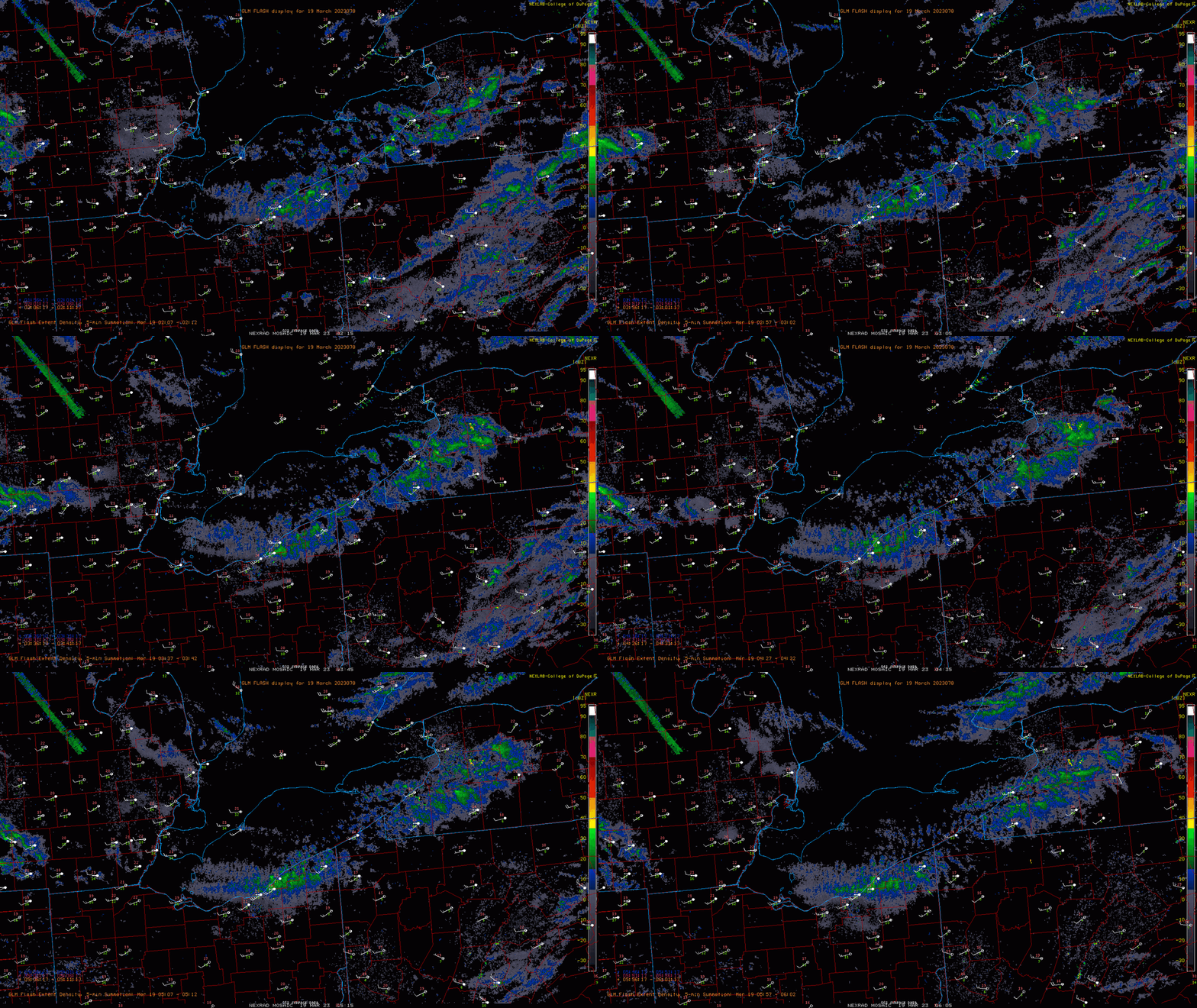
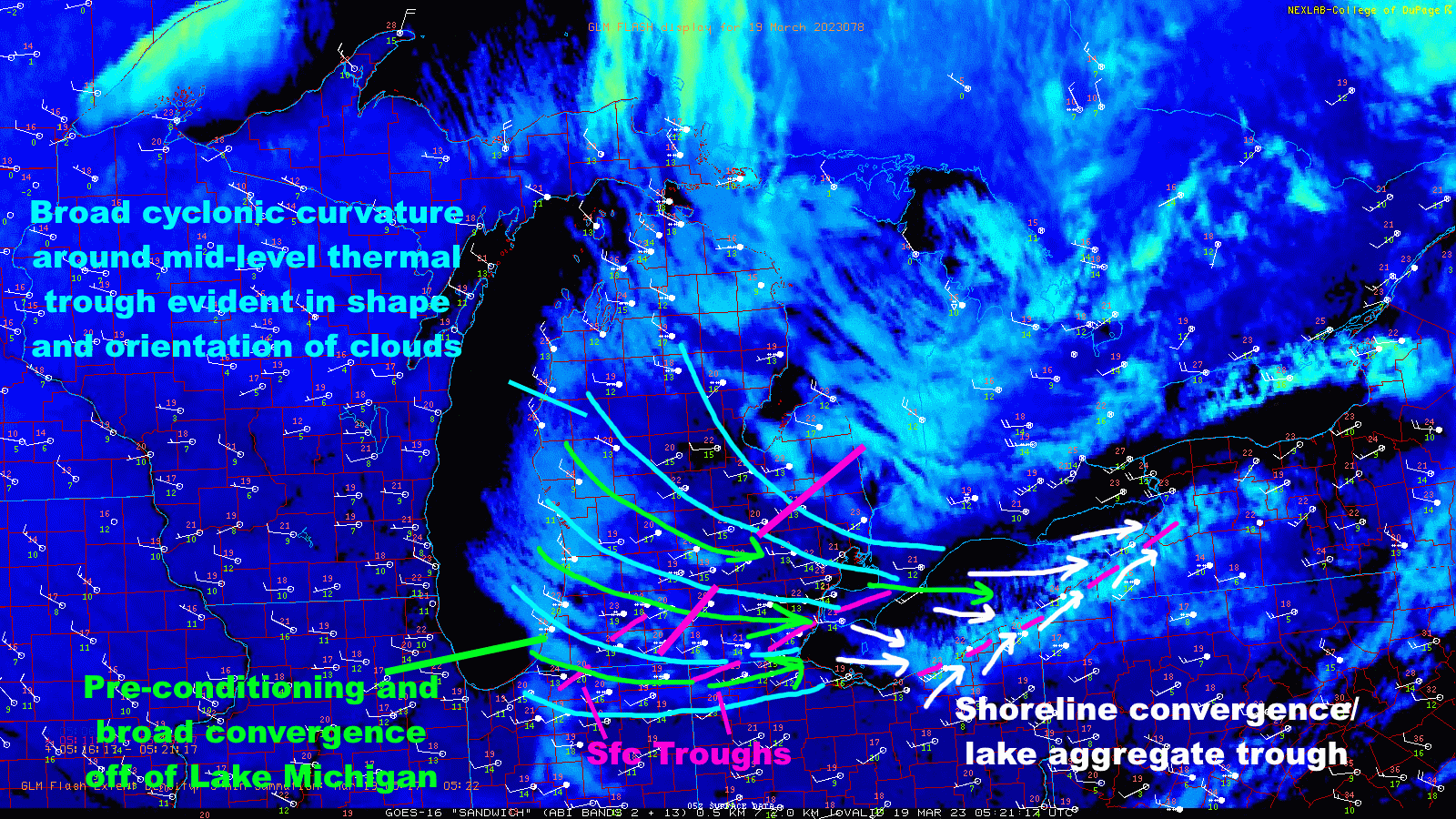
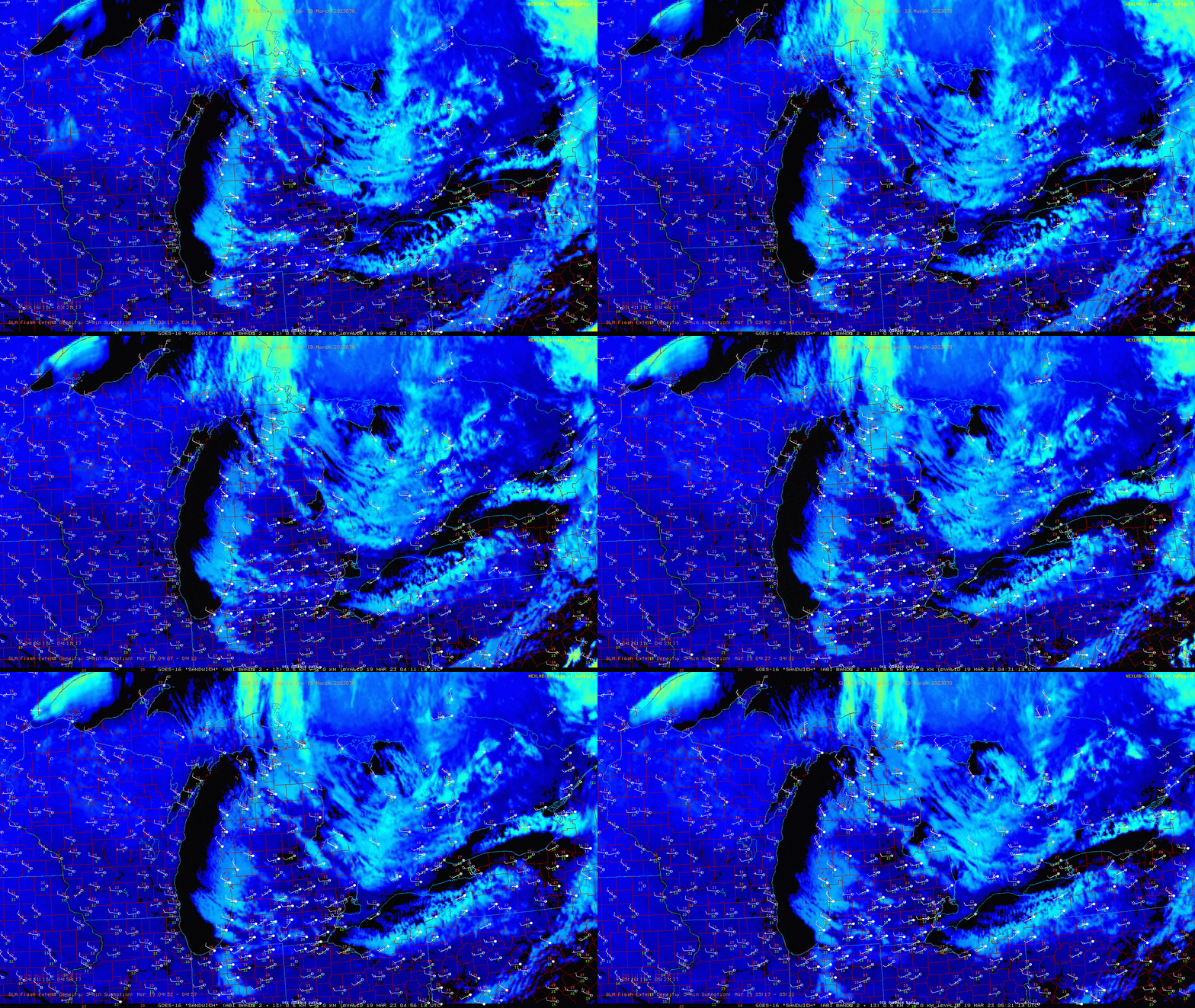
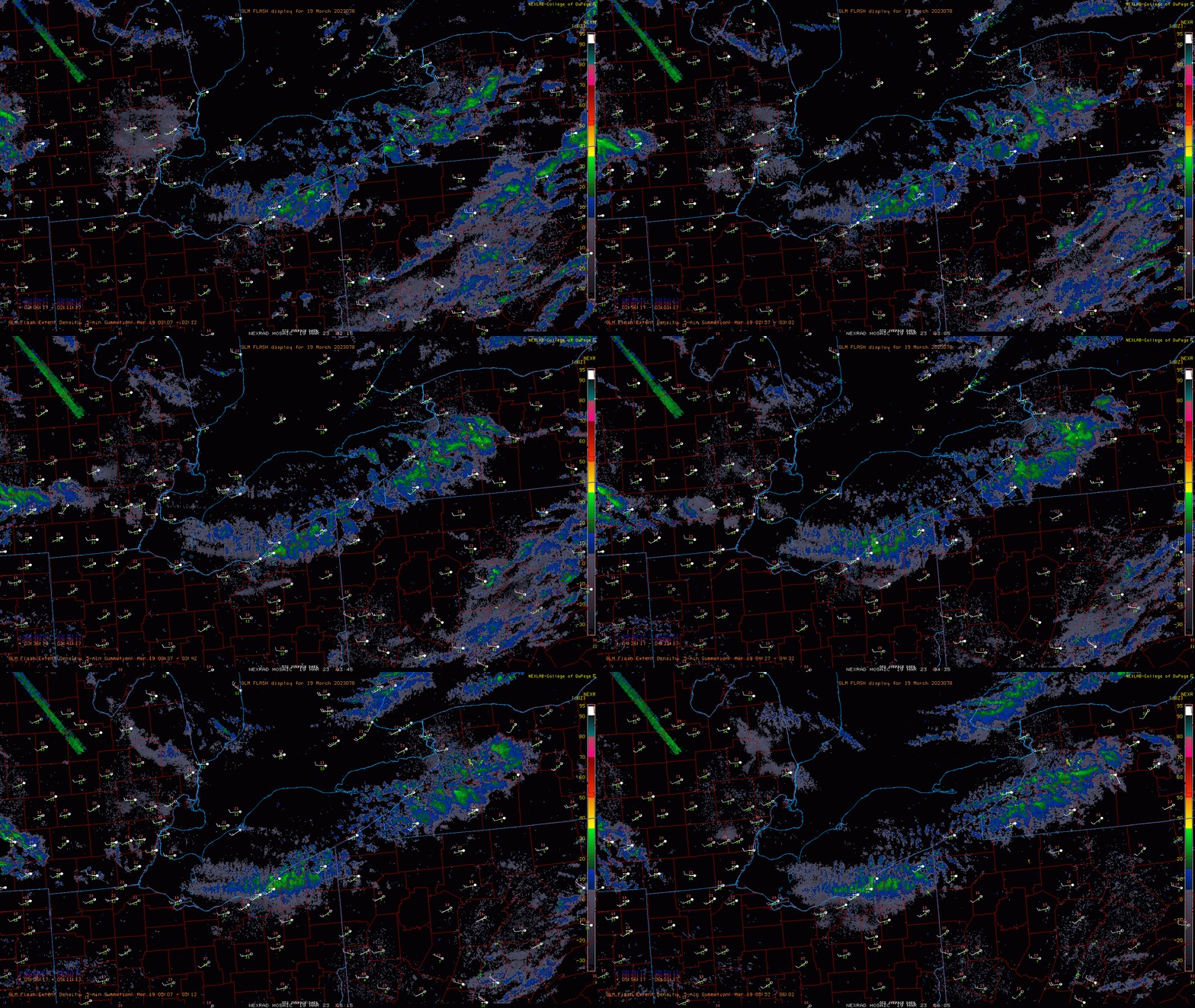
Some subtle features evident on satellite helping our lake effect peak in intensity tonight...unfortunately winds on land are backed to the southwest so it's struggling to push south into more of Cuyahoga and southern Geauga. Basically, subtle sources for ascent and convergence are aligning near and just downwind of Lake Erie as we approach the diurnal maximum in lake-induced instability. This is allowing Lake Erie's lake effect event to peak. Activity may shift slightly farther south as surface troughs over Michigan move southeast across the lake. It's snowing pretty good and I think the warnings will marginally verify in a few spots (probably southern Lake or northern Geauga, and southern Erie or northwestern Crawford), though it probably won't be a very widespread 6"+. This event isn't dropping quite as much as the instability and snow growth could support. Looking at a radar loop and surface obs, some limiting factors are evident. It is a dry airmass and winds are strong with gale warnings over the lake. This is limiting residence time and pushing the snow fairly far inland. However, winds over land are backed pretty far southwest, about 240 degrees, while winds in the lake effect clouds average closer to 280 degrees. This leads to a fair amount of shear, which is limiting band organization somewhat. Winds over the lake are much better-aligned, so I think if the winds were lighter we'd see more focused bands closer to the lake that could drop higher totals. Because of the instability and very efficient snow growth this is a nice little event, just not huge because of the limiting factors (really, lighter winds would've made a big difference).
-
I'll phrase my response to that as: Given the nature of the snows this year (it's immediately settling or melting once it's on the ground) it's been easy to "under-measure" snows in Northwest Ohio if you wait until the synoptic times (i.e. 0z, 6z, 12z, 18z) to measure. Being at an open air field never helps when there's wind either. It's possible there's been a bit more snow in Toledo than the 14.1", though I'd also say it's somewhere in the ballpark even if it's a conservative number.
-
A bit over 4” since Sunday night here, with about 3.5” of that since yesterday afternoon. Not bad. Glad a snow event finally panned out.
-
Late Monday afternoon through early Tuesday strikes me as the kind of setup where a mesoscale surprise happens somewhere from the central lakeshore counties and Cleveland area points east-southeast towards Trumbull and Mahoning Counties and into western PA. Really good lift and instability under an upper trough as a surface trough drops southeast across the lake could cause quite an enhanced band to come onshore and then "train" along the surface trough axis, leading to a localized swath where moderate to heavy snow lasts a few hours. Could see a swath of locally over 4" of snow. It will be quite convective and should easily accumulate as the sun sets.
-
Areas where the bulk of the snow occurred during the daylight today mightily struggled...we used fairly low snow ratios to come up with the forecast but it was still way too much snow outside of the higher terrain. Had an inch or so here based on what's left in shaded areas. I don't know enough about the climate stuff discussed on the prior page off the top of my head to chime in, but will read through it and see if I can come up with anything.
-
I was on the desk today and one can see where there are advisories now in our CWA. Can add that the reason midnight shift didn't issue more advisories was due to feeling the set-up is fragile (due to temps) and the snow accum forecast uncertain more so than not thinking the forecast would warrant one if it held. Nothing major changed today (the forecast held) so advisories were expanded. Snow was still 24 or so hours out early this morning so midnight shift didn't necessarily need to issue advisories yet. I can see an argument that maybe not issuing just for Lucas (which some may have found misleading) and holding off altogether would've been better, but Toledo was completely boxed in otherwise and they felt confident enough that Lucas was pretty fail safe which is why they did what they did.
-
To both of these points, soundings off of Lake Michigan do support some marginal lake enhancement...there's a conditionally unstable layer up to about 900mb and while it isn't much (or into the DGZ), it's modeled to be saturated which if accurate would at least contribute some precip production. Since flakes are being made aloft and seeding the lower level lake enhancement, those low clouds will be able to make flakes and add some amount of snow. It won't be a ton, but over the course of several hours maybe is an extra inch or two. Models briefly have a rather similar look off of Lake Huron so there probably will be some enhancement, but it's similarly marginal...and the synoptic precip starts shutting off quicker so the lake enhancement may not last long off of Huron. Since it won't be that intense it may just not be able to add more than an inch?
.thumb.png.fa78ce8c20716e177e2032e18abb2eab.png)
.thumb.png.292697f42a4af86a439eadff5c29d259.png)
-
To your point, an argument could be made that there should've been a Wind Chill Warning (along with or perhaps instead of a Winter Storm Warning) since the cold was just as big of a hazard, sure. Unfortunately, it's not entirely consistent when offices issue cold headlines separately from or included in other winter weather headlines (some offices try not to issue both at once, others sometimes issue both at once). I think in that case the Winter Storm Warning was locked in more than a day out when the snow looked somewhat more impressive. In our area we figured about 2" of that snow led to enough blowing snow to necessitate a Winter Storm Warning, though we had prolonged 40-55 MPH wind gusts which may have been a bit stronger than what you had.
-
The pre-Christmas storm was absolutely worth Winter Storm Warnings btw...it wasn't much snow (yes, less than expected), but it was blowing around quite a bit for a day and a half with brutal wind chills. There was a prolonged period where travel was hazardous in any kind of open/windy area with dangerous cold causing infrastructure issues. It was a distinctly elevated risk to life and property for those not prepared for the conditions and lasted a solid day and a half. It was worth the warnings even if the impacts weren't as significant as what looked possible a couple days out. For this one, it's the short duration and marginal boundary layer that's the issue. The lift and moisture are good, agree with Stebo there should be some banding on the east/northern flanks, but it just won't last long and won't be extremely efficient so it'll be hard for many to get 6"+. It'll snow hard and be a wet/picturesque snow (though not quite as wet as last Friday's) but the totals will mainly be in the 3-6" range IMO. The area that could *locally* get 6"+ is near the western Lake MI shoreline where some lake enhancement will be in play, especially if banding can pivot over that general area. That'd be enough for a narrow 6"+ lolli just inland from the lake in WI or NE IL.
-
Going away would imply that it was ever here! I actually think this could be a warning-level snowfall for the primary snowbelt (and probably Cleveland metro too) if we see the southern low track advertised by the GFS and Euro, with at least a good few inches of synoptic snow Friday followed by wrap-around and some lake enhancement Friday night. However, the NAM/RGEM/CMC are a little farther north with the low track and bring a dry slot and some rain up to the lake even in northeast OH for a few hours Friday afternoon and would maybe more of a sloppy system with probably more of a casual advisory snow. The blocked pattern over eastern Canada and the north Atlantic at least leaves the door open for the southern track, but the bologna is sliced pretty thinly. Curious to see what today's 12z runs show. Suspect the NAM/RGEM are too amped but could see some sort of a compromise solution in which the GFS/Euro tick somewhat warmer.
-
Euro just bumped south. Friday is getting interesting.
-
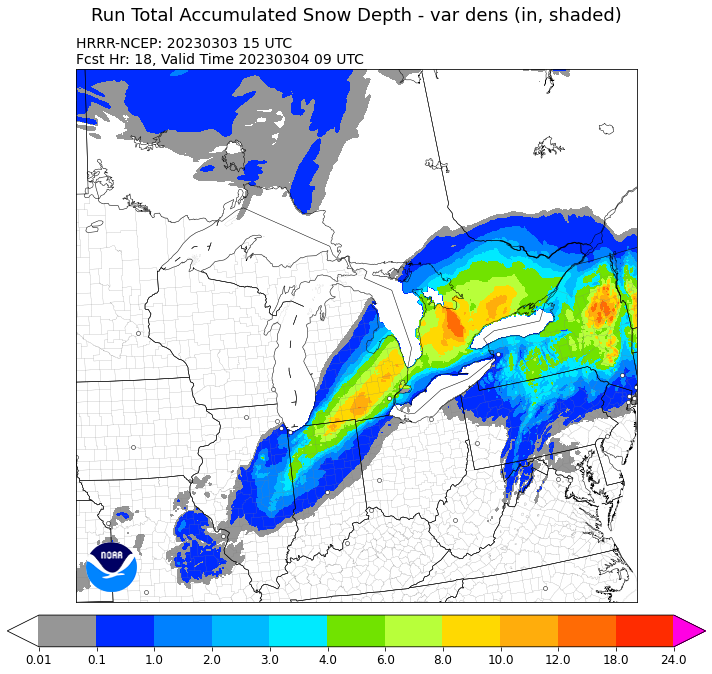
Was looking at the HRRR positive depth change, it did pretty well yesterday morning with the max swath (and maybe was just a tad too low on some on the fringes in eastern IL?). I thought the rates/QPF could support12”+ lollis where the band would pivot between N IN/SE MI/S ON (figured when rates were really heavy ratios would come up enough to allow for that kind of accumulation) but it seems like about 11” of concrete was the most anyone could muster.
-
Guessing it's mainly because their focus is on the severe wx in the Ohio/Tennessee Valleys as opposed to not expecting this/not thinking it's worth an MD.
-
I wouldn't have bet money on the 70mph gusts in IL on the north side of the low ahead of time either, but throwing out 50mph and hoping that holds when there was a pretty coherent hi-res signal for at least 60mph (with the HRRR consistently advertising the potential for 70+ exactly where it happened) is pretty blegh given the borderline rapid deepening and very anomalously low MSLP values...that were fairly well-advertised.



.png.b366c61686b02c73ed93e82f113057d3.png)
.png.8fefd73b07db4e0a6e0843d1507fbacb.png)