

OHweather
-
Posts
5,057 -
Joined
-
Last visited
Content Type
Profiles
Blogs
Forums
American Weather
Media Demo
Store
Gallery
Everything posted by OHweather
-
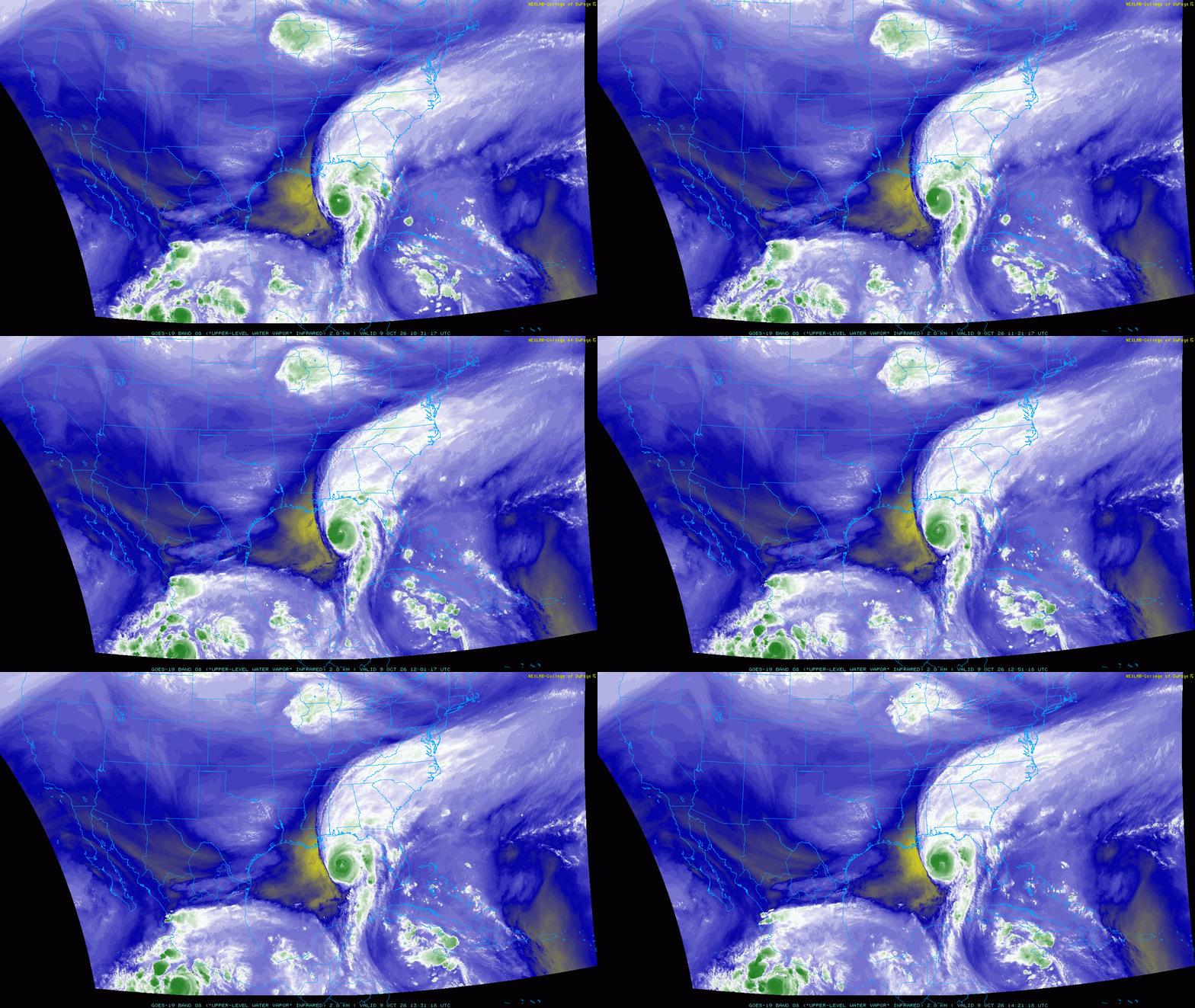
For all the talk of wind measurements with landfalls, I agree the measurements we got from Isaias were impressive and suggest it probably was in fact a low-end cat 2 around the time of landfall. Given how quickly it was weakening at that point it wouldn’t surprise me if it did weaken slightly more than the operationally estimated 90kt at landfall, but the eyewall was impacting the coast when it was at that intensity. I agree with some points raised here - the maximum sustained winds are not something people should expect to see at their location on land, and properly communicating that (while still maintaining the proper level of urgency) is important. Even if you’re not seeing the max sustained winds on land, hazards such as wind damage and surge are very much proportional to those max sustained winds. You won’t see cat 5 sustained winds away from the coast in a cat 5 eyewall, but it would still be destructive and no one would be quibbling over it. Would also like to mention that when storms are sampled by recon, there is a wide array of instrumentation measuring winds at/near the surface and aloft, with well-researched and established reduction factors to equate low-level winds to the surface winds in these storms. The NHC is not just making up the max sustained winds. I do agree with the sentiment that NHC can be slow to operationally reduce the winds in storms that are weakening as landfall approaches, but understand why they’re cautious with that.
-
What if…and hear me out on this…the highest sustained winds were over water at the time of landfall?
-
If you squint, maybe some sting jet type processes going on?
-
By definition the “maximum sustained wind” is going to occur over a very small area and is always going to be over water. This table literally proves nothing.
-
The pressure did just rise 13mb between the last two recon passes. Not enough time for it to make a huge difference but it’s starting to weaken pretty quickly now.
-
Agree that radar has suggested a partially open eyewall since late morning…perhaps my phrasing that the inner core has “held up” wasn’t the best way to put it as it hasn’t been able to close off an eyewall for several hours, but overall it’s been a pretty steady robust half eyewall on the northern side. I do think we are starting to see signs on radar of further degradation of the core, but the northern eyewall remains nasty and the most recent dropsonde suggested a ~957mb pressure…so the pressure isn’t rising yet and that eyewall is only 2 or so hours from affecting the coast. As the hurricane’s motion continues bending slightly left and a bit more into the increasing shear and as core starts interacting with the rather chilly/stable air getting pulled into the storm off of land I’m guessing the eyewall slowly degrades through landfall and rapidly falls apart as it pushes inland, though for practical purposes that won’t be enough to significantly change the impacts as landfall occurs. These interactions between shear and storms approaching landfall is fascinating and not the same from storm to storm as you said. I thought the hurricane and global models did a pretty good job of showing the pressure holding steady or falling until some point between 18-0z, before rising rapidly beginning near landfall later this evening. So the guidance seemed to resolve the more positive interaction we’ve seen through most of today before the negative factors finally overwhelm the storm tonight, though the timing of things changing even a few hours makes a difference so close to landfall. The HAFS models were too drastic with last minute weakening, but the HWRF and even Euro were more accurate in showing just some modest last minute weakening before landfall. I think that with Isaias, the storm motion paralleling the shear vector until very recently may have helped stave off its impacts by making it easier for convection to wrap around the up shear side of the storm. The very impressive upper-level divergence/outflow over very warm waters supported robust convection and deepening as well, so long as shear and dry air largely stayed out of the inner core. We’ve probably been near an equilibrium between the increasing shear and favorable thermodynamics/strong eyewall convection since late morning, with the scales gradually tipping towards weakening this evening but not fast enough to help anyone on the coast. In some of the storms you mentioned that weakened much more drastically before landfall, I wonder if an ERC coinciding with increasing shear led to more drastic weakening? An ERC can cause a cat 4 or 5 to weaken pretty notably even in a more favorable environment (at least temporarily)…Isaias didn’t undergo a true ERC at any point today, and I have to wonder if an ERC starting this morning or afternoon would have allowed for the storm to weaken more in the face of the increasing shear today.
-
Curious to see if they got a good dropsonde in the eastern eyewall where those FL winds were just measured…the eye sonde continued to support 959mb, but those FL winds could support 110-115kt.
-
Judging by radar, the shear is starting to impact the southwestern eyewall a bit more. At the moment convection in the northern and eastern eyewall is still quite robust and the inner core is holding up well. Per recon the pressure and winds have seemingly leveled off for a few hours now. I’m guessing we see a few more hours of relatively steady state intensity before shear and dry air start taking a more substantial toll on the inner core.
-
The models were pretty insistent that Isaias would be able to gradually deepen and improve structurally through most of the day today as long as it stays on a NNE heading, with shear and dry air likely to rapidly begin affecting the inner core in the last few hours before landfall as the storm's heading starts bending more towards the left/due north. The strong west-southwesterly shear and very dry mid-level air are definitely impinging on the core of Isaias this morning, but convection has continuously wrapped around the upshear side of the storm and is insolating the core from this unfavorable environment for now as a shortwave approaches from the west. With the storm over very warm waters and beneath enhanced upper-level divergence ahead of the shortwave it can continue to gradually intensify/deepen. With a very intense convective burst ongoing in the NW eyewall right now, we probably have one more burst of intensification into the afternoon. The shear will increase further in a few hours and the storm motion will become less parallel to the shear vector this evening, so it remains likely the unfavorable environment starts affecting the inner core as landfall approaches. Per the regional hurricane models the inner core may break down pretty quickly tonight right around the time of landfall, though with a bit more near-term intensification and only a few hours for the environment to negatively affect Isaias this evening before landfall my guess is landfall occurs with a peak wind between 90-100kt, with the wind field beginning to expand by then due to interaction with the incoming shortwave.
- 733 replies
-
- 13
-

-

-
Also saw some frost on the rooftops Tuesday morning, and leaves are starting to change. Some signs of the changing of the seasons...last winter was great with lots of WNW and NW flow.
-
Yeah, there definitely was some positive feedback over Lake Erie that night with the convection helping to develop a mesolow, which in turn then kept the convection relatively stationary and intense.
-
There have been a few of these massive downpours over Lake Erie during the summer months over the last several summers. It happens when the lake water is in the upper 70s/lower 80s and we get slow moving convection over the lake (usually at night). Put-In-Bay got 8-10” of rain and flooded one night in August 2023, and there have been a couple other times where I remember radar estimates of 10”+ over the open lake. This event was very high end and affected an island directly. There was significant flooding from 4-7” of rain (after 1-3” the day before) along the western Lake Erie shoreline on Monday from continued lake enhanced thunderstorms.
-
How large was it in your area? Definitely think there was some 2”+ diameter hail in SW Geauga around Bainbridge/Auburn, but wasn’t sure if the largest skirted south of you and DTA. Some pretty significant damage with it as you said and it was across a long swath from the southeastern suburbs and through northern Trumbull across OH and it continued into PA. We had roughly quarter sized at the office in Brooklyn Heights, the core of it missed us by a couple of miles which I was ok with!
-
We heard (and felt) the sonic boom from the meteor at the office in Brooklyn Heights, and then dealt with a barrage of phone calls and media requests that rivals a major severe weather event. What a day. Also saw some gnarly snow squalls today (and drove on some icy roads last night and this morning) as March does its thing. I believe that 85mph gust at Burke on Friday was the strongest gust measured at the site.
-
It’s always fun to guess if the low CLE measurements are real, or a product of “measurement difficulties” at an open airfield. In this case the snow was mainly upslope driven so they definitely got less, but it’s possible the measurement was still a little low there since it was pretty windy. I can say in Brooklyn Heights there was dramatically less snow than even 2-3 miles farther inland most of the day, it was pretty remarkable.
-
I had 3” during the day yesterday and a little over an inch more overnight. My total since Saturday night came out to 8.4”. In terms of counties needing warnings, it was really close in a few. The upslope definitely was more impressive than expected. The tricky aspect is the storm totals are impressive, but occurred between Saturday night and early Tuesday morning which is a very long duration. The heaviest snow was during the day yesterday and it was struggling to consistently cover main roads due to the higher sun angle for several hours. Still, some areas got over 8” and a <24 hour span which is getting to the point where it’s hard to look the other way. I’ll be looking closely at Medina and Geauga in particular…a few spots in Cuyahoga, Summit, and Erie Co PA were close to that as well, but Medina and Geauga seem most impressive overall.
-
The upslope has been performing quite well all day (arguably over performing). It’ll be confined to a narrow strip along the higher terrain from Medina to Geauga, but it seems like spots in there will come in with 6-9” type amounts. I got close to 3” overnight, pushing my storm total to 4” as of 7am. It’s been snowing pretty good at home all day, so I’m expecting to come home to over half a foot on the ground. Not a bad event, not really an impressive setup but the upslope is really pulling it out for the favored areas.
-
Had a bit under an inch here as of 10:30 AM, since then it's been snowing lightly at times but largely not accumulating. It looks like the best push of snow will be late tonight/Monday morning in the Cleveland area and NE OH snowbelt...west of Cleveland may see a half decent uptick late this evening, along with late tonight into Monday. Overall not the most exciting, but winter is back and the higher terrain/upslope areas should see snow add up to several inches by Monday night.
-
The squalls didn’t disappoint, at least where I’m at. Slept through a good portion of it, but it was nearly a whiteout when I looked outside and it looks like I’ve gotten 2-3” of new snow since 6pm.
-
There was definitely more freezing drizzle and less snow than hoped this morning. Upstream honestly looks a little underwhelming, but there’s still a bit of time for stuff to pick up before the front gets here.
-
Recently tallied up my seasonal snowfall, and I'm sitting at 67" to date. Last season, I had 68" all winter. Friday's system looks like a nice refresher of the snowpack. It's more of a lobe of the polar vortex than a regular clipper...there will be synoptic snow in the warm advection ahead of the system Friday morning and afternoon, which looks like a quick 1-3". The more dynamic portion will be Friday evening/night, when an Arctic front pushes through. That should bring a nice burst of lake-enhanced snow (looking at satellite, the ice is still somewhat lose and has cracks, so there should be a limited flux from the lake), along with rapidly falling temperatures and strong wind gusts. It'll only last a few hours, but conditions will be quite harsh along and just behind the front Friday evening. Some limited lake effect lingers Friday night into early Saturday. The snow Friday evening through early Saturday probably adds a variable accumulation of 1-4" to most of the area downwind of Lake Erie, pushing event totals into a 3-6" type range.
-
After getting a little over 7" of synoptic snow through Sunday evening, got a little over 3" of LES overnight Sunday night through Monday. Event total of 10.4". Today, had about a two hour period of light to moderate snow late morning, followed by two pretty decent snow squalls in the early evening. Another 2.2". What a stretch of cold and snow! Could use a little warm up soon though for sure!
-
The strongest lift was focused above the preferred dendritic growth zone (DGZ) for most of the storm…so flakes were forming in a part of the atmosphere that was too cold for good crystal growth. It seemed like there were bands of higher ratios across parts of NW OH, and then down towards central OH ENE towards YNG, with lower ratios in between. It’s not uncommon to get bands of higher/lower ratios based on where better banding sets up, and is not easy to predict ahead of time unfortunately.
-
The fluffy lake enhanced snow last night into this morning has been a nice bonus…I was a little over 7” for the synoptic snow, but was at a running total of 9.6” this morning after the overnight lake enhanced stuff. A few spots may add 2-4” of fluff today. The lake enhanced snow will make most of the totals look nicer in the metro area.
-
1/24-1/25 Major Winter Storm - S. IL, IN, and OH
OHweather replied to A-L-E-K's topic in Lakes/Ohio Valley
Fluffy/efficient lake effect processes occurring beneath/within a broader synoptic snow are basically magic in terms of getting good snow, but it’s rarely organized into a firehose like what’s been going into Toronto.