
NittanyWx
-
Posts
793 -
Joined
-
Last visited
Content Type
Profiles
Blogs
Forums
American Weather
Media Demo
Store
Gallery
Everything posted by NittanyWx
-
You may have found a universally acceptable definition of persistence. Edit: card carrying member of #TeamWCanFirst
-
I suspect you will end up finding progression here in these VP anomalies as well. Particularly as the IOD has collapsed and there's a smoothing of ocean temperature anomalies between WIO and EIO.
-
This was a fun debate earlier in December.
-
Source region remains an inhibitor to anything other than transient early January cool shots surrounded by warmth. Keeping a side eye on the Jan 5-7 window in the event this low amps a bit more, but outside of that 'know your source' remains quite prudent. Looking bigger picture, seeing signs of the erosion of Pac air upstream into W Canada deeper into Jan. Should be less hostile then. But as far as this early Jan period goes, the book was written early. A modest h5 improvement, but lack of source air first week.
-
The GFS Ens is going to again beat the EC Ens in this post-Christmas period. Both will end up too cold.
-
I think this was well telegraphed personally. In years where you 'got out of it' after a very mild start, this was normally the step change observed.
-
Thoughts today: The lack of source region remains a barrier to significant cold despite h5 improvements. As such, first 5 days of Jan should average above normal before a transient cooler period 5-7th. Think the risk is cold air overdone by modeling in extended range and HP rolls forward less intense due to lack of snowcover and Pacific air contributing to that issue. Locally, we'd need to thread a needle for a significant snow and you only have a couple windows where I see that as possible early January. As I've said several times now, source is still vitally important. And we are in an improved h5 pattern with marginal source region through the first 7 days of Jan. That's not a death sentence for snow, but margin of error is slim. First period of interest would be Jan 5-7 range as some HP in Canada and a wave in the southern stream moving northward. I flagged this as a period of potential interest last week and thoughts haven't changed on it. Old adage is 'WAA waits for no man' but this is a situation where if you can avoid a coastal bomb you could get an overrunning situation into NE Canadian high pressure if the cards on the table lay out properly. Several things need to go right, theyre not all 'right' as of today, but that may change. Big picture, thinking this is a multi step process moving forward whereby the upper level pattern shift will be most notable during the Jan 8-15 window as we scour out some Pac air in North America, TPV retrograde westward (slowly), PNA drops and EPO rises. That should, in theory, start the process of allowing for some carpet to be laid in the Canadian prairies and upper Midwest later in the month. It's not brutally cold, but it's a way to begin to scour some of the much above normal temps in time. It'll be stormy, but mild here I think during that second week of Jan. Could have some much above normal temp days. Could you see something in that window of transition? Perhaps, but again need several things to go right and big coastals are a no go for snow here in this window. I expect polar regions to be less hostile heading into mid-late month, but the Pac still hostile for the bulk of early Jan. That brings us to the MLK weekend whereby you're looking for some of this cooler air to potentially migrate S/E ward as PNA rises and board resets towards more traditional Nino with potentially some blocking. Maybe. I think you've got a lot more reasons to be optimistic after MLK than before, with the caveat that you'd hope the Pac jet isn't as hostile as it has been if you're a snow lover. As an aside, I'm not considering any potential Strato interaction on this pattern until perhaps February, if at all. I just view any potential 'help' there as supportive of blocking and not necessarily supporting a Pac change.
-
MJO shouldn't be weenied for this one. He's right that most are calling for a warming event and potential split. It does look valid and will qualify as an SSW event in all likelihood. What will be overhyped is the correlation between SSW and t2m in the east. SSW events are essentially a correlation of a correlation to 2m temps. SSW inducrd PV displacement and splits are correlated to periods of more blocking which is correlated to colder temps in the mid latitudes of varying intensity and regionally/unevenly distributed. That correlation to temperatures is mostly 3-4 weeks after event. So this would in theory increase colder odds for the mid latitudes in February. But that doesn't necessarily mean colder in the northeast. It might, but it's not guaranteed. Historically splits work better for NA in analogs....but theres a huge caveat that the pac jet will need to relax and the EPO will need to be way less positive that it is right now. In short, its a situation where one of the factors we track in the weather becomes less hostile in theory to cold in the mid-latitudes. That said, we don't live at 10-50mb level, so it's one piece of a large puzzle.
-
Not enough cold air to tap into
-
I think we have different definitions of excited
-
For what it's worth, these models have no real E Canadian HP signal until very briefly around the 5th. So if we were to get any storm ahead of that, regardless if it's a lake cutter or not, you'd have a big issue with cold air supply. If you were to get some energy out of the southern stream around then while that high is retreating, there's a small potential window around than Jan 4-6. As noted, however, I tend to think in regimes like this where h5 is favorable but source air is not, risk is HP/cold air associated with it gets overdone extended range.
-
The NAO difference is actually fairly marginal. Synoptically most have a piece of the PV near or just north of the Davis Strait. There's no real Atlantic block of note in the traditional sense, just heights building Iceland/E of Greenland which is of little significance to us.
-
The IOD seasonal collapse is consistent with past years. Even high amplitude IOD patterns collapse by the New Year almost without fail. So, in time, the jet will retract and there will be a retrograding PNA area ridge setting up. At that point with PV consolidation you'd hope that some form of wave breaking can perturb the PV and displace it towards this side of the pole for deeper into January to at least provide some chill to tap into and perhaps start building some snowpack in Canada in due time. Until that source is resolved how I view these setups for snow: HP/cold will likely be overdone on modeling without a true snowpack build in the extended range. So, generally, less is more when it'll come to coastals if/until this source airmass problem is resolved. Deepening coastals will likely be primarily rain producers where overrunning events or even clippers have the better potential to deliver wintery results.
-
Just a note that the GFS Ens has been posting higher skill scores in the 6-10 at 2m and suspect the EC Ens surface reflections will end up a couple degrees too cold. Sadly even the GFS Op has had less of a cold bias past 3 weeks. That said, do believe the base state is changing from December. Not a great source region still, but not as dire as late Dec.
-
Ok, get what you're saying now. Only reason I'm kinda hammering on this tropical forcing vs model T2m point is because I think it was a situation, and clear a clear one at that, that we can learn from as forecasters and apply to future predictions. Multi-faceted signal that - even in a situation where tropics were underamped - the model was still able to lead you to a place where you'd be happy going warm to very warm week 3/4.
-
You do follow Joe. I know because he tweeted almost verbatim what you wrote. I do not follow Greta Thunberg because she isn't a forecaster or really relevant at all to what I do.
-
You're ascribing PV displacement to what? Just the tropics? Because I vehemently disagree with that idea if you are. You've got 3 of the factors covered, but saying 'MJO inherent biases' is still a misread on the situation. Because the 'MJO inherent biases' were part of that weekly EC ens first week of Dec...and the model still went torch...and we still ended up in a torch nationally.
-
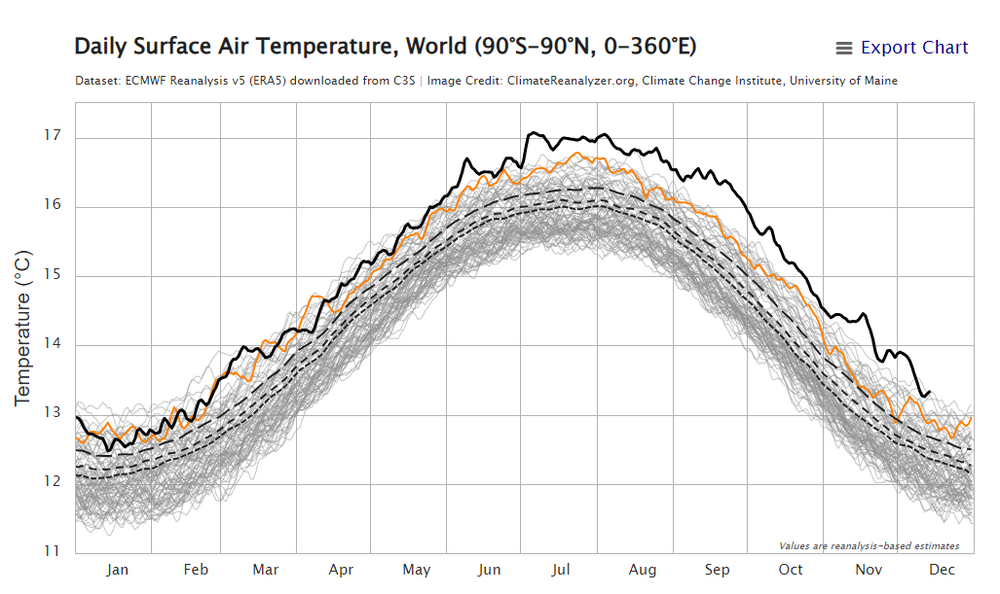
Bro is a comedy act. In commodities (where I work) we have people taking positions on buying/selling nat gas on the basis of the weather forecast, production and implied demand. Those people who sold this market with the view of the weather being bearish this month are pretty happy. Those who bought it are pretty unhappy. Trading is capitalism. Weather trading is capitalism. The beautiful thing about these markets is they tell you who's right and who's wrong. And you, my friend, would be broke if you tried to trade off your politics. Weather knows no politics, it just is. And this year, it just is the warmest we've had in our climatic record on a global basis (aka 1850). And that includes cold China in case you're wondering. Anyway, back to dissecting late Dec forecast busts.
-
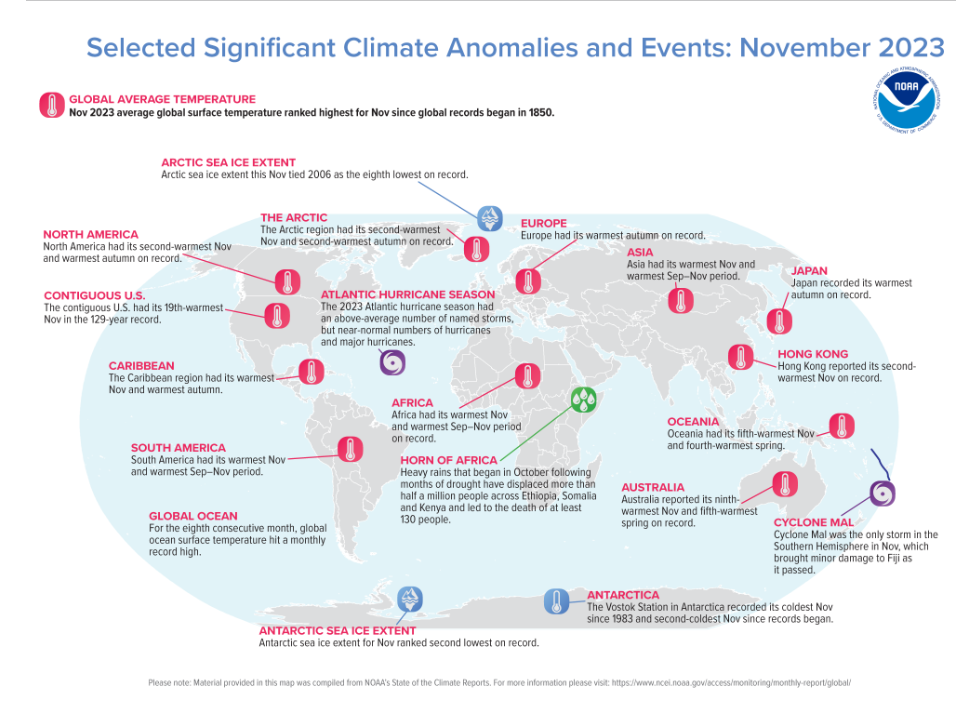
Believe it or not, I'm capable of being able to see the globe. Because I forecast for...the globe. I forecast for 4 continents. Germany is not in a monthlong cold spell shattering records. Berlin is +10 anomaly today lol. Did you know Brazil is locked in it's hottest and also many areas driest Novy-Dec on record? I can cherrypick data too. The good news is we have a tool to determine how EVERYTHING is performing at a given time. Joe's a book salesman now. All his energy clients left him because he kept forecasting too cold. He went from widely followed in 2010 to little more than noise.
-
Someone's been following Joe Bastardi on twitter. You gonna blame underwater volcanoes next?
-
Honest question...did you read what I wrote? I laid out a multifactor reason for why this is warm. I've repeated it about 5 times over the course of the month and never once mentioned 'oversimplified El Nino', so not sure why I'm being quoted with that lexicon. Yes, background warming plays an issue too, but how much of that +10 you want to ascribe to that is anyone's guess. +1F? +2.5F? I honestly don't know. What I have said, and will continue to say, is that the EC weeklies gave you a very, very warm signal for end Dec, have been consistent with it since the first week of the month, and a lot of folks dismissed it for reasons relating to 'well MJO 8 is a colder phase and that'll solve it'. The Hovvies show you that VP200 progression alone is not enough to solve a problem. Even if you believe that the weeklies were underdamped (welcome to ensemble forecasting), you still had a massive, massive warm signal staring you in the face with a high degree of conviction. So even if it really did miss on amplifying p7, it STILL verified very close to final outcome. What does that tell you? It tells you that there were a confluence of factors...about 5 of them...as I'm now saying the 4th time...that led you this way. Tldr; the data was there to go very warm. People thought they could outperform the model at T2m and got smoked on it. We can call it what it is.
-
For the record, these were the temp anomalies shown for this Christmas week during the first week of December: and current (yes, I know shorter time horizon): If you had copy/pasted EC Weeklies as a forecaster, you feel pretty damn good about how this turned out. Rare that you get modeling in that strong of a conviction aligned with the seasonal work.
-
This is why these tools aren't meant to be viewed in isolation, there are more tools at your disposal than that. I did use a stratospheric signal, however, in conjunction with a view that PV displacement into Siberia would cause a significant source region issue for the month across the continent. When you overlaid that with December Nino analogs and an ongoing tropical forcing signal which argued dominant forcing in a bad place you had about 5 different factors pointing very warm into the continental US. I see what's put out on weather twitter, I see what gets put out by vendors...I see a lot of folks blaming the MJO and I don't think that's right in this case. I think it was forecasters underweighting other signals in lieu of overweighting MJO phase progression. For the life of me I don't understand sometimes the obsession with the tropical space as the answer to all. In this case, it wasn't. You had VP progression, you had some h5 response and....you still didn't have a source region. The reason you didn't have a source region is a combination of about 3 or 4 different things happening at the same time.
-
I boil the late Dec cold misses from a lot of folks down to an error in analyzing source region, not an error in model diagnosis of MJO. Yes the MJO 'signal' as it were lost some steam as it rolled forward, which may have tripped people up. But those weeklies, even with that h5 look were still very warm and will verify pretty well considering lead time.
-
I'm very aware of how amplified the signal was...which is why I don't use the RMM's operationally. I think they're perhaps the worst way to illustrate tropical forcing to a forecaster. The reason VP was amplified is due to the strongly anomlous ENSO 4' SSTs yes, but there was also a traversing Kelvin Wave in the region which is and was clearly identifiable. Also had a couple of SHEM cyclones spawn out of that pattern. My point is that during the month forcing did shift east, h5 pattern had the appearance of more favorable for cold, but source region was still not conducive for colder conditions. I understand a lot of folks want to boil weather down to one single element causing a forecast miss. The MJO component wasn't as badly forecasted as you think. And the PV displacement had an absolutely crucial role to play in this moment, particularly as VP200 signature improved.