


Stormchaserchuck1
-
Posts
4,687 -
Joined
-
Last visited
Content Type
Profiles
Blogs
Forums
American Weather
Media Demo
Store
Gallery
Everything posted by Stormchaserchuck1
-

El Nino 2023-2024
Stormchaserchuck1 replied to George001's topic in Weather Forecasting and Discussion
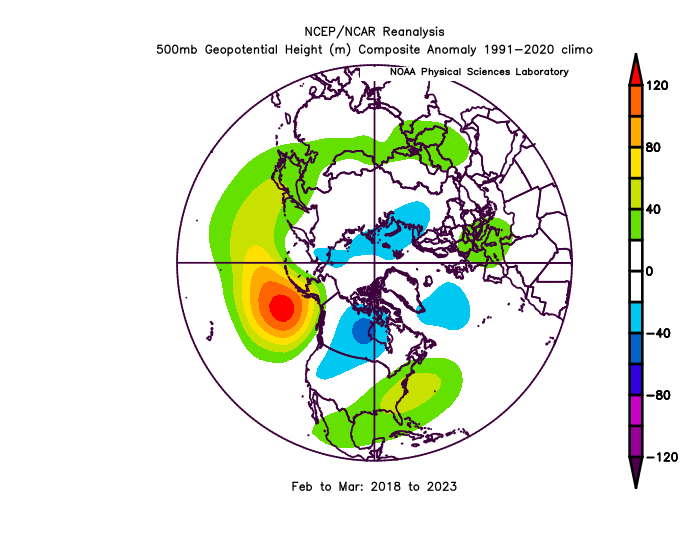
Very interesting that, that's when the N. Pacific High has been fluxing: This 7-year trend now, is record breaking ('64-69 -NAO comes in 2nd, at 80% of the anomaly). 2-months including March is also record breaking for a 6/7 year stretch.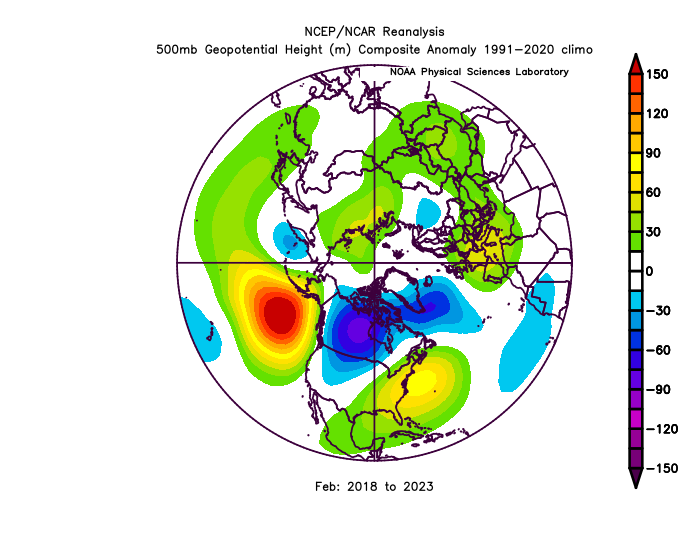
-
Late Feb/March Medium/Long Range Discussion
Stormchaserchuck1 replied to WinterWxLuvr's topic in Mid Atlantic
Yeah, PDO's usually go in the direction of ENSO state like 85% of the time. Another thing too is, this La Nina is already heavily supporting -PNA.. Since the subsurface cooled, and the SOI flipped, this new High pressure pattern took over in the N. Pacific. so if that trend continues through the Spring and Summer, which I think it will, the PDO should drop further. -
The crazy thing about this map and us being the 3rd warmest is, it looks like it's a -AO pattern! It was once theorized that AO was our #1 pattern for warm and cold, but there have been some warm -AO's the last few Winters.. I think the key these days is more on the Pacific side. The circulation between the Poles and the mid-latitudes seems to have quieted down some.. it's more about having more low pressures around the Earth at your latitude.
-
The thing about the expanded Hadley Cell is, what's causing it? For the Hadley cell to expand, another cell has to contract. You could say that the +AMO and -PDO favor more mid-latitude High pressures. I also think it could come from more La Nina patterns that we have seen (almost 2:1), since sunspots started quieting down in the 1990s? In global warming, the poles are hit the hardest, but it seems like a La Nina pattern to me. That doesn't mean general warming still isn't occurring.. it is, and actually, almost exponentially.
-
Here is what I accidentaly posted in the long range thread.. I left it there because PSUhoffman replied quoting it. I think the reason for less clippers and Miller A's is lack of +PNA, although even when that pattern is present, those two storm types are happening about 30% less of the time. Basically.. I don't have a good answer for you. The pattern has been more zonal, vs major troughs.. now, the -PNA that we have seen since 1998 and then 3x more since 2016 is a real anomaly, and not a product of global warming.
-
We had a minor 10mb warming Feb 15-23 The estimated time to impact, March 3-10, looks very warm on current models in the Eastern, US (No +NAO though, it's because of +EPO/-PNA). We may get cold shots in the West during that time. This was our 3rd 10mb warming event of the Winter season. I believe models were showing a 4th warming event starting after ~March 5.
.gif.3de8112b7c845eb6c09b3a07154caeb9.gif)
-
Late Feb/March Medium/Long Range Discussion
Stormchaserchuck1 replied to WinterWxLuvr's topic in Mid Atlantic
Oops.. I meant to post it in the other thread. Oh well, might as well say that until that trough moves from Alaska, we will be in the 50s and 60s. Good news is LR models haven't been great this year. -
Late Feb/March Medium/Long Range Discussion
Stormchaserchuck1 replied to WinterWxLuvr's topic in Mid Atlantic
I think the reason for less clippers and Miller A's is lack of +PNA, although even when that pattern is present, those two storm types are happening about 30% less of the time. -
+EPO/+WPO floods the surface CONUS with warm air. The number 2 on record, I think? 01-02, had a similar pattern. https://ibb.co/VLCJDVG We are also shattering previous records for global temperature, the chart is starting to move more exponential.
-
lol.. you guys.. Raleigh, NC is going to go 1000 days without any snow, no flurries, nothing. Richmond hasn't snowed in 2 years.
-
There's a really strong 10mb correlation with -QBO/Stronger Nino and +QBO/Stronger Nina.. but that's about as far as that goes. QBO is an upper atmosphere wind index.
-
2024-2025 La Nina
Stormchaserchuck1 replied to George001's topic in Weather Forecasting and Discussion
For the next 2 weeks, there is an impressive High pressure setting up in the N. Pacific Ocean. The strength is going to rival some of the strongest on record. This pattern started, imo, when the cold water moved into the central-ENSO-subsurface. The SOI being super negative was holding the pattern back for a while, but when that moderated, the major pattern moved into the N. Pacific Ocean. It seems to be super-connected to the La Nina early, so I don't see why that wouldn't last through the event, and maybe even with such a strong correlation that it holds the strength of the coming La Nina down some. With the 500mb conditions in the N. Pacific that have occurred Feb-March 2018-2024, breaking high anomaly records in other times by +20-25%, it's easy to formulate that we are at the peak of this "global La Nina cycle", or some are calling it the -PDO, or +AMO. The -PNA pattern held in the Summer/Fall through a lot of the Strong El Nino last year, breaking the strong-ENSO correlation we had, had for many decades, so it will be interesting to see what happens going back to the opposite ENSO state this year. La Nina's have been hitting on N. Pacific pattern correlation, El Nino's have not been. -
Lol, yeah, we have a really hot Summertime pattern setting up now. It's connected to the La Nina early, so my thoughts is it will continue if the La Nina does continue to develop.
-
2024-2025 La Nina
Stormchaserchuck1 replied to George001's topic in Weather Forecasting and Discussion
Better start breeding those butterflies in Africa. -
Late Feb/March Medium/Long Range Discussion
Stormchaserchuck1 replied to WinterWxLuvr's topic in Mid Atlantic
The surface is very warm in that pattern.. warmer than 500mb implies. Here's the March correlation (opposite).gif.e12621d00857ac5725966149d6ad2918.gif)
.gif.7d49d171e69db995a2e2554bf50641f0.gif)
-
Late Feb/March Medium/Long Range Discussion
Stormchaserchuck1 replied to WinterWxLuvr's topic in Mid Atlantic
GFS ensembles trended warmer today.. On March 3-4 on the 12z GEFS, the 570dm line goes north of Toronto! The big difference is the NAO-domain.. yesterday they were showing signs of blocking in the long range.. today, there is +NAO in the medium range, and neutral in the long range.. Agrees with my Natural Gas analogs, which I posted about yesterday. -
The PDO actually has a high correlation with the EPO-WPO (even with lead time) Here's a post
-
I think you underestimate the EPO/WPO.. when they are +, they are some of our worst Winters. Yeah, -PNA's can be wet.. but precip plus temps in EPO patterns is the highest of all patterns (+snow), by a pretty good margin! I said before 1 reason they didn't show up in your research, is because the average cycle of a flux there is 7-12 days at a time, The PNA and NAO regions last much longer (can go 30-40+ days, which makes them more visible).
-
The differences between weak and stronger ENSO events, are because there's more happening all the time than just ENSO. A small sample size gives skewed results because of coincidence, or it lining up with other factors. Weak Nina's were always cold in the composite, until a few years ago, when they started to go warm. If it's a modoki Nino, the stronger the better... you will say, well, 91-92, but that's a total of 0/1 all time.. I think we want forcing out of the western-ENSO regions to amplify above it a +PNA and maybe -EPO.
-
I don't think it was a true disaster because we had 4 Stratosphere warmings (if you include the one projected to come in March). The QBO does not effect the surface directly, all of its linear correlations are weak. It's an upper atmosphere oscillation. I did pick the -QBO/Nino, and record global precipitation in the Fall to have high totals in the snowfall forecast. I did not really think we would be that cold, but I thought our opportune times (When -NAO's came in El Nino) could give us big storms (in contests you do not want to not be near the majority). I underestimated the effect of the PDO, and that the global pattern is very stagnant right now (High pressure systems).
-
Late Feb/March Medium/Long Range Discussion
Stormchaserchuck1 replied to WinterWxLuvr's topic in Mid Atlantic
Because models had been showing that for a while, I think it was already factored into the price. The Natural Gas market was jumping way before these models came within range. I think there was always potential for a near average mid-late March, and in my opinion that's what the move today was about.. Again though, long range weather forecasting methods should be able to beat that, ideally, or normally... that's the challenge given lol -
Late Feb/March Medium/Long Range Discussion
Stormchaserchuck1 replied to WinterWxLuvr's topic in Mid Atlantic
I would say the can was kicked today.. Natural Gas fell 8%, I've found a high correlation with March above average temperatures in the NE. There does seem to be a lot pointing to a -NAO though, I think if the -PNA sustains past March 10th, a -NAO will develop with it. 12z GEFS has a nice west-based -NAO starting around the 8th, but let's see if that holds.. -
Late Feb/March Medium/Long Range Discussion
Stormchaserchuck1 replied to WinterWxLuvr's topic in Mid Atlantic
12z GEFS has the Aleutian High pressure going strong at 384hr, Alaska trough too.. no signs of a pattern change in the Pacific. -
El Nino 2023-2024
Stormchaserchuck1 replied to George001's topic in Weather Forecasting and Discussion
After the next few weeks, the Pacific is going to look nothing like that. You underestimated the PDO. You'll score really high in the Atlantic. -
Late Feb/March Medium/Long Range Discussion
Stormchaserchuck1 replied to WinterWxLuvr's topic in Mid Atlantic
I don't mind having troughs digging into the SW, US, to be honest. That sets us up for future Winters. I made a prediction a long time ago The warmth has actually gone extreme in the last 2 Winters, so I think we have knocked a good amount of this "5 year variable" out, although I still wouldn't be surprised if the average of the next 3 Winters is above average in the same area. I found on micro and macro-scales, pressure in the SW leads us.

