Volcanic Winter
-
Posts
1,674 -
Joined
-
Last visited
Content Type
Profiles
Blogs
Forums
American Weather
Media Demo
Store
Gallery
Everything posted by Volcanic Winter
-
That’s the event I’m craving, a nice coastal northeast nuke. 6-10 would do nicely if something like that were in the cards. Doesn’t have to be a HECS. Let’s just get a nice broad untainted hit. Would be fun to track and then experience, and lift a lot of spirits. Hopefully something like that is plausibly in the pipeline for that mid - late month window. Would be yet another waste of a pattern and ultimately a waste of the Niño if not.
-
 The Younger Dryas Impact Hypothesis is sobering because about 12kya we were probably close to an extinction level event (large comet airburst and fell as fragments instead of intact), but that theory is very contentious and isn’t necessary to explain the YD as a climate excursion. Still, it’s crazy to think about even just as a thought exercise. From the evidence I saw personally, I do think something fell around that timeframe, though it may not have been quite as large as the hypothesis puts forward and I don’t believe it caused the YD - perhaps was responsible for a wonky several year pulse within it if anything. Tunguska was about 40m of diameter away from being a landfalling superbolide, supposedly they’re more likely to stay together at the 100m diameter mark. It also caused a monstrously powerful explosion that had some level of ignition in the immediate locale, along with a flash that was capable of blinding people who were unfortunate enough not to look away in time. Fortunately it fell in a very remote section of Siberia (actually fell on one of the main outcrops of Siberian Traps flood basalt). I agree that impact events of small to moderate size are really not as rare as we tend to think they are, and many of the 1km+ events are likely hidden by ocean impacts (hypothetical Shiva crater comes to mind). Just not something we can expect on human timescales, yet we had Chelyabinsk in 2013 which was a substantial 20m airburst. And Tunguska close to merely one lifetime earlier at 60m. These are events that could cause major damage were they to occur over a city, especially at Tunguska size. Apparently they (Tunguska class) may recur roughly every 200-2000 years, difficult to know for sure. That’s certainly not that rare for a potential city catastrophe. Also the Eocene was notable for having many 1km+ impacts IIRC. Yeah idk, this stuff is fascinating. I too wonder how many impacts we simply are unaware of due to the location of impact. We only recently discovered the Chesapeake impact event 33mya, and that was a big one. Nobody on the east coast would’ve enjoyed that one. And the area today is shaped the way it is because of that impact.
 -
It was a Flop... February 2024 Disco. Thread
Volcanic Winter replied to Prismshine Productions's topic in New England
I have 7 inches on the season down here which thankfully makes it a meaningful improvement on last year (), but I’m very much looking forward to a 4-5 day getaway to VT/NH with my wife for my bday in a couple weeks, get into some real snow and do some snowshoeing. I haven’t been to NNE since I was a kid, so I’m very much looking forward to heading up that way. With that said, really hoping something comes together the latter half of Feb at least. Good luck guys . -
Good post, but just would offer the perspective that the Permian Great Dying happened across many millennia whereas Chicxulub happened on a single day (with respect to the primary forcing element). Two different processes, one acute and one chronic. Both were catastrophic though. Life is lucky to have survived the Permian though, earth was close to sterilized.
-
@LibertyBell This is a spectacular summary of the Chicxulub impact and what we know about it. I’ve read through this several times and still always come back to it. Keep clicking through to each page as you get to the bottom (the formatting is a little not obvious). https://www.lpi.usra.edu/science/kring/Chicxulub/regional-effects/
-
Btw, Chicxulub was believed to have caused magnitude 10+ earthquakes that persisted for months. Whatever dinosaurs survived the thermal radiation spreading through the troposphere immediately following the impact would’ve had a very bad time. Impact events of that size are mind breaking. Genuinely can’t even imagine what it would’ve been like be alive the day it hit. Likely, wouldn’t be alive for very long, but I’d still love to see the show for however long I could.
-
The more you learn about the earth, geological processes, and all of the extinction events throughout geologic time, the crazier and crazier it becomes that we’re here at all. We wouldn’t be if not for that single asteroid impact to end the Cretaceous; whatever life would look like today, it wouldn’t be “us” as we know it. Perhaps “we’d” be some bipedal, large brained offshoot of therapods, but in the same token dinosaurs ruled for over a hundred million years and there wasn’t exactly tremendous evolutionary pressure for them to evolve hyper intelligence. Who knows? The fact that we owe our existence to an extremely low probability catastrophically large impact event (10-15km wide, insane) that just happened to hit during the Deccan Traps flood basalt eruption (the combination all but ensuring a global reset to the biosphere) is just an incomprehensible level of chance. And that’s only one component that paved the way for our existence… The more I learn the more I agree that if life is common out there, it’s far more common within relatively stable planetary oceans like what exists on Europa, than on an open air rocky body with active plate tectonics. It seems easier for life to proliferate unharmed in that environment, though it would be very different to life on earth. Or would it resemble aquatic life as we know it, especially abyssal lifeforms? I sure as hell want to find out within my lifetime.
-
The… North Pole?
-
Asteroids, yes. Comparatively little involved when you’re talking about crashing an expendable craft into an asteroid to slightly bump it off course. The whole reason it works is because even large asteroids need merely a slight adjustment to their course to no longer threaten an impact, the precision of orbital trajectories is so high for something to actually hit the earth comparatively little is required to make them miss. But earthquakes and volcanism? Eh, not for a very, very long time IMHO. The sheer scale and forces involved suggests a task that’s well beyond our capabilities, and I’m not really sure what would move the needle there enough to ever really be a plausible thing we’re capable of. The earth is powerful, man. Consider something like Yellowstone. It has a massive, stale rhyolitic magma chamber that exists as a sort of “crystal mush” with a low percentage of fluidized magma. What would then change that into an eruptable state is an injection of hot, fresh, basalt from deep below into the asthenosphere. That then begins the process of re-melting the rhyolitic mush and can ultimately lead to a very quick, and very enormous instability that leads to an eruption. The forces involved here are almost beyond comprehension (heat, pressure, etc). I don’t have the foggiest idea how we would realistically halt or block that process. Perhaps in much smaller systems first, but I would suggest that’s a long way away, realistically - if it’s even plausible. The same applies to earthquakes. Take a subduction zone where the continental slab is riding over an oceanic plate, and is slowly being bent backward building up absurd levels of strain over time. That eventually has to snap and yield a megathrust quake, how would we even conceivably stop that without shutting down plate tectonics? Plates move a couple to a few centimeters a year, and the byproduct of that movement (force by way of strain) is probably not something we could ever circumvent IMHO.
-
Human activity is mimicking the powerful natural atmospheric changes brought on by the largest flood basalt eruptions. Look up the Siberian Traps which ushered in the Permian Mass Extinction and came very close to sterilizing the planet. This occurred due to absolutely monstrous CO2 gas release sustained over many thousands of years, as these eruptions are beyond any human comprehension. They dwarf VEI 8 explosive eruptions like Yellowstone (last was 1,000-1,500 cubic kilometers of volume). Flood basalt eruptions are 100,000+ cubic kilometers, sustaining at an enormously high yearly rate of effusion. They’re major players of global climate change and are often responsible for some of the warmest excursions our planet has seen. The earth has “tools” to recover from these excursions, but they too take many, many millennia in order to scrub CO2 and bring global temps back down. I can only say continuing mass deforestation is catastrophically short sighted on our part, and couldn’t be more antithetical to what we should be doing right now. I understand all the ways modern society depends on lumber, but we need to figure it out - fast. The earth hasn’t seen a flood basalt event since the Columbia River Basalts about 16mya, and as you can probably tell they’re extremely rare from a human perspective. They’re believed to often be the birth of a new hotspot as an enormous mantle plume pushes toward the surface and forces out spectacular amounts of freshly melted magma as the plume pushes into the crust. And with all that melted rock comes all that exsolved gas, CO2 chief among them. And yes, the hotspot that caused the CRB in the PNW is very likely the hotspot powering Yellowstone presently, albeit in a reduced capacity. Human activity is mimicking a flood basalt event, except at an even more rapid rate. They take thousands of years generally to have the kind of impact we’ve seen in a hundred. Short of catastrophic instantaneous events like asteroid impacts, we have to be the fastest instance of major climate change in the geologic record.
-
I just got heat stroke imagining your comment. Too funny how people differ, I don’t run but only hike below 60 degrees. Anything warmer I get on the treadmill. Nov to April is my hiking season, lol. To be fair I’m way different from most and probably a bit mad, but yeah!
-
This one was frustrating, I had nothing but virga. Did nicely a few days later with the rest of you though.
-
Those temps are obscene. Also, I don’t begrudge people for their preferences and absolutely respect them. But I don’t want 60 degree weather here in winter, ever. It’s just wrong, unseasonable, and actually truly makes me depressed. So yes, it’s dreary and chilly and wet which sucks, but I’ll still take it over whatever the hell DC is getting right now. I always look at it, too, like this; we have warmth, heat, and humidity to contend with almost all year these days. We don’t need warmth in the winter, because even having said that we still often get it anyway, and unfortunately often at the worst times (bad air masses ruining snow chances, etc). We often say “it just needs to be cold enough to snow,” and yeah, isn’t that the crux of it? Unfortunately the last few years, it simply hasn’t been for many events that rained throughout almost the whole Metro. Give me the cold, always. I’ve mentioned this before but didn’t @bluewavepost last year that for NYC, seasonal snow totals correlated to DJF average temperatures, to a point? And that the higher the average got above 35 or 36, the lower the seasonal snow totals? So I never cheer on warmth here in the winter, personally.
-
Crazy!! I’m at 48 currently.
-
“Did you know you were going 36 in a 35 and that I punched six holes through my bathroom wall this morning to commemorate NYC’s epic snow drought???!” “Go ahead and tell me what you were doing on the night of NYC’s last 6 inch+ snow event?”
-
Stockpile of rapid antigen tests. Both my wife and I work with the public and are constantly around lots of people, so over the course of the pandemic we frequently tested one another. They work pretty well, I’ve seen some likely false negatives but they usually correct with further testing. Just good to know what you have, when possible.
-
Thank you, and thank you @donsutherland1. I really hope you recover swiftly as well, I know how miserable it can be! The last time I had it, I had a 101-103 fever for about 8-9 days. Awful. Yeah, I’ve actually been up all night this evening due to the extreme discomfort of the congestion I have right now. My nose is like a blockade that won’t let a single molecule of air through, and that always triggers a sort of anxiety in me that makes sleep difficult to impossible. On the bright side my cough has been improving and along with it, the chest pain. Just gotta ride it out. COVID is extremely unpleasant, as is the flu or any other similar hard hitting virus.
-
Ugh. I think I have COVID again, luckily haven’t had it in like 18 months. But I’m fairly sure I have it right now, deep chesty cough with a lot of pain. Feel like el crapola. Time for some movies and video games .
-
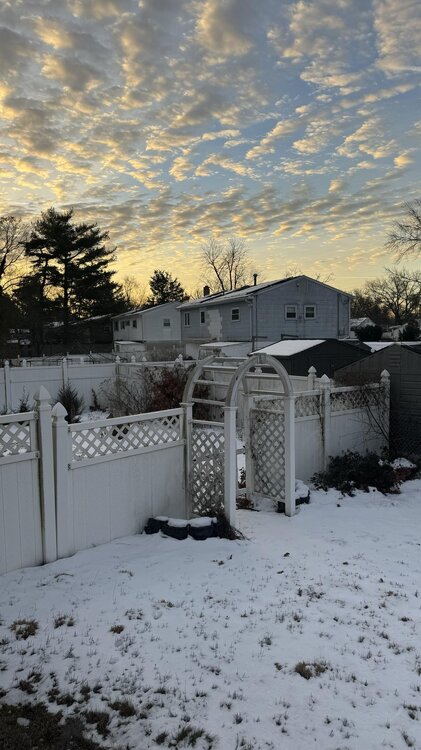
Beautiful morning
-
Yes! I’ve seen eruptions computed into joules and compared to earthquakes, but that kind of mathematics is far beyond me. It’s possible though, and I’ve seen multiple eruptions compared to earthquake energy releases (and nuclear events like Tsar Bomba).
-
Toba Catastrophy Theory. The Toba eruption 75kya was 3-5x larger than the most recent Yellowstone supereruption. It was as big as 5000 cubic kilometers of erupted material which is mind boggling. For reference, Mt St Helens was about 1.2 cubic kilometers of erupted material and a low end VEI 5. If you want to know why I have such a burning interest in volcanology, the scale we’re talking about here is precisely the reason. It’s beyond comprehension and not even really all that long ago, 75kya is geologically last week. Events of similar magnitude will occur again, though of course not likely tomorrow. With that said, the genetic bottleneck component is disputed. There’s absolutely no doubt an eruption that monstrously large would’ve had a huge climate impact, however it’s not always that simple. There is evidence that Toba erupted huge (I mean HUGE) lava fountains around the circular caldera ring fault and then the primary ash column would’ve been something called a co-ignimbrite plume. This is sort of a secondary eruption column that follows a less explosive episode and creates strong thermal updrafts that lofts material high, but not quite as high as a primary explosive (plinian) sequence. Semeru had an eruption a couple years ago that demonstrated co-ignimbrite plumes well. Long story short, it may not have had as enormous an impact as the volume alone would suggest as climate disrupting gases may not have completely and consistently reached the stratosphere. We don’t really know for sure, but this is plausible. It definitely caused a volcanic winter don’t mistake me, I’m just speaking about the absolute magnitude of the event. The evidence against comes from a lakebed in Africa which shows little climate disruption from this time period. However, playing devil’s advocate we know even very large volcanic eruptions tend to regionally have varying impacts. Averaged globally there are pronounced effects, but certain regions may be more or less impacted than others. So it’s interesting but also not conclusive IMHO. There is probably more evidence and discussion about this nowadays, I haven’t read into Toba in quite a while. Regardless, an eruption that large - hominids at the time weren’t having very much fun. Indonesia would’ve been absolutely destroyed.
-
And yep, that’s the one I was thinking of! Conflated the dates with Tambora, which of course is pure lol as that stuff is always on my mind. Thanks!
-
Very fascinating stuff, thanks for that!! And yep I’m familiar with the Chesapeake impactor which fell during the Eocene something like ~33mya. Was a 1-2km bolide IIRC, certainly wouldn’t be a great time for us would that repeat today! Have you heard about the Australasian Strewnfield from less than 1mya?? It may have impacted an active volcano on the Bolaven Plateau in SE Asia, and subsequent lava flows buried the crater. It’s an insane possibility and one of the most fascinating subjects in recent geologic history. It was a relatively large impact event. Here’s a paper on it I read recently: https://www.pnas.org/doi/10.1073/pnas.1904368116 And of course the Younger Dryas impact hypothesis had me hook line and sinker for a while, just because the possibility of a large airburst event significantly bigger than Tunguska only thousands of years ago is extremely intellectually appealing. But it’s heavily, heavily contentious and it’s not necessary to explain the Younger Dryas cooling excursion. The final pulse of melting from the Laurentide shutting down the AMOC is sufficient to explain that. Of course it could’ve still happened and simply not been the primary driver of the cooling episode, but again the supposed platinum anomalies found at Clovis culture sites from the time period are heavily disputed in literature. I always find that in and of itself kind of crazy, that material is either “there” or it isn’t. But I suspect that’s a major oversimplification. That sort of material analysis isn’t really my forte.