high risk
-
Posts
3,307 -
Joined
-
Last visited
Content Type
Profiles
Blogs
Forums
American Weather
Media Demo
Store
Gallery
Everything posted by high risk
-
While we're enjoying an amazing afternoon, the 18Z NAM just happy hour'd us for Saturday snow.
-
All of the CAMs nicely depict cooler air to our east coming westward towards our area, but they really don't have it arriving until after dark. By then, nocturnal cooling will make it less apparent that a backdoor front is arriving.
-
If one loops back through the older NAM Nest forecasts for this morning, its 00Z cycle last night picked up on the idea that it would take time this morning to bust into the warmer air. 80 is likely now off of the table for most, but at least the low 70s seems likely for much of the DC area with 75 still possible on the south side of town.
-
2023 Mid-Atlantic Severe Wx Thread (General Discussion)
high risk replied to Kmlwx's topic in Mid Atlantic
The best signal is for those north of the DC Beltway, but most of the CAMs do show convection rolling through during the early to mid afternoon hours. The soundings to me support small hail more than they support strong winds, so I'm not sure about the 5% wind threat, but I'll take it for late February. -
Jan 31 - Feb 1 Snow/Sleet/Misery Obs & Disco
high risk replied to NorthArlington101's topic in Mid Atlantic
Nice to see the entire 00Z suite of CAMs show a "non-shutout" (with some much better) for most of us.- 546 replies
-
- 10
-

-
agreed. The forecasted soundings show some elevated CAPE, and there were a few lightning strikes earlier in the storms that fired just east of DC.
-
Actually, it warms my heart to see so many people posting the accumulated snow depth maps, as the 10:1 maps are for sure going to be inflated. That said, while I strongly support the snow depth products, they can run low in events in which the soil is warm. If we can hold off the snow until dinner time and get some decent rates, it might stick a bit ore efficiently than the snow depth maps show. Not a fan of the Kuchera.
-
The primary low transfers to a new low near.... check notes.... Winchester.
-
Radar looking impressive!
-
Pretty solid signal in the CAMs this evening for low-topped convection later Thursday for north-central MD. Soundings might support some very small hail if the updrafts are sufficiently strong.
-
I should have clarified that the model struggles with the temperature drop were east of the mountains.... which makes sense.
-
The models have done a lot of aspects of this frontal passage well, but one struggle has been how quickly the temps drop behind the front, and that had huge implications for potential for the flash freeze. Even all of the 12Z models today show me in the low 20s by 11AM, but it's still 28 here. If you look at HRRR trends, it took a long time to catch on to the idea that the big drop would be delayed.
-
Snowing in southern Howard County. 37 degrees
-
Verbatim, the CAMs have consistently been showing that if there is a threat of snow developing immediately behind the front, it won't be until the boundary crosses the Potomac. Doesn't mean it will happen, but the lack of snow in northern VA should not be a surprise.
-
Here is how it works. Inside the GFS, there is a bucket for snow accumulation. Anything from the direct model integration of the microphysics scheme that reaches the ground as snow or sleet goes into the snow accumulation bucket as a liquid equivalent. This liquid equivalent is output as a snowfall product. The snow (+ sleet) is also passed into the land-surface part of the model where an SLR is applied. This determines how much snow is on the ground in the model. The disconnect has 2 sources: 1) users apply their own ratios. Most use 10:1, but some use the generous Kuchera. Kuchera for this case will love the crashing temps and put some weenie ratios and end up with big accumulations 2) the snow depth is instantaneous, and some melting (not in the Friday example) or compacting may occur by the time shown The model is absolutely "handling the fast-moving front". Right or wrong, it has snow falling on the cold side of the front. The products showing "snowfall" do have an element of post-processing artifacts, especially the Kuchera.
-

-
While some displays are wonky, the GFS (and the other NCEP models) internally do track precipitation at every time step, and if it's falling through a thermal profile that supports snow (or sleet), it will be tallied into the snow bucket. Algorithms, based off of temperature profiles, are used to compute instantaneous precip type, but if we're seeing snow accumulation output, the model integration has precipitation falling into a column supporting either snow or sleet. It gets dicey because the "snowfall" is a liquid equivalent, and users have to apply a ratio, and we all know that the commonly-used 10:1 is often not representative. It's worth noting here, though, that the accumulated snow depth field looks similar to the 10:1 maps. so the model is legitimately accumulating snow on the ground. To be clear, the GFS might be totally wrong with the idea that significant anafrontal precip will fall in this event. But the snow on the GFS maps is not due to weird post-processing.
-
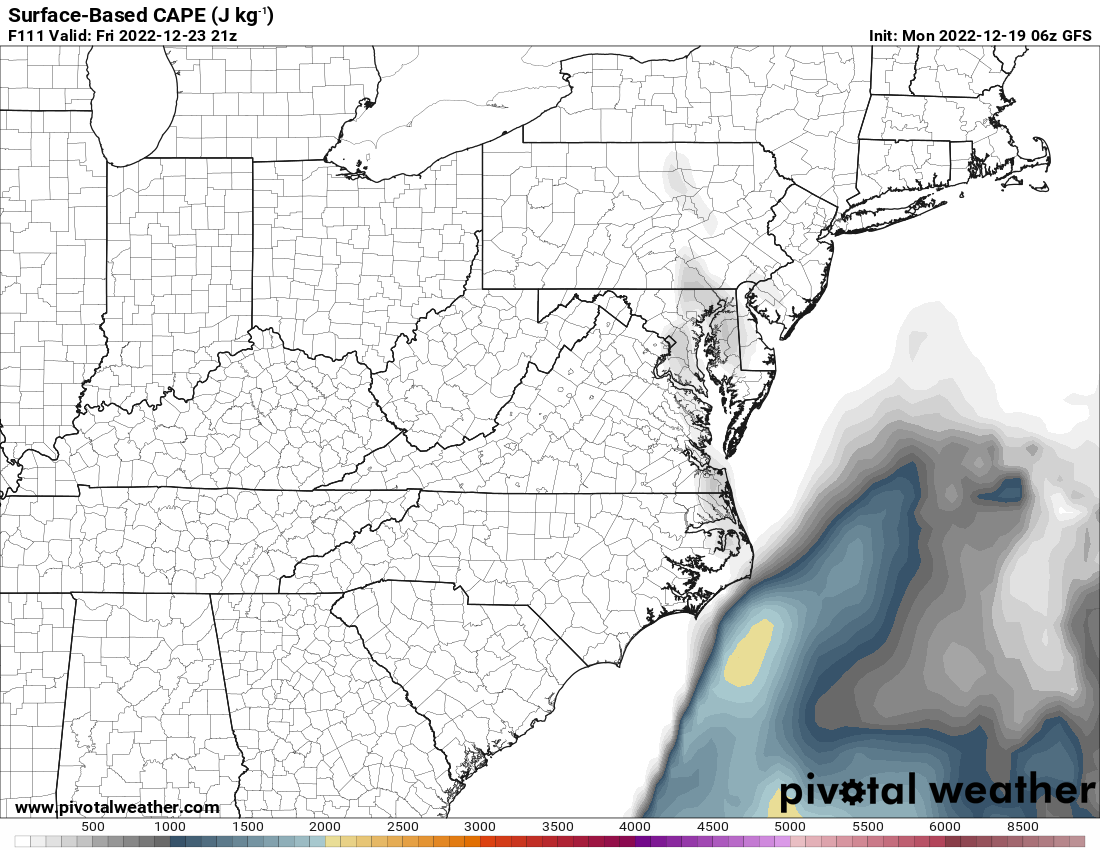
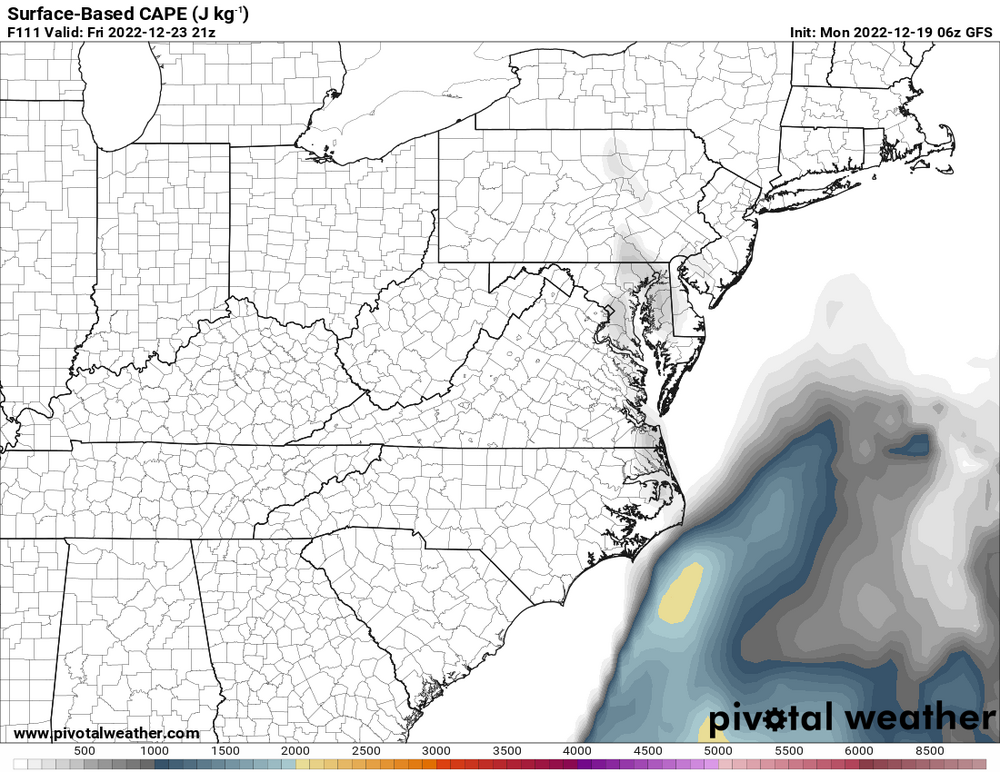
A period of anafrontal snow is definitely on the table. It's also worth watching to see how warm we get ahead of the front and the timing. GFS right now actually shows some instability for areas east of the Potomac, and with intense winds above the surface and strong shear, a low-topped convective line with damaging wind and perhaps a few brief spinnies would be possible.
-
When the NAM Nest loses the low-level cold air really quickly, you know it's not going to be a huge deal.....
-
That's not correct. The snowfall includes sleet, so those 10:1 maps are useless in any type of mixed event. The map being shown, though, is the change in snow depth which correctly applies a very low ratio with sleet. I'm not saying that this GFS map will verify - just saying that it's not the same issue as with 10:1 snowfall maps.
- 596 replies
-
- 10
-
-

-
3. See rule 1, and the GFS always erodes the surface cold air too quickly.
-
Pretty clear trend in the guidance for a further west track which will knock down rain totals for those of us along the I-95 corridor. It does, however, open the door for a TOR threat, although instability may be too meager to take advantage of the very strong low-level shear.
-
2022 Mid-Atlantic Severe Wx Thread (General Discussion Etc)
high risk replied to Kmlwx's topic in Mid Atlantic
Yeah, the timing is better, and instability therefore looks ever-so-slightly better. There will pretty clearly be a line of strong convection just ahead of the front. Whether it will contain lightning or be surfaced-based is unclear. Some of the CAMs even suggest some discrete cells in advance of the line. The shear is very strong, and some of the models even suggest some healthy low-level shear, so this event certainly warrants some watching. -
2022 Mid-Atlantic Severe Wx Thread (General Discussion Etc)
high risk replied to Kmlwx's topic in Mid Atlantic
Yeah, definitely looks better south and east of here, where the better instability will reside. A slightly slower system could, however, change things a bit. Pros: good wind fields including some favorable hodographs, good surge of low-level moisture Cons: limited heating leading to crappy lapse rates and very limited CAPE, no real height falls of note (the trough lifts to the northeast, which also explains why it won't be very cold behind the front) -
2022 Mid-Atlantic Severe Wx Thread (General Discussion Etc)
high risk replied to Kmlwx's topic in Mid Atlantic
Looks like the outflow from the northern line really disrupted the primary line arriving from the west.