Holston_River_Rambler
-
Posts
6,212 -
Joined
-
Last visited
About Holston_River_Rambler

Recent Profile Visitors
17,746 profile views




-
Caught a debris ball, I think, for the Greene county storm: Looks like a similar place to the couplet: A friend sent my wife these pics of the Greene County storm. Looks like they are pretty zoomed in: Another pic of the storms growing down this way:
-
Got some storms starting to fire as far west as my area now. This one was rolling in from the wnw: This one is over Oak Ridge and Hardin Valley: Nothing severe down here, but these suckers went up quick. I was doing yard work and checking out the clouds and nothing could seem to break the cap, although there must have been some lower level mixing with occasional decent wind gusts.
-
Tried to make a gif with of the mesoscale GOES floater, but just can't get the quality I used to be able to get in IMGUR or GIPHY https://i.imgur.com/mWDQCjE.gif
-
Looks like coming across Chimney top Mt might have messed up its circulation: https://i.imgur.com/LHc2SAr.mp4 I tried to catch it on TDOT cameras, but the closest one "Dark Hollow Rd" was aimed north at the time.
-
Bays Mt band area for that Tornado warning. Darn good hook on it too:
-
Hope everyone is doing well in these dry conditions. I'm about to head out for the annual camping trip to the southwest and was reading the ABQ forecast discussion. It was informative (mostly in the short term), but also kind of funny (mostly in the long term), so I thought I'd share .SHORT TERM... (Today through Sunday) Issued at 107 AM MDT Sat May 9 2026 Day 1 Saturday: It is May so that means virga "bomb" season in New Mexico. Virga being rain that evaporates from a thunderstorm before reaching the ground. The rain cooled air still does reach the ground causing a dry microburst hence the "bomb" term. Today looks to be a decent set up for that to occur over the northern mountains into the northeast Highlands. Isolated activity should develop over the central RGV and then back over the Gila Forest as well. Instability (CAPE) looks rather limited with weak "moisture" over the state within increasing NW flow aloft. Storms will be moving pretty quickly as well so any convection could produce a quick microburst with winds most likely not reaching severe levels due to lack of CAPE and downdraft CAPE (DCAPE). Impacts from the gusty winds will be pretty minor and limited to the typical blowing dust and displaced trampoline or bouncy house. Day 2 Sunday: The downburst potential increases more on Sunday with a much more supportive upper level pattern. A fast moving short wave trough passes through northern NM on Sunday increasing the NW flow aloft and cooling aloft. Lapse rates steepen quite a bit more by early afternoon and supportive of CAPE around 400-800 J/kg and DCAPE around 600 J/kg. Deep layer shear increases to 30-40 kts especially from the Highlands south towards SE NM and in phase with the instability. HREF hints at a least small chance (<10%) of CAPE reaching 1000 J/kg in a few spots in E NM. Should the models be under forecasting CAPE then maybe there is support for a marginal severe weather risk for damaging winds. More than likely storms produce wind gusts closer to 50 mph than 60 mph. The main impacts from these kinds of winds will again be blowing dust but could damage weak structures and toss trampolines. Hi-res CAMs and synoptic models all have a pretty clear signal for convection developing in the Las Vegas (not Nevada) area of the Highlands in the early afternoon and then work off to the SE. Isolated activity then develops down the mountain chains towards the Sacramento Mountains. It looks like storms will be in the vicinity of Ruidoso but likely moving too fast and with not a lot of rain to cause any issues on the burn scars. The wildcard in all of this is the back door surface cold front that surges down the eastern Plains bring a surge of moisture to the region. Models need to have a good handle on it`s evolution and magnitude of moisture. The boundary layer moisture will be key to the whole convective scenario and where the forecast goes sideways for the intensity of storms. Will dewpoints in the 40s be the key to this all? Lastly we will throw in the mention of east canyon winds for the ABQ metro area late Sunday due to the back door front but just not a lot of confidence on the intensity of winds with it. 39 && .LONG TERM... (Sunday night through Friday) Issued at 107 AM MDT Sat May 9 2026 Day 3 Monday: The upper level ridge strikes back. Star Wars reference intended. Yes that synoptic feature that reared its ugly head back at the end of March comes back to life like Darth Maul. Synoptic ensemble model suites are all in pretty good agreement with an anomalously high (+12 DAM) 500 mb ridge building over AZ/NM on Monday. As such temperatures rebound quite a bit in E NM with temperatures back into the mid/upper 80s after 70s on Sunday. Day 4-7: Tuesday the ridge builds over NM with 590 DAM heights at 500mb or again about +12 DAM above normal. It will be quite possible that kind of 500mb height would be close to a record on the 18Z ABQ sounding. And that would make sense given this height would be right around the 99th percentile of climo. Heat risk builds into the moderate category for much of NM as high temps reach the 90s which will be only about 2 weeks ahead of schedule instead of 2 months (at least for ABQ metro). Roswell will probably be in reach of 100F. Wednesday through the end of the week the upper level ridge moves over Texas and southwest flow aloft develops over NM. A weak shortwave passes by on Thursday which could bring some elevated convection to the area. Again not much moisture with this system so virga will be the most likely outcome from any convection. After that ensemble model suites become quite divergent in their solutions. Cluster analysis shows exactly that...a cluster. GFS, ECMWF and Canadian ensembles all favor different outcomes from each other. All this means is that there is very low confidence in the forecast day 7 and beyond. 39/Discussion courtesy the WCM working night ops. Take it for what it is worth.
-
Spring/Summer 2026 Pattern Discussion Thread
Holston_River_Rambler replied to Carvers Gap's topic in Tennessee Valley
I'm under that band in RoCo right now -
Spring/Summer 2026 Pattern Discussion Thread
Holston_River_Rambler replied to Carvers Gap's topic in Tennessee Valley
12z HRRR just had a conniption over the Smokies -
Spring/Summer 2026 Pattern Discussion Thread
Holston_River_Rambler replied to Carvers Gap's topic in Tennessee Valley
Pretty enthused that this afternoons potential precip shield is looking is looking less potential and more actual this AM: There was even a severe t-storm warning associated with it earlier. Now we see if the cold air can make it. -
Spring/Summer 2026 Pattern Discussion Thread
Holston_River_Rambler replied to Carvers Gap's topic in Tennessee Valley
Just woke up to see some of the hi-res were showing and I will take. Looks like the Nam is showing a 300mb jet acceleration that enhances lift behind the front: Precip. pops over central Alabama and Mississippi and ride up into eastern TN. I think there's probably more dynamically going on that that too, but I'm just excited to see what happens. Maybe we can get some tasty lapse rates with that March sun as the cold pools rolls through tomorrow PM? We'll see if we can get some good rates, but it has been pretty warm so I'd hedge against road problems in areas with lots of traffic especially. Also, just now logging back in, so I wanted to add sorry for your loss Daniel -
Spring/Summer 2026 Pattern Discussion Thread
Holston_River_Rambler replied to Carvers Gap's topic in Tennessee Valley
Kind of surprised the precip shield isn't further west with this satellite: -
Spring/Summer 2026 Pattern Discussion Thread
Holston_River_Rambler replied to Carvers Gap's topic in Tennessee Valley
Wondering if my 60 day trough would swing back by this month. November 11, 2025: January 11, 2026 March 16, 2026 (ok, so a little over 60 days): -
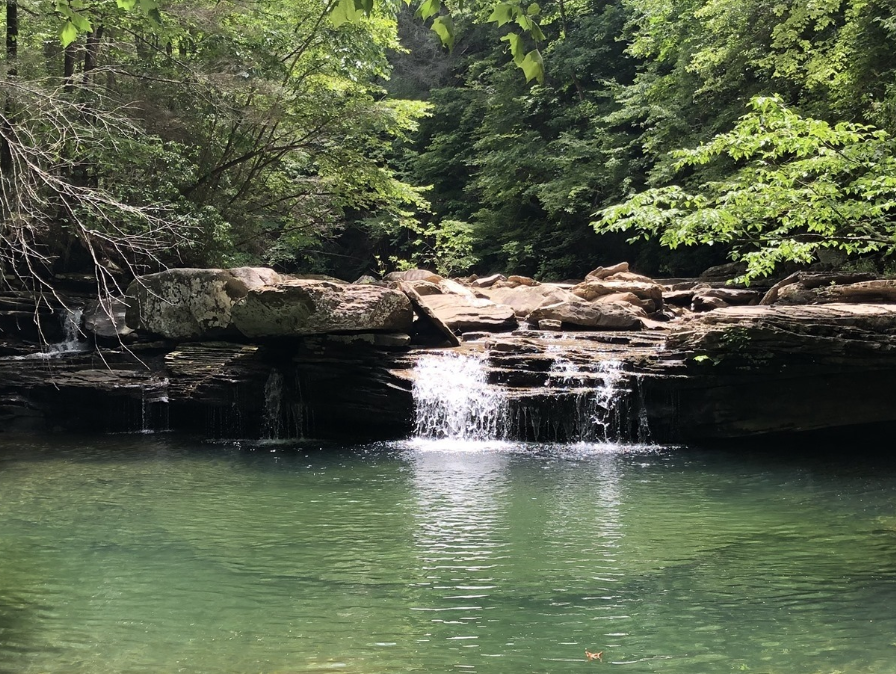
Hope everyone is doing well. Finally getting caught up on no weather things after Jan and early Feb. Thought I'd start and spring/ summer general obs. thread with some recent pictures as I await the line of storms this PM. Drought seems to be slowing easing, at least in some areas. Piney Falls in Rhea County, TN on Feb 20. Diurnal and differential heating aided thunderstorm tops building over the Smokies on *.....checks calendar....* March 6: Waterfall at Sand Cave in Cumberland Gap on March 10: Heading to Boone tomorrow, so I guess we'll see if I can get some Watauga headwaters snow pics.
-
Winter 25/26 General Obs
Holston_River_Rambler replied to Holston_River_Rambler's topic in Tennessee Valley
Winds are cranking up here on the plateau. Cold air rushing in. -
Winter 25/26 General Obs
Holston_River_Rambler replied to Holston_River_Rambler's topic in Tennessee Valley
Interesting features to the lee of Black Mt. KY and High Knob, VA earlier this AM: