Jump to content

brooklynwx99

Meteorologist
  • Posts

    5,871
  • Joined

  • Last visited

Everything posted by brooklynwx99

  1. it's a good sign. there's pretty notable split flow, so this ups the risk for phasing scenarios and general storminess with the northern and southern streams mingling
  2. I don't think it would be an issue, per se, but it would not shock me to see a beefy system slam DC as the cold press strengthens. I think this pattern favors pretty much all of the E US that split flow is a nice asset as well... ups the phasing possibilities
  3. I would be surprised if there wasn't a significant overrunning/coastal storm in the E US with that waveguide... suppression quite far S could be a risk though. it's happened before in these kinds of setups where even DC cashes in
  4. hmm, I think you guys could still be in for something too. there's going to be enough strong HP in SE Canada that you'll have some chances in NC. the 12z GFS shows how you can get there that kind of amplified -EPO is something that's good for the entire E US
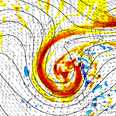
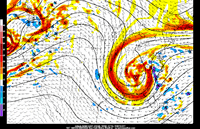
  5. So, there has been a lot of speculation as to why the pattern for the beginning of March has taken such a turn since just last week. I was pretty much in agreement with much of the meteorological community that the beginning of March would be quite warm as the pattern would be breaking down. It appeared that the tropical forcing would move into unfavorable areas of the Pacific for E US winter weather, like towards the Maritime Continent. However, that tropical forcing has become less and less of a factor in the pattern, as the amplitude of the wave looks quite low: So, instead, there must be another pattern driver that's led to such a dramatic change in the NH waveguide. It looks like the culprit is an extratropical cyclone over the W Pacific near Japan. It will develop by the beginning of next week, and it looks to become a highly anomalous cyclone, reaching over 4 sigma below normal SLP: This cyclone will induce an extension of the Pacific jet and anticyclonic wave breaking, which leads to the anomalous ridging over the EPO domain: I don't think that this is a head fake, and there is the potential for a significant high-latitude blocking event. It hinges on the strength of the cyclone in the Pacific, but there is tremendous agreement between models and their ensembles, so I do think that it's a legitimate pattern driver. Something similar to this also happened with Nuri at the end of October 2014, which was also a highly anomalous N Pacific cyclone. Nuri had a tremendous impact on the pattern in November 2014 with regards to N Pacific blocking: Therefore, I do believe that the first couple (or perhaps few?) weeks of March hold elevated potential for a significant late-winter event. Time will tell, but things should start to ramp up once heading into the start of the month.
  6. So, there has been a lot of speculation as to why the pattern for the beginning of March has taken such a turn since just last week. I was pretty much in agreement with much of the meteorological community that the beginning of March would be quite warm as the pattern would be breaking down. It appeared that the tropical forcing would move into unfavorable areas of the Pacific for E US winter weather, like towards the Maritime Continent. However, that tropical forcing has become less and less of a factor in the pattern, as the amplitude of the wave looks quite low: So, instead, there must be another pattern driver that's led to such a dramatic change in the NH waveguide. It looks like the culprit is an extratropical cyclone over the W Pacific near Japan. It will develop by the beginning of next week, and it looks to become a highly anomalous cyclone, reaching over 4 sigma below normal SLP: This cyclone will induce an extension of the Pacific jet and anticyclonic wave breaking, which leads to the anomalous ridging over the EPO domain: I don't think that this is a head fake, and there is the potential for a significant high-latitude blocking event. It hinges on the strength of the cyclone in the Pacific, but there is tremendous agreement between models and their ensembles, so I do think that it's a legitimate pattern driver. Something similar to this also happened with Nuri at the end of October 2014, which was also a highly anomalous N Pacific cyclone. Nuri had a tremendous impact on the pattern in November 2014 with regards to N Pacific blocking: Therefore, I do believe that the first couple (or perhaps few?) weeks of March hold elevated potential for a significant late-winter event. Time will tell, but things should start to ramp up once heading into the start of the month.
  7. So, there has been a lot of speculation as to why the pattern for the beginning of March has taken such a turn since just last week. I was pretty much in agreement with much of the meteorological community that the start of March would be quite warm as the pattern would be breaking down. It appeared that the tropical forcing would move into unfavorable areas of the Pacific for E US winter weather, like towards the Maritime Continent. However, that tropical forcing has become less and less of a factor in the pattern, as the amplitude of the wave looks quite low: So, instead, there must be another pattern driver that's led to such a dramatic change in the NH waveguide. It looks like the culprit is an extratropical cyclone over the W Pacific near Japan. It will develop by the beginning of next week, and it looks to become a highly anomalous cyclone, reaching over 4 sigma below normal SLP: This cyclone will induce an extension of the Pacific jet and anticyclonic wave breaking, which leads to the anomalous ridging over the EPO domain: I don't think that this is a head fake, and there is the potential for a significant high-latitude blocking event. It hinges on the strength of the cyclone in the Pacific, but there is tremendous agreement between models and their ensembles, so I do think that it's a legitimate pattern driver. Something similar to this also happened with Nuri at the end of October 2014, which was also a highly anomalous N Pacific cyclone. Nuri had a tremendous impact on the pattern in November 2014 with regards to N Pacific blocking: Therefore, I do believe that the first couple (or perhaps few?) weeks of March hold elevated potential for a significant late-winter event. Time will tell, but things should start to ramp up once heading into the start of the month.
  8. yeah, the NAO is so positive that the TPV kinda acts as a pseudo-50/50 and helps provide confluent flow in SE Canada. it's weird, but that same kind of pattern was able to produce Marches 2014/15, which were snowy for the entire E US. lots of cold overrunning snows in those months
  9. this is some serious split flow with an active STJ, which ups the risk for phasing scenarios as well. it's a great pattern as advertised
  10. this is a really nice look. cold and active as the -EPO forces the boundary S split flow evident too with the STJ in the picture
  11. this pattern would provide lots of chances for us heading into March development of a stout -EPO lets cold air bleed S... would probably be overrunning primarily but coastals could be more favored as the pattern matures. good stuff
  12. yeah, this pattern is a nice look for the E US N of DC development of a stout -EPO lets cold air bleed S... would probably be overrunning primarily but coastals could be more favored as the pattern matures. good stuff
  13. GEFS is juicy in the LR… this is a big time overrunning setup as modeled with split flow
  14. this is gorgeous. big March 2015 vibes with a cold overrunning pattern -EPO with split flow
  15. yeah, it's March '15-esque. would be an active overrunning look if it were to verify
  16. the pattern showing up in the LR is actually a bit deceiving... this does look like a "torch" at first glance, but there's actually a ton of cold air in SE Canada, and the TPV S of Greenland provides confluence. so, even though there's a SE ridge, there would more than likely be a pretty stout cold press with lots of HP over the top March 2015 is a pretty similar analog to this type of gradient pattern. NOT saying that we're getting a month this anomalous, but the NAO was extremely positive and there was considerable SE ridging. however, we all remember how the TPV parked S of Greenland provided significant confluence and kept areas N of DC colder than average thanks to the Pacific help. so, just because you see a SE ridge and +NAO doesn't mean you torch if the TPV is in a favorable location for providing confluence so, if this pattern was to verify (I have no reason to believe it's outlandish), then we would see an active overrunning pattern with lots of chances to open the month. let's hope the guidance holds on this March '15-esque look
  17. GEFS does just that... this is March 2015-esque NOT saying that this March will be anything that extreme, but the advertised pattern could certainly deliver with overrunning events riding the boundary
×
×
  • Create New...