
Ellinwood
-
Posts
6,210 -
Joined
-
Last visited
Content Type
Profiles
Blogs
Forums
American Weather
Media Demo
Store
Gallery
Everything posted by Ellinwood
-

Mid-Atlantic Snow forecast For January 25 (Initial)
Ellinwood posted a blog entry in Ellinwood's Weather Blog
Certainly a new breed of winter storm for this winter as we now have plenty of cold air in place, but moisture will be lacking in most areas. The good news is most of the Mid-Atlantic will see high snow ratios around 15-20:1, giving the event more bang for the buck. Risks are more to the low side at the moment, with the current forecast leaning more towards the wetter European solutions. The NAM and GFS have been fairly insistent on a DC snow hole where accumulations are less than an inch. While entirely possible, I still think there's enough QPF for most to get around an inch. Some of those east of the mountains in PA and NJ have a shot at 2-3" if the higher-end QPF verifies. Confidence is lower than normal with this storm due to the QPF issues and because the energy that will create this system is still somewhat offshore in the Pacific Northwest, so it is not getting sampled as well as it would if it was onshore. -
Mid-Atlantic Snow forecast For January 17 (Final)
Ellinwood posted a blog entry in Ellinwood's Weather Blog
A quick update before I head into work... shifted the forecast further south overall and tightened up the contouring in areas that have slightly higher confidence than the initial forecast. This results in a virtual no-show north of DC aside from some flakes in the air to a dusting. Southern VA into northern NC will get rocked as the vort. max pushes through. There is a risk of this shifting even further south according to some of the hi-res models. -
Mid-Atlantic Snow forecast For January 17 (Initial)
Ellinwood posted a blog entry in Ellinwood's Weather Blog
Here comes the first notable snow event for the southern Mid-Atlantic this winter! A powerful upper-level vort. max will push through the region tomorrow, bringing strong dynamics with it that will help create a period of moderate to heavy snowfall. The snow will start in the morning hours in the higher elevations and will work east through the afternoon and evening. The I-95 corridor will probably start off as rain in the morning. Some sleet could accompany the transition in the late morning and early afternoon, with the changeover to snow occurring around mid-afternoon on I-95 between DC and Richmond. This could lead to large traffic headaches during the afternoon rush hour. Just in case some people might be thinking it, the current forecast is not favorable for thundersnow/thundersleet. -
Mid-Atlantic Snow forecast For January 15-16 (Only/Final)
Ellinwood posted a blog entry in Ellinwood's Weather Blog
Very tough call on the southern edges of the contours as sleet and freezing rain make an appearance as far south as northern MD (not including the mountains). Some locally higher totals of 4-8" are possible, and I put a 4-8" contour area in the spot where I think that is most likely to occur. Ratios should be above 10:1 at least at the start of the snowfall across northern PA before the warmer mid-level air tries to nose in. -
Mid-Atlantic Snow forecast For December 28-29 (Final)
Ellinwood posted a blog entry in Ellinwood's Weather Blog
I did end up bringing the contours further south from DC eastward. Not really anything to add to yesterday's discussion. Good luck with the snow, everyone. I'm leaving to go up north now where there's 18 inches of snow on the ground. -
Mid-Atlantic Snow forecast For December 28-29 (Initial)
Ellinwood commented on Ellinwood's blog entry in Ellinwood's Weather Blog
Yeah... probably gonna have to pull the contours further south around Philly/NJ. -
Mid-Atlantic Snow forecast For December 28-29 (Initial)
Ellinwood commented on Ellinwood's blog entry in Ellinwood's Weather Blog
[quote name='gisman' timestamp='1356642260'] Might want to change the title on this post to the correct dates; predicting things before they happen rather than after gives you more credit. [/quote] Ha! Thanks for catching that... was copy/pasting an old title and didn't update the dates. -
Mid-Atlantic Snow forecast For December 28-29 (Initial)
Ellinwood posted a blog entry in Ellinwood's Weather Blog
Another quick-turnaround forecast as the next system looks to bring widespread 1-4" totals to the Mid-Atlantic, with higher totals in the central Appalachians. Marginal boundary layer temperatures and initial surface winds out of the southeast makes finding that 1" boundary a challenge yet again. Luckily, the upper-level temperatures are cooperating more this time around, so if your surface temperature is at or below freezing you'll almost certainly be getting some accumulation. Mixing areas will mostly be rain/snow, but some sleet is still possible. I'll be traveling tomorrow, so if/when I update it will be in the evening. -
Mid-Atlantic Snow forecast For December 26-27 (Only/Final)
Ellinwood commented on Ellinwood's blog entry in Ellinwood's Weather Blog
[quote name='anthonyweather' timestamp='1356456487'] 4-8" in eastern pa, you also agree that it will be more frozen than not? [/quote] Hard to tell... it'll be a good front-end thump for sure but I don't know how much QPF could come in as rain later on. -
Mid-Atlantic Snow forecast For December 26-27 (Only/Final)
Ellinwood posted a blog entry in Ellinwood's Weather Blog
Forecast confidence is low as most of the snow falls at the front end of the system before many areas switch over to mixed precipitation and/or rain. Very small changes in temperature at various levels of the atmosphere could lead to significantly different snowfall totals, especially east of the mountains. The northwestern parts of the forecast region could/should stay all snow throughout the event, which roughly matches up with the 8-12+ inch area along and west of the mountains. There will be some lingering snow in the central Appalachians at the end of the event as cold, northwesterly flow takes over. -
Mid-Atlantic Snow forecast For December 21-23 (Final)
Ellinwood posted a blog entry in Ellinwood's Weather Blog
No major changes to the forecast, though I did decide to go a bit more aggressive with the totals in some areas. The most notable changes were in northern PA and southwestern NY, with an 8-12" contour added as lake-effect off of Lake Erie helps drive up totals. The back edge of the main area of precipitation is expected to change over to snow, but how much of that actually accumulates ahead of the later snow is uncertain. Localized totals of >12" are possible within the 8-12" contours. -
Mid-Atlantic Snow forecast For December 21-23 (Initial)
Ellinwood commented on Ellinwood's blog entry in Ellinwood's Weather Blog
This is where I made the base map: [url="http://nationalatlas.gov/mapmaker"]http://nationalatlas.gov/mapmaker[/url] Best thing to do is grab the map in parts and make them separate layers in Photoshop, then draw in the contours below the lines and labels. -
Mid-Atlantic Snow forecast For December 21-23 (Initial)
Ellinwood posted a blog entry in Ellinwood's Weather Blog
Since my forecast maps cover parts or all of several different sub-forums in the eastern US, I've decided to just post my snowfall forecasts on this blog to get more exposure without having to spam all of the different sub-forums with my forecast. For those of you who don't know, my main focus with snow forecasting is centered around the Mid-Atlantic. The geographical location does not regularly change from storm to storm, and neither do my snowfall contours. You can interpolate snowfall totals within the contours (for example, the outer edge of the 2-4" contour is for 2", and in most cases the center of the 2-4" contour is closer to 3-4"). I usually try to issue an initial map and one updated (final) map, though sometimes I like to throw in an a second update. Other times, I might only issue one forecast near the start of the event. No updates are issued once the snow starts to accumulate within the forecast region (except in rare cases when the accumulation starts just before I get home from work). ----- Most if not all of the snow with this disturbance will accumulate well behind the cold front, with lake-effect snow bringing some respectable totals to western PA and WV. Most of the snow will fall Friday morning through Saturday afternoon. Low-level temperatures will limit accumulations across central and eastern PA. South and east of the 1" line could see snow in the air Friday, with little to no accumulation expected. -
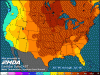
Temperature anomalies July 6, 2011 through July 5, 2012: That's just nuts... not just for our region, but for North America.
-
April 2012: Extreme boredom.
-
I do not.
-
Reconsider majoring in meteorology!
Ellinwood replied to stormguy80's topic in Weather Forecasting and Discussion
No prob. I don't know why anyone would waste their time and money getting a met. degree if they didn't plan on getting a job within the field. I think vortmax112 nailed it. -
Reconsider majoring in meteorology!
Ellinwood replied to stormguy80's topic in Weather Forecasting and Discussion
It has been brought up... more than once... including in this thread. -
Reconsider majoring in meteorology!
Ellinwood replied to stormguy80's topic in Weather Forecasting and Discussion
Thanks for pulling the data! It was also interesting (though unsurprising) to note that in Atmos. Sci. and Meteorology, the number of males to females is 4:1. The only physical science with a bigger ratio is physics, which is 82% male. -
Reconsider majoring in meteorology!
Ellinwood replied to stormguy80's topic in Weather Forecasting and Discussion
Neither the article nor the link to the data in the article specify whether the employment is within the actual field of study or not... I would venture a guess that it applies to any employment and not just within the field. -
Devastating tornado strikes Joplin, Missouri
Ellinwood replied to Hoosier's topic in Weather Forecasting and Discussion
Chasers caught the beginning of the tornado: WARNING: NSFW language -
Devastating tornado strikes Joplin, Missouri
Ellinwood replied to Hoosier's topic in Weather Forecasting and Discussion
This. I haven't seen anything indicative of an EF-5 yet... should be able to get some quick shots in this morning before the next storm rolls through. -
Can we get this OP in the Mid-Atlantic? We desperately need it Great set of rules, and from what I hear/see you have been using it well. If only I was still in Raleigh...
-
Reconsider majoring in meteorology!
Ellinwood replied to stormguy80's topic in Weather Forecasting and Discussion
No love for the UAlbs? -
Reconsider majoring in meteorology!
Ellinwood replied to stormguy80's topic in Weather Forecasting and Discussion
Double-check the course requirements to do an Atmos/Comp Sci double major... not sure about Lyndon State, but in SUNY Albany I was a year in before I decided to try the same thing... would have had to stay in school for 4.5-5 years to accomplish the double-major at that point. As it is, I had to take a Comp Sci class in the summer to make up for the time I lost by not doing Comp Sci freshman year. If you do want to go into the world of broadcast, I would suggest taking at least one broadcast/journalism class that works on vocal training and composure for when you're in front of the camera.