frostfern
-
Posts
2,140 -
Joined
-
Last visited
Content Type
Profiles
Blogs
Forums
American Weather
Media Demo
Store
Gallery
Everything posted by frostfern
-
Is it time I pony up some of my quarantine stimulus check money to watch the 384 hr Euro? Or will that just make me more depressed? I don't understand why the weather gods have to conspire to make 2020 even more hell-year than it already is. Just need a little hope please. I suppose it could be worse. My neighborhood didn't get flattened by a tornado. I mean, I feel bad complaining about the weather of all things but I just need something to look forward to after rona-hell.
-
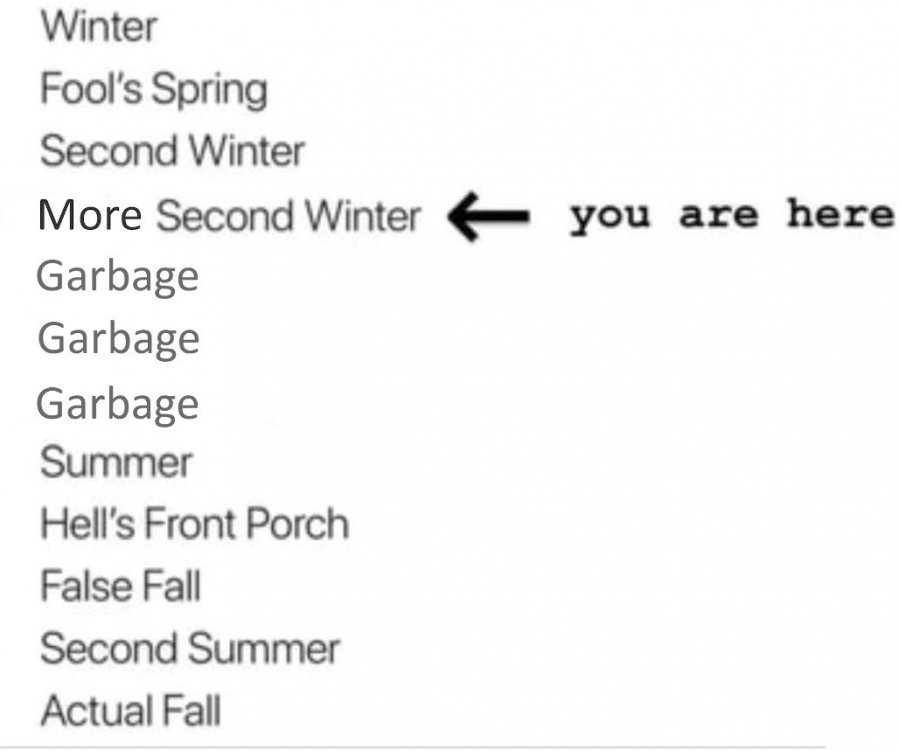
Fixed that for anywhere east of Lake Michigan and north of I-80. Also, "winter" = London-style. Cold and damp but no real snow.
-
There will probably be some thunder over there. The freezing level is real low so graupel will almost certainly make it to the ground. Stronger updrafts may have some small hard hail too. I don't think there will be any thunder in my area but still could see some graupel and gusty winds. This setup reminds me of mountain weather. Dry atmosphere with steep lapse rates and low freezing level.
-
Losing electricity while under quarantine would be awful though. Can't cook and can't go out to eat. Even worse situation for field hospitals taking care of COVID victims. Are they even built to withstand hurricane force wind gusts?
-
That Euro map is hilarious. I thought it was in cm at first. It's inches! WTF!!! Funny how that storm keeps disappearing from one model only to show up on the other. It was on the ECMWF a few runs ago, went away, appeared on the GFS, went away again. Now it appears once more on the ECMWF more powerful than before.
-
Even if there isn't a snowstorm, these cold outbreaks in April can be interesting due to the increasing afternoon instability. Heaviest snow showers's I've ever seen in my life in Michigan have always been on April afternoons. They tend to be wet and mix with a lot of graupel though, so not much accumulation.
-
ECMWF had it one run then lost it. Now GFS is showing it.
-
GFS is now showing a Great Lakes snowstorm on the 14th. Maybe Grand Rapids MI finally gets the bulls-eye 8" swath after we missed it every time this winter. Now that the buds are just starting to open it's finally time for some snow. lol
-
The destabilization will be driven by cold air advection aloft more than surface heating. The upper low moving in was producing thundersnow showers over the southwestern US. These will be very low-topped cells. Less instability is needed. The bigger problem will be whether there's enough upward forcing to overcome dry air entertainment with such a big shear-to-instability ratio. I don't think CAMS really know how to handle these kind of small-scale details. Chasing small fast-moving cells that can poop out at any moment will be frustrating. It also gets dark early this time of year. If it's a late-evening event it will be mostly in the dark.
-
Yea. There might be an outbreak of low-topped supercell storms coming out of Iowa as the dry slot and upper low sweeps in from the west. Not a lot of CAPE needed because the tropopause/EL will be low. It's hard to predict if there will be any really persistent cells though. Updrafts might have a lot of spin but are usually kind of small and can be snuffed out pretty easily in the dry slot.
-
I had a bad cough and 102 F fever a couple nights in a row about 2 weeks ago. I get colds and bad intestinal stuff a couple times a year but I don't recall the last time I had full-blown flu symptoms like that. I'd probably have to go back to childhood. Thankfully I was only really sick for about 3 days. I want to the doctor but there was no test. They said 90% likelihood it was influenze B or H1N1 (even though I had a normal flu shot last October). It would have been nice to know for sure what it was and why the flu shot didn't prevent it. I didn't travel anywhere but now it's a little concerning that random celebrity cases are turning up. It's a worry if non-severe cases are slipping through untested.
-
Yea. I think sometimes intense sunshine is unhelpful because it produces a deep dry adiabatic layer. Supercell tornadoes tend to like areas where there the low-level lapse rate isn't too steep. Downdrafts don't become too dominant then. You also get more backing near the ground when the first 1000 feet is a little more stable because there aren't as many dry thermals mixing westerly momentum down from above. The most likely place for big tornadoes usually isn't in the middle of a bubble of high SBCAPE. It's usually around the edge of the SBCAPE bubble (i.e. where there's a sharp SBCAPE gradient). I think tornadic supercells are often pulling in the most unstable air from a slightly elevated layer, but the meso is able to "dig" down and pull in surfaced based air as well. For example, you might have a MUCAPE of 1400 j/kg for a layer rooted around 900 hPa on the "cool" side of an old outflow boundary, but the storm is also pulling in surface parcels with CAPE around 700 j/kg. The surface parcels probably have a fairly high LFC, but the vacuum effect of the meso can get them up there. These parcels have a lot more "backed" momentum profile than those entering the storm from the 900 hPa level, so they can contribute a lot of extra spin to the meso, helping to reinforce the upward vacuum effect. On the warm side of the outflow boundary you might have SBCAPE of 2500 j/kg, but meso's are all weak and elevated due to strong cold pools and lack of near-surface backed flow.
-
Yea. Tornado outbreaks in March and April are usually going to coincide with abnormal warmth and humidity for the time of year. That doesn't mean you need summer-like temperatures though. Shear is far more important, and low cloud bases / high relative humidity is very beneficial because evaporative cooling from nearby precip won't completely stabilize surface-based storm-inflow. I think Dr. Leigh Orf's work provided some pretty strong evidence that violent tornadoes ingest a lot of surface-based parcels that are more stable than average, yet still realize some positive buoyancy once lifted into the middle levels of the storm by the upward vacuum-suction force of the rotating meso. Hot weather brings you the highest surface based CAPE, but that CAPE can be completely neutralized by just a little bit of precip if the boundary layer is characterized by low relative humidity. The result is many hot-day summer supercells have elevated inflow, and thus never produce tornadoes. Early spring supercells are very good at producing tornadoes because they often form in an environment where instability is more than adequate for strong convection despite high boundary layer relative humidity.