


cbmclean
-
Posts
3,365 -
Joined
-
Last visited
Content Type
Profiles
Blogs
Forums
American Weather
Media Demo
Store
Gallery
Posts posted by cbmclean
-
-
9 hours ago, Avdave said:
I was all set for some food storm activity here in Eastern Durham County today. Watching football and the radar and it all looked great. Sky was getting dark to my Northwest and said to myself yeah this is our turn. Went outside and the outflow boundary kicked in big time, winds whipping and It felt great sitting on the back porch. Clouds still look nice and dark, radar looked good. Then it happened. As soon as the bulk of the storm decided to shift a tad NE of me and the line split and died when it got here and wound up with .01" here today. So everyday this week has been a shutout until today with a most nice looking radar line and kapoof. So I feel your pain Wake county peeps. It isn't any better here in eastern Durham county. Western Durham county/city gets the rain though. The shield lives on.
Looking forward to a nice comfortatable day tomorrow well Sunday here.
I'm visiting family for the holiday and wasn't watching the radar closely. Did anyone capture a file?
-
11 hours ago, SEwakenosnowforu said:
Hey, I forget what part of wilson you are in. I lived near Gillette park
In the northern part, close to Lake Wilson.
-
A disappointing 0.20" today.
-
1 hour ago, SEwakenosnowforu said:
Just under 0.50 of rain here last month...nothing this month. What is with all these storms hammering greensboro then falling apart as they approach wake co? It has happend numerous times this summer. It's strange.
Two items
1. Thunderstorms require a source of lift to form. The western piedmont trough is such a source, which is why many times cell pop-up there first.
2. Thunderstorms are by nature self-limiting as the downdraft from the rain chokes of the convective updraft. There must be some mechanism to separate the downdraft from the updraft for a system to last. One example is shear.
In a stagnant dynamic environment, which is very common in this area in late summer, it is common for cells to pop off the piedmont trough but then die quickly without any mechanism to keep them going.
That's not the whole story, but it's definitely a major part.
Some of it is also just bad luck.
-
 1
1
-
-
A spectacular cell started falling apart on its way to me, as usual. Still managed 0.42" but places not far north have 1.5"+. Hopefully some more tomorrow.
-
2 hours ago, NorthHillsWx said:
Crazy variance across the state in rainfall totals this month
Overall a dryish month across the state. Broadly speaking the southern half of the state did OK. The northern half, outside of the mountains had a very bad month, especially the NE quadrant. Very frustrating as we had made huge progress from D2/D3 all the way back to D0 or D1 but now we're right back in the hole. What makes it even more frustrating is that it's not like a massive ridge baking out the Southeast; there's been plenty of moisture around and several episodes of good lift, stalled fronts etc. For some reason cells had a hard time popping and those that did seemed to have a short lifespan.
-
Southern half of Wilson county is getting a decent soaking but nothing wants to pop north.
-
 1
1
-
-
There are finally cells firing in my area but at this time none seem good candidates to hit me. It's maddening! I'm at 0.85" for the month.
-
1 hour ago, NorthHillsWx said:
Holding strong so far. Just 0.01” here
Still holding strong. The norther lobe of the cell conglomeration is dying in Wake County.
-
4 hours ago, NorthHillsWx said:
The relief from the heat was nice, as were the low DPs. Back up into the 70's with current DP. Looks like another extended period AN just as football season kicks off, joy

Meanwhile, please drop the Raleigh rain shield. There's a nice line of storms moving in from the SW and I don't want to see it die.
-
A gut punch. It appears that the dynamics were not enough to overcome the stubborn cloud cover over the NE quadrant of NC. An anemic 0.19" for the day. Glad I got the 0.33" yesterday so I at least break 0.50" for the week.
-
1
-
-
Seeing pinks on radar returns north of Wadesboro out west. Meanwhile I'm at 0.09" for the day.
-
1
-
-
2 minutes ago, SEwakenosnowforu said:
That stuff out west is wild. However...this cloud covered showered cool air will do to it what it always does!
It's all about the dynamics. Get the right dynamics and you can pop whoppers in a wedge. Not sure if this system is going to have the umph we need, but it is certainly more dynamic than anything we have seen this month.
-
 1
1
-
-
17 minutes ago, NorthHillsWx said:
First measurable rain since start of the month but just 0.02” lol
Just judging by upstream radar, things look good, but we know how upstream cells can vanish mysteriously once hitting the Raleigh shield.
-
1
-
-
Radar blossoming in NC sandhills and southern coastal plain. Heavy returns moving through Scotland and Hoke counties right now. Hopefully a sign of things to come further north. I was well on my way to climbing out of the short-term drought altogether but then stumbled into a sneaky dry three week period. It has been extra frustrating as the atmosphere has been loaded with moisture, and not just at the low levels, but outside of the piedmont trough and the Seabreeze, most of the state seems to have been completely devoid of dynamics or lift.
-
1
-
-
Rain!! Only 0.33" but more than doubled my total for the month. Hopefully just an appetizer before a feast tomorrow.
-
1 hour ago, olafminesaw said:
If you are feeling you have gotten unlucky in over the last few weeks with daily storms missing your location, just know that the footprint of these storms has been relatively small and most areas have been drier than normal across the area with a few lucky winners
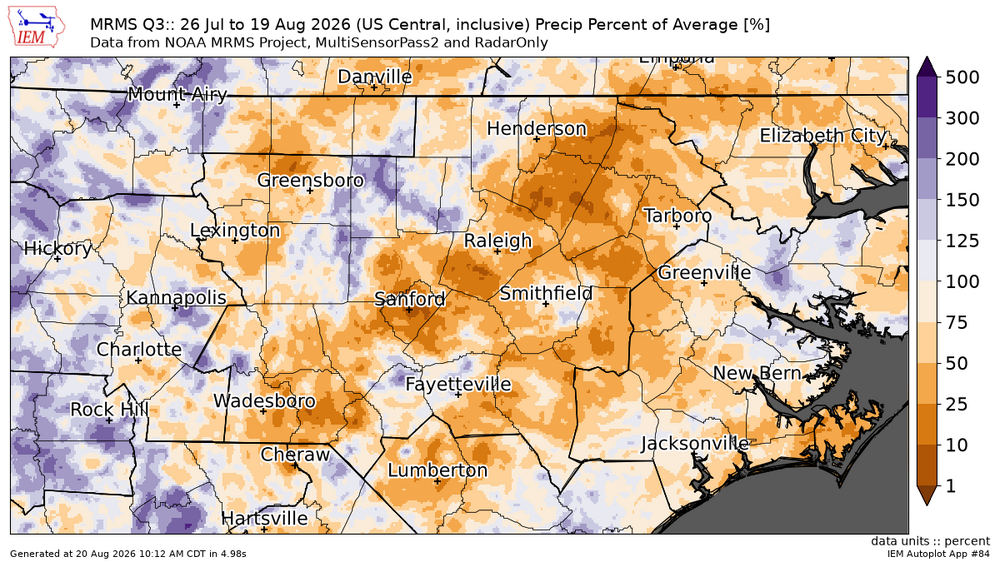
This definitely tracks with OTG truth here. I am at 0.28" for the month. According to the RAH AFD, Raleigh east is in the crosshairs for tomorrow, we shall see. Just warning you guys ahead of time if it's a dud for me, I will whine a bit.
-
1
-
-
And of course the line of storms is collapsing on cue. Not that it would have amounted to much, with it being a thin line and fast moving, but the quadrant of the RAH CWA from Raleigh, east to me, and north, cannot get jack doodly to fire for the past week. Yeah, there is no mesoscale focus and we're too far east for the piedmont trough cells to hit us and we're too far north for the sea breeze front. But with so much heat and moisture leading to instability, you'd think cells wouldn't just shrivel up and die every time.
-
1
-
-
One of the twitter mets I follow mentioned this would be a hit-or-miss pattern with erratic rainfall, and he was right. Widespread rain was moving NNE from the SE NC coast and just dying as it moved inland just ignoring orographic lift. Not sure how there can be such high PW and multiple lift sources and so little rain in the coastal plain.
-
It's not my week. Sunday the axis of convection was too far west. Yesterday it was too far east. Today it was back west. Did manage 0.28" in three separate events today so not a total shut out. Things look hit or miss for the rest of the week.
-
A crescent of heavy rain essentially stationary in southern Wilson, through Wayne, Johnston and Harnett counties. Going to be some prodigious totals there. Still 0.0" for me MTD.
-
4 hours ago, NorthHillsWx said:
Picked up 0.03” (1.12” daily and MTD total) more yesterday evening but today has trended drier on models as the boundary sagged a little further south. With all the rain, it might be a blessing if we avoid a tropical system this year as grounds are completely saturated despite long term drought impacts. Earlier this summer I was adamant that we needed a tropical system to ease drought conditions but after the past month, it would likely be too much. What a crazy turnaround
Slightly annoying as yesterday the moisture axis was 50 miles too far west and today it looks to be 50 miles too far east. We had a good July but not as spectacular as the Raleigh area and I'd like to keep the momentum going. NAM 3K suggests Tuesday and Wednesday may be better for me.
-
1
-
-
7 hours ago, olafminesaw said:
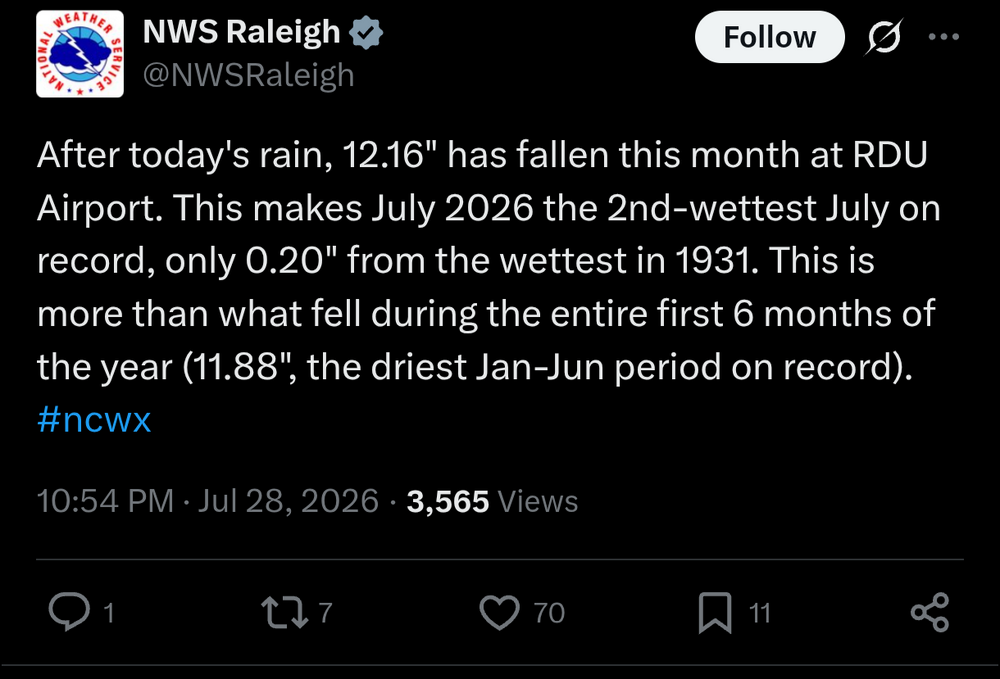
That should make it the wettest in RDU (as opposed to Raleigh NWS) history correct?
-
Ended up with 0.66" last night plus plenty of thunder and lightning. Will end up with 9.41" for the month.
-
1
-

September Obs 2026
in Southeastern States
Posted
The southern tier of NC continues to do well; a nice long-lasting MCC plowed from well west of Charlotte to Brunswick County.