donsutherland1
-
Posts
24,322 -
Joined
Content Type
Profiles
Blogs
Forums
American Weather
Media Demo
Store
Gallery
Everything posted by donsutherland1
-
I hope all is well with you in Israel. Here is a link to the Times Square webcam. With the lighting, one can see the first snowflakes of the forthcoming storm already swirling about. Stay well.
- 1,925 replies
-
- 4
-

-

-
- heavy snow
- wind damage
- (and 1 more)
-
January 2021 General Discussions & Observations Thread
donsutherland1 replied to Stormlover74's topic in New York City Metro
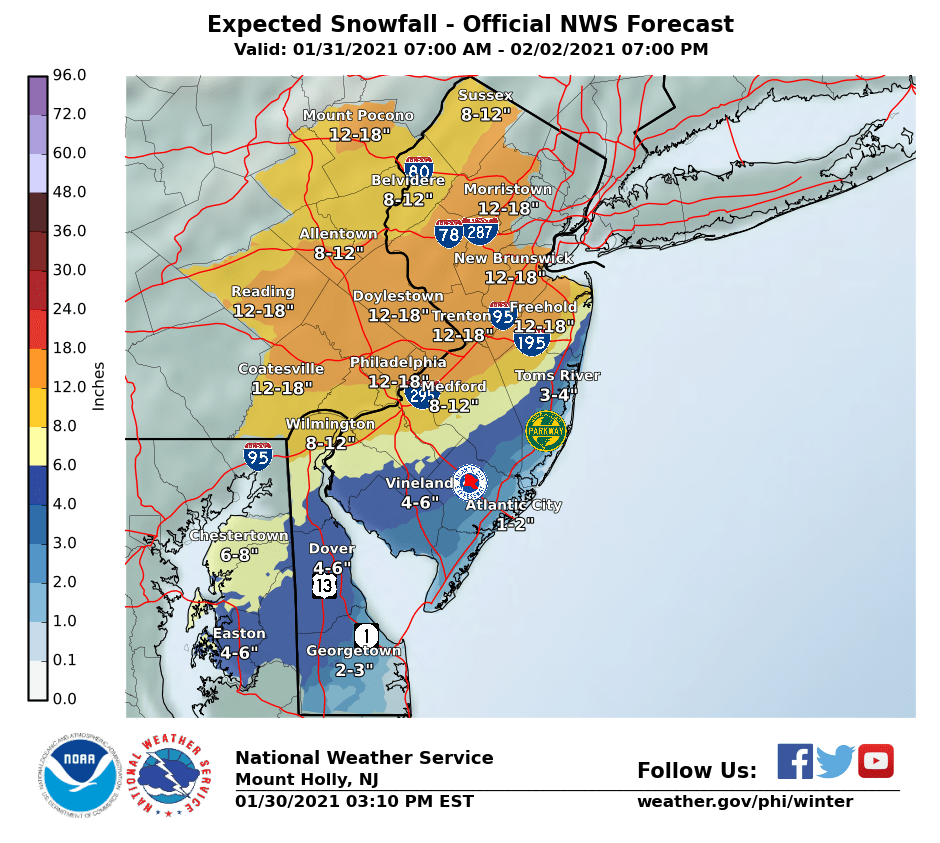
January finished with a mean temperature of 34.8° (2.2° above normal) in New York City. February will likely finish with temperatures averaging within 0.5° of normal in both the New York City and Philadelphia areas. A major to perhaps historic snowstorm is now moving into the region. Parts of Long Island could see its biggest snowfall since March 20-22, 2018. The New York City and Philadelphia areas could experience their largest snowfall since January 22-24, 2016. Blizzard conditions are possible in parts of the region tomorrow afternoon and evening. Enough warmer air could come in off the Atlantic Ocean to change the snow to mixed precipitation or rain along New Jersey's south shore, parts of Long Island and southeastern New England (Cape Cod and Nantucket). Some of the guidance continues to bring the mixing into New York City. Final snowfall estimates: Allentown: 16"-24" Boston: 5"-10" Bridgeport: 12"-18" Islip: 12"-18" Mount Pocono: 20"-30" New York City: 14"-20" Newark: 16"-24" Philadelphia: 7"-14" Poughkeepsie: 12"-18" After somewhat milder air returns late in the first week in February, another shot of cold air is possible early in the second week of the month. That cold shot could be preceded by a storm. The ENSO Region 1+2 anomaly was -0.8°C and the Region 3.4 anomaly was -1.1°C for the week centered around January 20. For the past six weeks, the ENSO Region 1+2 anomaly has averaged -0.85°C and the ENSO Region 3.4 anomaly has averaged -1.07°C. La Niña conditions will likely prevail at least through meteorological winter. The SOI was +6.18 today. Today, the preliminary Arctic Oscillation (AO) figure was -2.496. On January 30 the MJO was in Phase 6 at an amplitude of 2.358 (RMM). The January 29-adjusted amplitude was 2.446. Following a significant stratospheric warming event, the stratosphere has continued to cool. Based on the latest guidance, no significant stratospheric warming event is likely into the first week of February. The significant December 16-17 snowstorm during what has been a blocky December suggests that seasonal snowfall prospects have increased especially from north of Philadelphia into southern New England. At New York City, there is a high probability based on historic cases that an additional 20" or more snow will accumulate after December. Were blocking to disappear, snowfall prospects would diminish. -
Thanks for the kind words.
-
If things remain on course and there are no surprises, parts of the Lehigh Valley could see 20"-30" snow. A lot depends on where the banding will set up. This should be a memorable storm.
-
The entire 1950-99 period had 10 such storms. Almost certainly, the increased moisture content associated with warming is leading to higher impact storms when there is sufficient cold. There has also been a disproportionate increase in the frequency of such storms in the Islip, Newark and New York City areas since 2000..
-
That was a remarkable winter. Philadelphia received a seasonal record 78.7" snow.
-
For reference, Philadelphia has had 10 snowstorms of 12" or more since 2000. Those snowstorms were: February 15-18, 2003: 20.8" January 22-24, 2005: 13.2" February 11-12, 2006: 12.0"' December 19-20, 2009: 23.2" February 5-6, 2010: 28.5" February 9-10, 2010: 15.8" December 26-27, 2010: 12.4" January 26-27, 2011: 15.1" January 21-22, 2014: 13.5" January 22-23, 2016: 22.4"
-
January 2021 General Discussions & Observations Thread
donsutherland1 replied to Stormlover74's topic in New York City Metro
JFK: 12”-18” MPO: 20”-30” -
January 2021 General Discussions & Observations Thread
donsutherland1 replied to Stormlover74's topic in New York City Metro
Morning thoughts... A major to perhaps borderline historic snowstorm (top 20 or above) will affect the region over the next several days. At 6:45 am, snow was falling in Washington, DC and parts of nearby Maryland. That snow will move into Baltimore early this morning and Philadelphia later this morning or early this afternoon. Clouds will increase and snow will push in Newark and New York City late this afternoon or perhaps early this evening. Snow will fall at varying intensities overnight. Temperatures will top out in the upper 20s and lower 30s in most of the region. Likely high temperatures around the region include: New York City (Central Park): 28° Newark: 29° Philadelphia: 32° As the secondary storm develops and then wanders near the Middle Atlantic coastline, blizzard conditions are possible in parts of the northern Mid-Atlantic region tomorrow into tomorrow night. An area running from eastern Pennsylvania through the New York City Metro area and across Nassau County could see some of the storm’s highest snowfall totals with embedded figures approaching or reaching two feet. Estimated snowfall totals: Allentown: 16”-24” Boston: 5”-10” Bridgeport: 12”-18” Islip: 8”-16” New York City: 14”-20” Newark: 14”-20” Philadelphia: 7”-14” Poughkeepsie: 8”-16” This storm will very likely join the 10 one-foot or larger snowstorms that have blanketed New York City since 2000. Six of those storms dumped 18” or more snow. Those 10 storms were: December 30, 2000: 12.0” February 16-17, 2003: 19.8” December 5-7, 2003: 14.0” January 22-23, 2005: 13.8” February 11-12, 2006: 26.9” February 25-26, 2010: 20.9” December 26-27, 2010: 20.0” January 26-27, 2011: 19.0” February 13-14, 2014: 12.5” January 22-24, 2016: 27.5” -
January 2021 General Discussions & Observations Thread
donsutherland1 replied to Stormlover74's topic in New York City Metro
The overnight guidance (UKMET excluded) was great. -
The NAM’s focus of heaviest snows closely resembles earlier cycles of the GFSv16.
- 2,424 replies
-
- 2
-
-
- heavy snow
- ice pellets
- (and 3 more)
-
January 2021 General Discussions & Observations Thread
donsutherland1 replied to Stormlover74's topic in New York City Metro
A storm will move into the Ohio Valley tomorrow with secondary development taking place off the Middle Atlantic coast. As a result, much of the region will experience its biggest snowfall since at least December 16-17, 2020. At present, much of the region appears to be in line for a significant to potentially major snowfall from late Sunday through Tuesday. There will be widespread amounts of 6" or above in the Middle Atlantic and southern New England areas. There will also be a swath of 12" or greater snowfall, but details concerning the location of the heaviest snow still remain somewhat uncertain. Enough warmer air could come in off the Atlantic Ocean to change the snow to mixed precipitation or rain along New Jersey's south shore, parts of Long Island and southeastern New England (Cape Cod and Nantucket). Some of the guidance even brings the mixing into New York City. Initial snowfall estimates: Boston: 5"-10" Bridgeport: 7"-14" Islip: 6"-12" New York City: 7"-14" Newark: 8"-16" Philadelphia: 6"-12" Poughkeepsie: 5"-10" The GFSv16 is more aggressive with snowfall amounts across New York City and Long Island. In contrast, the National Blend of Models shows at least a 40% probability of rain in New York City Tuesday morning, which results in a lower accumulation figure than seen on much of the individual guidance. The ENSO Region 1+2 anomaly was -0.8°C and the Region 3.4 anomaly was -1.1°C for the week centered around January 20. For the past six weeks, the ENSO Region 1+2 anomaly has averaged -0.85°C and the ENSO Region 3.4 anomaly has averaged -1.07°C. La Niña conditions will likely prevail at least through meteorological winter. The SOI was +6.65 today. Today, the preliminary Arctic Oscillation (AO) figure was -2.904. On January 29 the MJO was in Phase 6 at an amplitude of 2.436 (RMM). The January 28-adjusted amplitude was 2.281. Following a significant stratospheric warming event, the stratosphere has continued to cool. Based on the latest guidance, no significant stratospheric warming event is likely into the first week of February. The significant December 16-17 snowstorm during what has been a blocky December suggests that seasonal snowfall prospects have increased especially from north of Philadelphia into southern New England. At New York City, there is a high probability based on historic cases that an additional 20" or more snow will accumulate after December. Were blocking to disappear, snowfall prospects would diminish. Based on sensitivity analysis applied to the latest guidance, there is an implied near 100% probability that New York City will have a warmer than normal January. January will likely finish with a mean temperature near 34.8°. -
January 2021 General Discussions & Observations Thread
donsutherland1 replied to Stormlover74's topic in New York City Metro
Morning thoughts... Today will be fair but continued unseasonably cold. In spite of bright sunshine, temperatures will likely top out in the upper 20s and lower 30s in most of the region. Likely high temperatures around the region include: New York City (Central Park): 29° Newark: 31° Philadelphia: 33° A significant to potentially major snowstorm is likely in the northern Middle Atlantic and southern New England regions late Sunday through Tuesday. -
January 2021 General Discussions & Observations Thread
donsutherland1 replied to Stormlover74's topic in New York City Metro
At New York City, the temperature fell to 14°. That was Central Park's coldest reading since February 15, 2020 when the temperature fell to 14°. At Boston, the temperature fell to 7°. That was Boston's coldest temperature since January 31, 2019 when the mercury dipped to 5°. Select low temperatures in the Northeast included: Albany: 0° Allentown: 17° Boston: 7° Bridgeport: 12° Burlington: 2° Concord: 4° Hartford: 6° Islip: 15° New York City: 14° Newark: 16° Philadelphia: 23° Portland: 10° Poughkeepsie: 11° Providence: 9° White Plains: 11° Worcester: 2° Following another very cold night, tomorrow will be a cold but dry day. Temperatures will likely reach only the upper 20s in much of the region with some lower 30s near or around Philadelphia and southern New Jersey. Afterward, the pieces will likely come together for the region's biggest snowfall since at least December 16-17, 2020. The potential currently exists for a significant (6" or greater) snowfall in parts of the Middle Atlantic and southern New England regions from late Sunday through Tuesday. An area of totals of 1 foot or more is likely, but details remain to be resolved. The EPS ensemble forecast 500 mb pattern in eastern North America is somewhat similar to that on January 30, 1966 except that the trough is modeled somewhat to the south of where it was then. The January 29-31, 1966 storm brought a widespread 6" or more snowfall from Washington, DC to Boston. In short, the forecast pattern suggests potential and it is similar to one case where the snowfall potential was realized. Nevertheless, one should not use the 1966 case to infer largely identical outcomes. The evolution of the storm will determine where the heaviest snows fall and how much snow falls. The ENSO Region 1+2 anomaly was -0.8°C and the Region 3.4 anomaly was -1.1°C for the week centered around January 20. For the past six weeks, the ENSO Region 1+2 anomaly has averaged -0.85°C and the ENSO Region 3.4 anomaly has averaged -1.07°C. La Niña conditions will likely prevail at least through meteorological winter. The SOI was +8.91 today. Today, the preliminary Arctic Oscillation (AO) figure was -2.458. On January 28 the MJO was in Phase 6 at an amplitude of 2.272 (RMM). The January 27-adjusted amplitude was 1.908. Following a significant stratospheric warming event, the stratosphere has continued to cool. Based on the latest guidance, no significant stratospheric warming event is likely into the first week of February. The significant December 16-17 snowstorm during what has been a blocky December suggests that seasonal snowfall prospects have increased especially from north of Philadelphia into southern New England. At New York City, there is a high probability based on historic cases that an additional 20" or more snow will accumulate after December. Were blocking to disappear, snowfall prospects would diminish. Based on sensitivity analysis applied to the latest guidance, there is an implied near 100% probability that New York City will have a warmer than normal January. January will likely finish with a mean temperature near 34.7°. -
January 2021 General Discussions & Observations Thread
donsutherland1 replied to Stormlover74's topic in New York City Metro
One should not use the 1966 blizzard to draw conclusions about the upcoming event. I mentioned it just to illustrate that reasonably similar 500 mb patterns in eastern North America have produced big storms before. The 1966 storm brought 6” or more snow from North Carolina to southern New England. It also triggered lake effect snow around its strong circulation. Some accumulations: Boston: 6.3”; New York City: 6.8”; Philadelphia: 8.3”; and, Washington, DC: 13.8”. New York City changed over to rain as the storm tracked northward just to its west. Where lake effect snow was involved, Rochester received 26.7” and Syracuse picked up 39.0”. Unlike the upcoming storm, the 1966 storm developed along an advancing Arctic front. -
Morning thoughts... The coldest air so far this season now covers the region. At 7 am, the temperature in Central Park was 16°. That is New York city’s first reading in the teens since February 15, 2020 when the temperature fell to 14°. Winter 2019-20 had 3 days on which the temperature fell below 20° in New York City. Winter 2018-19 had 11 such days. Despite sunshine, temperatures will likely top out in the lower and middle 20s in most of the region. Areas near Philadelphia could rise into the upper 20s or perhaps lower 30s. Likely high temperatures around the region include: New York City (Central Park): 24° Newark: 25° Philadelphia: 30° A significant snowfall is possible early next week. The 0z GFS and GDPS, along with the 6z GFS favor a significant snowfall. Through 84 hours, both the NAM and RGEM are reasonably in line with the guidance showing a significant snowfall. However, this outcome is not yet cast in stone. The 0z ECMWF is an outlier with a more offshore solution. The percentage of EPS ensemble members showing 6” or more snow for the Philadelphia to Boston area has decreased from 1/28 0z and 12z.
- 2,424 replies
-
- 3
-
-
-
- heavy snow
- ice pellets
- (and 3 more)
-
January 2021 General Discussions & Observations Thread
donsutherland1 replied to Stormlover74's topic in New York City Metro
Seasonal snowfall amounts to date include: Albany: 39.5" (6.4" above normal) Baltimore: 2.1" (7.2" below normal) Binghamton: 65.1" (21.0" above normal) Boston: 23.1" (1.1" above normal) Bridgeport: 13.0" (0.3" above normal) Buffalo: 42.0" (17.3" below normal) Burlington: 34.1" (8.3" below normal) Caribou: 44.7" (13.2" below normal) Harrisburg: 11.7" (1.4" below normal) Islip: 7.8" (4.1" below normal) New York City: 10.6" (0.7" below normal) Newark: 12.9" (0.1" above normal) Philadelphia: 6.6" (2.7" below normal) Portland: 25.2" (7.4" below normal) Providence: 15.0" (3.3" below normal) Washington, DC: 0.3" (7.4" below normal) Many of those locations will likely see additions to these figures within the next week. The coldest air mass so far this season is now pushing into the region. As a result, tomorrow and possibly Saturday could see high temperatures only in the lower and middle 20s in much of the region. Central Park will very likely see its first teens of the season overnight tonight. The ensembles suggest that the PNA could approach positive levels or even go positive near the end of the month into the start of February. That could allow for the potential of a snow event during the February 1-2 period before milder air returns during the first week of February. At present, the potential currently exists for a significant (6" or greater) snowfall in some parts of the Middle Atlantic and/or southern New England regions. The EPS ensemble forecast 500 mb pattern in eastern North America is somewhat similar to that on January 30, 1966 except that the trough is modeled somewhat to the south of where it was then. The January 29-31, 1966 storm brought a widespread 6" or more snowfall from Washington, DC to Boston. In short, the forecast pattern suggests potential and it is similar to one case where the snowfall potential was realized. Nevertheless, one should not use the 1966 case to infer largely identical outcomes. The evolution of the storm will determine where the heaviest snows fall and how much snow falls. The ENSO Region 1+2 anomaly was -0.8°C and the Region 3.4 anomaly was -1.1°C for the week centered around January 20. For the past six weeks, the ENSO Region 1+2 anomaly has averaged -0.85°C and the ENSO Region 3.4 anomaly has averaged -1.07°C. La Niña conditions will likely prevail at least through meteorological winter. The SOI was +21.11 today. Today, the preliminary Arctic Oscillation (AO) figure was -2.601. On January 27 the MJO was in Phase 6 at an amplitude of 1.903 (RMM). The January 26-adjusted amplitude was 1.736. Following a significant stratospheric warming event, the stratosphere has continued to cool. Based on the latest guidance, no significant stratospheric warming event is likely into the first week of February. The significant December 16-17 snowstorm during what has been a blocky December suggests that seasonal snowfall prospects have increased especially from north of Philadelphia into southern New England. At New York City, there is a high probability based on historic cases that an additional 20" or more snow will accumulate after December. Were blocking to disappear, snowfall prospects would diminish. Based on sensitivity analysis applied to the latest guidance, there is an implied near 100% probability that New York City will have a warmer than normal January. January will likely finish with a mean temperature near 34.7°. -
January 2021 General Discussions & Observations Thread
donsutherland1 replied to Stormlover74's topic in New York City Metro
While Phase 7 (amplitude 1.000 or above) is typically very warm in February (mean temperature of 43.4° in New York City for the February 1-29, 1974-2020 period), it is somewhat cooler when the AO is at or below -1.000 (41.0°). However, there have been exceptions. Early February 1978, which culminated in a major blizzard was one such case. One long-duration event was February 1-10, 1993. There was a lot of variation in daily temperatures, but the mean temperature was 31.6°. There were also three days on which the temperature fell into single digits (February 1-2, 7). The coldest temperature was 7°, on February 2 and February 7. March 1993 saw a major East Coast snowstorm. Just as one has witnessed competing factors that have precluded a canonical La Niña response to date, despite the La Niña's relative stability at moderate levels), there could be factors that delay or even limit the magnitude of warming should the MJO enter a long-duration pause in Phase 7. Having said that, I think the first week of February will turn warmer following the storm on February 1-2. Whether that warmth is sustained is uncertain. Some of the guidance has periodically suggested another fresh shot of cold near the end of the first week of February or just afterward. -
January 2021 General Discussions & Observations Thread
donsutherland1 replied to Stormlover74's topic in New York City Metro
About 75%-80% of the precipitation was snow on the 6z soundings. I haven't looked at the 12z soundings, but will check later. Things, of course, can still change given how far the storm is in the future and the complexity involved with Miller B transitions. -
It scores high at 500 mb, but it can be often quite volatile with poor run-to-run continuity. The difference between its 1/28 0z and 1/28 12z runs is a case in point. Let’s see what the ECMWF shows.
- 2,424 replies
-
- 3
-
-
- heavy snow
- ice pellets
- (and 3 more)
-
January 2021 General Discussions & Observations Thread
donsutherland1 replied to Stormlover74's topic in New York City Metro
Morning thoughts... Today will be variably cloudy and cold. A strong cold front will cross the region this afternoon. Some areas could see some flurries or even a burst of snow. Temperatures will likely top out in the lower and middle 30s in most of the region. Likely high temperatures around the region include: New York City (Central Park): 32° Newark: 33° Philadelphia: 34° A significant snowfall is possible early next week. Approximately 75% of the EPS ensemble members from the 1/28 0z run showed 6” or more snow for New York City. GFS soundings suggest that there will be some rain or sleet in the City and that the snow could be fairly wet as temperatures hover around 33° or 34° during much of the storm. -
January 2021 General Discussions & Observations Thread
donsutherland1 replied to Stormlover74's topic in New York City Metro
The recent light snow event brought 0.1" snow to New York City's Central Park. However, Boston picked up 4.6" snow. That was the third 4" or greater snow event Boston has seen during winter 2020-21. The last winter with at least three such events was winter 2017-18 when Boston had five such snowfalls. Tomorrow will be fair and colder. The coldest air mass so far this season will begin moving into the region. In its wake, Friday and possibly Saturday could see high temperatures only in the lower and middle 20s in much of the region. Central Park will very likely see its first teens of the season. The ensembles suggest that the PNA could approach positive levels or even go positive near the end of the month into the start of February. That could allow for the potential of a snow event during the February 1-2 period before milder air returns during the first week of February. The EPS ensemble forecast 500 mb pattern in eastern North America is somewhat similar to that on January 30, 1966 except that the trough is modeled somewhat to the south of where it was then. The January 29-31, 1966 storm brought a widespread 6" or more snowfall from Washington, DC to Boston. In short, the forecast pattern suggests potential and it is similar to one case where the snowfall potential was realized. Nevertheless, one should not use the 1966 case to infer largely identical outcomes. The evolution of the storm will determine where the heaviest snows fall and how much snow falls. At present, the potential currently exists for a significant (6" or greater) snowfall in some parts of the Middle Atlantic and/or southern New England regions. The ENSO Region 1+2 anomaly was -0.8°C and the Region 3.4 anomaly was -1.1°C for the week centered around January 20. For the past six weeks, the ENSO Region 1+2 anomaly has averaged -0.85°C and the ENSO Region 3.4 anomaly has averaged -1.07°C. La Niña conditions will likely prevail at least through meteorological winter. The SOI was +30.39 today. Today, the preliminary Arctic Oscillation (AO) figure was -3.313. On January 26 the MJO was in Phase 6 at an amplitude of 1.734 (RMM). The January 25-adjusted amplitude was 1.891. Following a significant stratospheric warming event, the stratosphere has continued to cool. Based on the latest guidance, no significant stratospheric warming event is likely into the first week of February. The significant December 16-17 snowstorm during what has been a blocky December suggests that seasonal snowfall prospects have increased especially from north of Philadelphia into southern New England. At New York City, there is a high probability based on historic cases that an additional 20" or more snow will accumulate after December. Were blocking to disappear, snowfall prospects would diminish. Based on sensitivity analysis applied to the latest guidance, there is an implied near 100% probability that New York City will have a warmer than normal January. January will likely finish with a mean temperature near 34.8°.