NittanyWx
-
Posts
793 -
Joined
-
Last visited
Content Type
Profiles
Blogs
Forums
American Weather
Media Demo
Store
Gallery
Everything posted by NittanyWx
-
Background
-
We're talking about very different time horizons. I'm not using a Euro monthly inside d7, I'm not using a Euro weekly inside D7. I am seeing W Pac subsidence inside d7 on most dynamic models though, and I'm also seeing upper level pattern shifts in regions of the tropics I forecast for reflect those changes. I don't think persistence is going to outperform the models inside d7, personally. But we can verify on Feb 5-6 and see whether that's true or not. I suspect the model will win in this Jan 29-Feb 5 window.
-
Let's check back in a week and see whether the OLR/VP diagrams back up your claim. Because so far, this has 'rolled forward' as it were. Long term trends also are subject to sub-seasonal variability, so you're essentally boiling this down to a persistence forecast inside the d7 timeframe. I don't agree with that approach right now. Sub-seasonal variability still does occur even with bg warming and longer term signals you're describing persisting. If this was week 2 and this subsidence hadn't rolled forward, think it'd be fair to question whether this identified subsidence pattern ever emerges. But you're now arguing that a very strong +OLR anomaly west of the dateline is being misdiagnosed d 1-7 and therefore arguing more skill than the model inside the d7 window. I'm skeptical of that, but let's see.
-
Just talking about the weather, man!
-
Like there's a clear difference between saying 'the P8-1 response is not as clean as I'd hoped' in tropical forcing terms and arguing 'oh this is stuck in P7'. I have a hard time making the argument 'this is stuck in P7' when the eastward migration of VP200 anomalies has already occurred and there's a Subsidence/+ OLR signal just west of the dateline...and a pretty coherent one at that. That does NOT mean the MJO is 'not progressing'' What it does show, however, is the largely subjective nature of MJO usage...
-
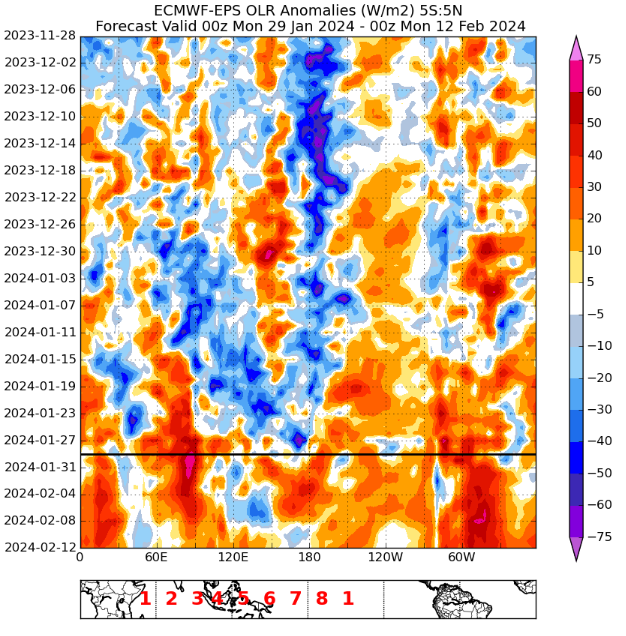
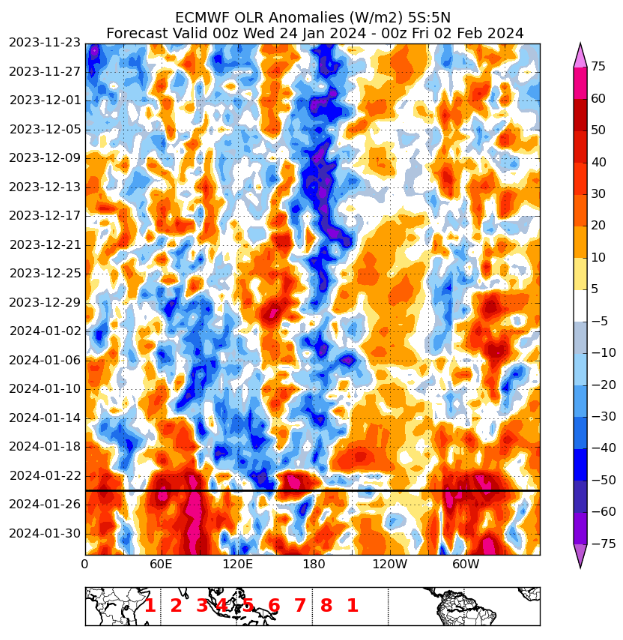
Your OLR maps here also show an eastward progression and reduction in W Pac forcing for the 6-10 day window. So, as diagnosed, a reduction in W Pac forcing and shift eastward. Do you want to try again? Here's another way to look at it Now if you wanted to make the argument that E pac forcing is not responding as cleanly as you'd hoped to -VP anomalies in the region, I'd maybe think you'd have a point. But you didn't make that point, so...
-
Show your work.
-
I'm beginning to think you don't know what you're talking about. On the other hand @bluewave does know his methodology even though I disagree with it and his conclusions right now. I don't think the tropical forcing is as hostile as he's making it out to be.
-
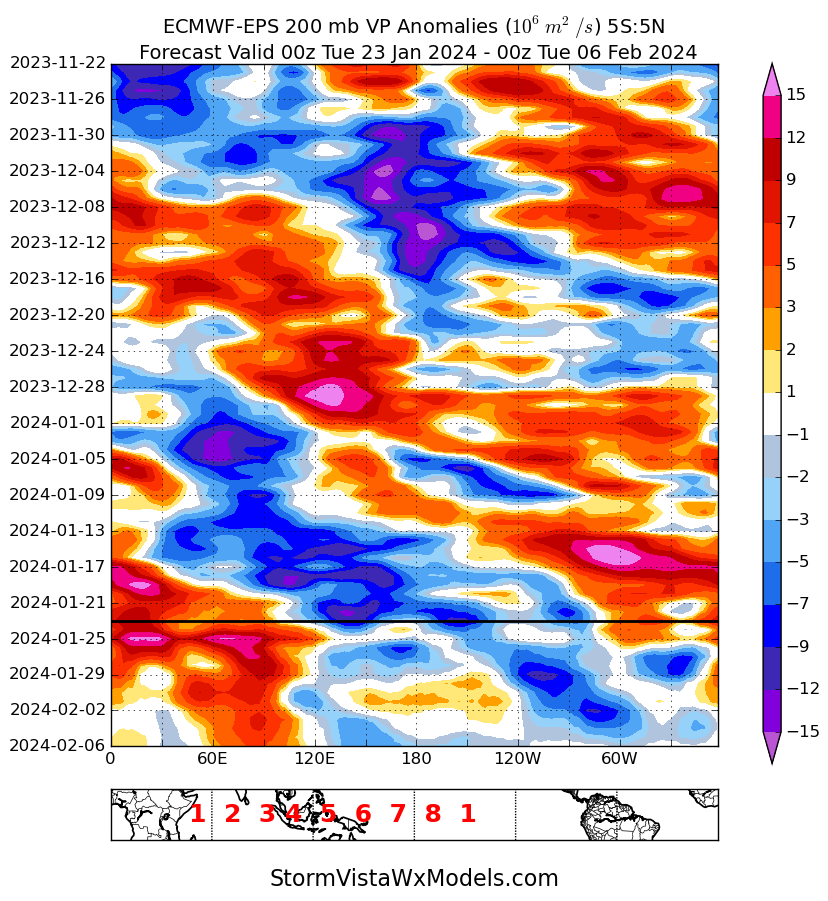
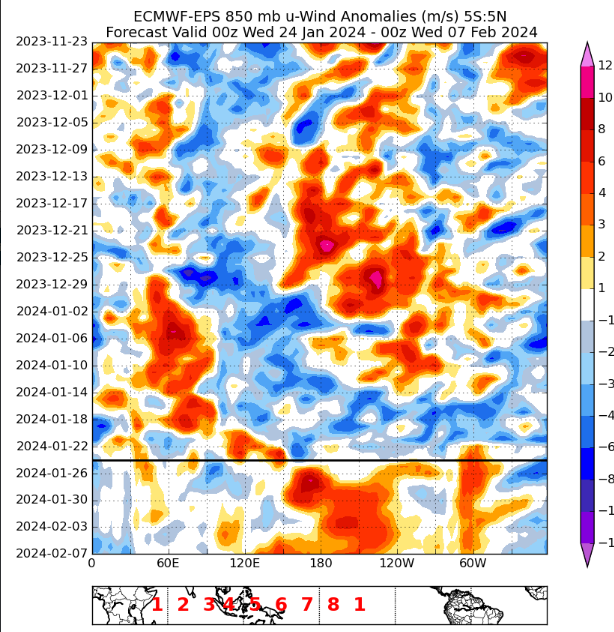
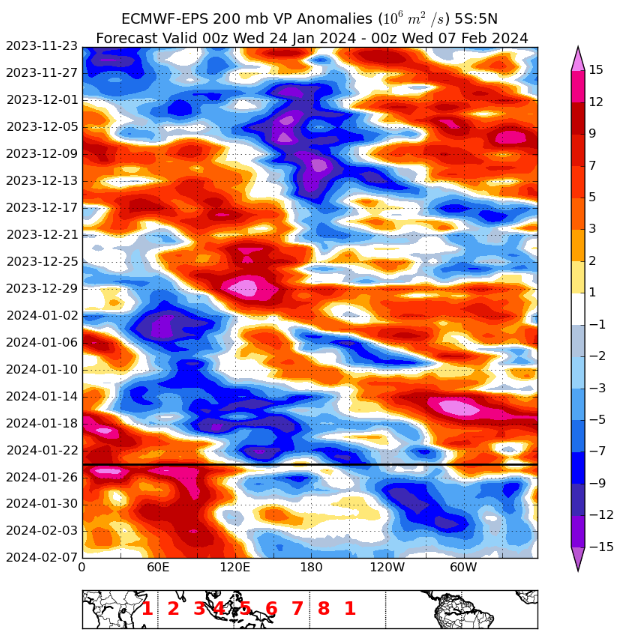
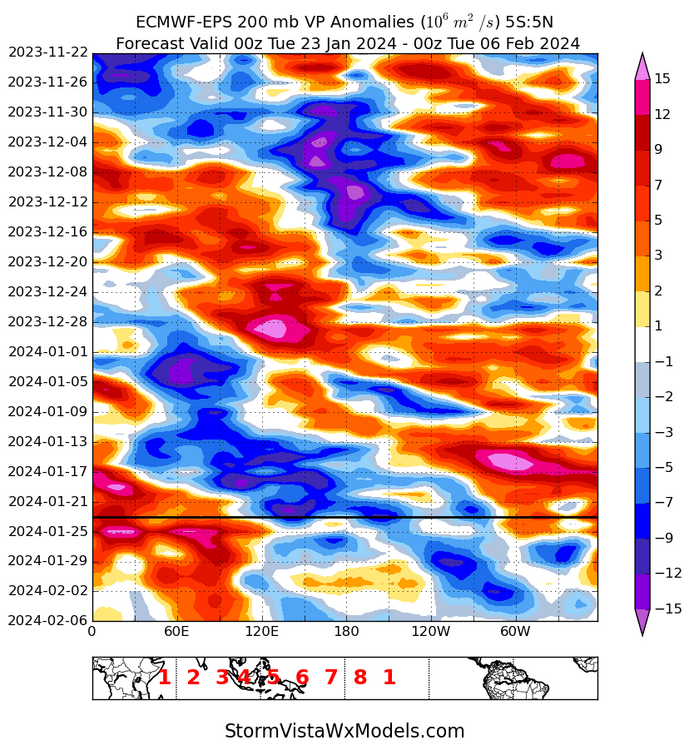
I think your diagnosis of the forcing here is off. I see this as clear Nino forcing at the expense of the maritime continent, coinciding with +VP200 anomalies maritime continent. You've got about as clean of an eastward propagation in the VP signal as you'd like. If this doesn't work in traditional canonical fashion for more active (potentially snowier) purposes, it will likely be due to the erosion of source region combined with a poor placement/durability of high latitude blocking as a result of several factors discussed over the past few weeks in here. All valid, but not cleanly explained by tropical forcing alone. Right now and for the next week, however, you're getting the cleanest + 850 u-wind anomaly signal we've had so far this Nino with an eastward propagation of VP anomalies and a jet extension in the sub-tropics along with a fairly clean shut off of convection for about a week just west of the dateline (as shown in OLR anomalies too). Wheeler plots aside, those are the typical ingredients of a canonical back half Nino pattern from a tropical forcing/synoptics perspective. So if this doesn't work, I think you'll need to look at factors other than the tropics for why this split flow pattern did not deliver. I've got a few reasons ready and I'm not convinced this is going to offer much, but I don't agree with your assessment of tropical forcing right now.
-
It's a fairly coherent 1 week period of E Pac to Central Am forcing while coinciding with subsidence over maritime continent, Pretty clean Nino all things considered. If this doesn't work, it's likely for reasons unrelated to tropical forcing, which is the drawback to using this methodology. To me it looks like a split-flow NIno look for a bit though.
-
Please, for the love of God, look at hovmollers to diagnose forcing. Happy Sunday.
-
Not accurate. Subsidence emerging in p7 for the next week or so. Strong -VP anoms/forcing in E Pac. If this busts warm, cant blame p7.
.thumb.png.2dd75a59917b1fe791dad54953bb0c05.png)
-
Let me try to explain this a second time, becuase I'm not sure you're understanding what I'm saying. Those hovmoller charts are showing a +OLR anomaly in the phase 7 region for the 11-15 day window in response to an eastward propagation of the main negative VP200 anomaly. In laymans terms, the EC Ens today is showing progression. Now, the model is also trying to add some -VP anom noise late 11-15 day in those west/cpac regions too. But at a window where it's RMSE MJO forecast performance has been...not great. We've already had phase 8 physical forcing responses this year, the signal just wasn't particularly strong. That wasn't the case for phase 1/3 response, where we had a very nice and clean forcing for end December and early Jan...certainly that was shown at the VP200 level. Isolating out OLR:
-
VP200, 850 u-wind and OLR all show convection and the expected forcing response eastward with a progressive MJO signal. There really isn't much debate here as to the progressive nature of tropical forcing. There is a lot of debate on whether this parlays into cold in the windows it's supposed to for early-mid Feb. IO convection is shut off for the time being.
-
The VP signal for the MJO was and is a clear P-8-1 in Dec and it failed to produce expected results for reason's we've outlined in this forum in the past. A question I'm asking myself is whether the SPV/TPV decoupling actually allows wave breaking to do it's thing via jet retraction mid month. Think it's possible, but not yet totally sold on it. I still don't think we should be using wheeler plots as any sort of predictive basis for snow forecasting in this region... Your Hovmoller diagrams get you a much cleaner and disaggregated picture of the things that you would consider to matter from the tropical forcing perspective anyway.
-
This is the warmest winter on record nationally Dec 1 to date (total HDD).
-
As have I. And you know what has been observed in a fairly recent study? Weak vortex events leading to west pacific convection flaring 2 weeks later. A sign potentially the SPV was modulating the tropics and not the alternative and they went a step further to suggest tropo-strato interactions in the tropics themselves modulated MJO activity. Response of tropical convection over the western Pacific to stratospheric polar vortex during boreal winter - Wang - 2022 - International Journal of Climatology - Wiley Online Library And you know what I think? We're getting so far down the rabbit hole in trying to find any sort of signal or jam any sort of convective activity into the equation that we're losing the ability to use it in a forecast. I do know I can use strato-tropo coupling periods in a forecast though, and I did that this season.
-
I don't see how it would be given the strato-cross section view. Could be wrong, but it appears to be a top-down cooling response in this scenario. There's some wave breaking potential for mid-feb.
-
Cohen is to strato as some of the MJO/GSDM folks are to their chosen variable. Judah's about as one track as it gets to strato. Both sets of folks have their correlations fail spectacularly at times in the mid/high latitudes, especially when it comes to spatial distribution of 2m temps.
-
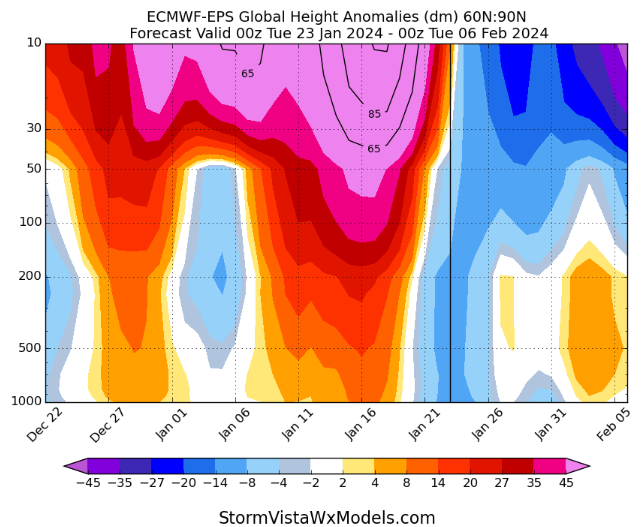
Correct, the SPV is completely decoupled right now (this wasn't the case a few weeks ago), and thus strato warming interactions (top down) at this point are likely to only play out in the typical 3-4 week delay. The reasons for this coupling in January can be traced back to about 3 separete things occurring, but I think this is a very nice and clean way to show the couple/decoupling of the SPV/TPV:
-
The arctic region shifts cannot be adequately explained by El Nino, warm SSTs and tropical forcing alone. And we've already determined the lagged MJO h5 charts via Roundy argued for more blocking in this period. You're practicing selective verification here.
-
If @bluewaveand other MJO folks want to argue amplification of the MJO in p6-p7 is driving the bus, that's fine. I'm gonna point out that the VP anomaly signal during this supposed 'lag' period that folks were trying to sell is 1) Nowhere near as prolonged and intense as late Novy 2) Displaced further west in the 'lag' period. 3) Not getting 'stuck' or 'slowing down' and again the VP signal is progressive. I admire the dedication to the cause though. I once again am gonna throw a challenge flag on this. I understand the argument, I've read the research and even a cursory look at the current observations via their own methodology is not lining up.
-
I see a very noticeable strato/troposphere decoupling over the pole which is again leading to a TPV displacement and polar air being shunted away from NA. We had the opposite occur in mid January. In an extremely warm climate year globally it makes sense that warm patterns are more extreme. But this is being exacerbated by the displacement and erosion of source region and the lack of snowpack recovery accordingly. It makes less physical sense that this is primarily an MJO byproduct. You're ignoring several large pieces of the puzzle.
-
Welp, good to see absolutely no one took my MJO comments to heart this week
-
My personal view is that if your lag time changes from next to nothing to 7 days and you don't have a predictive way to determine how long the lag actually is in a given moment, it is almost a hindrance to getting the forecast right in the timeframe you need it to be right. The models are also assimilating this data too, so I'm not really sure where the skill score improvement is coming from. I think the strato coupling had merit and I used it for this period.





.png.80abfe6d20353b307adf251344d93413.png)