
TheClimateChanger
-
Posts
4,617 -
Joined
-
Last visited
Content Type
Profiles
Blogs
Forums
American Weather
Media Demo
Store
Gallery
Everything posted by TheClimateChanger
-
Pittsburgh/Western PA Summer 2023
TheClimateChanger replied to Ahoff's topic in Upstate New York/Pennsylvania
Should the criteria be 100 though? The criteria is only 95 at Syracuse even though they have averaged 3 more 90+ days and 1 more 95+ day per year than Pittsburgh over the last 25 years. It doesn’t make much sense for our criteria to be higher than locations more prone to extreme heat. -
Pittsburgh/Western PA Summer 2023
TheClimateChanger replied to Ahoff's topic in Upstate New York/Pennsylvania
Looks like all of the construction at the airport is helping to increase the temperatures there. Up to 91 now. -
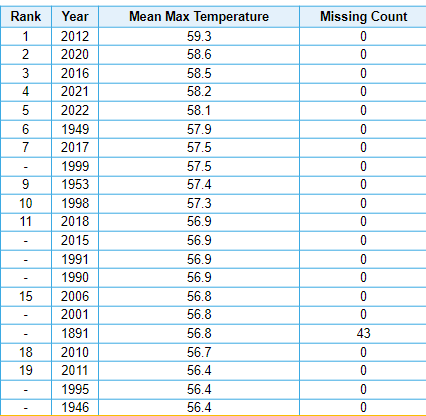
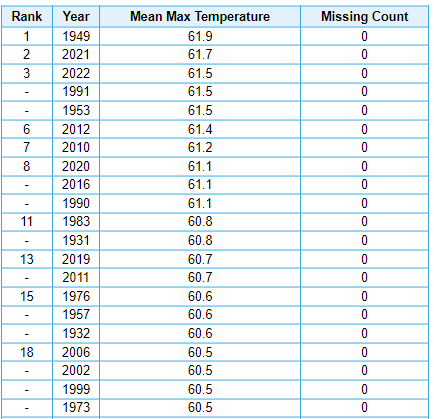
There have been incredible afternoon oddities across New England. They've just become normalized. Apparently, unless it's 100 degrees, it's not that hot. Look at BTV - top five highest mean maximum all since 2012, with 2012 being nearly 1.5 degrees higher than the prior record. Burlington, VT Similar pattern in Boston, despite being located right on the Harbor - which you would think would be cooler. You know the ol' "cooler by the water" meme? Boston, MA This is incredible, extraordinary stuff. There's no other way to characterize this. In any other era, a stretch like this would be headline news every single day. Only our advanced technology is preventing mass crop failures, famine and starvation. In the old days, they would be counting the bodies after heat like today. They called them "prostrations." No doubt our cooling technology has saved countless lives.
-
Looking at a chart like that, you have to expect some profit taking here at the top. If not, it could be off to the moon.
-
Central PA Summer 2023
TheClimateChanger replied to canderson's topic in Upstate New York/Pennsylvania
Are they sure there's no missing data in that Sarasota reading? That seems absurdly dry for Florida. -
Yes, you are correct. I took a look at the period of overlap between ORH and the city station (1948-1962). The city station did average about a degree more in the annual means; however, there was a distinct seasonality to the temperature differences. It was about 1.5-2 degrees warmer in January, but the differences were very small in July (with the city being generally less than 0.5 of a degree warmer). I believe the difference is because radiational cooling has an oversized impact in the warm season. Winter is cloudy and windy, so radiational cooling effects are minimized. The lower elevation city site in the valley radiates better than the surrounding hills, even despite the development around the site. This difference largely offset the elevational cooling in the summertime, but not in winter.
-
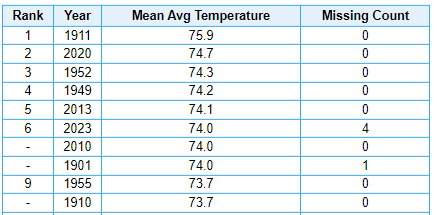
Impressive heat this month. Even ORH is in 6th place, with the opportunity to move up even more over the next couple of days. Due to the airport site being about 500' above the city of Worcester (a cooling effect of 1.5-2.5F), it is very difficult to set new warm monthly temperature records there particularly in the summertime when there is less internal variability.
-
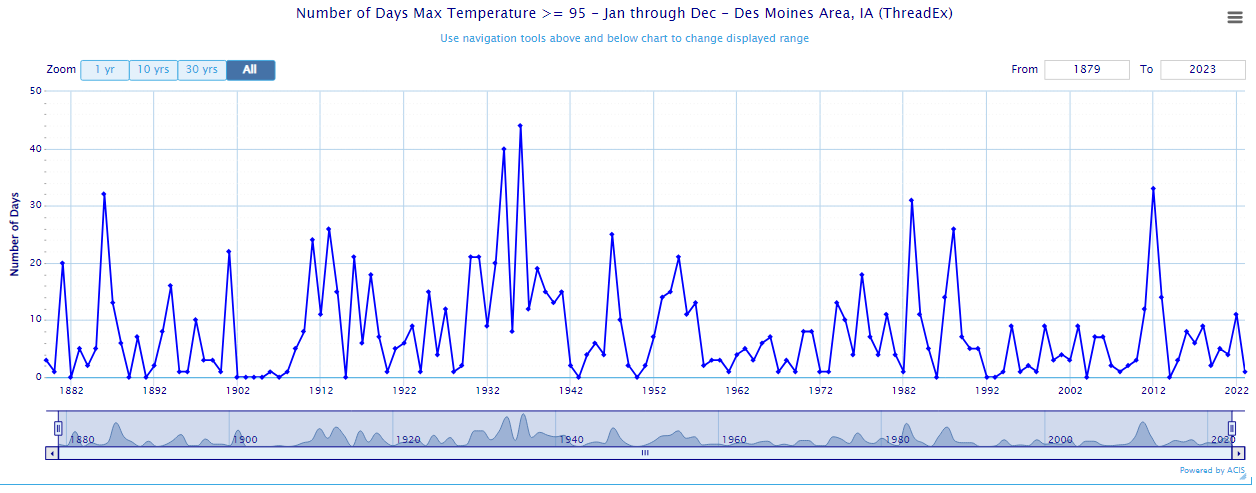
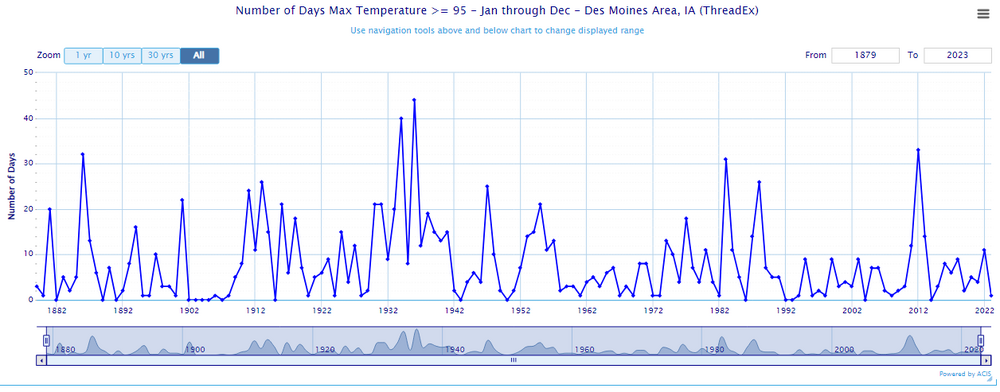
The use of data from Cedar Rapids also makes the trend look more pronounced. Cedar Rapids is often one of the cooler spots in the state of Iowa. The early records have an unbelievable number of days of 95+. It's not believable that Cedar Rapids would have experienced more days of 95+ than Des Moines in those years. That makes no sense climatologically. The data for Des Moines also show a trend towards less, but not nearly that pronounced.
-
Most of the region was prairie, not forest. You can't convert it back to something it never was.
-
No, because what these reports never tell you is the concomitant increase in dewpoints from the anthropogenically enhanced transpiration. Peoria, Illinois, for instance, had a heat index of 104F at 1 am. Some of these areas will likely see wet bulb temperatures approach the theoretical limits of human survivability later this century. Not to mention the devestation wrought on native plants and animals, which have evolved to live in a drier climate with periodic heat extremes.
-
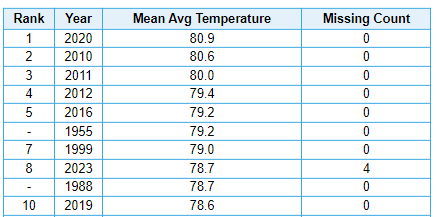
Impressive heat this month. Hagerstown is up to 8th place all-time. I like to use Hagerstown, since it's outside of the Baltimore-Washington urban heat island. Incredibly, 7 of the top 10 hottest Julys have occurred since 2010. Excluding years on or after 2010, this month would place in third place, just behind the hot Julys of 1955 and 1999, and tying 1988. By comparison, the "so-called" hottest July on record in 1936 saw a mean temperature of 73.8F. Excluding a 7-day heat wave that month [July 9-15], the mean for the other 24 days was an incredibly comfortable, summer of yesteryear-esque 71.4F.
-
Heat wave uncancelled with a high of 91 in Spartmanland. A few clouds were no match for Old Man Summer.
-
Pittsburgh/Western PA Summer 2023
TheClimateChanger replied to Ahoff's topic in Upstate New York/Pennsylvania
For nearby Wheeling - Ohio County Airport, there have only been 17 hours of 100+ heat indices dating since 2013. What's weird is this hasn't even been a stretch of unusually cool summers, but rather a stretch that has included some of the hottest summers in Wheeling weather history, including the hottest (2016), 5th hottest (2020), 8th hottest (2021), and 11th hottest (2018) on record.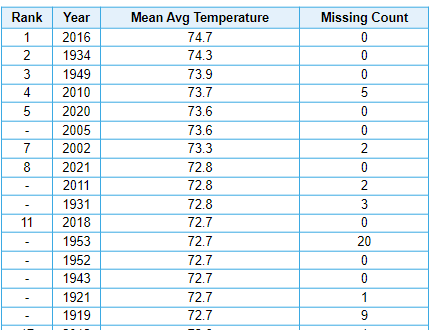
-
Pittsburgh/Western PA Summer 2023
TheClimateChanger replied to Ahoff's topic in Upstate New York/Pennsylvania
-
It looks like coastal regions in general are warming faster than continental interiors, with extreme marine heatwaves present near multiple coastlines driving intense surface air warming. Perhaps the models are simply incorrect, and coastal regions experience more warming from an enhanced greenhouse than do continental interiors? You can even see that same effect in the Alaskan inset, with a relative minimum of warming in the Alaskan interior and enhanced warming along all of the coastlines.
-
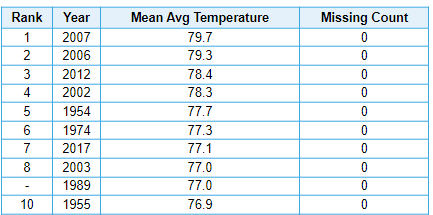
Also, I would expect Rapid City's ranking to climb well out of the top ten with the ongoing heat wave. Already up to 88 as of 9:50-ish a.m. local time. Looks like it may reach 100 there today. And upon further review, looks like Rapid City's warmest Julys are dominated by years in the past couple of decades. So not much evidence of a cooling trend.
-
Looks like there is a pretty strong relationship between El Nino conditions and cool Julys at Rapid City. Not sure about the corn effect though. Looks like the coldest anomalies are west of the Corn Belt this year. In fact, I don't think Rapid City or surroundings have a significant cropland presence for that matter. Edit: Also suspect the omnipresent Canadian wildfire smoke and haze has assisted in the cool anomalies across the northern Plains this summer by filtering the sunlight. While we have had some outbreaks of smoke in the Great Lakes and northeast, the northern Plains has been ground zero for a lot of the smoke.
-
Report: Another Year of Record Heat for the Oceans
TheClimateChanger replied to donsutherland1's topic in Climate Change
17 years at Caribou (since records began in 1939) have had monthly mean temperatures less than or equal to the current monthly minimum average for 2023. -
Report: Another Year of Record Heat for the Oceans
TheClimateChanger replied to donsutherland1's topic in Climate Change
Clearly, the Caribou lows are being elevated by the runaway urban heat island effect and non-existent jet traffic there. -
Pittsburgh/Western PA Summer 2023
TheClimateChanger replied to Ahoff's topic in Upstate New York/Pennsylvania
Fairbanks, Alaska has had as many 90-degree days as us this summer: National Weather Service : Observed Weather for past 3 Days : Fairbanks, Fairbanks International Airport -
-
Occasional Thoughts on Climate Change
TheClimateChanger replied to donsutherland1's topic in Climate Change
https://www.cnn.com/videos/world/2023/07/25/exp-climate-crisis-disaster-eliot-jacobson-vause-intv-07251aseg1-cnni-world.cnn -
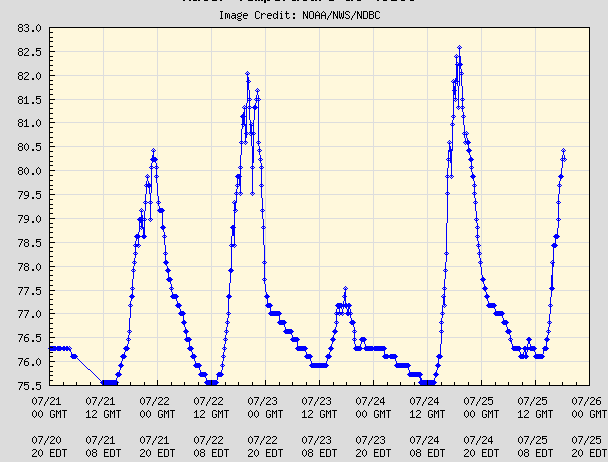
Wonder if we'll see some 90+ degree buoy readings on Lake Erie with the upcoming heat wave? Doesn't look like we'll be seeing those 101 degree SSTs they had off Key Largo, Florida, but 90 degrees is certainly a distinct possibility. 1 m water temperature up to 80 at the Toledo Crib. Reached 83 yesterday afternoon. Probably a decent chance of reaching into the 90s there in the coming days. Source: NDBC - Station 45165 Recent Data (noaa.gov)
-
Occasional Thoughts on Climate Change
TheClimateChanger replied to donsutherland1's topic in Climate Change
-
Occasional Thoughts on Climate Change
TheClimateChanger replied to donsutherland1's topic in Climate Change
Fortunately, it is mostly a myth that Europe is warmed by the Gulf Stream. In fact, the relative winter warmth is driven principally by stationary waves in the atmospheric flow driven by the Rocky Mountains in North America, and the atmospheric transport of heat released by the oceans that had been stored in the summertime. Actual oceanic heat transfer is only a minor contributor. Warming from rising greenhouse gases would probably exceed any cooling from an AMOC collapse. You have to be skeptical of a paper that predicts a colder future for Europe, when it contradicts our existing knowledge. See: The Gulf Stream Myth (columbia.edu) The Gulf Stream and future climate change A slowdown of the Gulf Stream and ocean circulation in the future, induced by freshening of the waters caused by anthropogenic climate change (via melting glaciers and increased water vapor transport into high latitudes) or simply by warming, would thus introduce a modest cooling tendency. This would leave the temperature contrast across the Atlantic unchanged and not plunge Europe back into the ice age or anything like it. In fact the cooling tendency would probably be overwhelmed by the direct radiatively-driven warming by rising greenhouse gases.