


GaWx
-
Posts
19,894 -
Joined
Content Type
Profiles
Blogs
Forums
American Weather
Media Demo
Store
Gallery
Everything posted by GaWx
-
Thanks for posting that OSTIA chart. I realize it isn't easy but it sure would help if all organizations went by one SST dataset for all measures. Regardless, I assume that looking at just the trend on whatever SST dataset one looks at is useful info and it is clear that both CDAS and OSTIA have been steadily increasing recently. Also, next Monday's update, which will incorporate the current week, will be informative. - There's "CDAS" that Levi Cowan's site uses. I googled and couldn't find anything telling me what CDAS is or even just what it stands for! Do you or does someone else here know more about what CDAS is and who uses it? - There's "OISSTv2.1", which is used for the SSTa tables that are updated each Monday. - There's "ERSST.v5" that's used for the ONI Nino 3.4 three month averaged charts that NOAA uses to determine the official ENSO classifications. - There's "OSTIA" that you just posted from the UKMET office. Edit: When I googled "CDAS", the first on the list was this: https://cdas.com It is for a law firm with "Cowan" as the first listed name. Is that not an unbelievable coincidence?!? I also googled CDAS SST and other similar things and didn't find what I was hoping to see.
-
That's the first time I can recall Paul Tweeting explicitly about the chance for a super El Niño. So, he's going ~50-50 on a 2015-16 strength, which was a peak at +2.6 (stronger than any other since 1900). This implies Paul is at higher than a 50% chance for a super since super starts at +2.0.
-
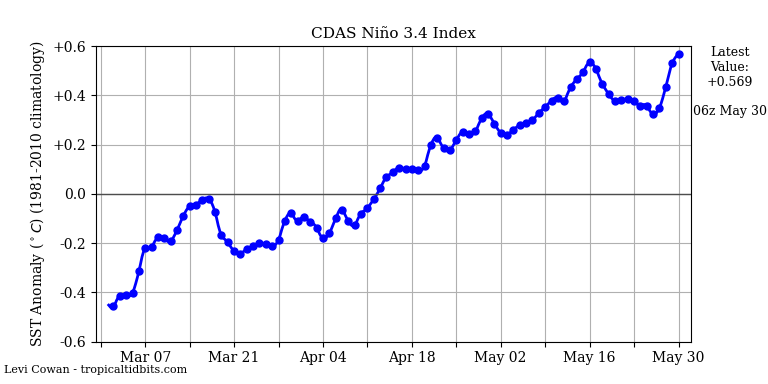
I was wrong. I thought Niño 3.4 was leveling out near +0.575 C. However, it is now up to +0.62 per Cowan's CDAS chart after some re-acceleration in the warming. It rose 0.015 just during the last 6 hours. It has risen nearly 0.3 over just the last 5 days. The recent BoM model had a warming to +1.25 in June. I've been thinking it was significantly too warm because I had been figuring that June would start near +0.5 C and that it would have to get to a seemingly unreasonable ~+1.5 by June 15th to have a chance for +1.25 in June overall. I still think that's going to be very tough as +1.5 is still a long way up from +0.62. That would require the next 15 days warm as fast as the last 5 days, which I could find only one instance of since 1981 during an incoming El Niño (March of 2014). Regardless, with the significant warming still not having stopped, it will be interesting to see where this will actually level off.
-
The full May of 2023 SOI comes in at -15. How does this rank compared to other Mays since 1876? It comes in 8th lowest, which is a strong indicator for an upcoming moderate+ and a decent indicator for the chance for a strong+ El Niño in the absence of an ongoing/outgoing one as per this list: Lowest 20 May SOIs since 1876/Nino peak 1896 -39 (oncoming strong) 1905 -34 (ongoing/oncoming mod) 1953: -26 (ongoing/oncoming weak) 1972: -24 (oncoming super) 1987: -20 (ongoing mod/oncoming strong) 1997: -19 (oncoming super) 1991: -18 (oncoming strong) 2023: -15 (???) 1897: -15 (outgoing strong) 2002: -14 (oncoming mod) 2015: -13 (ongoing weak/oncoming super) 1940: -13 (ongoing mod/oncoming strong) 1947: -12 (outgoing warm neutral) 2005: -12 (outgoing weak) 1994: -12 (oncoming mod) 1957: -12 (oncoming strong) 1951: -12 (oncoming mod) 1912: -12 (outgoing mod) 1929: -11 (oncoming weak) 1946: -10 (oncoming warm neutral) ---------------------------- Edit: I'll now take out ongoing/outgoing El Niño years: 1896 -39 (oncoming strong) 1972: -24 (oncoming super) 1997: -19 (oncoming super) 1991: -18 (oncoming strong) 2023: -15 (???) 2002: -14 (oncoming mod) 1947: -12 (outgoing warm neutral) 1994: -12 (oncoming mod) 1957: -12 (oncoming strong) 1951: -12 (oncoming mod) 1929: -11 (oncoming weak) 1946: -10 (oncoming warm neutral) ------------------ Data source: https://data.longpaddock.qld.gov.au/SeasonalClimateOutlook/SouthernOscillationIndex/SOIDataFiles/MonthlySOIPhase1887-1989Base.txt
-
How does the current OHC compare to past oncoming El Niño events? I used the 3rd column from here and compared Aprils to give an apples to apples comparison to 2023: https://www.cpc.ncep.noaa.gov/products/analysis_monitoring/ocean/index/heat_content_index.txt From warmest to coolest April OHC: 1997 (super peak): +2.17 2014 (weak peak): +1.41 2023 (????????): +1.19 1982 (super peak): +0.93 2018 (weak peak): +0.81 1991 (strong peak): +0.80 2009 (strong peak): +0.65 2006 (weak peak): +0.42 2002 (moderate peak): +0.32 2004 (weak peak): +0.21 1986 (moderate peak): -0.02 1994 (moderate peak): -0.14 1979 (weak peak): -0.21 Based on 13 rankings back to 1979: - 2023 is respectable 3rd warmest - Although much cooler than 1997, it is a little warmer than 1982. - A bit warmer than the 2 strongs - Much warmer than the 3 moderates - Much warmer than 3 of the weaks and a bit warmer than 1 of the weaks, but oddly enough a little cooler than 1 of the weaks (2014) - So, overall there's a pretty good correlation of April OHC to later peak ONI peak as all 4 strong to super are in top half and bottom half are all weak to moderate. - But the weak 2014 is way out of synch with its 2nd warmest OHC and 2018 is somewhat out of synch with its 4th warmest OHC - These April OHC rankings suggest that strong is very much a possibility for 2023 and even super can't at all be ruled out. But 2014 suggests that although highly unlikely that even a weak for 2023 is not out of the realm of reasonable possibilities.
-
Though far from perfect, I've found based on past cases that the 180-100W max OHC anomaly was often a decent leading indicator of about where an incoming El Niño ONI peak might end up a couple of months later. The tendency was for ONI peak to be a bit lower than the OHC peak. Thus, if this +1.2 maximum OHC were to not be exceeded later this year, then I might be looking for a low end moderate ONI peak a couple of months later as the most likely. However, it remains to be seen whether or not this +1.2 OHC holds up as the max. I expect it won't and that it will likely be exceeded this summer as May is almost always too early for it to peak. Most OHC peaks were in Oct or Nov. OHC by month: https://www.cpc.ncep.noaa.gov/products/analysis_monitoring/ocean/index/heat_content_index.txt I'll now compare the OHC peak including timing, with ONI peak/timing for El Niño events since 1978-80: 1. 1979-80: OHC peak +1.1 Nov ONI peak +0.6 DJF Lag: 2 months 2. 1982-3: OHC peak +2.1 Oct ONI peak +2.2 DJF Lag: 3 months 3. 1986-8: OHC peak +1.2 Jan '87 ONI peak +1.7 JAS '87 Lag: 7 months 4. 1991-2: OHC peak +1.7 Dec ONI peak +1.7 DJF Lag: 1 month 5. 1994-5: OHC peak +1.2 Nov ONI peak NDJ +1.1 Lag: 1 month 6. 1997-8: OHC peak +2.6 Oct ONI peak +2.4 NDJ Lag: 2 months 7. 2002-3: OHC peak +1.7 Oct ONI peak +1.3 OND Lag: 1 month 8. 2004-5: OHC peak +0.9 Sep ONI peak +0.7 NDJ Lag: 3 months 9. 2006-7: OHC peak +1.4 Nov ONI peak +0.9 NDJ Lag: 1 month 10. 2009-10: OHC peak +1.8 Nov ONI peak +1.6 NDJ Lag: 1 month 11. 2014-6: OHC peak +1.9 Oct '15 ONI peak +2.6 NDJ Lag: 2 months 12. 2018-9: OHC peak +1.5 Oct ONI peak +0.9 OND Lag: 1 month --------------------- Summary: 1. Avg lag OHC to ONI peak: 2 months 2. ONI peak averaged 0.1 cooler than OHC peak though range was 0.6 cooler to 0.7 warmer; ONI cooler 8 of 12 times and warmer 3 of 12 times
-
I believe that on average that the # of May-June Gulf TS has been higher during oncoming/current El Niño vs other ENSO.
-
Based on the last 24 hours, it appears that per Levi's CDAS chart that Nino 3.4 is probably going to top out for the time being near +0.575. Of course, even if that occurs it could still resume warming within a few days for another step up. By the way, there still is no new long string of solid -SOIs yet being strongly suggested on the two week runs meaning that probably will need to wait til mid June at the earliest. Today is and tomorrow will be pretty solid negatives (perhaps also June 1st), but I think that's about it for the near future.
-
Wasn't 1969-70, another cold E US winter, also an east based weak El Niño? There have also been a good number of other weak to low end moderate El Niño winters (I don't know about east vs west) that were cold in much of the E US such as 1939-40* (frigid in SE), 1919-20 (frigid in NE), 1904-05* (frigid in most of E US), 1887-8* (frigid in NE), 1884-5, 1880-1 *(frigid in NE), and 1876-7. But recent weak ones have not been (as) cold overall in the E US. I suspect some of that is related to their respective RONI being only warm neutral. *immediately followed La Niña
-
Interesting Tweets from Paul. I'm guessing that when he talks about there being no reason there couldn't be a "major" event that he's more or less saying there's no reason there couldn't be a +1.5+ 3.4 SSTa or strong+. Technically, he's not actually explicitly predicting a strong+, but he's just saying that one may very well occur/don't bet against it.
-
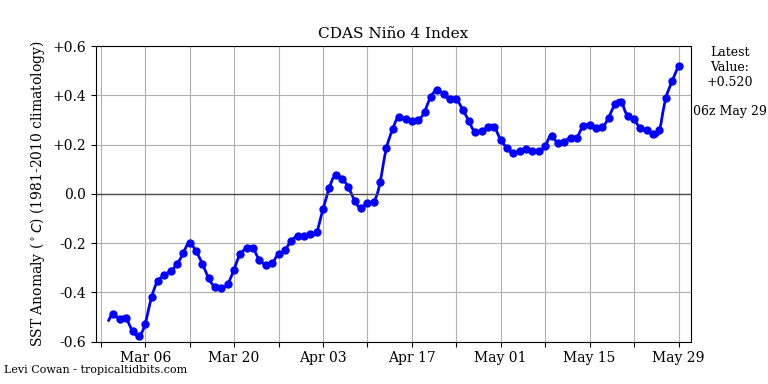
The 0.2 C warming of 3.4 on the Cowan CDAS chart the last couple of days was fueled largely by warming in the western portion of 3.4 based on a 0.25 C warming the last 72 hours in Nino 4 (fastest there since April 11-14) to its warmest yet of +0.52 C per this: It appears that this burst of warming might be slowing. So, we'll soon see if it is about to level off for the time being.
-
10/5/2
-
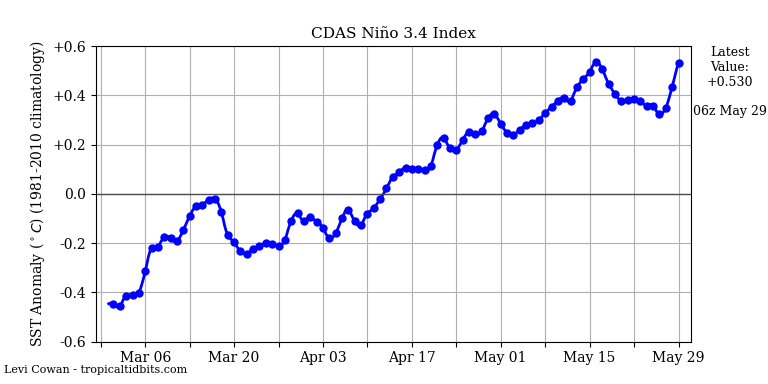
As snowman19 just posted via a Tweet, this new sudden warming in 3.4 per Levi Cowan's chart is notable: This shows the fastest 48 hour warming (0.2 C) since way back during March 5-7! But is it merely a short term rise that will soon level off making it insignificant in the big scheme of things as sometimes happens? After all, this warming has only warmed it back up to near its May 16th high. Or is there more to it? Also, keep in mind that this chart is only one source and not necessarily the "gospel". One thing I said here last week based on the past is that there often is a delayed several tenths rise in 3.4 ~3-4 weeks after a sustained solid -SOI. The recent 19 day long solid -SOI started on May 9th. We're nearly 3 weeks after that. Could this be related? Who knows but it will be interesting to follow. Regardless, there's no followup string of solid -SOI days in sight (on the 2 week models) as of yet. *Edited for correction as that's a 48 hour rise
-
Looking back in this ENSO thread allowed me to finally find the Roundy Tweet that started generating the posts here referring to him predicting a super Nino: This, indeed, is quite a bullish Tweet, but it was done nearly two months ago (on April 8th) and he hasn't Tweeted anything explicitly bullish about the potential Nino strength since then. All I've seen since are some bullish WWB related Tweets. The strongest JAS Nino 3.4 SSTa on record back to 1950 is +1.9 C. So, this post is implying that "perhaps" we'll have a +2.0+ in JAS, meaning "perhaps" a super Nino already by JAS. Just saying this is admittedly quite bullish. However, he only said "perhaps" rather than outright predicting that and he also said: "But it still has a month or two for the forcing to break down before it gets there." And again, that was way back on April 8th. So considering all of this, is it accurate to say that he currently thinks that a super Nino is coming? Opinions? I posted this on April 17th in response to it being posted: "Doesn't he mean strongest 3.4 on record for the late summer, itself? I see almost no chance for strongest on record 3.4 by late summer. That would be well into the +2 range: +2.6 per 2015-6 and +2.9 per 1877-8. The strongest on record in JAS, alone, is +1.9. The model consensus is no warmer than the high +1 area by JAS and that's ignoring what I think is a warm bias."
-
I'm reposting this that I did in here on March 31st: These El Niño winters that quickly followed La Nina were significantly colder in the SE US than the prior winter: 1876-7 (cold), 1880-1 (cold), 1904-5 (very cold), 1911-2 (cold), 1925-6 (normal), 1939-40 (very cold), 1957-8 (cold), 1965-6 (cold), 1972-3 (normal), 1976-7 (very cold), 2009-10 (very cold) These weren't: - 1887-8 was slightly warmer than 1886-7 and near normal - 1918-9 was much warmer than 1917-8 and was near normal. It followed the very cold 1917-8, which was one of the coldest La Niña winters on record - 2006-7 was warmer than 2005-6 and warmer than normal - 2018-9 was warmer than 2017-8 and warmer than normal --------- Tally: - 11 of 15 were significantly colder than the prior winter - 9 of 15 were cold to very cold - 4 of 15 were near normal - 2 of 15 were warmer than normal, two of the three most recent cases Conclusion: As one living in the SE who prefers a cold winter, I'd take my chances with El Niño this winter on a normal or colder winter based on the above history despite two of the three most recent cases being warmer than normal, which would keep from betting heavily on it. I certainly would prefer it over other ENSO! Keep in mind that four of these 15 were historically cold. Although this analysis is centered on the SE US, much of this can be used for other areas as well. That includes seeing which were the 15 El Niño winters since the late 1800s that quickly followed La Niña and analyzing those 15 winters for one's own region.
-
When did Roundy last actually state that he thinks a super Nino is coming? I'd like to see a link. I don't see it on Twitter going back through all of May, but maybe I missed it. TIA
-
"Carnival Cruise Ship Back Sailing After Stormy Cruise and Damage" https://www.cruisehive.com/carnival-cruise-ship-back-sailing-after-stormy-cruise-and-damage/102507
-
1. Per ONI (traditional measure), +1.4 to +1.8 is not super. It is upper end moderate through most of strong. 2. RONI (relative ONI) adjusts for the excess heat through all of the tropical oceans, including the very warm MDR. Currently, RONI is ~0.4 less than ONI. Thus, ONI of +1.4 to +1.8 is equivalent to RONI of +1.0 to +1.4, which is moderate El Niño. On a RONI basis, I'm currently favoring moderate with my "sweet spot" near +1.1.
-
In order for the upcoming Nino to end up as just weak, the ONI would need to peak at +0.9 at most. The May BoM is forecasting a +2.5+ peak. So, a weak peak would require a +1.6+ miss for the May BoM. Nothing even close to that much of a miss for the May BoM has occurred since way back in 2011. Then, in May it predicted +1.1 for ASO and ASO verified way down at -0.9 for a whopping +2.0 miss. But that was during a period (2008-12) when BoM missed for five years in a row significantly too warm. Since then, it has averaged no bias. So for now, I'm keeping weak's chances as very low.
-
I also still do. But based on a combo of my own observations/statistical analyses and what @bluewaveand others have said about the current state of the W/C Pacific, I've reduced the chance for strong+ somewhat in favor of a higher chance for moderate vs how I earlier thought. Earlier, I had strong as the best chance, followed by high end moderate (say, +1.3 to +1.4) followed by low end super. My sweet spot was ~+1.7. Now, I feel that moderate's chances are getting closer to strong's chances with a lower end moderate (+1.0 to +1.2) chance increasing vs how I earlier thought. Also, whereas I earlier had a small chance for low end super, I now feel its chances are barely hanging by a thread. Thus my continually adjusted sweet spot has dropped from ~+1.7 to ~+1.5. By the way, I'm licking my chops more and more as far as next winter's potential is concerned, especially here in the SE for the less unreliable temperatures vs the always hard to predict wintry precip since that is often mainly just a one major shot deal even in "good winters", but that's way on down the line and an issue for another time. If the W/C Pacific doesn't start to change soon, a high end weak is going to start to come into the picture as a nontrivial possibility in my mind.
-
The -SOI streak finally ended today. It ended up at a rather impressive 19 days long. But how does this compare to the longest -SOI streaks of other oncoming El Niño years through June 15th starting with 1994 (first year the daily data is available) along with the respective Nino strengths? -1994: 34 and 29 days (moderate) -1997: 35 and 27 days (super) -2002: 29 days (moderate) -2004: 25 days (weak) -2006: 14 days (weak) -2009: 13 days (strong) -2014: 25 days (weak) -2018: 22 days (weak) So, although rather impressive, the 19 days of 2023 is actually much shorter than the moderate 1994, the super 1997, and the moderate 2002. Also, it is a bit shorter than even the weak 2004, 2014, and 2018. But it is a bit longer than the strong 2009 and the weak 2006. So, overall six years had longer streaks and only two years had shorter ones. Based on this the 19 day longest streak of the year through June 15th isn't by itself screaming out that a super strong El Niño or even just a strong or, for that matter, even just a moderate is likely on the way. Looking at the entire year, the weak 2006's longest was only 16 days (twice). But the strong 2009 did have a 28 day streak from early October til early November. So, all four moderate+ had a 28+ day long -SOI streak by November. So, if 2023 is going to end up moderate+, I'd expect to see a much longer than 19 day streak to come no later than autumn and probably by summer. But OTOH only 1997-8 and 2009-10 had a lower -SOI than the -65 of 5/24/2023. So, that tells me that the chance for strong is probably higher than what the mere 19 day longest streak of the year to date suggests. So, lots of uncertainty remains as far as how strong will be the eventual peak this fall/winter.
-
Wow, that's fascinating! Thanks for posting that, Don. - The high ended up at only 61, seven below the record low high for the date and near the normal daily high for mid-winter! - That was the lowest high since way back on April 8th! Only six days since 2/1/2023 had cooler highs. - Only two other periods going way back to 1874 had a high that low this late in the season: 61 on 5/28/1934 and the 57/58 of 6/10-11/1913. There's not another high that low on the calendar til the aforementioned 54 on 9/22/1897! 5/28/1934 weather map shows a similar setup to 5/27/2023 with a strong extratropical low just offshore FL moving NNE after a cool high in the NE had been wedging down into the SE. It was similarly windy on the SE coast with gales. A landfall occurred on the lower SC coast late on 5/28/1934 pretty similar to what's about to occur on 5/28/2023 except that low strengthened through landfall to 29.35". https://library.oarcloud.noaa.gov/docs.lib/htdocs/rescue/dwm/1934/19340528.pdf The cold 6/10-11/1913 highs (along with what is still the coldest June low on 6/12/1913) were during another oncoming El Niño (one that late that next Feb produced a very rare major deep SE winter storm that included SAV) and were caused by SE rains that were generated by an unseasonably strong cold front that appears to have stalled out near N FL. This cold front had been pushed south by an unseasonably cold, strong high that had earlier dropped into the Lakes and lead to what then was about the coldest on record in the entire month of June for much of the NE, Ohio Valley, and near the Lakes along with freezes or frosts in many of these areas per this: https://library.oarcloud.noaa.gov/docs.lib/htdocs/rescue/dwm/1913/19130609.pdf I just saw that the cold, rainy 9/22/1897 was on the backside of a tropical storm: https://www.nhc.noaa.gov/data/tracks/tracks-at-1897.png The SAV high of 54 on 9/22/1897 was tied for the lowest high among major US reporting stations per this: https://library.oarcloud.noaa.gov/docs.lib/htdocs/rescue/dwm/1897/18970923.pdf
-
At 2:30 PM, it is windy from the NW with light rain and 57 F due to the nearby offshore low. This is ~27 F BN for mid afternoon on 5/27! Just 4 years ago at this time on this date it was ~100 F, 43 warmer! From this area to Hunter, we're at ~2.25" of rain today, ~2" more than expected as of yesterday.
-
This area has today gotten much more rain than expected yesterday with ~2" already fallen so far vs <1/2" progged then for the entire day! We even had thunder recently, which hadn't been expected. Temps have been in the chilly mid 50s with N wind gusts into the 30s. The 24 hour high is likely going to be the 12:01 AM's 63, which would be 5 below the 1972 record low high of 68! Normal high is 87. The walks the last few evenings have been fabulous for this time of year with dewpoints in the upper 40s (last evening) to upper 50s!
-
I'd like to look at the BoM model's May forecast's bias more closely, since it has been discussed quite a bit recently due to its extremely warm May forecast, to see if it really hasn't had a Eurolike strong warm bias when averaged out like I had been thinking. The BoM has been using "Access" since 2020 and POAMA prior to that. Year: May forecast for ASO BoM/Euro, actual ASO, BoM miss vs Euro miss 2022: -0.4/-0.3 -1.0 +0.6 vs +0.7 2021: -0.5/0.0 -0.7 +0.2 vs +0.7 2020: -0.8/-0.3 -0.9 +0.1 vs +0.6 2019: +0.2/+0.7 +0.2 0.0 vs +0.5 2018: -0.2/+0.6 +0.5 -0.7 vs +0.1 2017: +0.2/+0.8. -0.4 +0.6 vs +1.2 2016: -0.8/-0.5 -0.6 -0.2 vs +0.1 2015: +1.6/+2.4 +2.2 -0.6 vs +0.2 2014: +0.8/+1.5 +0.2 +0.6 vs +1.3 2013: -0.8/-0.1 -0.3. -0.5 vs +0.2 ----------------------------------- 2012: +0.9/+0.8 +0.4 +0.5 vs +0.4 2011: +1.2/-0.2 -0.8 +2.0 vs +0.6 2010: -0.4/-0.9 -1.6 +1.2 vs +0.7 2009: +1.4/+0.8 +0.7 +0.7 vs +0.1 2008: +0.3/-0.2 -0.2 +0.5 vs 0.0 2007: -1.0/-0.8 -1.1 +0.1 vs +0.3 ----------------------------------- 2006: -1.0/+0.4 +0.3 -1.3 vs +0.1 2005: +1.0/+0.4 -0.1 +1.1 vs +0.5 2004: +0.7/+0.5 +0.6 +0.1 vs -0.1 2003: -0.9/-0.4 +0.2 -1.1 vs -0.6 2002: +1.0/+0.7 +0.9 +0.1 vs -0.2 ------------------------------------- Analysis: 1) 2013-22: - BoM had no net bias (average miss of 0.0) with 3 significantly too warm and 3 significantly too cold - Euro had a strong warm bias (average miss of +0.6) with 6 of 10 significantly too warm - BoM cooler than Euro 10 of 10 and significantly colder 8 of 10 years 2) 2007-12: - BoM had a strong warm bias (average miss of +0.8) with 5 of 6 significantly too warm - Euro had a moderate warm bias (average miss of +0.35) with 2 of 6 significantly too warm - BoM warmer than Euro 5 of 6 3) 2002-06: based on JAS, not ASO - BoM had a moderate cold bias (average miss of -0.4) with 2 of 5 significantly too cold and 1 of 5 significantly too warm - Euro had no net bias (avg miss ~0) with 1 of 5 significantly too cold and 1 of 5 significantly too warm ------------------------------ Conclusions: 1. Based on the last 10 years, which is the most relevant period, the BoM has had no net bias vs the Euro's strong warm bias, which is what I earlier thought. The Euro hasn't been too cold since way back in 2004! 2. However, the BoM lack of a net bias doesn't mean it hasn't had too warm or too cold years. 3. May of 2023 is highly unusual in that the May BoM for ASO is way up at +2.5. This is a whopping 0.9 warmer than any other back to 2002! The second warmest was the +1.6 of 2015. That turned out to be 0.6 too cold. May of 2023's BoM's +2.5 for ASO is highly unusual also because it isn't just warmer than the Euro, it is MUCH warmer than the Euro's +1.8! The BoM hadn't been warmer than the Euro since way back in 2012 and this time it is 0.7 warmer! There's the chance that BoM had a major modification since 2021 that warmed it. 4. Keeping in mind points #2 and #3 above, considering that the May BoM predicted June to be +1.25 and seeing that it likely will start June no warmer than +0.5, and considering history, the odds are very high that BoM will verify too warm and possibly significantly too warm in June. This all tells me that BoM's +2.5 for ASO will likely verify significantly too warm. Being that the May Euro hasn't been too cold since 2004, I'm predicting 2023 won't be either. Thus, I'm predicting that ASO will end up no warmer than +1.8 and quite possibly cooler due to strong Euro warm bias.

